• Our new ticketing site is now live! Using either this or the original site (both powered by TrainSplit) helps support the running of the forum with every ticket purchase! Find out more and ask any questions/give us feedback in this thread!

Scunthorpe B.S.C. C.H.P.

Status
Not open for further replies.

JNicholson

Member
Joined
2 Feb 2025
Messages
19
Location
Stockport
Hi all,

I am new to the forum despite my long-standing interest in railways.

Whilst looking for information this site came up in searches a few times, so hopefully I can learn more and help out when I can.

Anyway, brief introduction aside I am wondering if anyone knows the railway (rather than as the crow flies) distance for Scunthorpe to Scunthorpe F.D. to Scunthorpe B.S.C. C.H.P.?

Miles and chains is sufficient. I have the time (six minutes), so cannot be very far.

I have tried looking on various websites such as Railwaydata and Railwaycodes, but nothing.

Finally, apologies if this is the incorrect forum/topic to put my request under.

Regards,
JNicholson.
 
Sponsor Post - registered members do not see these adverts; click here to register, or click here to log in
R

RailUK Forums

John Webb

Established Member
Joined
5 Jun 2010
Messages
3,768
Location
St Albans
Welcome to the forum! I assume 'FD' is 'Freight Depot' and 'Scunthorpe B.S.C.' is Scunthorpe's 'British Steel Corporation'? But unclear what the C.H.P stands for. Presumably most of this distance was on the private lines serving the steelworks, so possibly not recorded on records concerned with the national network?
The society that runs (or used to) trains on the steelwork's lines is www.afrps.co.uk (Appleby Frodingham Railway Preservation Soc.) as they might be able to help.
 

Tomnick

Established Member
Joined
10 Jun 2005
Messages
5,933
"Coal Handling Plant", on the Up side of the line after North Lincoln Junction and not directly connected to the internal system. No mileage is shown in Quail, but connections on the main lines adjacent to the plant itself are shown at 24m25ch (vs 22m54ch for the station). The sidings themselves extend for a further 30ch or so beyond that.
 

JNicholson

Member
Joined
2 Feb 2025
Messages
19
Location
Stockport
Welcome to the forum! I assume 'FD' is 'Freight Depot' and 'Scunthorpe B.S.C.' is Scunthorpe's 'British Steel Corporation'? But unclear what the C.H.P stands for. Presumably most of this distance was on the private lines serving the steelworks, so possibly not recorded on records concerned with the national network?
The society that runs (or used to) trains on the steelwork's lines is www.afrps.co.uk (Appleby Frodingham Railway Preservation Soc.) as they might be able to help.
Hi John,

Yes, FD (I think) means freight depot and BSC means British Steel Corporation. As Tommick pointed out C.H.P. is Coal Handling Plant.

Thank you for the link. I will have a nosey on over.
 

JNicholson

Member
Joined
2 Feb 2025
Messages
19
Location
Stockport
"Coal Handling Plant", on the Up side of the line after North Lincoln Junction and not directly connected to the internal system. No mileage is shown in Quail, but connections on the main lines adjacent to the plant itself are shown at 24m25ch (vs 22m54ch for the station). The sidings themselves extend for a further 30ch or so beyond that.
Thank you Tommick.
 

Tomnick

Established Member
Joined
10 Jun 2005
Messages
5,933
Could it mean 'Frodingham Depot'?
"Freight Depot", I'm sure – previously the facility for handling general freight, it's now the sidings (also on the Up side but west of Trent Jn) where imported coal trains to/from Immingham run round to access the west-facing CHP. The location in their schedules is "Scunthorpe F.D.". Frodingham Depot is on the other side of the single line to Roxby.
 

JNicholson

Member
Joined
2 Feb 2025
Messages
19
Location
Stockport
Could it mean 'Frodingham Depot'?
Could mean Frodingham Depot, but in the working timetable I have (2 October 1989 - 13 May 1990) the entries are for 'Scunthorpe F.D. Recp arr' and 'Scunthorpe F.D. Recp dep'. Scunthorpe F.D. Recp is where the Immingham - Steel works coal trains ran around for the section into the coal handling plant.

However,
22m54ch Scunthorpe
24m25ch junction for the Coal Handling Plant makes sense.

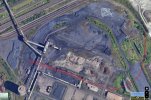
I have looked on a satellite photograph and seems to me the area below and to the right of Scunthorpe Station (a) would have been 'Scunthorpe F.D. Recp' as I cannot figure out where else the reception/freight depot/sidings/yard would be at least on the main line. Would be good to backdate it to 1989/1990, but I will have to make do. (b) is what thought the coal hopper (top right corner) would be with the CHP's dispatch/reception sidings at the bottom left.

(a)
Screenshot 2025-02-02 112038.png

(b)
Screenshot 2025-02-02 112249.png

== Doublepost prevention - post automatically merged: ==

"Freight Depot", I'm sure – previously the facility for handling general freight, it's now the sidings (also on the Up side but west of Trent Jn) where imported coal trains to/from Immingham run round to access the west-facing CHP. The location in their schedules is "Scunthorpe F.D.". Frodingham Depot is on the other side of the single line to Roxby.

Correct. I meant to state that I had forgotten about Quail, but I do not have a copy of that. However, I appreciate your help. Thank you.
 
Last edited:

Tomnick

Established Member
Joined
10 Jun 2005
Messages
5,933
Scunthorpe F.D. is (roughly!) in the area indicated in the aerial view below.

Screenshot_20250202_170217_Maps.jpg
 

JNicholson

Member
Joined
2 Feb 2025
Messages
19
Location
Stockport
Scunthorpe F.D. is (roughly!) in the area indicated in the aerial view below.

View attachment 173853
Thank you.

== Doublepost prevention - post automatically merged: ==

I thought both of you may well be interested to watch
.

56074 Kellingley Colliery doing the manoeuvre of entering Scunthorpe F.D. Recp, running around and then proceeding into Scunthorpe B.S.C. C.H.P. Much other interest. Three other class 56s (56013, 56014, 56070) on coal trains and other locomotives on other freights.
 
Last edited:

Adrian Barr

Member
Joined
2 Jul 2020
Messages
776
Location
Doncaster
Interestingly, Scunthorpe Freight Depot is on a list of sites available for rent on the DB Cargo website (where it appears as Scunthorpe Goods Yard, its name from steam days). The boundaries are marked out as per post #9.
https://uk.dbcargo.com/rail-uk-en/services/available-property
Like Tomnick says, the former Frodingham depot area is on the other side of the Roxby / Flixborough branch (now occupied by Volker Rail).

From TOPS:
22032 SCUNTHORPE COAL HANDLING PLANT CORUS
22041 SCUNTHORPE FREIGHT DEPOT DB CARGO
22043 SCUNTHORPE FRODINGHAM VOLKERRAIL

Note: if you right click on google maps satellite imagery, you can select "Measure distance" and work it out from that - I don't think the track layout between Scunthorpe FD and the CHP has changed substantially since British Rail days.

(b) is what thought the coal hopper (top right corner) would be with the CHP's dispatch/reception sidings at the bottom left.

The discharge shed is indeed in the top right. I'd not noticed it before, but there's a massive coal preparation and storage area just to the north of the railway which must be fed by underground conveyor from that shed. After blending e.t.c. the coal is transported by conveyors over the railway and into the steelworks (and formerly the coking plant). The two reception sidings for the CHP are just before (i.e. west of) the discharge shed, feeding into it.

The former practice (in EWS days with class 56s) was for a "drawback engine" to be present at Scunthorpe. I think incoming locos and crews on coal trains from Immingham would usually leave the loaded train at Scunthorpe FD and attach to a waiting rake of empties for the return to Immingham. Another loco would be based at Scunthorpe to discharge the wagons and bring them back empty into the sidings at Scunthorpe FD.

The layout of the CHP assumes that trains will be arriving from the west with British Coal, rather than imported! I think the original operation was for locos to arrive from the west into one of the two reception roads at the CHP, unload their train in the discharge shed, draw forward into a loop, run round, and exit on the departure track beside the discharge shed.

Some interesting photos on Flickr (I'll have a look at the video you linked too):

Scunthorpe Freight Depot / Goods Yard:
198? - 47340 on 6V60 Scunthorpe CHP - Severn Tunnel Junction passes Scunthorpe Freight Depot: https://www.flickr.com/photos/40236693@N08/49781524752/ (Photo: JS Collection, 6Y99)
1995 - 37689 in use as drawback loco, entering Scunthorpe FD with empties from the CHP: https://www.flickr.com/photos/gridchaser/21429116112/ (Photo: Mark Finch)
2003 - 56106 on HAAs at Scunthorpe FD (note second class 56 in sidings): https://www.flickr.com/photos/131175774@N06/25327830869/ (Photo: Steve Clark)
2003 - 56058 enters Scunthorpe FD, with the coal handling plant looming in the background: https://www.flickr.com/photos/gridchaser/16169065626/ (Photo: Mark Finch)
2003?: 66s and 56s at Scunthorpe FD: https://www.flickr.com/photos/131175774@N06/51002885266/ (Photo: Steve Clark)
2014: A later view of Scunthorpe FD with 66185 on HTAs: https://www.flickr.com/photos/75892080@N06/14595088475/ (Photo: Wilbert B)

Scunthorpe CHP:
1982 - 47230 pauses in reception sidings, Scunthorpe CHP: https://www.flickr.com/photos/blue-diesels/16476045531/ (Photo: Richard Binns, Models of Hull Collection)
1982 - 47298 passes unloading shed at Scunthorpe CHP on departure track: https://www.flickr.com/photos/blue-diesels/16516503442/ (Photo: Richard Binns, Models of Hull Collection)
2016 - View of unloading shed at CHP with 66119 alongside: https://www.flickr.com/photos/148194160@N04/32738726570/ (Photo: Jordan Kearney)
2018 - Panorama as 66088 unloads HTAs at Scunthorpe CHP: https://www.flickr.com/photos/148194160@N04/39639120315/ (Photo: Jordan Kearney)

There's also a DVD available of a cab ride from Immingham to Scunthorpe (with coal for the CHP) filmed in 2002:
https://www.videoscene.co.uk/black-and-blue-56006-immingham-scunthorpe

After that is Scunthorpe and another fascinating maze of trackwork. After negotiating its way across an almost endless series of points the 7C77 finally arrives in Scunthorpe Yard with its wagons loaded with 'black gold'.
56 006 then swaps trains by attaching on to the 6C75 empties for a spirited non-stop run back to Immingham Bulk Terminal.
 

AndrewE

Established Member
Joined
9 Nov 2015
Messages
7,344
I'm sure that after one/the first of the 3 steelworks at Scunthorpe was cleared a freightliner depot was put on the site. Maybe this is Scunthorpe FL.
 

JNicholson

Member
Joined
2 Feb 2025
Messages
19
Location
Stockport
Interestingly, Scunthorpe Freight Depot is on a list of sites available for rent on the DB Cargo website (where it appears as Scunthorpe Goods Yard, its name from steam days). The boundaries are marked out as per post #9.
https://uk.dbcargo.com/rail-uk-en/services/available-property
Like Tomnick says, the former Frodingham depot area is on the other side of the Roxby / Flixborough branch (now occupied by Volker Rail).

From TOPS:
22032 SCUNTHORPE COAL HANDLING PLANT CORUS
22041 SCUNTHORPE FREIGHT DEPOT DB CARGO
22043 SCUNTHORPE FRODINGHAM VOLKERRAIL

Note: if you right click on google maps satellite imagery, you can select "Measure distance" and work it out from that - I don't think the track layout between Scunthorpe FD and the CHP has changed substantially since British Rail days.


The discharge shed is indeed in the top right. I'd not noticed it before, but there's a massive coal preparation and storage area just to the north of the railway which must be fed by underground conveyor from that shed. After blending e.t.c. the coal is transported by conveyors over the railway and into the steelworks (and formerly the coking plant). The two reception sidings for the CHP are just before (i.e. west of) the discharge shed, feeding into it.

The former practice (in EWS days with class 56s) was for a "drawback engine" to be present at Scunthorpe. I think incoming locos and crews on coal trains from Immingham would usually leave the loaded train at Scunthorpe FD and attach to a waiting rake of empties for the return to Immingham. Another loco would be based at Scunthorpe to discharge the wagons and bring them back empty into the sidings at Scunthorpe FD.

The layout of the CHP assumes that trains will be arriving from the west with British Coal, rather than imported! I think the original operation was for locos to arrive from the west into one of the two reception roads at the CHP, unload their train in the discharge shed, draw forward into a loop, run round, and exit on the departure track beside the discharge shed.

Some interesting photos on Flickr (I'll have a look at the video you linked too):

Scunthorpe Freight Depot / Goods Yard:
198? - 47340 on 6V60 Scunthorpe CHP - Severn Tunnel Junction passes Scunthorpe Freight Depot: https://www.flickr.com/photos/40236693@N08/49781524752/ (Photo: JS Collection, 6Y99)
1995 - 37689 in use as drawback loco, entering Scunthorpe FD with empties from the CHP: https://www.flickr.com/photos/gridchaser/21429116112/ (Photo: Mark Finch)
2003 - 56106 on HAAs at Scunthorpe FD (note second class 56 in sidings): https://www.flickr.com/photos/131175774@N06/25327830869/ (Photo: Steve Clark)
2003 - 56058 enters Scunthorpe FD, with the coal handling plant looming in the background: https://www.flickr.com/photos/gridchaser/16169065626/ (Photo: Mark Finch)
2003?: 66s and 56s at Scunthorpe FD: https://www.flickr.com/photos/131175774@N06/51002885266/ (Photo: Steve Clark)
2014: A later view of Scunthorpe FD with 66185 on HTAs: https://www.flickr.com/photos/75892080@N06/14595088475/ (Photo: Wilbert B)

Scunthorpe CHP:
1982 - 47230 pauses in reception sidings, Scunthorpe CHP: https://www.flickr.com/photos/blue-diesels/16476045531/ (Photo: Richard Binns, Models of Hull Collection)
1982 - 47298 passes unloading shed at Scunthorpe CHP on departure track: https://www.flickr.com/photos/blue-diesels/16516503442/ (Photo: Richard Binns, Models of Hull Collection)
2016 - View of unloading shed at CHP with 66119 alongside: https://www.flickr.com/photos/148194160@N04/32738726570/ (Photo: Jordan Kearney)
2018 - Panorama as 66088 unloads HTAs at Scunthorpe CHP: https://www.flickr.com/photos/148194160@N04/39639120315/ (Photo: Jordan Kearney)

There's also a DVD available of a cab ride from Immingham to Scunthorpe (with coal for the CHP) filmed in 2002:
https://www.videoscene.co.uk/black-and-blue-56006-immingham-scunthorpe
Hi Adrian,

Thank you for the photo links. I had noticed a few before, but still appreciated those and the photographs I had not seen. I am mostly interested in the sectorisation era of British railways, so I tend to do a search on Flickr limited by date. Post 2016 my interest starts to wain as aggregate trains have never really interested me and that is the main type of traffic other than engineering (departmental) trains.

You are correct about the coal handling plant having a westward facing entrance (trains enter west to east). I have the book by David Monk-Steel on the history of M.G.R. trains and he comments that Immingham N.C.B. terminal opened in the late 1980s by agreement with the National Coal Board and British Steel. By 1989 Scunthorpe only received coal from a few British coal mines. Betteshanger in Kent four trains, Oakdale in South Wales (toward Ebbw Vale) ten trains, Oxcroft near Worksop five trains were three consistent flows per week plus other coal trains. One train from Toton; two trains from Doncaster Down Decoy (these were from Oakdale going to Scunthorpe C.H.P. arriving Saturday morning at Decoy and going to Scunthorpe on the Monday morning; five trains from Healey Mills Network Yard; 15 trains from Worksop Supply Sidings (all per week). The trains from the yards (Healey Mills, Toton, Worksop) would have been filled with coal potentially from one of many mines depending on what each mine could supply. Coal trains were rarely timetabled as British Coal, British Rail, the generating boards would all negotiate on a weekly basis leaving some spare capacity for unexpected demand as coal was the base load and easiest to increase production (I cannot find right now the information online, but I can retrieve it for you if you would like and I recommend Monk-Steele's M.G.R. history even as a specialist book on an aspect of economic/industrial history). Sometimes the coal from Worksop S.S. would have originated from Bolsover, sometimes from Maltby. The type of coal (anthracite) from South Wales was especially good for steel making. Anthracite (as well as South Wales anthracite is found in Canada, Poland, Russia, Ukraine, United States) is the densest and purist even when. Second to anthracite is bituminous coal, but requires turning into coking coal. The coal from the North/South/West Yorkshire was low grade (probably lignite) and so was preferred to fuel coal-fired power stations. Grimethorpe had a coking plant, so was probably able to supply coking coal for the Healey Mills - Scunthorpe run. Apparently the Healey Mills - Earles Sidings M.G.R. originated from Grimethorpe.

I am not sure about whether a previous empties were taken back, but that surprises me. The time between departure to and arrival from Scunthorpe B.S.C. C.H.P. at Scunthorpe F.D. Recp was one hour and 10 mins. Six minutes to C.H.P., six minutes back. Unloading would have been fast. Apparently an overhead bunker at a coal mine could discharge at the rate of four wagons per minute, so that is nine minutes to load the train. Twenty minutes (scheduled) for a run-round is the norm. Even a run-round would not take twenty minutes unless going slower than an asthmatic ant with heavy shopping (to quote Blackadder Goes Forth), so the extra minutes would be for making then checking chain and pipe connections as well as repositioning the end of train lamp. That is 32 of the 70 minutes. Hauling the wagons through the bunker at 0.5(?) mph would have been the way time would be expended. I am not saying are incorrect, though. Possibly empty stock was taken to facilitate inspection of wagons etc, though. Another benefit of such generous timings is that if a train becomes late for whatever reason the crew have claw-back time for late-running without having to disregard speed limits or weather conditions etc. By the way, I am not speculating as to why you are wrong, but I am outlining at why I am surprised.

Related to these trains is the Briton Ferry - Immingham train. I do not know the reason for such a long-distance train, but probably not to give people who model railways in South Wales an excuse to purchase a Toton-allocated Knottingley-based 56 30-40 years thence. Possibly export (when did Alexandra Docks stop exporting coal? Coal from South Wales has always been in demand for export markets and in the early 20th century export was the biggest single customer of South Wales coal). Possibly to supplement imported supply eastern Europe (even by the 1960s most of the United Kingdom ...'s iron ore demand was supplied from Sweden) and other examples of importing coal is Hunterston which supplied the Clyde valley steel works, but Port Talbot and Redcar had the imports fed directly into the blast furnaces). Either way two trains left Briton Ferry on the Sunday evening and arrived at Immingham on the Monday morning. These empties would go to Doncaster Down Decoy (via Gainsborough Trent Jns) later Monday morning and return to Briton Ferry on a Saturday. Although I suspect these were used throughout the week as one diagram (by 1991, possibly earlier) was used in a diagram which started with a 09 22 departure from Down Decoy (Monday only). Furthermore, the returns to Oakdale returned during the week under the headcode 6V87 and 6V89. Saturday the trains would use the same headcode to Briton Ferry. That said the Oakdale trains returned before the return from Scunthorpe had arrived at Down Decoy. Well, perhaps as similar to operations at Scunthorpe an empty set was already waiting for return. This way a set of wagons could be inspected and any requiring further attention could be taken into for repair if required. Today rail operators use what is sometime called Just-In-Time (remember the Ronseal phrase!) production which practically means that everything is run as often as it can be, the assets are pushed to the very limit, with everything being maximally used. Anything going the slightest bit wrong results in cancellations and/or delays and/or shorter trains (although, you could make the point that this is how the railways have always been operated - I doubt British Rail built 11k plus wagons for the innocent delight of wagon spotters getting a kop or for Accurascale, Cavalex, Hornby being able to produce different numbered wagons to stop people complaining about the lack of choice on model railway forums).

Thank you for the video suggestion, too. I remember watching a video around 2009 which showed the procession of trains going through Brocklesby from Immingham Docks and Lindsey Oil Refinery during either the late 1990s to early 200s. Edited, but still a good number of trains (coal, petrochemical, steel) hauled by 60s, 66s (possibly 31s, 47s, 56s, but I cannot remember) to video then. Now pretty much everything is a 66. Less freight and a numerous class which is reliable. Still boring, though. Despite being a sectorisation fan I think the EWS maroon and gold is a good livery and which I thought looked best on the 60s (and that the 60s looked best in that livery). I never really took to Freightliner. I like the DRS livery too. Anyway, I am wandering off the path. I am sure I could waffle on about liveries somewhere else on the forum.

Good to online meet a fellow YJer, though. I have a few other timetables. I am currently looking for the CW and CX timetables, so I can look at running the M.G.R. trains (to do with the way I operate model railways) which would have been normally hauled by a Knottingley 56. I have PE, YJ, YH, but looking for Midland timetables with the Earles Sidings, Fiddler's Ferry, Immingham, Scunthorpe, Toton, M.G.R. trains. I am also wondering how to make the scuff marks (the thick black bands about 1/3-1/2 way down the body sides from rubber tyres pushing the wagons at ports) frequently seen on the M.G.R. wagons, but I may leave weathering altogether given I never seem to get that correct. Either too much or too little and never even on the sides of the same wagon (recently I purchased some Cavalex HAAs from KMS and poorly weathered about half - I should have bought a few second-hand to practice on). Anyway, I have bought some wagon loads from someone on ebay, though. Doing my own wagon loads felt a little daunting.

I will reply to your other post in due course, but in writing this I have somewhat forgotten to get my dinner. I am a finish that thought sort of person, but sometimes one thought prompts another thought ad nauseum. Thank you for both posts, though.

Regards.
 
Last edited:

Adrian Barr

Member
Joined
2 Jul 2020
Messages
776
Location
Doncaster
I'm sure that after one/the first of the 3 steelworks at Scunthorpe was cleared a freightliner depot was put on the site. Maybe this is Scunthorpe FL.

I'm not aware of there ever being an actual "Freightliner terminal" at Scunthorpe as such for general container traffic, although now you mention it, the steelworks has despatched some container trains in the past.

In the early 2000s there were occasional trains of 20ft containers to Felixstowe hauled by EWS. At one point it was running more or less weekly, but it was a bit sporadic. From what I understand, this was a block train conveying wire rod coils (from Scunthorpe Rod Mill) in containers for export - I have a vague memory that it usually unloaded at Felixstowe on a Saturday.

Felixstowe - Scunthorpe empties seen in 2002 behind 66134: https://www.flickr.com/photos/tibshelf/9630743984/ (Photo: Keith Partlow)
Scunthorpe - Ipswich in 2009 with 66092: https://www.flickr.com/photos/151904976@N08/51231624086/ (Photo: Michael Hart)

In terms of where it was loaded at Scunthorpe, the logical place would be Redbourne sidings, a storage area / slab yard for outgoing steel with plenty of concrete hardstanding. All that would be needed for loading containers here is a reach stacker.

This photo of 66504 on a Freightliner train from Scunthorpe to Ipswich Yard in 2013 specifies Redbourne Sidings as the origin: https://www.flickr.com/photos/dave_orourke/9239574162/ (Photo: David O'Rourke)

22044 SCUNTHORPE REDBOURNE SDS (FLT) BRITISH STEEL

66165 shunting steel near Redbourne Sidings in 2021: https://www.flickr.com/photos/109723390@N03/51550749679/ (Photo: Adam J Gibbons). I think the channel tunnel steel trains to Hayange were loaded here too.

There's a 2017 map of the steelworks internal railway in this visit report on the Branch Line Society website (click it to enlarge) for anyone interested, although it doesn't include the Freight Depot / CHP area:
https://www.branchline.uk/pastevent-alt.php?eventid=137
 

AndrewE

Established Member
Joined
9 Nov 2015
Messages
7,344
In terms of where it was loaded at Scunthorpe, the logical place would be Redbourne sidings, a storage area / slab yard for outgoing steel with plenty of concrete hardstanding. All that would be needed for loading containers here is a reach stacker.

This photo of 66504 on a Freightliner train from Scunthorpe to Ipswich Yard in 2013 specifies Redbourne Sidings as the origin: https://www.flickr.com/photos/dave_orourke/9239574162/ (Photo: David O'Rourke)

22044 SCUNTHORPE REDBOURNE SDS (FLT) BRITISH STEEL

66165 shunting steel near Redbourne Sidings in 2021: https://www.flickr.com/photos/109723390@N03/51550749679/ (Photo: Adam J Gibbons). I think the channel tunnel steel trains to Hayange were loaded here too.
Redbourn being the name of the first of the 3 steelworks to close, in October 1979... see https://en.wikipedia.org/wiki/Scunthorpe_Steelworks
It had an Oberhausen rotor steelmaking converter wich I actually saw in use, a big horizontal tube rather than the tub-shaped Bessemer converter.
 

Adrian Barr

Member
Joined
2 Jul 2020
Messages
776
Location
Doncaster
I am not sure about whether a previous empties were taken back, but that surprises me.

I watched that Immingham - Scunthorpe cab ride DVD again (filmed in 2002). My previous comment was incorrect - the narrator explains that at the time of filming , it was normal for the locos to stay with the sets (the loco in the video swaps onto an empty set and heads straight back to Immingham, but this was not the usual practice). However, he does comment that "the long-standing practice of using a dedicated loco to discharge the wagons" at Scunthorpe has ended.

I think there were two slightly different practices in use at different times, one being the use of "drawback locos" and the other involving a dedicated loco at Scunthorpe undertaking discharge duties. In fact I'll start a new thread in the History & Nostalgia section (I'll link it here when I've written out a post) to discuss this and the other freight flows in more detail; I found some interesting snippets of info on the coal workings, and a couple of flows that used the freight depot at Scunthorpe. Edit: That thread is now up - https://www.railforums.co.uk/threads/immingham-and-scunthorpe-rail-freight.282064/

-------------------------------
Scunthorpe Coke Terminal
-------------------------------


In terms of the infrastructure and terminals at Scunthorpe related to coal traffic, it's also worth mentioning the coke trains. Rather than being discharged at the CHP, these ran into the steelworks itself. For example the September 1986 YH timetable has a 6D83 15:51 WX COY from Treeton Ex Sdgs (from Orgreave) arriving at Scunthorpe Entrance E at 17:13. That train used HTVs, but from what I can recall, I believe the later trains of coke from Redcar (in HEAs) also ran into the steelworks, arriving at Trent Yard if I recall correctly.

I'd be interested to know exactly where the coke wagons were discharged - somewhere close to the coke ovens would seem logical, for stocking / blending and feeding into the steelworks alongside locally produced coke.
Possibly somewhere in the sidings close to Dawes Lane or Appleby Coke ovens, the latter seen here: https://www.flickr.com/photos/12a_kingmoor_klickr/33379731746/ (Photo: Gordon Edgar)

22047 SCUNTHORPE COKE SIDINGS BRITISH STEEL

After the closure of both the coke ovens at Scunthorpe, the majority of services from Immingham Bulk Terminal (coal pads) are now conveying coke. Some coal is still required for injection into the blast furnaces (which is discharged at the CHP) but the coke trains use a new terminal accessed via Anchor Sidings / Entrance C (via "Brick Shed Junction" as shown on the map linked in post #14).

A couple of good shots have now appeared on Flickr of the new coke terminal:

This photo appears to be taken from near the buffers stops, looking back towards the discharge shed. The metal structures either side are supporting a coal conveyor overhead:
https://www.flickr.com/photos/99466199@N05/53917190669/ (Photo: Duncan McEvoy)

This photo appears to be taken close to the discharge shed (out of shot), looking back towards the coal conveyor and buffer stops.
https://www.flickr.com/photos/75464378@N04/53811490484/ (Photo: Gareth)

In terms of the actual location of the coke terminal, the line drawn on the google maps satellite view (attached) gives a general idea. It's very close to the site of Dawes Lane Coke ovens. Ideally the siding would have looped around to join "The Angle" to make a circular discharge track (as someone involved with the Appleby Frodingham Railway explained it to me), but with conveyors in the way, the buffer stops end up close to that piece of track, but at right angles to it.

This 2021 drone shot of the remains of Dawes Lane Coke Ovens (closed in 2016) shows the general location where the new coke terminal was built: https://www.flickr.com/photos/152150614@N05/51244165252/ (Photo: Martyn Jones). Where the chimney is located (since demolished), there is a sort of "hut" at a junction in the coal conveyor. This is recognisable from one of the photos taken of the coke sidings at ground level, along with the concrete structure to the left of it. The other photo was taken from underneath that conveyor, looking towards the two sheds visible further into the distance either side of the top of the yellow crane. Anchor sidings are to the left, an iron ore train is visible at the Santon terminal in the distance (zoom in, top right) and part of the Redbourn "semi-finished steel stockyard" is also visible on the right - I can just make out some buffer stops in there on the extreme right.

The area of grey piles of aggregate (alongside the line from the back of Anchor Sidings into the steelworks) is marked as "Tarmac Santon Asphalt2Go Asphalt Plant" on Google Maps. This is where trains of aggregate in box wagons, hauled by GBRF from Rylstone and sometimes elsewhere to Scunthorpe, are offloaded (I don't think there is a siding as such - just a pad adjacent to the internal steelworks line, which is double track at this point). This is also the location where imported GGBS (ground granulated blast furnace slag, resembling a white powder) from Redcar Bulk Terminal was offloaded from box wagons in recent years (with SSAs, MBAs and MEAs being used at various times from what I can remember). The demand for GGBS is as a partial replacement for cement in concrete - the imported material was to supplement local production processed from Scunthorpe's own blast furnace slag.

That photo can be compared with this 1993 aerial view of Dawes Lane Coke Ovens, with Anchor sidings nearest the camera: https://www.flickr.com/photos/chris_davis_photos/32666446194/ (Photo: delticfan)

---------------------------------
Immingham Bulk Terminal
-------------------------------


Moving on to Immingham Bulk Terminal, these two drone views are interesting:

2023 view overlooking the iron ore terminal, with the two coal pads behind: https://www.flickr.com/photos/23983516@N05/52909577049/ (Photo: Michael Rhodes)

2024 view from the back of the coal pads (pad 2 to the left, pad 1 to the right, with iron ore terminal extreme right): https://www.flickr.com/photos/darrenjb/54076528302/ (Photo: darren JB)
The loading silos of Immingham Humber International Terminal (biomass) are straight ahead. The material at pad 1 is rather grey and is probably coke. Trains tend to be planned out of pad 1, with pad 2 in this shot being used to stable an empty set. The photo also gives a nice view of the "stacker" used to stockpile coal or coke arriving on the conveyor belt from the dockside.

 

Attachments

  • Scunthorpe Coke Terminal location.jpg
    Scunthorpe Coke Terminal location.jpg
    299.5 KB · Views: 10
Last edited:
Status
Not open for further replies.

Top