I am not sure about whether a previous empties were taken back, but that surprises me.
I watched that Immingham - Scunthorpe cab ride DVD again (filmed in 2002). My previous comment was incorrect - the narrator explains that at the time of filming , it was normal for the locos to stay with the sets (the loco in the video swaps onto an empty set and heads straight back to Immingham, but this was not the usual practice). However, he does comment that "the long-standing practice of using a dedicated loco to discharge the wagons" at Scunthorpe has ended.
I think there were two slightly different practices in use at different times, one being the use of "drawback locos" and the other involving a dedicated loco at Scunthorpe undertaking discharge duties. In fact I'll start a new thread in the History & Nostalgia section (I'll link it here when I've written out a post) to discuss this and the other freight flows in more detail; I found some interesting snippets of info on the coal workings, and a couple of flows that used the freight depot at Scunthorpe. Edit: That thread is now up -
https://www.railforums.co.uk/threads/immingham-and-scunthorpe-rail-freight.282064/
-------------------------------
Scunthorpe Coke Terminal
-------------------------------
In terms of the infrastructure and terminals at Scunthorpe related to coal traffic, it's also worth mentioning the coke trains. Rather than being discharged at the CHP, these ran into the steelworks itself. For example the September 1986 YH timetable has a 6D83 15:51 WX COY from Treeton Ex Sdgs (from Orgreave) arriving at Scunthorpe Entrance E at 17:13. That train used HTVs, but from what I can recall, I believe the later trains of coke from Redcar (in HEAs) also ran into the steelworks, arriving at Trent Yard if I recall correctly.
I'd be interested to know exactly where the coke wagons were discharged - somewhere close to the coke ovens would seem logical, for stocking / blending and feeding into the steelworks alongside locally produced coke.
Possibly somewhere in the sidings close to Dawes Lane or Appleby Coke ovens, the latter seen here:
https://www.flickr.com/photos/12a_kingmoor_klickr/33379731746/ (Photo: Gordon Edgar)
22047 SCUNTHORPE COKE SIDINGS BRITISH STEEL
After the closure of both the coke ovens at Scunthorpe, the majority of services from Immingham Bulk Terminal (coal pads) are now conveying coke. Some coal is still required for injection into the blast furnaces (which is discharged at the CHP) but the coke trains use a new terminal accessed via Anchor Sidings / Entrance C (via "Brick Shed Junction" as shown on the map linked in post #14).
A couple of good shots have now appeared on Flickr of the new coke terminal:
This photo appears to be taken from near the buffers stops, looking back towards the discharge shed. The metal structures either side are supporting a coal conveyor overhead:
https://www.flickr.com/photos/99466199@N05/53917190669/ (Photo: Duncan McEvoy)
This photo appears to be taken close to the discharge shed (out of shot), looking back towards the coal conveyor and buffer stops.
https://www.flickr.com/photos/75464378@N04/53811490484/ (Photo: Gareth)
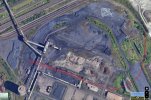
In terms of the actual location of the coke terminal, the line drawn on the google maps satellite view (attached) gives a general idea. It's very close to the site of Dawes Lane Coke ovens. Ideally the siding would have looped around to join "The Angle" to make a circular discharge track (as someone involved with the Appleby Frodingham Railway explained it to me), but with conveyors in the way, the buffer stops end up close to that piece of track, but at right angles to it.
This 2021 drone shot of the remains of Dawes Lane Coke Ovens (closed in 2016) shows the general location where the new coke terminal was built:
https://www.flickr.com/photos/152150614@N05/51244165252/ (Photo: Martyn Jones). Where the chimney is located (since demolished), there is a sort of "hut" at a junction in the coal conveyor. This is recognisable from one of the photos taken of the coke sidings at ground level, along with the concrete structure to the left of it. The other photo was taken from underneath that conveyor, looking towards the two sheds visible further into the distance either side of the top of the yellow crane. Anchor sidings are to the left, an iron ore train is visible at the Santon terminal in the distance (zoom in, top right) and part of the Redbourn "semi-finished steel stockyard" is also visible on the right - I can just make out some buffer stops in there on the extreme right.
The area of grey piles of aggregate (alongside the line from the back of Anchor Sidings into the steelworks) is marked as "Tarmac Santon Asphalt2Go Asphalt Plant" on Google Maps. This is where trains of aggregate in box wagons, hauled by GBRF from Rylstone and sometimes elsewhere to Scunthorpe, are offloaded (I don't think there is a siding as such - just a pad adjacent to the internal steelworks line, which is double track at this point). This is also the location where imported GGBS (ground granulated blast furnace slag, resembling a white powder) from Redcar Bulk Terminal was offloaded from box wagons in recent years (with SSAs, MBAs and MEAs being used at various times from what I can remember). The demand for GGBS is as a partial replacement for cement in concrete - the imported material was to supplement local production processed from Scunthorpe's own blast furnace slag.
That photo can be compared with this 1993 aerial view of Dawes Lane Coke Ovens, with Anchor sidings nearest the camera:
https://www.flickr.com/photos/chris_davis_photos/32666446194/ (Photo: delticfan)
---------------------------------
Immingham Bulk Terminal
-------------------------------
Moving on to Immingham Bulk Terminal, these two drone views are interesting:
2023 view overlooking the iron ore terminal, with the two coal pads behind:
https://www.flickr.com/photos/23983516@N05/52909577049/ (Photo: Michael Rhodes)
2024 view from the back of the coal pads (pad 2 to the left, pad 1 to the right, with iron ore terminal extreme right):
https://www.flickr.com/photos/darrenjb/54076528302/ (Photo: darren JB)
The loading silos of Immingham Humber International Terminal (biomass) are straight ahead. The material at pad 1 is rather grey and is probably coke. Trains tend to be planned out of pad 1, with pad 2 in this shot being used to stable an empty set. The photo also gives a nice view of the "stacker" used to stockpile coal or coke arriving on the conveyor belt from the dockside.