
Where it applies - this is a big factor- not only directly, through the general growth in the “night time economy”. Beats me how they can afford it….aided by factors like university growth but overall,

-
Our new ticketing site is now live! Using either this or the original site (both powered by TrainSplit) helps support the running of the forum with every ticket purchase! Find out more and ask any questions/give us feedback in this thread!
You are using an out of date browser. It may not display this or other websites correctly.
You should upgrade or use an alternative browser.
You should upgrade or use an alternative browser.
Did the equivalent of Beeching happen with buses?
- Thread starter Dyncymraeg
- Start date
- Status
- Not open for further replies.
Sponsor Post - registered members do not see these adverts; click here to register, or click here to log in
R
RailUK Forums
Goldfish62
Veteran Member
- Joined
- 14 Feb 2010
- Messages
- 13,221
Get an Oyster card then. It's not exactly dufficult.No I'm not holding contradictory views.
The buses running faster is not the same argument as saying people can only use a bus if they have a bank account and/or an Oyster card.
Evening services are a mixed bag. Up to the 1980s, there would be a clutch of last buses at 22:40 after the pubs had closed (but not changed to reflect the revised 23:00 hours). In some places, provision is better, aided by factors like university growth but overall, provision has declined.
Would agree with that. where I live now, there's more evening services since Reading Buses took on some of the rural services.
Where I used to live (until early 2000's) there used to be an hourly evening service with last bus at 11 pm, I think that went to council tendered while I lived there, then disappeared so last bus was about 7 pm. Evening service seems to be back with last bus nearer midnight - not sure if this is commercial or BSIP funded.

Justin Smith
Established Member
It's more of a problem if you don't live in London, and even more of a problem if you don't know about it before......Get an Oyster card then. It's not exactly dufficult.
I've not studied this in detail, but it feels like University-linked provision has actually dropped in many places. Sheffield no longer has any services directly to the various halls of residence for example, and they appear to have been cut back in Liverpool compared to when I studied there in the 90s.In some places, provision is better, aided by factors like university growth
Where halls are on existing commercial routes (I'm thinking Owens Park in Manchester as an example) then the student body certainly helps keep services commercial.
One factor may be that the surge in student numbers over the last decade or so has meant they are more spread out across a city, rather than concentrated in and around halls. Indeed, Sheffield Hallam have started suggesting students consider living in places like Doncaster and Chesterfield where housing costs are lower than in Sheffield itself.
Or like at my alma mater (Hull) they've closed the historic halls further away (in Cottingham about a ten/fifteen minute drive away from campus in this case) in favour of more on campus halls. When I was there, there was a very frequent bus service from Cottingham into Hull to serve the demand for students going from halls into the University including a dedicated bus route starting and finishing at The Lawns (the largest halls). My dim memory suggests it was the 105 but I used to walk to campus from Halls so only used it if it was pouring with rain!One factor may be that the surge in student numbers over the last decade or so has meant they are more spread out across a city, rather than concentrated in and around halls. Indeed, Sheffield Hallam have started suggesting students consider living in places like Doncaster and Chesterfield where housing costs are lower than in Sheffield itself.
It looks like something similar must have happened at Liverpool. I've just checked my old halls (Greenbank) and there are far fewer buildings than I recall, and most of the nice older ones have been pulled down.Or like at my alma mater (Hull) they've closed the historic halls further away (in Cottingham about a ten/fifteen minute drive away from campus in this case) in favour of more on campus halls. When I was there, there was a very frequent bus service from Cottingham into Hull to serve the demand for students going from halls into the University including a dedicated bus route starting and finishing at The Lawns (the largest halls). My dim memory suggests it was the 105 but I used to walk to campus from Halls so only used it if it was pouring with rain!
The service itself seems to have a 15 minute frequency from Arriva alone, when I was there it was every 5 minutes or less with Merseybus, Liverline and I'm sure one other all running on the corridor. There are buses up to nearly 11:30 but only every 45 minutes. I'm sure they were much more frequent but maybe not much later when I was there.
I do recall though that Liverpool never had night buses*. Someone once told me it was due to the unions, how much truth there is in that I'm not sure. I do vaguely recall an outfit setting up to run occasional night buses, from memory using an old Leyland National, but I don't think it lasted long...
* - with the exception of a bus that shuttled through one of the Mersey Tunnels, dumping people off in one of the dodgiest parts of Birkenhead.

TheGrandWazoo
Veteran Member
There will always be variations locally. However, student numbers have undoubtedly grown (doubling between 1990 and 2015). How that then impacts local bus services varies but on the flipside...I've not studied this in detail, but it feels like University-linked provision has actually dropped in many places. Sheffield no longer has any services directly to the various halls of residence for example, and they appear to have been cut back in Liverpool compared to when I studied there in the 90s.
Where halls are on existing commercial routes (I'm thinking Owens Park in Manchester as an example) then the student body certainly helps keep services commercial.
One factor may be that the surge in student numbers over the last decade or so has meant they are more spread out across a city, rather than concentrated in and around halls. Indeed, Sheffield Hallam have started suggesting students consider living in places like Doncaster and Chesterfield where housing costs are lower than in Sheffield itself.
- Lancaster University was predominantly based on the campus in the late 70s and there was an half hourly service to Lancaster with every other one heading to Morecambe with last bus about midnight. The service is now every 10 mins throughout, 20 mins in evenings, and with a service til 0300 PLUS additional new services
- Warwick now has twice as many buses between the Uni and Coventry especially at night
- Gloucester - main route to Cheltenham was every 12 mins in the 1970s and stopped at 2300 but now 8 buses/hour and operates 24h being half hourly in the midnight hours
One other thing I did notice when looking at Google Maps for my old halls is just how many cars are parked outside. When I was there it was very rare for a student to have a car, and those who did were very popular. How many actually use them to get to campus I don't know as I'd imagine parking there won't be as easy, but they are likely used more for leisure.There will always be variations locally. However, student numbers have undoubtedly grown (doubling between 1990 and 2015). How that then impacts local bus services varies but on the flipside...
I could also point you to Norwich, Bath and Bristol as other examples off the top of my head. Again, part of the growth in these locations are a) because there are more students per se and b) they are (as you suggested) because the students are accommodated in lower cost locations e.g. in Morecambe or Coventry rather than on campus.
- Lancaster University was predominantly based on the campus in the late 70s and there was an half hourly service to Lancaster with every other one heading to Morecambe with last bus about midnight. The service is now every 10 mins throughout, 20 mins in evenings, and with a service til 0300 PLUS additional new services
- Warwick now has twice as many buses between the Uni and Coventry especially at night
- Gloucester - main route to Cheltenham was every 12 mins in the 1970s and stopped at 2300 but now 8 buses/hour and operates 24h being half hourly in the midnight hours
I only have vague memories of the frequency of the 80/86 (the alternatives to the bus to my halls in Liverpool) but I'm pretty sure they aren't as frequent as they were when I was there. A lot of your comparisons are to the 70s though, I believe student numbers also increased between the 70s and 90s so maybe the increases you are talking about happened in that time frame? Or at least some of them.
I'm surprised Stagecoach locally don't do more to try and capture the student market. As well as the Derby Uni campus in Chesterfield they could run services from Sheffield that go to the Uni of Sheffield campus, but instead they seem happy to let students have to change using existing services. Maybe there market isn't there, but I suspect (having experienced the lack of interest in trying anything different) that they simply don't want to 'give it a go'.
TheGrandWazoo
Veteran Member
Stagecoach was certainly quite active in cultivating the student market, most notably in places like Warwick, Lancaster and Canterbury. I think those were all commercial initiatives. Given the student fares they have in Sheffield, they certainly want to gain that market but perhaps feel that existing services are enough rather than anything additional?I'm surprised Stagecoach locally don't do more to try and capture the student market. As well as the Derby Uni campus in Chesterfield they could run services from Sheffield that go to the Uni of Sheffield campus, but instead they seem happy to let students have to change using existing services. Maybe there market isn't there, but I suspect (having experienced the lack of interest in trying anything different) that they simply don't want to 'give it a go'.
So the period 1978-1981 was particularly notable for cuts to services. However, even in some areas, there were brutal cuts without an MAP scheme being undertaken (e.g. United Auto in North Yorkshire). Typically, local fleets saw reductions of 20% overnight and the introduction of double deckers in areas that hadn't seen them in years.
I recall taking a trip, on the spur of the moment after work one summer Friday afternoon/ evening in 1980, on the 16h35 No. 27 from Darlington to Richmond (RELH DP), then changing to a 26 (RE bus) at about 17h30 or so from Richmond. At Leyburn the bus met a no. 127 from Ripon (LH) also going to Hawes and I changed onto that. I think the 127 went up one side of Wensleydale and the 26 the other? (Only time I ever went on a 127 west of Leyburn!) Had some fish and chips in Hawes and returned on the last 26 (the RE bus) (about 19h30?) . No other passengers the whole way back, except for a short journey around the TB place (Thornton Rust?). I recall the drivers changed over midway between Leyburn and Richmond with the 20h50? ex Richmond to Hawes, which was also empty. Evening buses in the country didn't do very well even then!Evening services are a mixed bag. Up to the 1980s, there would be a clutch of last buses at 22:40 after the pubs had closed (but not changed to reflect the revised 23:00 hours). In some places, provision is better, aided by factors like university growth but overall, provision has declined.
I've not studied this in detail, but it feels like University-linked provision has actually dropped in many places. Sheffield no longer has any services directly to the various halls of residence for example, and they appear to have been cut back in Liverpool compared to when I studied there in the 90s.
Where halls are on existing commercial routes (I'm thinking Owens Park in Manchester as an example) then the student body certainly helps keep services commercial.
One factor may be that the surge in student numbers over the last decade or so has meant they are more spread out across a city, rather than concentrated in and around halls. Indeed, Sheffield Hallam have started suggesting students consider living in places like Doncaster and Chesterfield where housing costs are lower than in Sheffield itself.
There are some specific University services in Sheffield. Central Travel run a service from New Era Square to the University’s using a couple of ex London E200’s, an example is seen below
Attachments
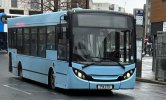
Without wanting to sound too pedantic, I believe these are only open to residents of New Era Square, so not really University services in the more usual meaning.There are some specific University services in Sheffield. Central Travel run a service from New Era Square to the University’s using a couple of ex London E200’s, an example is seen below
Have they replaced the Dart by the way? I'm actually surprised they don't use something like a Merc minibus for these - the road to New Era isn't easy to get a bus down due to the on-street parking and a decent amount of traffic. Plus not a lot of space to turn around once you get there.
GatwickDepress
Established Member
Leeds Beckett (formerly Leeds Met) run a free bus open to all students and staff (although I've used it a few times despite not being a student there). It runs hourly from their Headingley campus to the City campus, terminating outside the union on Portland Avenue. It supplements First's 22 which runs from the Headingley campus to the bus station every half hour.There are some specific University services in Sheffield. Central Travel run a service from New Era Square to the University’s using a couple of ex London E200’s, an example is seen below
It's also a former London Enviro200 and is currently operated by Tetley's.
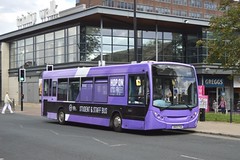
DB09 PAN: Tetley, Leeds (originally LJ09 KPR) by Richard Simons, on Flickr
We've seen something of a mini-Beeching in the eastern Scottish borders since 2020, with the axing of subsidies for evening buses (which was done "on the quiet" during lockdown), the splitting of the 67 Galashiels to Berwick via Kelso service at Kelso, and the loss of direct services between Jedburgh, Kelso and Edinburgh. These changes may have saved Scottish Borders Council a few quid, but it also gives the area a bad impression.
TheGrandWazoo
Veteran Member
You're just catching up with many places that lost evening services during 2011-3 when council grant funding was cut in England.We've seen something of a mini-Beeching in the eastern Scottish borders since 2020, with the axing of subsidies for evening buses (which was done "on the quiet" during lockdown), the splitting of the 67 Galashiels to Berwick via Kelso service at Kelso, and the loss of direct services between Jedburgh, Kelso and Edinburgh. These changes may have saved Scottish Borders Council a few quid, but it also gives the area a bad impression.
Going back to University services, I didn't mention Swansea that has it's own Unibus network that operates only in term-time. Also, for a few years, the only bus operating in Cornwall on a winter Sunday evening was between Falmouth and Penryn Campus - a few others have now been restored with council funding. Perhaps in the red brick city institutions, there's been a few changes integrate dedicated services but overall, it's been very much a growth area for bus operators. In fact, it might be single biggest factor (though far from the only one) behind First leaving Southampton in that Go South Coast had the Southampton University services that underpinned much of what they did.
- Status
- Not open for further replies.