• Our new ticketing site is now live! Using either this or the original site (both powered by TrainSplit) helps support the running of the forum with every ticket purchase! Find out more and ask any questions/give us feedback in this thread!

Different headcode systems intercompatability.

Status
Not open for further replies.

D6130

Established Member
Joined
12 Jan 2021
Messages
9,050
Location
West Yorkshire/Tuscany
Also begs the question why ScR works went to the trouble of rebuilding the earlier EE4s with 4 character boxes long before they were actually used - the other Regions that did use the new system for identification didn't.
IIRC, D260-266 had four character headcode panels fitted at their first main works overhaul for use on East Coast Main Line inter-regional services....particularly overnight sleepers.

Slightly more obscure is the reason why all but one of the NBL Type 2 (later class 29) rebuilds were fitted with four character indicators, even though they worked inter-regional services very, very rarely. Perhaps the advent of four character train describers in new Scottish power boxes had already been programmed by then?
 
Sponsor Post - registered members do not see these adverts; click here to register, or click here to log in
R

RailUK Forums

Gloster

Veteran Member
Joined
4 Sep 2020
Messages
12,976
Location
Up the creek
IIRC, D260-266 had four character headcode panels fitted at their first main works overhaul for use on East Coast Main Line inter-regional services....particularly overnight sleepers.

Slightly more obscure is the reason why all but one of the NBL Type 2 (later class 29) rebuilds were fitted with four character indicators, even though they worked inter-regional services very, very rarely. Perhaps the advent of four character train describers in new Scottish power boxes had already been programmed by then?

I think that complete coverage of the main part of the network, both national and Scottish, by panel boxes with four-character description boxes was intended from an early date. The whole thing slipped early on and timescales have wandered, usually backwards, but the use of four-character descriptions was intended…sometime. So might as well fit the locos as you went along, particularly as that would be convenient in the bits that had been done.
 

Merle Haggard

Established Member
Joined
20 Oct 2019
Messages
3,909
Location
Northampton
IIRC, D260-266 had four character headcode panels fitted at their first main works overhaul for use on East Coast Main Line inter-regional services....particularly overnight sleepers.

Slightly more obscure is the reason why all but one of the NBL Type 2 (later class 29) rebuilds were fitted with four character indicators, even though they worked inter-regional services very, very rarely. Perhaps the advent of four character train describers in new Scottish power boxes had already been programmed by then?

Thanks for that information.
On the subject of the NBL re-engine rebuilds - there was one that was't re-engined but did receive the 4 character heads code panel (and repainted blue). It confused me when I saw it on the Eastfield scrap line in the Summer of 1968 (6109???).
 

D6130

Established Member
Joined
12 Jan 2021
Messages
9,050
Location
West Yorkshire/Tuscany
On the subject of the NBL re-engine rebuilds - there was one that was't re-engined but did receive the 4 character heads code panel (and repainted blue). It confused me when I saw it on the Eastfield scrap line in the Summer of 1968 (6109???).
Yes....and 6109 was also the only class 21 to receive BR corporate Rail Blue livery. There is some debate in Anthony Sayer's book about the reasons for this....but the consensus seems to be that 6109 was originally planned to have been the final class 29 conversion, but for some reason was found at a late stage in the works to be unsuitable to receive a Paxman Ventura engine, so it went into 6108 instead. Ironically, although the last to be rebuilt as a 29, 6108 was the first to be withdrawn following a generator fire just over a year later. I can only recall having seen it in service twice....once on the evening Oban-Glasgow service and once on a ballast train.
 

Route115?

Member
Joined
26 Jun 2021
Messages
372
Location
Ruislip
On SWD wasn't it 91 for fast Bournemouth trains, 92 for semi-fasts and 93 stopping services? Stopping patterns were more distinct in those days with less skip stopping. Staff would often refer to headcodes ) - 'Is the 23 down operating on time?'.

Some trivia. SUBS and earlier units used stencils rather than roller blinds and only one of each number was carried - later stock had roller blinds. Therefore codes with repeated numbers - 11, 22, etc - were allocated to non-electrified routes such as the Oxted line where Subs would not operate.
 

contrex

Established Member
Joined
19 May 2009
Messages
1,664
Location
St Werburghs, Bristol
Not at all. The headcodes were carefully planned so that the same two-character headcode could be used for several routes which did not come into contact with each other.
When I were a lad, on the CD, 94 was the headcode for London Bridge - London Bridge via Tulse Hill & Crystal Palace, and also Victoria - Coulsdon North via Selhurst. And 2 for Wimbledon - West Croydon and Victoria - London Bridge via the South London Line (both directions for these).
 

nw1

Established Member
Joined
9 Aug 2013
Messages
9,414
On SWD wasn't it 91 for fast Bournemouth trains, 92 for semi-fasts and 93 stopping services?
Yes, that's correct. 91s were generally Weymouth but the 91 didn't denote the Weymouth extension, it denoted the service being a fast.
Likewise, 51/2/3 for Alton (though 51 didn't seem to be actually used until the 90s); 61/2/3 for Basingstoke/Salisbury/Exeter; 71/2/3 for Portsmouth Direct terminating between Haslemere and Portsmouth and Southsea; and 81/2/3 for Portsmouth Harbour.

Guildford via Cobham was 42, but all services called at roughly the same stations (Wimbledon was skipped in the peak, otherwise it was very consistent in slam-door days) so I never got the chance to discover whether 41 was used for a hypothetical fast service or 43 for a hypothetical service which called at all stations between Waterloo and Surbiton.
Some trivia. SUBS and earlier units used stencils rather than roller blinds and only one of each number was carried - later stock had roller blinds. Therefore codes with repeated numbers - 11, 22, etc - were allocated to non-electrified routes such as the Oxted line where Subs would not operate.
This also resulted in the East Grinstead and Uckfield lines being an exception of the usual "Add one to Victoria headcode for London Bridge". In the case of these lines it was add 11. So, 66 and 77 were East Grinstead to Victoria and London Bridge respectively, and 88 and 99 for Uckfield to the two termini.

According to the CWN for 1982 that I have, the same was also true for Charing Cross to Hastings (22): the corresponding peak-only Cannon Street services (normally +1) were 33, and not 23.

However I am about 95% certain that about a year after electrification in 1987, the Cannon Street-Hastings peak hour services had become 23 (based on memory of actual in-person observation). However by contrast the electric London Bridge-East Grinstead services later the same year were still definitely 77, and not 67.
 
Last edited:

Gloster

Veteran Member
Joined
4 Sep 2020
Messages
12,976
Location
Up the creek
On SWD wasn't it 91 for fast Bournemouth trains, 92 for semi-fasts and 93 stopping services? Stopping patterns were more distinct in those days with less skip stopping. Staff would often refer to headcodes ) - 'Is the 23 down operating on time?'.

90 was used for Weymouth Quay. The same system was used for Exeter line (6x), Portsmouth & Southsea via Worplesdon (7x) and Portsmouth Harbour via Worplesdon trains (8x): x1 for fast (not for Portsmouth & Southsea), x2 for semi-fast and x3 for slow services.

There is a guide on the .sremg.org.uk site, just Google Southern Region headcodes for a wealth of information.
 

nw1

Established Member
Joined
9 Aug 2013
Messages
9,414
When I were a lad, on the CD, 94 was the headcode for London Bridge - London Bridge via Tulse Hill & Crystal Palace, and also Victoria - Coulsdon North via Selhurst. And 2 for Wimbledon - West Croydon and Victoria - London Bridge via the South London Line (both directions for these).

2 was also Victoria-Littlehampton via Quarry and Hove so that's a total of three occurrences for the Central Division!
I guess to be fair the Central Division had a very complex suburban network with many variations possible so they probably exhausted all 108 possibilities (1-99 and 01-09) that would be possible with non-duplication.

This was much less the case for SWD though, and I think it would have been possible, certainly post-Beeching, to use the 108 possible headcodes with no duplication at all.

== Doublepost prevention - post automatically merged: ==

90 was used for Weymouth Quay. The same system was used for Exeter line (6x), Portsmouth & Southsea via Worplesdon (7x) and Portsmouth Harbour via Worplesdon trains (8x): x1 for fast (not for Portsmouth & Southsea), x2 for semi-fast and x3 for slow services.

There is a guide on the .sremg.org.uk site, just Google Southern Region headcodes for a wealth of information.

Another variant was 74/84 for Portsmouth Direct via Cobham, 74 terminating between Haslemere and PSS and 84 at Harbour. Perhaps coincidentally, perhaps not, you ended up with 42 and 84 on the Cobham line, 84 being twice 42, of course.

For a short time in late 1994, early 1995, the 74 headcode was used hourly for a quirky Waterloo-Haslemere service which ran non-stop to Guildford via Cobham, before calling at all stations to Haslemere. Usually a single VEP, and in the down direction was looped at Guildford to allow the 81 to pass, even though it was itself fast to Guildford. See screenshot of Sep 94-May 95 WTT, taken from Network Rail.

(Note also the duplicated 75 headcode on 2K17 and 2P43. 75 was on the one hand Waterloo-Woking-Guildford, on the other hand Southampton-Portsmouth and Southsea).


.74.png
 
Last edited:

D6130

Established Member
Joined
12 Jan 2021
Messages
9,050
Location
West Yorkshire/Tuscany
74 & 84 were used for Waterloo to Porstmouth & Southsea & Portsmouth Harbour respectively via Cobham. In my days on the South Western Divison (mid-'seventies) they were used exclusively for Sunday engineering works diversions.
 

nw1

Established Member
Joined
9 Aug 2013
Messages
9,414
74 & 84 were used for Waterloo to Porstmouth & Southsea & Portsmouth Harbour respectively via Cobham. In my days on the South Western Divison (mid-'seventies) they were used exclusively for Sunday engineering works diversions.

As there's maybe a sub-conversation on Portsmouth via Cobham workings developing, I can add that: in addition to the 1994 service above, the xx40 fast Waterloo-Portsmouth and Southsea introduced 1995 also went via Cobham for a while, though as it was mostly operated by 442s, the 74 headcode was in practice not carried by most trains. By 1997 this service had been re-routed via Woking.

Additionally, in the early-to-mid 80s a small number of Portsmouth stoppers around the fringes of both peaks were diverted via Cobham. These included the 0830 and 1530 Waterloo-Portsmouth Harbour, the 1630 Waterloo-PSS, and the 0829 and 1629 up services from Portsmouth Harbour to Waterloo. In these hours, the normal 73/83 at xx20 from Waterloo became a 75 (Guildford via Woking).
 

Big Jumby 74

Established Member
Joined
12 Feb 2022
Messages
2,238
Location
UK
SUBS and earlier units used stencils rather than roller blinds and only one of each number was carried
Not a problem. There was a full set in each van, if the crew were inclined to use both of one number.
 

Gloster

Veteran Member
Joined
4 Sep 2020
Messages
12,976
Location
Up the creek
74 & 84 were used for Waterloo to Porstmouth & Southsea & Portsmouth Harbour respectively via Cobham. In my days on the South Western Divison (mid-'seventies) they were used exclusively for Sunday engineering works diversions.

Back in the early 1970s when I were nobbut a lad, they used to send up Portsmouth line trains via the New Line on a weekday, mostly in the evening. I don’t know whether they were timetabled or ad hoc diversions to avoid crossing the layout at Woking, but I could see them hammering through Horsley from my bedroom window (in winter at least).
 

jfollows

Established Member
Joined
26 Feb 2011
Messages
10,098
Location
Wilmslow
90 was used for Weymouth Quay. The same system was used for Exeter line (6x), Portsmouth & Southsea via Worplesdon (7x) and Portsmouth Harbour via Worplesdon trains (8x): x1 for fast (not for Portsmouth & Southsea), x2 for semi-fast and x3 for slow services.

There is a guide on the .sremg.org.uk site, just Google Southern Region headcodes for a wealth of information.
In my time (late 1970s), the 09:54 from Waterloo which I just made (twice) from the 09:34 arrival into Euston from Macclesfield was 90 to Weymouth Quay. Once I went all the way, the second time just to Bournemouth.
Later I lived in the area when the 91 services were non-stop Southampton-Waterloo and the 92 were Woking-Basingstoke-Winchester-Eastleigh where I changed for Fareham.
80 was re-used for Portsmouth via Eastleigh following electrification. 80 as fast Portsmouth Direct went before I moved to the area in 1984, when 81 was the fastest service.
 
Last edited:

nw1

Established Member
Joined
9 Aug 2013
Messages
9,414
Back in the early 1970s when I were nobbut a lad, they used to send up Portsmouth line trains via the New Line on a weekday, mostly in the evening. I don’t know whether they were timetabled or ad hoc diversions to avoid crossing the layout at Woking, but I could see them hammering through Horsley from my bedroom window (in winter at least).

A 1974 timetable extract I have (courtesy of another forum member) shows one of the two fasts per hour not calling at Woking, with services departing Guildford at xx42, due into Waterloo at xx17. Perhaps some of these went via Cobham. Interestingly the non-stop timing to and from Guildford in 1974 (35 mins both directions) was slower than the timing with a Woking stop in the down direction in the early 80s (34 mins).

== Doublepost prevention - post automatically merged: ==

In my time, the 09:54 from Waterloo which I just made (twice) from the 09:34 arrival into Euston from Macclesfield was 90 to Weymouth Quay. Once I went all the way, the second time just to Bournemouth.
Later I lived in the area when the 91 services were non-stop Southampton-Waterloo and the 92 were Woking-Basingstoke-Winchester-Eastleigh where I changed for Fareham.

A curious feature of this era was how the 91 departed Waterloo at xx35 and the 92 just ten minutes later, at xx45. Both were operated with REP/TC express stock, and later, 442s. I guess the rationale was that they were serving different markets so almost no-one, presumably, used the 92 to get from London to Southampton or Bournemouth unless they just missed the 91. On the other hand the 92 fully served the London-Winchester and Eastleigh flow and around half the flow to Basingstoke, along with the Salisbury/Exeter.

In the up direction it was different as the services departed Southampton at 30-min intervals, thus the 92 would have attracted some custom on that flow, even if the 91 caught it up to some extent.

Eventually, but not until the 90s, they moved to a more even spread at xx32 and xx53, and eventually to a 20-min-interval service.
 
Last edited:

jfollows

Established Member
Joined
26 Feb 2011
Messages
10,098
Location
Wilmslow
Back in the early 1970s when I were nobbut a lad, they used to send up Portsmouth line trains via the New Line on a weekday, mostly in the evening. I don’t know whether they were timetabled or ad hoc diversions to avoid crossing the layout at Woking, but I could see them hammering through Horsley from my bedroom window (in winter at least).
Generally timetabled. I can give more detail if you want a specific year.
 

jfollows

Established Member
Joined
26 Feb 2011
Messages
10,098
Location
Wilmslow
A curious feature of this era was how the 91 departed Waterloo at xx35 and the 92 just ten minutes later, at xx45. Both were operated with REP/TC express stock, and later, 442s. I guess the rationale was that they were serving different markets so almost no-one, presumably, used the 92 to get from London to Southampton or Bournemouth unless they just missed the 91.
I was a regular user of the xx.45 to Eastleigh, for Fareham. 4-Rep+4/8-TC indeed.

== Doublepost prevention - post automatically merged: ==

I realise I'm not @Gloster but was this hourly throughout the day, or just evenings?
Up morning and down evening peak services.
Plus Saturday/Sunday extras earlier on.
 

nw1

Established Member
Joined
9 Aug 2013
Messages
9,414
I was a regular user of the xx.45 to Eastleigh, for Fareham. 4-Rep+4/8-TC indeed.
Looks like it was a good connection, xx58 into Eastleigh then xx03 out to Fareham (1982 TT). Interesting to note the operation of two separate Class 1 services on the same line (the 91 and 92), serving different markets - you don't seem to get that so much these days but the same principle was also seen on the WCML and other InterCity routes.

I didn't move to the area until later but I still remember an almost-identical xx02 departure from Eastleigh in early 1990, very shortly before electrification. Post-electrification the through service was introduced of course, but the xx02 path was still used for peak additionals.

== Doublepost prevention - post automatically merged: ==

Up morning and down evening peak services.
Plus Saturday/Sunday extras earlier on.
Ah ok, thanks.
 

Gloster

Veteran Member
Joined
4 Sep 2020
Messages
12,976
Location
Up the creek
I have a feeling that even then I noticed a definite imbalance with more Up trains than Down ones and believed that it was to avoid the movement across the Down Brookwood lines at Woking, a problem that doesn’t arise with Down Pompeys. There is always the problem on the New Line that a fast will catch up with one of the 42s, which were all stops, or clash with an Epsom line movement at Effingham Junction. So you have a potential disadvantage of using the New Line for Down Pompeys and no great advantage, but a bit of both for Ups.
 

Big Jumby 74

Established Member
Joined
12 Feb 2022
Messages
2,238
Location
UK
I was a regular user of the xx.45
Ditto. 16.45.

Going back to 4 character headcodes, although well established in the WTT's, they remained absent from the CWN's for some time, until (an educated guess as I can't now remember), about the time Wimbledon Panel went live, which would make sense. In my time I also tried to include the line of arrival and departure within the Waterloo pages, eg: 2Lxx/0812/(plat)10/MF/Basingstoke (etc) and that's just the outbound side of the page. Wasn't really viable as the page width made things too cramped whereby many destinations would need to be abbreviated, but of more concern it would have left little space for the short term planning people to make their rough working amendments - they would photocopy the 'master' copy of the perm plan CWN to use as a working document.
The line of route thing was only an idea that could have been used as an aid when making amendments and lack of same in the CWN was not the end of the world, as the bobbies at Wimbledon (and elsewhere) used the CWN to produce their own simplifiers, which contained all the info they required.
 

nw1

Established Member
Joined
9 Aug 2013
Messages
9,414
I have a feeling that even then I noticed a definite imbalance with more Up trains than Down ones and believed that it was to avoid the movement across the Down Brookwood lines at Woking, a problem that doesn’t arise with Down Pompeys. There is always the problem on the New Line that a fast will catch up with one of the 42s, which were all stops, or clash with an Epsom line movement at Effingham Junction. So you have a potential disadvantage of using the New Line for Down Pompeys and no great advantage, but a bit of both for Ups.

I seem to remember from previous discussions that there has been an increase in recent years of sending down peak services via Cobham, even though the mainline is actually slightly less intensively worked than in the slam-door days. One thing that allows more Cobham diversions nowadays is the very significant thinning out of the peak 42s in recent times; IIRC it was only half-hourly in the peak even pre-Covid while in the early 80s it was around 4tph (1702, 1722, 1742, 1752, 1802, 1812, 1830 departures on Cobham stoppers in 1982). Given the high frequency of the 42s back in the day, it would have been much more difficult to divert Direct services that way.

(It's probably a subject for another thread, but I wonder what caused the apparent crash in demand for peak-hour Cobham stoppers in the 21st century?)
 

Big Jumby 74

Established Member
Joined
12 Feb 2022
Messages
2,238
Location
UK
I have a feeling that even then I noticed a definite imbalance with more Up trains than Down ones and believed that it was to avoid the movement across the Down Brookwood lines at Woking
One of the ruling factors in the planning of the 2004 re write was to maximise the number of instances when UP and DOWN Pompey's were timed to pass each other across Woking Junction, to minimise the number of potential conflicts with the Basingstoke route.
 

nw1

Established Member
Joined
9 Aug 2013
Messages
9,414
Ditto. 16.45.

Going back to 4 character headcodes, although well established in the WTT's, they remained absent from the CWN's for some time, until (an educated guess as I can't now remember), about the time Wimbledon Panel went live, which would make sense.
I can say they were entirely absent in both 1981 and 1982 for all three divisions (I have CWNs from these years thanks to another forum member and someone on another group).

Interestingly the Charing Cross and Cannon Street sections of the SED CWNs showed the two-digit headcodes, presumably because so many trains were going in and out during the peaks.
 

jfollows

Established Member
Joined
26 Feb 2011
Messages
10,098
Location
Wilmslow
Looks like it was a good connection, xx58 into Eastleigh then xx03 out to Fareham (1982 TT). Interesting to note the operation of two separate Class 1 services on the same line (the 91 and 92), serving different markets - you don't seem to get that so much these days but the same principle was also seen on the WCML and other InterCity routes.
It was a good connection, but it helped that it was in an era when connections were held. I have no memory of ever failing to make the connection in either direction.
 

contrex

Established Member
Joined
19 May 2009
Messages
1,664
Location
St Werburghs, Bristol
I guess to be fair the Central Division had a very complex suburban network with many variations possible
I once read on here, I think, of someone whose mate worked as a signaller and knew of 30 different ways of routing a train from Victoria to Sutton. Many a night I've lain awake trying to work count them in my head. It usually works to send me off to sleep before I've got past 20.
 
Last edited:

norbitonflyer

Established Member
Joined
24 Mar 2020
Messages
5,718
Location
SW London
I once read on here, I think, of someone whose mate worked as a signaller and knew of 30 different ways of routing a train from Victoria to Sutton. Many a night I've lain awake trying to work count them in my head. It usually works to send me off to sleep before I've got past 20.
Do fast and slow lines count seprarately? And presumably no reversals?

I've already got eight
via Balham, Crystal Palace and West Croydon
via Balham, Norbury and West Croydon
via Balham and Carshalton
via Balham, Tooting and St Helier
via Herne Hill, Tulse Hill, Crystal Palace and West Croydon
via Herne Hill, Tulse Hill, Norbury and West Croydon
via Herne Hill, Tulse Hill and Carshalton
via Herne Hill, Tulse Hill, Tooting and St Helier

Multiply all these Balham routes by two depending whether the high level or low level route is used out of Victoria. so sixteen

(pre Tramlink, you also had
via Balham, Tooting, Merton Park and Carshalton
via Herne Hill, Tulse Hill, Tooting, Merton Park and Carshalton

Additionally, until the remodelling at Battersea Park, there was a third route to Herne Hill by the South London route. That makes 25. If using the fast lines and slow lines through Balham both count that's an extra five.

If you want to go to extremes, you can replace the St Helier line by:
- Wimbledon - Eastleigh - Havant - Horsham - Leatherhead -
- Wimbledon - Eastleigh - Havant - Guildford - Leatherhead -
 
Last edited:

30907

Veteran Member
Joined
30 Sep 2012
Messages
21,949
Location
Airedale
According to the CWN for 1982 that I have, the same was also true for Charing Cross to Hastings (22): the corresponding peak-only Cannon Street services (normally +1) were 33, and not 23.

However I am about 95% certain that about a year after electrification in 1987, the Cannon Street-Hastings peak hour services had become 23 (based on memory of actual in-person observation).
According to the SEG book on the topic (Southern Electric Two-character Headcodes/Rick Squirrell) the change over was in 1985: 23 had previously been short workings south of Tonbridge/T wells, and 33 became Cannon St-T Wells.
 

Mollington St

Member
Joined
4 Mar 2019
Messages
280
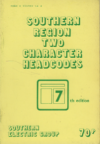
I have both the 1974 and 1984 publication by the Southern Electric Group

Southern Region 2 Character Headcodes

They detail all the Number and Number and Letter trains , passenger and Freight

I have now up loaded them on to my site - Transport Past Times

Handy little publications
 

Attachments

  • Scan_20241230 (21).png
    Scan_20241230 (21).png
    80.6 KB · Views: 10
  • Scan_20241230 (22).png
    Scan_20241230 (22).png
    178 KB · Views: 10

D6130

Established Member
Joined
12 Jan 2021
Messages
9,050
Location
West Yorkshire/Tuscany
Somewhere in a box in the attic I have a copy of the 1966 edition of the Ian Allan publication "British Railways Headcodes". Now if I could only find it.:?:
 
Status
Not open for further replies.

Top