• Our new ticketing site is now live! Using either this or the original site (both powered by TrainSplit) helps support the running of the forum with every ticket purchase! Find out more and ask any questions/give us feedback in this thread!

Castleton South Junction Renewal and M62 bridge replacement

Status
Not open for further replies.

D6130

Established Member
Joined
12 Jan 2021
Messages
9,083
Location
West Yorkshire/Tuscany
I notice they're putting the junction back in 'as was' rather than taking the opportunity to replace the diamond with a crossover and standard turnout. I guess the signalling changes would be too much for the 'box to handle so it'll need to wait until a wider project comes around...
At least now Steam to/from the East Lancs will be able to do the 3-point turns away from Manchester.
Looking at the ariel views in the video, would I be correct in assuming that Castleton South was originally a standard double track junction with the double track continuing round the curve towards Heywood?
 
Sponsor Post - registered members do not see these adverts; click here to register, or click here to log in
R

RailUK Forums

zwk500

Veteran Member
Joined
20 Jan 2020
Messages
18,602
Location
Northampton
Looking at the ariel views in the video, would I be correct in assuming that Castleton South was originally a standard double track junction with the double track continuing round the curve towards Heywood?
It certainly was previously, although the maps on the NLS website don't extend as late as after the Motorway was constructed.
 

Mcr Warrior

Veteran Member
Joined
8 Jan 2009
Messages
17,266
Looking at the ariel views in the video, would I be correct in assuming that Castleton South was originally a standard double track junction with the double track continuing round the curve towards Heywood?
Yes, I believe so, certainly from Castleton North Junction to Castleton South Junction. Not sure when the Down South Curve was taken out, but some time prior to 2005.
 

D6130

Established Member
Joined
12 Jan 2021
Messages
9,083
Location
West Yorkshire/Tuscany
Yes, I believe so, certainly from Castleton North Junction to Castleton South Junction. Not sure when the Down South Curve was taken out, but some time prior to 2005.
I have the Quail Map Company track diagrams book Volume 4: London Midland Region, published in October 1990 and the present day layout from Castleton South to North Junctions was the same then. It's a strange kind of 'one way' layout that has always intrigued me. Was it modified in that way because of already-apparent structural problems with the bridge....or were there other reasons?
 

Mcr Warrior

Veteran Member
Joined
8 Jan 2009
Messages
17,266
I have the Quail Map Company track diagrams book Volume 4: London Midland Region, published in October 1990 and the present day layout from Castleton South to North Junctions was the same then. It's a strange kind of 'one way' layout that has always intrigued me. Was it modified in that way because of already-apparent structural problems with the bridge....or were there other reasons?
Likely little residual traffic via Heywood after the station there closed 1970. Almost surprising anything survived.
 

Geeves

Established Member
Joined
6 Jan 2009
Messages
2,638
Location
Rochdale
Likely little residual traffic via Heywood after the station there closed 1970. Almost surprising anything survived.

Don't forget Heywood had the standard Wagon Works into the early 90s which likely generated a fair bit of traffic. That's probably the reason it survived really. Also I remember wagons on the Heywood stretch from the rail depot as a kid so I'm wondering if they used the other curve for turning long welded rail rakes?
 

zwk500

Veteran Member
Joined
20 Jan 2020
Messages
18,602
Location
Northampton
Don't forget Heywood had the standard Wagon Works into the early 90s which likely generated a fair bit of traffic. That's probably the reason it survived really. Also I remember wagons on the Heywood stretch from the rail depot as a kid so I'm wondering if they used the other curve for turning long welded rail rakes?
I expect the south curve survived in the Up direction only because it means all movements onto the mainline would be with the loco at the front, and all movements off the mainline would have the loco at the north end so it didn't get trapped on the blocks of the sidings.
It also means 1 less facing point and all shunting concentrated nearer the surviving box. I don't know if tail lamp advice would be relevant here, as there are track circuits on approach to the south junction.
 

Mcr Warrior

Veteran Member
Joined
8 Jan 2009
Messages
17,266
Don't forget Heywood had the standard Wagon Works into the early 90s which likely generated a fair bit of traffic. That's probably the reason it survived really.
Good shout. Believe the Powell Duffryn Standard wagon works at Heywood closed on or around Christmas Eve 1992 (due to lack of orders) this after Heywood wagon works had been operational for some 150 years, and so this would have been more than a couple of decades after Heywood station had been shut in 1970. Just maybe this possibly narrows down the timeframe when the Down South Curve at Castleton was likely removed.
 

D6130

Established Member
Joined
12 Jan 2021
Messages
9,083
Location
West Yorkshire/Tuscany
Good shout. Believe the Powell Duffryn Standard wagon works at Heywood closed on or around Christmas Eve 1992 (due to lack of orders) this after Heywood wagon works had been operational for some 150 years, and so this would have been more than a couple of decades after Heywood station had been shut in 1970. Just maybe this possibly narrows down the timeframe when the Down South Curve at Castleton was likely removed.
When did the Rawtenstall freight trip stop running? Could that have had any effect on the rationalisation of the layout at Castleton? Also when did the long-welded rail depot there close?
 

Sir Felix Pole

Established Member
Joined
21 Oct 2012
Messages
2,187
Location
Wilmslow
Coal trains ceased in December 1980, with formal closure coming in 1982. The expensively provided flat crossing across the throat of the new Bury Interchange had a short life. ELR took over in 1987.
 

D6130

Established Member
Joined
12 Jan 2021
Messages
9,083
Location
West Yorkshire/Tuscany
Coal trains ceased in December 1980, with formal closure coming in 1982. The expensively provided flat crossing across the throat of the new Bury Interchange had a short life. ELR took over in 1987.
Thanks. The photo I had seen must have been taken earlier than I had remembered then.
 

D6130

Established Member
Joined
12 Jan 2021
Messages
9,083
Location
West Yorkshire/Tuscany
The bridge appears to have reopened on schedule this morning....but trains crossing it - especially those in the Down (Eastbound) direction - have been sustaining delays of up to 10 mins due to the temporary speed restriction across it.

According to the station staff at Hebden Bridge, Network Rail staff neglected to erect the necessary speed boards and temporary AWS magnets prior to the line reopening, causing all trains to be stopped and cautioned at the preceding signalboxes - Castleton East Jn in the Up direction and Vitriol Works in the Down. This in turn has caused a long tailback of trains in either direction.

Perhaps @Geeves could confirm or otherwise that this was the case?

 

SuspectUsual

Established Member
Joined
11 Jul 2018
Messages
6,782
Not sure what’s going on but I was at Todmorden an hour or so ago and everything heading west was being turned at Rochdale

The 1154 departed ok for Headbolt Lane but the 1206 and everything since terminated short at Rochdale. NRE is using “an obstruction on the track” as the reason
 

D6130

Established Member
Joined
12 Jan 2021
Messages
9,083
Location
West Yorkshire/Tuscany
Not sure what’s going on but I was at Todmorden an hour or so ago and everything heading west was being turned at Rochdale

The 1154 departed ok for Headbolt Lane but the 1206 and everything since terminated short at Rochdale. NRE is using “an obstruction on the track” as the reason
According to RTT trains seem to be running through again....but still with substantial delays.
 

Geeves

Established Member
Joined
6 Jan 2009
Messages
2,638
Location
Rochdale
The bridge appears to have reopened on schedule this morning....but trains crossing it - especially those in the Down (Eastbound) direction - have been sustaining delays of up to 10 mins due to the temporary speed restriction across it.

According to the station staff at Hebden Bridge, Network Rail staff neglected to erect the necessary speed boards and temporary AWS magnets prior to the line reopening, causing all trains to be stopped and cautioned at the preceding signalboxes - Castleton East Jn in the Up direction and Vitriol Works in the Down. This in turn has caused a long tailback of trains in either direction.

Perhaps @Geeves could confirm or otherwise that this was the case?

All I can add is that the first few trains ran through seemingly okay and even though I was on shift all morning it never became clear why the delays suddenly became so huge! I don't know what exactly the obstruction was either, I can only assume they took a line block to sort things out

There was quite a few pre planned cancellations too which stopped an even larger jam of trains stretching back to Mills Hill.

I did hear that the man with the signs was supposed to travel there by train but missed said train!
 

SuspectUsual

Established Member
Joined
11 Jul 2018
Messages
6,782
All I can add is that the first few trains ran through seemingly okay and even though I was on shift all morning it never became clear why the delays suddenly became so huge! I don't know what exactly the obstruction was either, I can only assume they took a line block to sort things out

There was quite a few pre planned cancellations too which stopped an even larger jam of trains stretching back to Mills Hill.

I did hear that the man with the signs was supposed to travel there by train but missed said train!

At lunchtime it looked (have to admit I didn't look too deeply) that eastbound was moving OK and it was only westbound that wasn't getting through
 

roughyed

Member
Joined
7 Nov 2023
Messages
11
Location
Saddleworth
Bridge 48A (over the M62) is for want of a better phrase, absolutely knackered. Only one train can be on that bridge at any one time. They plain lined Castleton South Jn to save weight on the bridge. The current estimate is 2025 for renewal of the bridge so this arrangement will be in for a while yet, which led to a groan from me when I was informed by my LOM a few days ago.
The horrific state of bridge 48A can clearly be seen on Google Street View, not just from corrosion but also from multiple bridge strikes by high vehicles. Does the new bridge give more headroom to prevent this. If not, does it have built in resilience against future strikes. Incidentally why weren't over bridges designed and built with enough headroom so that a high vehicle could never strike them. Surely bridges built today are designed this way.
 

swt_passenger

Veteran Member
Joined
7 Apr 2010
Messages
34,285
The horrific state of bridge 48A can clearly be seen on Google Street View, not just from corrosion but also from multiple bridge strikes by high vehicles. Does the new bridge give more headroom to prevent this. If not, does it have built in resilience against future strikes. Incidentally why weren't over bridges designed and built with enough headroom so that a high vehicle could never strike them. Surely bridges built today are designed this way.
The planning drawings reckon the original bridge had at least 16ft 6” clearance, so AIUI would not have been classed as a ‘low bridge’. Is there any evidence of multiple bridge strikes? Were there any warning signs?

The replacement bridge appears to give at least the same clearances as before, however the replacement’s planning drawing doesn’t include the exact height.
 
Last edited:

david l

Member
Joined
27 Dec 2016
Messages
468
Location
Wigan
Yes, I believe so, certainly from Castleton North Junction to Castleton South Junction. Not sure when the Down South Curve was taken out, but some time prior to 2005.
Castleton North to Castleton South was singled in January 1973. Am advised that the layout has remained as such since. The apparent reason for the layout adopted was to allow 'full' trains from Standard Wagon and/or the Long Welded rail depot to depart in the Manchester direction, empty trains inwards could be marshalled via the sidings and/or Castleton East.
The 'new' diamond crossing appears to be in the same place as the 'old' one, still on the bridge - which will presumably in xx years cause the same problems as have been encountered of late, the connection from South to North apparently has had to be left in as a result of objections to its removal (not from the obvious user(s) though..........) even with very little usage. I would have thought that it would have been better for long term maintenance if a trailing crossover had been installed nearer to Manchester off the bridge and a simple facing point at Castleton South through to North Junction. Yes, would have cost in terms of signal alterations, but there were 3 weeks to do it and not have to have a diamond crossing manufactured.
 
Last edited:

Mcr Warrior

Veteran Member
Joined
8 Jan 2009
Messages
17,266
Castleton North to Castleton South was singled in January 1973. Am advised that the layout has remained as such since.
Good stuff. Couldn't find that info anywhere else. Not that long then after the BR Heywood station had closed?!
 

david l

Member
Joined
27 Dec 2016
Messages
468
Location
Wigan
Good stuff. Couldn't find that info anywhere else. Not that long then after the BR Heywood station had closed?!
Bolton to Rochdale (passenger traffic) ceased from 5 Oct 1970. The line from Bolton Burnden Junction to Bury Knowsley Street closed completely at that time then being fairly soon after lifted, whilst Bury (Bolton Street via Knowsley Street to Castleton East & South Juncs remained open for freight traffic, there being coal traffic to Rawtenstall and various 'bits' around Castleton/Heywood for Standard Wagon at Heywood and the long rail welding depot at Castleton.
Am advised that the line was 'progressively' singled from Bury Bolton Street via Knowsley Street towards Heywood from late 1970 onwards, but the interesting part is that latterly, there was no connection between platform 2 and platform 3 at Bury Bolton Street so that the coal trains to Rawtenstall had to come in (from Middleton??) via Heywood which resulted in a single line bridge over the M66 having to be constructed near Heap Bridge Junction at a cost of £m several, with also in 1980 (& the opening of Bury Interchange with the 504's diverted from Bolton Street) the flat junction at Knowsley Street also having to be constructed which was used by a single figure number of trains (coal until they ceased- last one on 5 Dec 1980, & two DMU specials) - again a good cost and a question that if the cost of a bridge over a motorway and a flat crossing in 1980 was considered viable and sanctioned, and with the Bolton-Rochdale route not being considered as a Beeching closure ( indeed was a route for 'development') who on earth had all of this as joined up thinking!!
 

roughyed

Member
Joined
7 Nov 2023
Messages
11
Location
Saddleworth
The planning drawings reckon the original bridge had at least 16ft 6” clearance, so AIUI would not have been classed as a ‘low bridge’. Is there any evidence of multiple bridge strikes? Were there any warning signs?

The replacement bridge appears to give at least the same clearances as before, however the replacement’s planning drawing doesn’t include the exact height.
Yes, as I said the evidence is clearly shown on Google street view. I suspect that a mobile crane or low loader with crane was the culprit, but there are several different strikes visible.
 

Mcr Warrior

Veteran Member
Joined
8 Jan 2009
Messages
17,266
The planning drawings reckon the original bridge had at least 16ft 6” clearance, so AIUI would not have been classed as a ‘low bridge’. Is there any evidence of multiple bridge strikes? Were there any warning signs?
What's the typical height clearance for the majority of other overbridges above the motorway?
 

swt_passenger

Veteran Member
Joined
7 Apr 2010
Messages
34,285
What's the typical height clearance for other overbridges above the motorway?
It will vary a lot. The 16’ 6” height is the cut off where there’s no special signage, because normal loads are supposed to be limited to 16 ft. If vehicles hit a 16’ 6” bridge it’s the drivers fault, as opposed to the highway or rail authority.

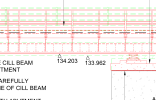
I’ve had another check of the drawing, and the bridge is possibly about 240mm higher, there’s a figure given for the underside of the old and new bridges that I think is referred to the OS height datum, (rather than the road surface), but I‘m not an expert in reading these drawings, so perhaps someone could have a look. Link to the planning website is in post #33
 

Attachments

  • Screenshot 2024-09-30 at 11.26.34.png
    Screenshot 2024-09-30 at 11.26.34.png
    236.2 KB · Views: 51

InOban

On Moderation
Joined
12 Mar 2017
Messages
4,537
The standard clearance height is if course given in metres. 5m.
A stretch of the M9 has notices warning that the clearance is only 4.9m.
 

Geeves

Established Member
Joined
6 Jan 2009
Messages
2,638
Location
Rochdale
Yes, as I said the evidence is clearly shown on Google street view. I suspect that a mobile crane or low loader with crane was the culprit, but there are several different strikes visible.

If you go through the dates the Google car has been under you can see the concrete is getting progressively worse. I have lived near by all my life never heard of any bridge strikes, I think it was just genuinely ready to fall down.

Railway rumors' say it should've been replaced a decade ago, and on the last inspection it was basically a case of "if you don't do something now its coming down by itself!"
 
Status
Not open for further replies.

Top