The other problem is the timetable. Even in the capital city of Wales, you will struggle to use a bus if you work shifts. For example, Asda and Tesco both open at 6 am but the first bus heading out of the city centre doesn't arrive until well after 6.EDIT:
As to "struggling to keep a roof over their heads can't afford a car", in a lot of cases they can't afford not to.
Public transport in the vast majority of Britain is terrible and expensive, and the technologies chosen mean it will always be so.
WIthout the car they will not be able to economically make it to their job or obtain food etc etc etc.

-
Our new ticketing site is now live! Using either this or the original site (both powered by TrainSplit) helps support the running of the forum with every ticket purchase! Find out more and ask any questions/give us feedback in this thread!
You are using an out of date browser. It may not display this or other websites correctly.
You should upgrade or use an alternative browser.
You should upgrade or use an alternative browser.
UK switching to electric vehicles discussion
- Thread starter MattA7
- Start date
Sponsor Post - registered members do not see these adverts; click here to register, or click here to log in
R
RailUK Forums
Enthusiast
Established Member
- Joined
- 18 Mar 2019
- Messages
- 1,226
And it's likely to remain so for some time to come. There are more public charging devices (>5,100) in the two London boroughs of Westminster and Hammersmith & Fulham than there are in (take a deep breath) Liverpool, Birmingham, Leeds, Glasgow, Edinburgh, Sheffield, York, Nottingham, Manchester, Perth, Bradford, Dundee, Aberdeen, Plymouth, Oxford, Bristol, Cambridge, Swansea, Cardiff, Newcastle, Southampton and Doncaster taken together. You could probably take many other groups of about 20 areas to show that disparity because only one other area in the whole of the country (Coventry) has more that 1,000 public charging devices and only seven more have more than 500.I believe there are many residential lamppost chargers in London. But I've never seen any anywhere else. Certainly up North they remain a dream.
And it isn't only at that end of the day. I visit a reasonably sized town in East Hampshire from time to time. It's commuting distance to London (fastest journey 40mins, usual journey time 50-55mins). The last buses from the centre (including the railway station) to most of the outskirts leave before 6:30pm. So, imagine living there without a car. Working a bit late (perhaps 6pm) in London? You need a cab from the station. Work late in a shop in town? You can't get a bus home. Fancy a bit of late night shopping in those shops? Ditto. A meal in town? A cab both ways. Charging devices per 100,000 people in that area: 34. Devices per 100,000 people in Westminster: 1,262. Few people should need to drive a car (of any sort) in Westminster. Few people can afford to be without a car in East Hampshire.The other problem is the timetable. Even in the capital city of Wales, you will struggle to use a bus if you work shifts. For example, Asda and Tesco both open at 6 am but the first bus heading out of the city centre doesn't arrive until well after 6.
I think many politicians simply do not appreciate the difficulties some people would face without a car. Whilst there is such a disparity in public charging facilities, persuading them to go electric is going to be an uphill struggle.
Cardiff is okay at the end of the day with most routes running up to approx 23:00. So you could get to or from work for a 22:00 shift change. However, it's nowhere near as good as it used to be. Back in the bad old days when the was a bus station, all the main routes had a 23:00 and 23:20 departure. Now the time of the last bus is all over the place and from different stops. Progress?And it isn't only at that end of the day. I visit a reasonably sized town in East Hampshire from time to time.
Deafdoggie
Established Member
- Joined
- 29 Sep 2016
- Messages
- 3,414
I don't know, but I imagine a lot fewer people in Westminster have drives and therefore home charging, so they therefore need more public chargers.And it's likely to remain so for some time to come. There are more public charging devices (>5,100) in the two London boroughs of Westminster and Hammersmith & Fulham than there are in (take a deep breath) Liverpool, Birmingham, Leeds, Glasgow, Edinburgh, Sheffield, York, Nottingham, Manchester, Perth, Bradford, Dundee, Aberdeen, Plymouth, Oxford, Bristol, Cambridge, Swansea, Cardiff, Newcastle, Southampton and Doncaster taken together. You could probably take many other groups of about 20 areas to show that disparity because only one other area in the whole of the country (Coventry) has more that 1,000 public charging devices and only seven more have more than 500.
And it isn't only at that end of the day. I visit a reasonably sized town in East Hampshire from time to time. It's commuting distance to London (fastest journey 40mins, usual journey time 50-55mins). The last buses from the centre (including the railway station) to most of the outskirts leave before 6:30pm. So, imagine living there without a car. Working a bit late (perhaps 6pm) in London? You need a cab from the station. Work late in a shop in town? You can't get a bus home. Fancy a bit of late night shopping in those shops? Ditto. A meal in town? A cab both ways. Charging devices per 100,000 people in that area: 34. Devices per 100,000 people in Westminster: 1,262. Few people should need to drive a car (of any sort) in Westminster. Few people can afford to be without a car in East Hampshire.
I think many politicians simply do not appreciate the difficulties some people would face without a car. Whilst there is such a disparity in public charging facilities, persuading them to go electric is going to be an uphill struggle.
Those London boroughs are in areas where EVs are more important to constrain levels of pollution than almost anywhere else. Walking the streets of central London confirms the need for the early adoption of low emission vehicles, and indeed the vehicle owners there have reponded to that need.I don't know, but I imagine a lot fewer people in Westminster have drives and therefore home charging, so they therefore need more public chargers.
London is also a major destination of vehicle journeys compared to all those other areas mentioned.
Yup. I'm in London 2 or 3 days a week and it's absolutely horrible breathing all the traffic fumes and pollution.Those London boroughs are in areas where EVs are more important to constrain levels of pollution than almost anywhere else. Walking the streets of central London confirms the need for the early adoption of low emission vehicles, and indeed the vehicle owners there have reponded to that need.
London is also a major destination of vehicle journeys compared to all those other areas mentioned.
Last place on earth I'd want to live or bring up kids. Horrible.
House prices would suggest otherwise.Yup. I'm in London 2 or 3 days a week and it's absolutely horrible breathing all the traffic fumes and pollution.
Last place on earth I'd want to live or bring up kids. Horrible.
Most of us Londoners don't live on Oxford Street thoughYup. I'm in London 2 or 3 days a week and it's absolutely horrible breathing all the traffic fumes and pollution.
Last place on earth I'd want to live or bring up kids. Horrible.
 .
.
RailWonderer
Established Member
Majority of it is buses, lorries and vans rather than vehicles.Yup. I'm in London 2 or 3 days a week and it's absolutely horrible breathing all the traffic fumes and pollution.
Last place on earth I'd want to live or bring up kids. Horrible.

birchesgreen
Established Member
Not as bad outside the very centre, i have family in Beckton and to be honest i find the noise and pollution worse where i live in Brum.Yup. I'm in London 2 or 3 days a week and it's absolutely horrible breathing all the traffic fumes and pollution.
Last place on earth I'd want to live or bring up kids. Horrible.
Nor necessarily, maybe on a per vehicle basis, but there are many more (IC engined) cars and vans than large vehicles, and they contribute to most of the street level pollution. The LEZ has been in place since between 2008 and 2012 with Euro V1 since 2021. The charges for Buses and Goods vehicles is £100 - £300 per day for non-compliance and the nonber of thos non-compliant vehicles dropped by a third just one month after the LEZ was introduced.Majority of it is buses, lorries and vans rather than vehicles.
Yup. I'm in London 2 or 3 days a week and it's absolutely horrible breathing all the traffic fumes and pollution.
Last place on earth I'd want to live or bring up kids. Horrible.
Personally I find London’s air quality has dramatically improved over the last decade, and particularly the last 3-4 years. This is mostly due to ULEZ and increased uptake of EVs (especially cabs and buses - I reckon well over half the black cabs in central London are now electric), but also due to traffic suppression. There is much less traffic in central London now than there was a decade ago.
Fossil fuels providing 73% of electricity this morning. Not looking too good compared to my 100% fossil fuelled diesel & petrol cars, which coincidentally don't suffer a massive range drop because it's -2 outside.
I wonder if TfL's Detroit project has the capability to dynamically vary the per mile charge for EVs based on current/recent fossil fuel ratio of the grid? Or are we going to bury our heads in the sand and pretend that EVs don't use fossil fuels because that damages the warm cuddly feeling that EV virtue signalling provides?
I wonder if TfL's Detroit project has the capability to dynamically vary the per mile charge for EVs based on current/recent fossil fuel ratio of the grid? Or are we going to bury our heads in the sand and pretend that EVs don't use fossil fuels because that damages the warm cuddly feeling that EV virtue signalling provides?
Haha.Fossil fuels providing 73% of electricity this morning. Not looking too good compared to my 100% fossil fuelled diesel & petrol cars, which coincidentally don't suffer a massive range drop because it's -2 outside.
It's absolutely fine because the EV is much more efficient than your diesel. Even at these temperatures, the energy use of my Tesla is equivalent to 150mpg.
CCGT is about 80% efficient. Even if we still used lots of coal at no more than 35-40% efficiency the EV would still outperform most cars on an overall efficiency basis. And if we included the energy and emissions from producing the fuel in the first place, would wipe the floor with it.
It was lovely getting into a warm car at 6am yesterday morning. Yeah I lose a bit of range in the cold, but still easily does my 200 mile round trip commute so it's just a few more pence charging overnight.
Fossil fuels providing 73% of electricity this morning. Not looking too good compared to my 100% fossil fuelled diesel & petrol cars, which coincidentally don't suffer a massive range drop because it's -2 outside.
You’ve been waiting a long time to make that statement.
Last edited:
It has just had a mention on TV news so it seems newsworthy.Youve been waitign a long time to make that statement.
Deafdoggie
Established Member
- Joined
- 29 Sep 2016
- Messages
- 3,414
I don't understand all the facts and figures and costs, but I know I was paying £50 a week in petrol for my ICE car & now pay around £5 a week in extra electric to charge the EVHaha.
It's absolutely fine because the EV is much more efficient than your diesel. Even at these temperatures, the energy use of my Tesla is equivalent to 150mpg.
CCGT is about 80% efficient. Even if we still used lots of coal at no more than 35-40% efficiency the EV would still outperform most cars on an overall efficiency basis. And if we included the energy and emissions from producing the fuel in the first place, would wipe the floor with it.
It was lovely getting into a warm car at 6am yesterday morning. Yeah I lose a bit of range in the cold, but still easily does my 200 mile round trip commute so it's just a few more pence charging overnight.
A full charge gives me (even in the depth of winter) enough charge for a round-trip commute.
The only minor inconvenience is a couple of weeks a year when going on holiday and I have to charge. But I'll take that.
Fossil fuels providing 73% of electricity this morning. Not looking too good compared to my 100% fossil fuelled diesel & petrol cars, which coincidentally don't suffer a massive range drop because it's -2 outside.
UK Grid carbon intensity over the last couple of days of very cold weather has been around 300g/kWh at worst, ( https://carbonintensity.org.uk/ ) assume a typical EV in icy weather getting only 2 miles per kWh, that's 150g CO2/mile for the EV in worst case conditions. Generously assuming a diesel is the same conditions gets 50mpg, it would be emitting: 2.68kg CO2/litre diesel x 4.546 litres/gallon x 1/50 miles = 244g CO2/mile.
So the EV is still significantly better even in the worst case conditions which apply only for relatively short periods, and then massively better for the rest of the year.
I think in cold conditions the bigger benefit is air quality - no need to have lots of cars idling in drives and at the side of the road while people defrost them, all the petrol-y and diesel-y exhaust fumes you get pumped out because the engines are running rich and the catalysts don't work when cold, adding to local air pollution.

GLC
Member
- Joined
- 21 Nov 2018
- Messages
- 403
The EPA in the US have conducted studies which show ICE cars consume around 15% more fuel in colder temperatures (like -2 degrees). The reasons are varied, some of which also effect EVs, but the gist is:Fossil fuels providing 73% of electricity this morning. Not looking too good compared to my 100% fossil fuelled diesel & petrol cars, which coincidentally don't suffer a massive range drop because it's -2 outside.
- Colder engines need longer to warm both coolant and oil, which means running a richer Air Fuel Mixture (i.e. burn more fuel)
- Electric heaters will be running in the rear window, mirrors, seats, (my old car even had heated armrests!) which increase electrical load, increasing fuel consumption
- Cold air is denser, and so requires more effort to cut through whilst driving (and at higher speeds, air resistance is what holds you back the most, so the effect is greater at higher speeds)
- The cold air will also reduce tyre pressure, which increases rolling resistance
Of courses EVs are negatively impacted by colder temps, in ways that ICE cars are not, but the effect is not unique to EVs
I don't disagree with your general argument but if you are in the East Midlands today (and most of England & Wales) carbon intensity is 423g/Kwh as generated according to National Grid Assuming your charging at home from a single phase 7 KW charger transmission losses to 230 volts at the fuse box are around 15 to 20% then losses to the wheel at least another 10%. So you need to add at least 30%. So in your example it's something like 300g/mile for an EV.UK Grid carbon intensity over the last couple of days of very cold weather has been around 300g/kWh at worst, ( https://carbonintensity.org.uk/ ) assume a typical EV in icy weather getting only 2 miles per kWh, that's 150g CO2/mile for the EV in worst case conditions. Generously assuming a diesel is the same conditions gets 50mpg, it would be emitting: 2.68kg CO2/litre diesel x 4.546 litres/gallon x 1/50 miles = 244g CO2/mile.
So the EV is still significantly better even in the worst case conditions which apply only for relatively short periods, and then massively better for the rest of the year.
I think in cold conditions the bigger benefit is air quality - no need to have lots of cars idling in drives and at the side of the road while people defrost them, all the petrol-y and diesel-y exhaust fumes you get pumped out because the engines are running rich and the catalysts don't work when cold, adding to local air pollution.
I don't disagree with your general argument but if you are in the East Midlands today (and most of England & Wales) carbon intensity is 423g/Kwh as generated according to National Grid Assuming your charging at home from a single phase 7 KW charger transmission losses to 230 volts at the fuse box are around 15 to 20% then losses to the wheel at least another 10%. So you need to add at least 30%. So in your example it's something like 300g/mile for an EV.
I take the regional averages with a pinch of salt because it is a national grid with national markets, your local supply is not linked to a particular power station and so changing your demand level does not directly affect the operation of power stations in your region, which are supplying into the national grid to meet national demand.
Transmission and distribution losses are not as high as 15-20%, estimates for transmission loses are under 2%, distribution losses depend on where you connect to the distribution system, somewhere between 5-8%, so 10% combined in the worst case.
So probably equivalent to my diesel car and way worse than my petrol car? Without any of the manufacturing impact of replacing both of them with EVs?I don't disagree with your general argument but if you are in the East Midlands today (and most of England & Wales) carbon intensity is 423g/Kwh as generated according to National Grid Assuming your charging at home from a single phase 7 KW charger transmission losses to 230 volts at the fuse box are around 15 to 20% then losses to the wheel at least another 10%. So you need to add at least 30%. So in your example it's something like 300g/mile for an EV.
I don't object to anyone going for an EV but they're not quite as stunningly brilliant as a particularly vocal segment of owners make out. Apart from Tesla, the infrastructure is pathetic.
When I'm financially able, I'll be replacing my diesel with a petrol V8 for some fun whilst such things are ULEZ compliant. Hybrids are the logical choice after that whilst charging infrastructure remains at pathetic levels. By which time, fuel cells of some kind will be a reality and EVs will be the Betamaxes of the car world.
Ahh, hydrogen cars, great thing with them is that no matter when the chemistry textbook was published they always seem to be "10 years away"...By which time, fuel cells of some kind will be a reality and EVs will be the Betamaxes of the car world.
You complain about charging infrastructure but ~70% of UK houses have off street parking (all with electricity...) and many councils are putting up lamppost chargers. Meanwhile there are just 5 hydrogen stations in the UK and that number is lower than it was a few years ago.
You've also sample picked one of the worst possible days, the vast majority of the year EVs are far, far cleaner.So probably equivalent to my diesel car and way worse than my petrol car? Without any of the manufacturing impact of replacing both of them with EVs?
As for hydrogen it can never be more efficient than pure electric.
So probably equivalent to my diesel car and way worse than my petrol car? Without any of the manufacturing impact of replacing both of them with EVs?
No that's wishful thinking, better than your diesel, better than your petrol and way ahead over the vehicle's lifetime as a whole.
EV range dropping in the cold is of course a thing, but it's more a problem for places experiencing -10 or colder, not near freezing or minus overnight and positive in the day (when most will be using an EV). After this weekend, we're looking a milder temperatures next week.
The anti EV press has jumped on this obviously, enabling people like talldave to use it as ammunition but in the UK it rarely gets extremely cold.
As for electricity generation, you can't cherry pick one bad day where coal powered stations had to be fired up. Look as a whole for the whole year, including what is generating power overnight when most EVs are being charged.
The anti EV press has jumped on this obviously, enabling people like talldave to use it as ammunition but in the UK it rarely gets extremely cold.
As for electricity generation, you can't cherry pick one bad day where coal powered stations had to be fired up. Look as a whole for the whole year, including what is generating power overnight when most EVs are being charged.
You've picked one day where it might be just about equal in some areas if the country. 99% of the time the EV absolutely wiped the floor with ICE.So probably equivalent to my diesel car and way worse than my petrol car? Without any of the manufacturing impact of replacing both of them with EVs?
Oh and even if the grid is mainly gas, that doesn't mean there isn't renewable energy which would otherwise be curtailed if my energy supplier wasn't charging my car for me.
Enjoy your V8. My Tesla will leave it for dust at the lighs and cost a tenth of it to fuel.
A fully charged Tesla has about the same amount of energy on board as 7 or 8 litres of petrol. That's why things that affect efficiniency are much more noticable in an EV.EV range dropping in the cold is of course a thing, but it's more a problem for places experiencing -10 or colder, not near freezing or minus overnight and positive in the day (when most will be using an EV). After this weekend, we're looking a milder temperatures next week.
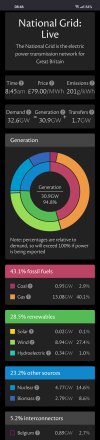
Good point. If anyone is interested in the data, then the I Am Kate website has live generating data as well as weekly, yearly, and all time.As for electricity generation, you can't cherry pick one bad day where coal powered stations had to be fired up. Look as a whole for the whole year, including what is generating power overnight when most EVs are being charged.
I've attached a picture showing today's live figures showing oil and gas generation at 43.1% fossil fuels, 28.5% renewable, and 23.2% other sources (nuclear and biomass).
Attachments
I didn't particularly cherry pick, I'd have picked later when things got worse. It was just the day I happen to revisit the thread. If we were fossil free we'd be screwed. We need a rethink; even if the number of wind turbines tends to infinity, with no wind the output is zero.
It's the usual political rubbish - set a target with no understanding of the issues, no supporting strategy or plan and then flounder around hopelessly as the target dates gets relentlessly closer. The smart meter debacle is a prime example. We'll be scrapping smart meters with dead batteries long before the rollout is complete.
It's the usual political rubbish - set a target with no understanding of the issues, no supporting strategy or plan and then flounder around hopelessly as the target dates gets relentlessly closer. The smart meter debacle is a prime example. We'll be scrapping smart meters with dead batteries long before the rollout is complete.