• Our new ticketing site is now live! Using either this or the original site (both powered by TrainSplit) helps support the running of the forum with every ticket purchase! Find out more and ask any questions/give us feedback in this thread!

Rishi Sunak and the Conservative Party.

Status
Not open for further replies.

yorksrob

Veteran Member
Joined
6 Aug 2009
Messages
44,414
Location
Yorks
And the issue with getting a range of views of economic matters between different parties is that it isn't 'allowed' anymore. See : Corbyn, Truss - neither of whom had extreme econmic policies, at least that would have been considered extreme in the 70s or 80s, but today went so far beyond the terribly narrow bounds of 'allowed' financial orthodoxy.

Fortunately, the paradigms on economic market orthodoxy are beginning to shift (see Biden's inflation reduction act) we might need to move in step with other Western countries though.
 
Sponsor Post - registered members do not see these adverts; click here to register, or click here to log in
R

RailUK Forums

Gloster

Veteran Member
Joined
4 Sep 2020
Messages
13,043
Location
Up the creek
Fortunately, the paradigms on economic market orthodoxy are beginning to shift (see Biden's inflation reduction act) we might need to move in step with other Western countries though.

What, do the same as those horrible Europeans! Never, I say, never will we stoop so low. We are British after all. (*) Oh, you mean do what the Americans want. If you say so…er, buddy.

* - We certainly are after all…the other countries in the economic rankings. (Speelchock: what have otters to do with anything?)
 

najaB

Veteran Member
Joined
28 Aug 2011
Messages
33,732
Location
Scotland
Corbyn, Truss - neither of whom had extreme econmic policies, at least that would have been considered extreme in the 70s or 80s, but today went so far beyond the terribly narrow bounds of 'allowed' financial orthodoxy.
As many have pointed out the problem with Truss wasn't what she was doing as much as it was how she went about it.
 

DynamicSpirit

Established Member
Joined
12 Apr 2012
Messages
9,218
Location
SE London
Not necessarily (though admittedly I don't fully support all aspects of current Labour).

In an ideal world:

Labour could be socially liberal, and more left-wing on issues such as workers' rights and public spending.

The Tories could then also be socially liberal, but fiscally conservative, much as they often were under Major and Cameron (despite the efforts of people like Dicks!)

The populist right could then be represented by the current Farage project.

The Lib Dems could be a centrist party, halfway between the Tories and Labour, and particularly strong on liberty and internationalism.

That would put clear water between the parties on many issues.

Out of interest, how would this set of parties serve someone like me who is socially conservative but definitely not populist, and would be completely repelled by someone like Nigel Farage? You seem to have assumed everything is either socially liberal, or 'populist'.
 

yorksrob

Veteran Member
Joined
6 Aug 2009
Messages
44,414
Location
Yorks
What, do the same as those horrible Europeans! Never, I say, never will we stoop so low. We are British after all. (*) Oh, you mean do what the Americans want. If you say so…er, buddy.

* - We certainly are after all…the other countries in the economic rankings. (Speelchock: what have otters to do with anything?)

I expect both. The Europeans will also be contemplating such changes (if they've any sense).
 

DynamicSpirit

Established Member
Joined
12 Apr 2012
Messages
9,218
Location
SE London
Whilst this statement is true, it's questionable as to how much of our media is liberal?

For example is the Daily Mail? The Sun? The Telegraph? The Times? Sky News? GB "News"?

Yes, much of the printed media is politically and socially conservative, and historically that did give something of a media advantage to the Tories until about 10 years ago. But these days, social media is arguably more influential than traditional newspapers, and the sense I have is that social media tends to be much more liberal. And of course tv and radio is mainly politically neutral. You mention GB News, but that's hardly a very influential channel - it seems to have pretty small viewing figures.

Whilst there's sections which people would argue are (the Guardian and the BBC, the latter is so liberal that it regularly has Farage on it as he's so left wing), it's certainly not all of it.

I would say that the BBC is politically neutral, in the sense that it tries to give equal coverage to political parties in proportion to their electoral strength, and to prominent politicians of all persuasions - which is why people like Nigel Farage regularly appear on it. But the cultural values it projects are very liberal, with very little thought or respect given to people who are culturally more conservative - and that's a big part of why many on the right feel the BBC is biased against them. One example would be how, in 2020-2021 when the BLM movement came to prominence, most BBC coverage seemed to almost unquestioningly accept the views of the BLM movement, frequently going along with the (completely false) assumption that anyone who opposed BLM must be somehow racist. I would say that since then, the BBC has become culturally a little more balanced, and I'm guessing that may be because of pressure from the Government.
 

Gloster

Veteran Member
Joined
4 Sep 2020
Messages
13,043
Location
Up the creek
Yes, much of the printed media is politically and socially conservative, and historically that did give something of a media advantage to the Tories until about 10 years ago. But these days, social media is arguably more influential than traditional newspapers, and the sense I have is that social media tends to be much more liberal. And of course tv and radio is mainly politically neutral. You mention GB News, but that's hardly a very influential channel - it seems to have pretty small viewing figures.

I would agree that social media is probably more diverse, but feel that the right, particularly the extreme end of the spectrum (out beyond even the wacky end of the Conservatives), is more effective at using it to influence others. (One of the reasons being that, put very simply, the more money you have, the more effective you can make a social media campaign.) And you have others, such as that tower block in St Petersburg, that are getting better at targeting their views. With, so I read, the majority of the young having their opinions on current affairs, politics, etc., being formed by social media as they do not use traditional outlets such as newspapers, TV or radio, they are far more likely to be swayed by inaccurate and biased information than those who use more reliable outlets. (Although some of these can hardly be called accurate and unbiased.)

I do admit that I don’t really use social media: I have a life.
 

nw1

Established Member
Joined
9 Aug 2013
Messages
9,430
Out of interest, how would this set of parties serve someone like me who is socially conservative but definitely not populist, and would be completely repelled by someone like Nigel Farage? You seem to have assumed everything is either socially liberal, or 'populist'.

Split the Conservative Party, perhaps. So half could be socially liberal as I suggested (and perhaps even incorporate some of the more economically right-wing Lib Dems), and half more socially conservative but not as strident or reactionary as Farage.

With a PR system, the liberal Conservatives could then govern either with the Lib Dems or the socially-conservative Conservatives, depending on the numbers.

I will say that, from my perspective there does seem to be a strong intersection between social conservatism and right-wing populism at the moment (Anderson, the Mail and Express, and Farage are perhaps manifestations of that) so I guess (while I don't want to make assumptions on exactly what you think!) you are something of an outlier.
 
Last edited:

Thirteen

Established Member
Joined
3 Oct 2021
Messages
1,902
Location
London
That's my recollection of it too. Another thing about Dicks was that he apparently had cerebral palsy, so some who might have been more critical of him bit on their tongues. I have M.S. and I'm always telling people that having a significant disability doesn't necessarily make you a nicer or more moral person, even if you were born with it. There's a guy with a self-propelling wheelchair near me who's one of the nastiest, foul-mouthed, most selfish people I know and I always try to avoid him.
Totally off-topic but the BBC sitcom Jerk is about a man with cerebral palsy who's an utterly terrible person.
 

bspahh

Established Member
Joined
5 Jan 2017
Messages
2,444
Out of interest, how would this set of parties serve someone like me who is socially conservative but definitely not populist, and would be completely repelled by someone like Nigel Farage? You seem to have assumed everything is either socially liberal, or 'populist'.
I'd like some politicians who are prepared to put in the work to come up with acceptable compromises. Its easy to head to the extremes and shout about how eveyone else is evil. Its more difficult to deal with a balance of competing interests.
 

nw1

Established Member
Joined
9 Aug 2013
Messages
9,430
To some degree, but (a) we're terribly far away from that now, and (b) that would only be for economic matters. Even if we got back to that place, Labour and the Tories will still agree on net zero, on Ukraine, on pandemic restrictions and WHO treaties, censorship of the internet, digitalisation of society, etc.
Perhaps though note that my idealised Lib Dems would be "strong on liberty". So under this scheme, the Lib Dems might stand up against excessive lockdowns, not that I can ever see a lockdown happening again unless a really serious disease (significantly worse than Covid) came about - and hopefully that won't happen anytime soon.

Also an economically left-wing Labour could call for controls on the excessive digitalisation of society, particularly the threat that generative AI poses to jobs.
And the issue with getting a range of views of economic matters between different parties is that it isn't 'allowed' anymore. See : Corbyn, Truss - neither of whom had extreme econmic policies, at least that would have been considered extreme in the 70s or 80s, but today went so far beyond the terribly narrow bounds of 'allowed' financial orthodoxy.
Corbyn didn't have particularly extreme policies IMO, but not so sure about Truss.

Not sure how you'd solve this problem but if you had a party with a charismatic leader and good at marketing itself - offering a more left-wing economic agenda - I suspect it would get in. The trouble is that Labour lacks those charismatic figures, and I will include Corbyn in there as well as Starmer.
 

Senex

Established Member
Joined
1 Apr 2014
Messages
2,957
Location
York
Yes, much of the printed media is politically and socially conservative, and historically that did give something of a media advantage to the Tories until about 10 years ago. But these days, social media is arguably more influential than traditional newspapers, and the sense I have is that social media tends to be much more liberal. And of course tv and radio is mainly politically neutral. You mention GB News, but that's hardly a very influential channel - it seems to have pretty small viewing figures.


I would say that the BBC is politically neutral, in the sense that it tries to give equal coverage to political parties in proportion to their electoral strength, and to prominent politicians of all persuasions - which is why people like Nigel Farage regularly appear on it. But the cultural values it projects are very liberal, with very little thought or respect given to people who are culturally more conservative - and that's a big part of why many on the right feel the BBC is biased against them. One example would be how, in 2020-2021 when the BLM movement came to prominence, most BBC coverage seemed to almost unquestioningly accept the views of the BLM movement, frequently going along with the (completely false) assumption that anyone who opposed BLM must be somehow racist. I would say that since then, the BBC has become culturally a little more balanced, and I'm guessing that may be because of pressure from the Government.
I think there's certainly an attempt to be party-politicallly neutral, sometimes carried to extremes as with the present tendency when reporting anything vaguely critical of government to follow up with a brief "government" says statement about how much they're spending. But the organisation is indeed very culturally liberal in sort of fashionable metropolitan elite way — you're right about BLM, and there are other ethnic minority questions also seemingly plugged excessively. Yet there are some social issues where they are very reluctant to spend much time, such as assisted dying for one. Current liberal falvour of the month, getting far more coverage than it really seems to justify, is so-called refugees.
 

The Ham

Veteran Member
Joined
6 Jul 2012
Messages
12,042
Yes, much of the printed media is politically and socially conservative, and historically that did give something of a media advantage to the Tories until about 10 years ago. But these days, social media is arguably more influential than traditional newspapers, and the sense I have is that social media tends to be much more liberal. And of course tv and radio is mainly politically neutral. You mention GB News, but that's hardly a very influential channel - it seems to have pretty small viewing figures.

I mentioned GB News to highlight that there's other options beyond the traditional news channels, the fact that it had very low viewing numbers arguably shows that whilst there maybe a need for such a channel it's only fairly limited in its attractiveness (whether is not gone far enough or it's just there's not many who hold similar views is something for them to consider).

Where you spend your time on social media is down to age, TikTok will generally be younger people rather than Facebook. Some would argue that they find it's easier to teach a larger audience naturally with TikToc than Facebook or X (was Twitter).

I would say that the BBC is politically neutral, in the sense that it tries to give equal coverage to political parties in proportion to their electoral strength, and to prominent politicians of all persuasions - which is why people like Nigel Farage regularly appear on it. But the cultural values it projects are very liberal, with very little thought or respect given to people who are culturally more conservative - and that's a big part of why many on the right feel the BBC is biased against them. One example would be how, in 2020-2021 when the BLM movement came to prominence, most BBC coverage seemed to almost unquestioningly accept the views of the BLM movement, frequently going along with the (completely false) assumption that anyone who opposed BLM must be somehow racist. I would say that since then, the BBC has become culturally a little more balanced, and I'm guessing that may be because of pressure from the Government.

I generally agree with the above - I would however question how far it's possible to object to BLM before people do stray into being racist (that's not too say it can't be questioned about what it's doing, how is funded, or other questions whilst not being racist).
 

Gloster

Veteran Member
Joined
4 Sep 2020
Messages
13,043
Location
Up the creek
I think there's certainly an attempt to be party-politicallly neutral, sometimes carried to extremes as with the present tendency when reporting anything vaguely critical of government to follow up with a brief "government" says statement about how much they're spending. But the organisation is indeed very culturally liberal in sort of fashionable metropolitan elite way — you're right about BLM, and there are other ethnic minority questions also seemingly plugged excessively. Yet there are some social issues where they are very reluctant to spend much time, such as assisted dying for one. Current liberal falvour of the month, getting far more coverage than it really seems to justify, is so-called refugees.

I would have thought that it is the government that is pushing refugees, etc. to the forefront of the media. They seem to be using them as both a distraction from their endless mistakes and as part of their preparations for an election: they probably feel that they have nothing else and refugees don’t have votes. (’No, Baldrick, they’ve got boats.’)
 

MikeWM

Established Member
Joined
26 Mar 2010
Messages
4,965
Location
Ely
Perhaps though note that my idealised Lib Dems would be "strong on liberty". So under this scheme, the Lib Dems might stand up against excessive lockdowns, not that I can ever see a lockdown happening again unless a really serious disease (significantly worse than Covid) came about - and hopefully that won't happen anytime soon.

The 'idealised' version perhaps. In the current world, they voted for most lockdown measures (admittedly not mandatory vaccinations or vaccine passports, so they did get some things right) and support the online 'safety' bill.


Also an economically left-wing Labour could call for controls on the excessive digitalisation of society, particularly the threat that generative AI poses to jobs.

They could, but they show no signs of it. Eg. Starmer recently saying that all NHS communication should happen via apps rather than the post.


Corbyn didn't have particularly extreme policies IMO, but not so sure about Truss.

The thing most people made a big fuss about with Truss was returning the higher rate of tax to the level it was at under, err, Blair.


Not sure how you'd solve this problem but if you had a party with a charismatic leader and good at marketing itself - offering a more left-wing economic agenda - I suspect it would get in. The trouble is that Labour lacks those charismatic figures, and I will include Corbyn in there as well as Starmer.

Even if they got in, I suspect you'd see the same market reaction as happened with Truss and they'd panic, replace leader and pivot to a more 'moderate' position within months.
 

The Ham

Veteran Member
Joined
6 Jul 2012
Messages
12,042
Current liberal falvour of the month, getting far more coverage than it really seems to justify, is so-called refugees.

Should news channels not cover the cost of housing people (whether they should be here or not it's another matter) when:

A lot of the backlog could be attributable to the fact that the government had previously cut spending on people to make the decision, meaning that there's more people waiting for longer (which unsurprisingly adds costs and means that more people that shouldn't be here get to stay here for longer rather than being sent to where they should be).

Some of the solutions being put forwards are quite costly, those barges are costing £1.6bn to house 2,000 people. If you brought 2,000 homes at £400,000 each that would only cost £0.8bn and you could sell then back at the end to recover at least some of your costs. Likewise others have pointed out that you could lease cruise ships (fully staffed and operating at sea) for significantly less money and could house more people.

The painting over of cartoons, whilst being "out of specification", was attributed to bring as they would be too welcoming - not only in the meeting but repeated again when defending the decision. They could have easily said paint over them because they are out of specification and/or that it was unknown of they had the rights to use Disney images (even after the event). There's can be a big difference as to why you think something and what you will say to justify your actions - the fact that there didn't appear to be that filter even after the event, could lead some to question their suitability.

It's also worth highlighting that the government is making a lot of noise about small boats (1 of 5 key pledges set out by the PM), so the press are arguably are only reporting what the elite are talking about.
 

oldman

Established Member
Joined
26 Nov 2013
Messages
1,353
A lot of the backlog could be attributable to the fact that the government had previously cut spending on people to make the decision,
Or it could be attributable to the increased numbers making the crossing. Or both.

The (I beieve) objective Migration Observatory at the University of Oxford has details of the numbers for both channel crossings and 'irregular arrivals' in general. Both show large increases in 2021 and 2022 over previous years.
 

The Ham

Veteran Member
Joined
6 Jul 2012
Messages
12,042
It's definitely both - there was already a backlog before the more recent increase in numbers.

Indeed, in the last 5 years there's be about 100,000 arrivals by small boats, as of the end of 2022 there were about 130,000 primary individuals who were in the backlog (with family members that rises to about 160,000).
 

najaB

Veteran Member
Joined
28 Aug 2011
Messages
33,732
Location
Scotland
Indeed, in the last 5 years there's be about 100,000 arrivals by small boats, as of the end of 2022 there were about 130,000 primary individuals who were in the backlog (with family members that rises to about 160,000).
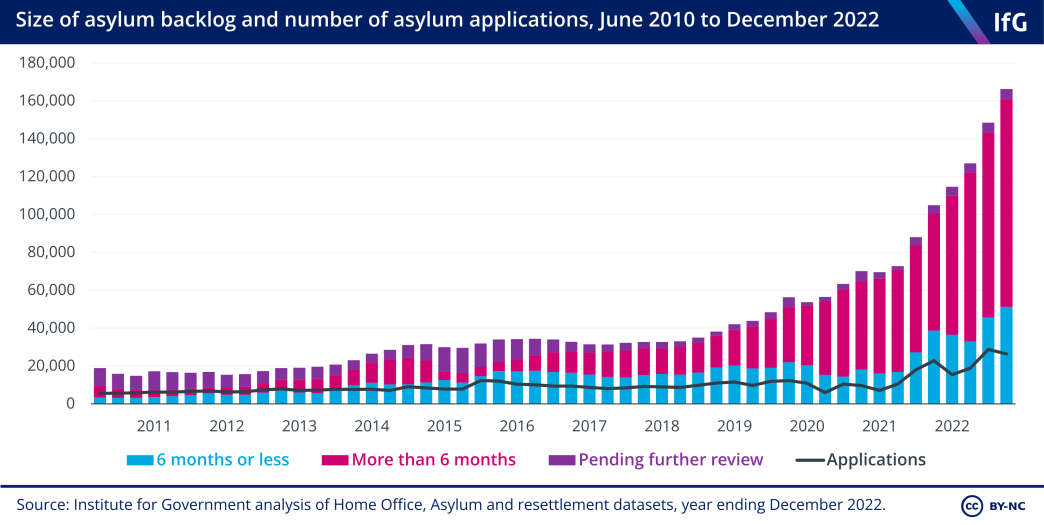
This chart from the Institute from Government makes it clear that the backlog is largely due to slow processing of claims as the backlog was growing even during 2020 and 2021 when the number of claims had fallen:

Asylum%20backlog%20vs%20applications%2023.2%20data%20release_0.png


Source: https://www.instituteforgovernment.org.uk/article/explainer/asylum-backlog
 

DynamicSpirit

Established Member
Joined
12 Apr 2012
Messages
9,218
Location
SE London
This chart from the Institute from Government makes it clear that the backlog is largely due to slow processing of claims as the backlog was growing even during 2020 and 2021 when the number of claims had fallen:

Asylum%20backlog%20vs%20applications%2023.2%20data%20release_0.png


Source: https://www.instituteforgovernment.org.uk/article/explainer/asylum-backlog

2020 and 2021 were the Covid years when many immigration staff would have either been not working or working much less efficiently due to Covid restrictions, so it seems unsurprising that the backlog would grow during that time
 

najaB

Veteran Member
Joined
28 Aug 2011
Messages
33,732
Location
Scotland
2020 and 2021 were the Covid years when many immigration staff would have either been not working or working much less efficiently due to Covid restrictions, so it seems unsurprising that the backlog would grow during that time
The rate of growth was actually lower in the first three quarters of 2020 when the impacts of Covid restrictions would have been at their peak.
 

The Ham

Veteran Member
Joined
6 Jul 2012
Messages
12,042
2020 and 2021 were the Covid years when many immigration staff would have either been not working or working much less efficiently due to Covid restrictions, so it seems unsurprising that the backlog would grow during that time

Whilst 2020/2021 are always going be abnormal, the bigger issue is that if you look at the pink segment (over 6 months) it's very small in 2015 and fairly stable between 2010 and 2017 before it starts getting bigger and bigger. Even the blue section (less than 6 months) was broadly equal to the number of applications for 2010 to 2015, it's been typically about 50% bigger since about 2017.


Both of which show a system in about 2017 starting to show signs of needing improvement, the governments reaction was to, in early 2019, abandon the 6 month target:


The Home Office has confirmed that it has abandoned its target to process the majority of asylum applications in the UK within six months.
In a statement after reports the standard had been dropped, the department said that it had “moved away from the six-month service standard to concentrate on cases with acute vulnerability and those in receipt of the greatest level of support, including unaccompanied asylum-seeking children”.

Without that target there's almost nothing stopping people to be held for longer than that.

Obviously targets can be a double edged sword, in that one someone is beyond 6 months there's no incentive to deal with them at all.

However, the increase in backlog is only going to lead to extra costs in housing and providing for people as they wait for a decision.

Whilst case numbers have been growing, that's been made much worse than it needs to be by poor management.

As whilst the numbers displaced worldwide had grown from 43 million in 2010 to 68 million in 2017 and to 108 million in 2022 the vast majority of those are not in another country (2022 had 62 million internally displaced - i.e. they are still in the home nation) , of the rest a significant number stay locally to their country (for example a lot of people from Ukraine or Syria are in the countries which boarder them).

 

Yew

Established Member
Joined
12 Mar 2011
Messages
7,245
Location
UK
Whilst 2020/2021 are always going be abnormal, the bigger issue is that if you look at the pink segment (over 6 months) it's very small in 2015 and fairly stable between 2010 and 2017 before it starts getting bigger and bigger. Even the blue section (less than 6 months) was broadly equal to the number of applications for 2010 to 2015, it's been typically about 50% bigger since about 2017.


Both of which show a system in about 2017 starting to show signs of needing improvement, the governments reaction was to, in early 2019, abandon the 6 month target:


Without that target there's almost nothing stopping people to be held for longer than that.

Obviously targets can be a double edged sword, in that one someone is beyond 6 months there's no incentive to deal with them at all.

However, the increase in backlog is only going to lead to extra costs in housing and providing for people as they wait for a decision.

Whilst case numbers have been growing, that's been made much worse than it needs to be by poor management.

As whilst the numbers displaced worldwide had grown from 43 million in 2010 to 68 million in 2017 and to 108 million in 2022 the vast majority of those are not in another country (2022 had 62 million internally displaced - i.e. they are still in the home nation) , of the rest a significant number stay locally to their country (for example a lot of people from Ukraine or Syria are in the countries which boarder them).
This very much feels like this is a crisis that is of the Tories own making.
 

Peterthegreat

Established Member
Joined
22 Feb 2021
Messages
1,802
Location
South Yorkshire
This very much feels like this is a crisis that is of the Tories own making.
Absolutely. And by continually bringing it to people's attention they are hostage to fortune. Whilst migrants are literrally risking their lives in the Channel will they be put off by Rwanda, barges, etc? I doubt there are any measures which will substantially reduce the number of attempted crossings in the near future.
 

brad465

Veteran Member
Joined
11 Aug 2010
Messages
11,551
Location
Taunton or Kent
"Stop the boats
Oh stop the boats baby!
Stop the boats
Let's tip the boats over"


If Braverman sang Forrest - Rock the Boat
 

DynamicSpirit

Established Member
Joined
12 Apr 2012
Messages
9,218
Location
SE London
This very much feels like this is a crisis that is of the Tories own making.

Eh? I can believe that better management at the Home Office might have lead to a lower backlog starting from the period from 2017 onwards, but how on Earth did the Tories cause the vast and sudden increase in the numbers of people crossing the Channel in small boats and claiming asylum over the last couple of years? As far as I can see, the most you can say is that the crisis may have been exacerbated by the way the Tories have managed asylum claims.
 

najaB

Veteran Member
Joined
28 Aug 2011
Messages
33,732
Location
Scotland
I can believe that better management at the Home Office might have lead to a lower backlog starting from the period from 2017 onwards, but how on Earth did the Tories cause the vast and sudden increase in the numbers of people crossing the Channel in small boats and claiming asylum over the last couple of years?
Surely the backlog is the crisis. It wouldn't matter how many claims were made if they were being processed quickly. There wouldn't be masses of people who need to be housed - they would either have their claim granted and able to work and support themselves, or they would have been deported.
 

Falcon1200

Established Member
Joined
14 Jun 2021
Messages
6,608
Location
Neilston, East Renfrewshire
Surely the backlog is the crisis. It wouldn't matter how many claims were made if they were being processed quickly.

Why is there a backlog in the first place? If it is taking too long to process each claim, how can that be resolved? Labour say they will deal with the backlog, but what does that mean in practice; Appoint more processing staff (from where, based where, trained how, by who and to what standard?); Simplify the process by being less rigorous in assessing claims? I'm not sure there is a simple and satisfactory answer.
 
Status
Not open for further replies.

Top