• Our new ticketing site is now live! Using either this or the original site (both powered by TrainSplit) helps support the running of the forum with every ticket purchase! Find out more and ask any questions/give us feedback in this thread!

Warrington Bank Quay - Great Western/LMS

Status
Not open for further replies.

BeijingDave

Member
Joined
26 Jul 2019
Messages
804
Recently I saw a Great Western network map (1930s, the one on the Wikipedia page) that shows Chester to Manchester via Warrington Bank Quay was part of the Great Western.

I always, rightly or wrongly, assumed that it was an LMS route.

1. Was it a joint route?
2. If it was a Great Western route, did Warrington Bank Quay in fact see more Great Western stopping services in those days than LMS? (effectively making it a GWR rather than LMS station?)
 
Sponsor Post - registered members do not see these adverts; click here to register, or click here to log in
R

RailUK Forums

daodao

Established Member
Joined
6 Feb 2016
Messages
3,603
Location
Dunham/Bowdon
Recently I saw a Great Western network map (1930s, the one on the Wikipedia page) that shows Chester to Manchester via Warrington Bank Quay was part of the Great Western.

I always, rightly or wrongly, assumed that it was an LMS route.

1. Was it a joint route?
2. If it was a Great Western route, did Warrington Bank Quay in fact see more Great Western stopping services in those days than LMS? (effectively making it a GWR rather than LMS station?)
The Chester-Warrington Bank Quay line was part of the Birkenhead Joint Railway, jointly owned by the GWR and LNWR (latterly LMSR). However, all the regular passenger services over this section of the Birkenhead Joint Railway were in practice operated by the LNWR. The GWR had running powers over the LNWR as far as Manchester Exchange station.
 

BeijingDave

Member
Joined
26 Jul 2019
Messages
804
Is this of any use?


Quite useful, thanks.

I'm still quite curious as to how the services would have operated in the 1930s through Warrington Bank Quay.

Would they have mostly been:
LMS (Manchester-Warrington) and GWR (Chester-Warrington)
GWR (Chester all the way through to Manchester)
Something else?

== Doublepost prevention - post automatically merged: ==

The Chester-Warrington Bank Quay line was part of the Birkenhead Joint Railway, jointly owned by the GWR and LNWR (latterly LMSR). However, all the regular passenger services were operated by the LNWR. The GWR had running powers over the LNWR as far as Manchester Exchange station.
I see. So it would have been highly unlikely to see GWR passenger trains at WBQ?
 

Andy873

Established Member
Joined
23 Mar 2017
Messages
1,421

30907

Veteran Member
Joined
30 Sep 2012
Messages
21,990
Location
Airedale
On a quick check on timetableworld.com I can't find evidence of through trains from the GW over that route, but I would have thought through carriages to Manchester Exchange might have run.
 

6Gman

Established Member
Joined
1 May 2012
Messages
9,231
The Chester-Warrington Bank Quay line was part of the Birkenhead Joint Railway, jointly owned by the GWR and LNWR (latterly LMSR). However, all the regular passenger services over this section of the Birkenhead Joint Railway were in practice operated by the LNWR. The GWR had running powers over the LNWR as far as Manchester Exchange station.
I think this is the correct answer.

Being really pedantic I suspect the Birkenhead Joint ran to somewhere like Acton Grange Junction and the final section into Bank Quay was pure LNWR/ LMS.
 

jp4712

Member
Joined
1 May 2009
Messages
562
Location
Lichfield
The whole of the railway between Warrington BQ and Manchester Exchange was LNWR, but the GWR had running powers to Manchester that were exercised until the outbreak of the Second World War. There are several photos in books showing a GW Hall or Star in Manchester Exchange. But to answer the other question, no - there were always significantly more LMS stopping trains at Warrington BQ than Western ones.
 

LNW-GW Joint

Veteran Member
Joined
22 Feb 2011
Messages
21,946
Location
Mold, Clwyd
Don't forget that the original Birkenhead Railway reached Warrington BQ on an independent route east of the LNWR main line.
There were two low level bridges over the Mersey at Walton, one for each line.
When the Manchester Ship Canal (MSC) was built (1890-ish), a single 4-track high level bridge was built over the canal, with corresponding embankments for LNWR/BJ trains.
The BJ trains diverted at the new Acton Grange junction over the new bridge, then split from the LNWR route to go down to the original BJ alignment through Walton Old Jn.
Today, TfW trains typically use the BJ route out of Warrington BQ station southbound from P1, but use the LNWR route northbound into P4.

Thus a mile or so of BJ route, severed by the MSC, became disused and its stubs were used for parking empty stock - on the Warrington side these are now Canal Sidings.
A similar mile of LNWR route was disused, and on the Warrington side the stub between the two original routes became Walton Old Jn sidings.
South of the MSC you can still trace the routes of both lines until they join the current alignments, although farmers have filled in most of the cuttings.
I have a copy of Cooke's Atlas of the GWR in 1947, which has full detail on all the joint lines, and the GWR detail ends at Walton Old Jn.

GWR trains could also use the connection from Walton Old Jn onto the Bank Quay Low Level line at Warrington Arpley.
 
Last edited:

ian1944

Member
Joined
13 Dec 2012
Messages
691
Location
North Berwick
Good question, didn't know the GWR got that far north.

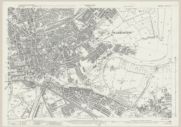
Looking at this map from 1928, look for Arpley station (towards the bottom left of the map) and follow it left, you will see there is a junction. Going south the line is joint LMS and GW, the other one going left runs to Bank Quay lower level station - that however is marked LMS.

I have a working rule: any query about old working beyond ten posts will cite an NLS map. Where would we be without them?
 

Taunton

Veteran Member
Joined
1 Aug 2013
Messages
12,332
It was a curious arrangement, the "Birkenhead Joint", owned GWR and LNWR jointly, was Chester to Birkenhead and to Warrington, in practice passenger services to Birkenhead were run 50-50 between the LNWR (later LMS) and GWR, while those to Warrington were almost wholly LNWR. The GWR arrangement continued with running powers to Manchester, and that was the key part, to allow their freight services to run through, to Ordsall Lane, the docks, etc. The GWR had substantial sheds at Chester and Birkenhead, but none at Warrington or Manchester, so freight locos must have worked out and home within a shift.

It was normal for joint ownership lines to have some sort of proportioning of operation, on a train mileage basis or similar, but there seemed as many different versions of this as joint companies. Shrewsbury to Hereford was also LNWR/GWR joint, but operated pretty much wholly by the GWR, certainly south of Craven Arms. I suspect the operational division of these two companies was pooled across all their different joint lines.
 
Joined
30 Sep 2012
Messages
85
Great Wesrern loco,s were serviced and stabled at Patricroft ,at least 2 roads on the Old shed were for GWR Locos.Frieght to Liverpool Rd msy well have been turned and serviced at Liverpool Rd. A freight in BR days used to depart Liverpool Road approx 20.05 for Bristol and was a working for GW locos prior to 1940 when GWR ceased running to Manchester.
When I was train recorder at Eccles signzlbox in the late 50s the signalmen were always going on about how clean polished GW locos were never having seen GW loco through Eccles bugged me for years until 5043 EARL OF MOUNT EDGCUMBE passed through Eccles with railtour 2016 approx 5051 EARL BATHURST Passed through Eccles en route Rocket 150 Sept 1980 missed that
It was a curious arrangement, the "Birkenhead Joint", owned GWR and LNWR jointly, was Chester to Birkenhead and to Warrington, in practice passenger services to Birkenhead were run 50-50 between the LNWR (later LMS) and GWR, while those to Warrington were almost wholly LNWR. The GWR arrangement continued with running powers to Manchester, and that was the key part, to allow their freight services to run through, to Ordsall Lane, the docks, etc. The GWR had substantial sheds at Chester and Birkenhead, but none at Warrington or Manchester, so freight locos must have worked out and home within a shift.

It was normal for joint ownership lines to have some sort of proportioning of operation, on a train mileage basis or similar, but there seemed as many different versions of this as joint companies. Shrewsbury to Hereford was also LNWR/GWR joint, but operated pretty much wholly by the GWR, certainly south of Craven Arms. I suspect the operational division of these two companies was pooled across all their different joint lines.
Ū
?
 

LNW-GW Joint

Veteran Member
Joined
22 Feb 2011
Messages
21,946
Location
Mold, Clwyd
Shrewsbury-Hereford was initially a Thomas Brassey line until leased to the LNWR/GWR.
I think the LNWR were quite prominent, and the line maintenance switched between the GWR and LNWR every 20 years - hence the two LNWR-pattern signal boxes at Shrewsbury station.
The LNWR ran Stafford-Shrewsbury-Welshpool trains pre-grouping, and of course the Cambrian was at least as close to the LNWR as the GWR.
In BR days, before being downgraded c1970, most of the north-and-west trains via the Severn Tunnel were of LMR stock, though worked by both LMR/WR engines.
Notably, the trains had armrests in 3+3 compartments, rather than the crush-loaded 4+4 WR stock with no armrests.
These things mattered!

At Warrington, some old maps show that the curve from Warrington Arpley to Walton Old Jn is labelled as part of the Warrington & Stockport line.
Ownership might well have changed during the new works related to the MSC construction (paid for by the MSC, like all the other new rail crossings on its route to Manchester - at Latchford, Partington and Irlam).
 

geoffk

On Moderation
Joined
4 Aug 2010
Messages
3,933
Location
Exeter
The whole of the railway between Warrington BQ and Manchester Exchange was LNWR, but the GWR had running powers to Manchester that were exercised until the outbreak of the Second World War. There are several photos in books showing a GW Hall or Star in Manchester Exchange. But to answer the other question, no - there were always significantly more LMS stopping trains at Warrington BQ than Western ones.
I've got the book "Salford in the days of steam" by Paul Shackcloth, which includes photos of a GWR Saint, Mogul, Duke and Dukedog at Patricroft shed. One of the captions refers to the presence of two GW moguls there in September 1942, which must have been near the end of these visits.
 

Taunton

Veteran Member
Joined
1 Aug 2013
Messages
12,332
Shrewsbury-Hereford was initially a Thomas Brassey line until leased to the LNWR/GWR.

Well, with your username you should know :) . Although I've never seen a photo of an LNWR train south of Craven Arms, I presume they ran there, thence onwards by running powers over the GWR to Abergavenny, in order to get to the LNWR Heads of the Valley line to Merthyr etc.

The North & West expresses from 1960 onwards were indeed all LMR stock, because they needed to be dual heated once Crewe to Liverpool/Manchester was electrified. I once read that there was an exchange of stock with NE-SW services through Birmingham to maintain the balance between the regions, which led to the latter service getting some distinctly older specimens, early Mk 1 with the corrosion starting to show.

Alternating the maintenance must have needed special procedures once the GW-pattern AWS ('ATC') was installed, on GWR main lines in the 1920s-30s, as the LMS would not have that knowledge. The main day train by this route was the longest loco run on the GWR (and later WR), from Newton Abbot to Shrewsbury, for which Newton shed always turned out their best-polished Castle of the day. Being a lodging turn the crew returned likewise the next day, and from times when mileages over 100 paid the crews extra, must have been very worthwhile. The LNWR/LMS took over north of Shrewsbury.

There are no GWR locos at Manchester in a 1923 allocation list, and presumably no crews either, so they must have just been daily visitors.
.
 
Last edited:
Status
Not open for further replies.

Top