• Our new ticketing site is now live! Using either this or the original site (both powered by TrainSplit) helps support the running of the forum with every ticket purchase! Find out more and ask any questions/give us feedback in this thread!

What decisions could the UK actually take to avoid managed decline?

Status
Not open for further replies.

DC1989

Member
Joined
25 Mar 2022
Messages
553
Location
London
If they fix the housing crisis then lots of other issues get solved. Childcare costs won't be such a barrier as the parents are paying less on their mortgage for example.

It's going to be tough though - it will take decades just to build enough houses for what we need today and the NIMBY vote is powerful and all political parties are NIMBY at local level.

I read many of the comments on planning applications and it can be quite depressing. Just one last week near me. Redeveloping a dozen of 50+ year old warehouses (of which half are empty and used for illegal raves) for a modern 840 house development. Includes a health centre space that can have a GP and dental surgery, includes a school. Car free development except 20 odd blue badge spaces)

All of the comments are variations on the 'concrete jungle' 'GP appointments' 'School' 'Too much traffic'

Even when it's pointed out that those things have been catered for it's then 'car free? Ridiculous everyone I know has at least 2 cars'

You really can't win
 
Sponsor Post - registered members do not see these adverts; click here to register, or click here to log in
R

RailUK Forums

Bletchleyite

Veteran Member
Joined
20 Oct 2014
Messages
113,568
Location
"Marston Vale mafia"
Car-free is onto a loser. Two spaces per household are needed.

The correct answer is (as usual) found in the German speaking countries - you put the parking underground. This allows them to still be owned but provides an "awkwardness barrier" to using them, encouraging you to go out on foot instead.

This needs to be done without agendas and providing housing people want to buy in places where they want to live.
 

RT4038

Established Member
Joined
22 Feb 2014
Messages
5,457
As I said I think most single people would be happy to live in quality flats. I'd actually prefer one. The main reason I live in a (smallish) house rather than a flat is that most UK flats are rubbish (badly constructed, uselessly small balconies, poorly designed layouts etc) and that leasehold is a feudalist scam. Plus many flats are overpriced, being sold for more than small, older Victorian terraced houses despite costing far less than houses to build and using far less valuable land.

Solve those and I'd be glad to move into one, I'd prefer it anyway.
I am not disagreeing with you. But building loads of new houses in eco towns or wherever is not going to make one iota of difference to this issue. My wife & I live in a largish family home, would quite like to downsize to a decent, comfortable flat for retirement but there is very little on the market which, as you say, isn't some kind of property scam. It is the flat market (or lack of it) where the intervention is required, and not some 'flooding' of the house market which will have all sorts of undesirable side effects.

If they fix the housing crisis then lots of other issues get solved. Childcare costs won't be such a barrier as the parents are paying less on their mortgage for example.

Well of course everybody wants everything cheaper! But it won't be fixed, because if house prices are cheaper then people will want to buy bigger and better houses, or in better locations. And the market will cater for this quite happily. The more cheaper houses we build, the more single people will want to live in them and the more people will want to buy them as an investment to rent out. It is just like building roads to solve traffic congestion!
 

DC1989

Member
Joined
25 Mar 2022
Messages
553
Location
London
Car-free is onto a loser. Two spaces per household are needed.

The correct answer is (as usual) found in the German speaking countries - you put the parking underground. This allows them to still be owned but provides an "awkwardness barrier" to using them, encouraging you to go out on foot instead.

This needs to be done without agendas and providing housing people want to buy in places where they want to live.

Never going to happen - The London Plan specifies car free for areas with PTAL above 6 I think. This area has the highest PTAL so therefore has to be car free.
 

HSTEd

Veteran Member
Joined
14 Jul 2011
Messages
20,342
So are you saying that the shortage (which is on price, rather than actual capacity?) is for single people in their own houses?
No, its for groups of people that want to live together in a housing unit.

This is sometimes single people, sometimes couples, sometimes couples with children and sometimes other arrangements.

Not that long ago single people generally didn't leave their parents until they got married, or they lived on their own in a room.
Yes, and that was ultimately a miserable time that we escaped.
People might romanticise the slum living of the 40s and 50s, but it was all around miserable.
I note that you refer to 'desired' households - which in terms of affordability is presumably mainly single people in their own houses, as by and large two people living together with two incomes can afford to buy their own property
Really?
Have you looked at the housing market now? Given the constraint of living somewhere where there jobs are, house prices have become absurd. The average house price is now ~£300,000 and rising rapidly.

There is a reason the government has now proposed multi-generational mortgages, because house prices have risen so high that purchasing is simply not a reasonable expectation.

So the question is, can our society sustain/afford that kind of desired living?
Given that the onyl reason society does not have adequate housing is because the state threatens to use violence to prevent additional construction? Yes.

== Doublepost prevention - post automatically merged: ==

Well of course everybody wants everything cheaper! But it won't be fixed, because if house prices are cheaper then people will want to buy bigger and better houses, or in better locations.
And?
Why is this a problem?

The more cheaper houses we build, the more single people will want to live in them and the more people will want to buy them as an investment to rent out. It is just like building roads to solve traffic congestion!
That argument follows that we would be better off if all roads were destroyed, after all without roads there is no congestion!
It's an insane argument that gets an unreasonable amount of traction.

Just as traffic in a finite economy with a finite population cannot grow without limit, housing demand will not grow without limit. Single people won't want eight or ten room mansions or something, they just want a reasonable living space.

Right now housing costs, which are driven entirely by scarcity, are strangling the rest of the economy.
The only way to get them to fall is to flood the market.

House prices are so high precisely because people are desperate to escape current living arrangements - all continuing with the status quo will do is direct ever greater resources to the homeowning class.
 
Last edited:

Bletchleyite

Veteran Member
Joined
20 Oct 2014
Messages
113,568
Location
"Marston Vale mafia"
Never going to happen - The London Plan specifies car free for areas with PTAL above 6 I think. This area has the highest PTAL so therefore has to be car free.

Then they'll never attract families. It is how it is. We need to pack in the agenda and build properties people want.

== Doublepost prevention - post automatically merged: ==

I am not disagreeing with you. But building loads of new houses in eco towns or wherever is not going to make one iota of difference to this issue. My wife & I live in a largish family home, would quite like to downsize to a decent, comfortable flat for retirement but there is very little on the market which, as you say, isn't some kind of property scam. It is the flat market (or lack of it) where the intervention is required, and not some 'flooding' of the house market which will have all sorts of undesirable side effects.

I was referring to the housing market as a whole, not the market for (e.g.) 4 bed family houses.

Simplifying and streamlining the sales process would also help. Blair was perhaps ahead of his time with Home Information Packs so the seller had to do the survey, searches etc once, not each buyer do them several times.
 

DC1989

Member
Joined
25 Mar 2022
Messages
553
Location
London
Then they'll never attract families. It is how it is. We need to pack in the agenda and build properties people want.

== Doublepost prevention - post automatically merged: ==


I was referring to the housing market as a whole, not the market for (e.g.) 4 bed family houses.

Simplifying and streamlining the sales process would also help. Blair was perhaps ahead of his time with Home Information Packs so the seller had to do the survey, searches etc once, not each buyer do them several times.

I don't disagree necessarily but I guarantee these properties will sell out (if it was ever approved) If people need a car then they are free to get a house with a car parking space

Even in Berlin most new flats are car free
 

Bletchleyite

Veteran Member
Joined
20 Oct 2014
Messages
113,568
Location
"Marston Vale mafia"
I don't disagree necessarily but I guarantee these properties will sell out (if it was ever approved) If people need a car then they are free to get a house with a car parking space

They'll mostly sell out to investors and be rented as distress purchases, as most non-desirable flat developments do.

Even in Berlin most new flats are car free

I guess you've been around long enough on here to know that Germany does public transport and car-free life options generally way, way better than any of the UK does, even London. What works in Berlin won't necessarily work here. It needs to be carrot before stick.
 

DynamicSpirit

Established Member
Joined
12 Apr 2012
Messages
9,213
Location
SE London
Economic rates to whom? Not the building industry presumably? The new housing would have to be built with public money, and therefore presumably diverted from other expenditure such as education, health and rail etc.) and would disadvantage, with negative equity, anyone who has bought a house recently.

Not really. Even if the Government did pay for new housing initially, that would be capital, not current spending - and the cost would be either recouped completely (possibly with profit) either when houses are sold, or the interest paid for out of rents (if the houses are rented). No need therefore for money to be diverted from current spending.

But actually building houses is arguably the kind of thing that's best done by the private sector anyway. The real question to ask is, why the private sector is not currently building enough houses for people when demand is clearly there and it's clearly possible to make a profit by doing so. I suspect the answer is partly that we are limited by how many trained people with the right building skills there are, and partly (or mostly) to do with the problems getting planning permission for new houses in the places where they are needed. If I'm correct, then solving those problems will by itself go a long way to fixing the housing crisis in the long run.

I am not so sure that there is a need for massive building of new homes, probably more repurposing of what we have (possibly including knocking down of some current stock and replacing with flats for singles), a realisation that single people are not going to be living in family homes unless they are in high earning jobs; and a sensible policy to enable older people to downsize comfortably.

Yes, making it cheaper for people to downsize would be important. One thing that would make a huge difference here would be to abolish stamp duty - which acts as a huge disincentive for people to move house, and therefore is very likely contributing to the crisis by causing a lot of people to live in houses that are bigger than they need.

Another thing that might make a difference in the short term would be to encourage people with spare rooms to rent them out to lodgers. The response to the Ukrainian crisis proved that there is capacity here. It's not an ideal solution - I doubt that many people really want to lodge with a landlord, but it's a lot better than nothing, and could be done relatively quickly. Building enough new houses is going to take years, even if the Government started doing all the right things tomorrow.
 

Bletchleyite

Veteran Member
Joined
20 Oct 2014
Messages
113,568
Location
"Marston Vale mafia"
But actually building houses is arguably the kind of thing that's best done by the private sector anyway. The real question to ask is, why the private sector is not currently building enough houses for people when demand is clearly there and it's clearly possible to make a profit by doing so. I suspect the answer is partly that we are limited by how many trained people with the right building skills there are, and partly (or mostly) to do with the problems getting planning permission for new houses in the places where they are needed. If I'm correct, then solving those problems will by itself go a long way to fixing the housing crisis in the long run

The private sector is building lots of houses - they're just the wrong ones - it's mostly larger, more lucrative houses, and poorly designed leasehold flats.

I think it is necessary to regulate the sector to solve this. Part of planning permission for a large development (I'd not bind people building one house in their back garden on this as it would just be petty) should be to establish what the housing need in the area is, and should be able to control exactly what form of housing is to be built.

As for leasehold, it should ideally be banned outright in favour of commonhold/condominium ownership, including existing blocks. For houses, it should be a legal requirement that freehold is the only tenure possible. For flats, if condominium ownership is too complex, legislation should mandate indefinite leases (or 9,999 years if they have to put a number on it), ban forfeiture entirely (there are perfectly good legal methods for collecting unpaid debt), ban ground rent, regulate service charges and ban the requirement for permission to carry out matters which are related only to the inside of the flat e.g. replacing kitchens and the likes.

But also, the building of badly designed flats should stop. Every time I see one, I see something stupid about its layout. For instance, my friend's flat has a lift and is so wheelchair accessible, but there's a step up onto the balcony so a wheelchair user can't go outside. This is just ridiculous. Another issue is inside bathrooms with inadequate ventilation.
 
Last edited:

HSTEd

Veteran Member
Joined
14 Jul 2011
Messages
20,342
But actually building houses is arguably the kind of thing that's best done by the private sector anyway. The real question to ask is, why the private sector is not currently building enough houses for people when demand is clearly there and it's clearly possible to make a profit by doing so. I suspect the answer is partly that we are limited by how many trained people with the right building skills there are, and partly (or mostly) to do with the problems getting planning permission for new houses in the places where they are needed. If I'm correct, then solving those problems will by itself go a long way to fixing the housing crisis in the long run.
Ultimately the planning system is the primary reason such a blockage exists.
It allows the sustainment of a cartel of major housebuilders that have a stranglehold on the industry and have managed to acquire all the land that the government is willing to allow building on. They then build at the rate that maximises their profits and noone can undercut them.

If, as an extreme example, people could build largely wherever they wanted such a cartel would not be sustainable because people would just buy a plot of land beyond the areas the housebuilders control and drop a prefabricated house on it.

The planning system also further delays the adoption of the kind of mass construction techniques that have been used in industry and the commercial sectors to slash the cost of housing.
Given our labour shortage problems, as talked about upthread, wet plastering and bricklaying probably have little future in housing construction in the long term.
 

simonw

Established Member
Joined
7 Dec 2009
Messages
1,408
There has been pages of discussion on here about housing, but the thread title is about avoiding managed decline. Personally, I don see fixing the housing market will fix the IOS economic problems.
 

Bletchleyite

Veteran Member
Joined
20 Oct 2014
Messages
113,568
Location
"Marston Vale mafia"
Given our labour shortage problems, as talked about upthread, wet plastering and bricklaying probably have little future in housing construction in the long term.

One thing I have noticed between Germany etc and the UK is that here we accept slightly off-shape doorframes and spend time cutting doors to fit, whereas in Germany the correct size of hole is cut and a strong metal frame is fitted with a standard door. More fire-safe too.

I'm not sure how you'd replace plastering, though - it's a mighty pain, but most countries do plaster interiors in some form. Just using panels like prefabs did just looks a bit rubbish, and wood isn't as fire safe as plaster.

Having said that, my bathroom walls are plasterboard, and because I'm bad at plastering (I had to replace the inner plasterboard as it was rotten through damp) I just filled the gaps rather than fully plastering, and you can't really tell unless you looked for it knowing it was there. I filled them slightly proud, allowed to dry then sanded flat with the board.

== Doublepost prevention - post automatically merged: ==

There has been pages of discussion on here about housing, but the thread title is about avoiding managed decline. Personally, I don see fixing the housing market will fix the IOS economic problems.

Because housing is the biggest cost anyone pays in their lifetime (unless they're into expensive cars), it has a massive, massive effect on the economy. Low spending power by households = decline in service industries.
 

najaB

Veteran Member
Joined
28 Aug 2011
Messages
33,703
Location
Scotland
Because housing is the biggest cost anyone pays in their lifetime (unless they're into expensive cars), it has a massive, massive effect on the economy. Low spending power by households = decline in service industries.
Not to mention that someone spending most of their wage to pay for crappy housing isn't likely to feel that they are "living the dream" and a poor national morale is one of the drivers of national decline.
 

Bletchleyite

Veteran Member
Joined
20 Oct 2014
Messages
113,568
Location
"Marston Vale mafia"
Not to mention that someone spending most of their wage to pay for crappy housing isn't likely to feel that they are "living the dream" and a poor national morale is one of the drivers of national decline.

Agreed.

FWIW poor national morale is twofold - poor living conditions/life experience and poor experience in work. The way we treat people doing important but low-paid jobs e.g. shop workers is awful - and "we" includes businesses as well as customers. One thing we've lost is progression (that is, if you joined the Council as a street sweeper you might have been able to progress to the important, proud role of park keeper, complete with peaked cap), but also valuing people in important jobs who don't progress out of them for whatever reason.

The whole "Friday night, ten pints and a fight" thing comes from people who literally get nothing out of the rest of their life so revert to basically being animals. It's truly tragic.
 

simonw

Established Member
Joined
7 Dec 2009
Messages
1,408
One thing I have noticed between Germany etc and the UK is that here we accept slightly off-shape doorframes and spend time cutting doors to fit, whereas in Germany the correct size of hole is cut and a strong metal frame is fitted with a standard door. More fire-safe too.

I'm not sure how you'd replace plastering, though - it's a mighty pain, but most countries do plaster interiors in some form. Just using panels like prefabs did just looks a bit rubbish, and wood isn't as fire safe as plaster.

Having said that, my bathroom walls are plasterboard, and because I'm bad at plastering (I had to replace the inner plasterboard as it was rotten through damp) I just filled the gaps rather than fully plastering, and you can't really tell unless you looked for it knowing it was there. I filled them slightly proud, allowed to dry then sanded flat with the board.

== Doublepost prevention - post automatically merged: ==


Because housing is the biggest cost anyone pays in their lifetime (unless they're into expensive cars), it has a massive, massive effect on the economy. Low spending power by households = decline in service industries.
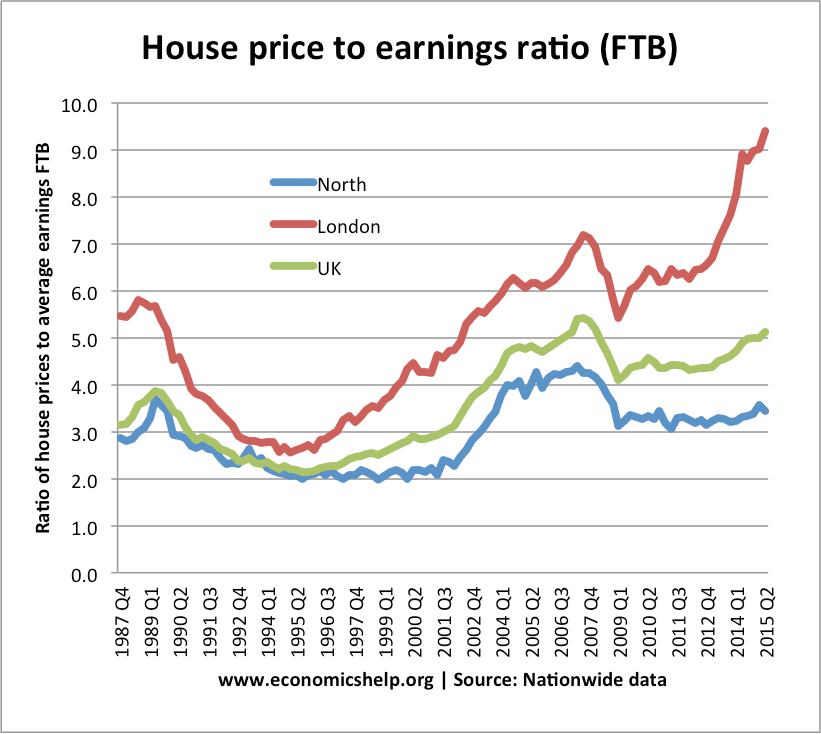
But the data shows that houses are as affordable now as they were 40 years ago.

Whilst some area (London for example) are not as affordable as they once were, plenty of areas are actually more affordable.

The issue is not house prices but the concentration of employment and more importantly, wealth, in the south east.

It is the death of jobs that had a reason to be other than in the South East that is the main driver of economic disparity.


If this country is to recover it needs to find a way of increasing the economic attractiveness of the regions to business compared with the SE.
 

Bletchleyite

Veteran Member
Joined
20 Oct 2014
Messages
113,568
Location
"Marston Vale mafia"
But the data shows that houses are as affordable now as they were 40 years ago.

Whilst some area (London for example) are not as affordable as they once were, plenty of areas are actually more affordable.

Can you please provide actual figures and references to this? Because to be blunt I don't believe you.
 

simonw

Established Member
Joined
7 Dec 2009
Messages
1,408

RT4038

Established Member
Joined
22 Feb 2014
Messages
5,457
Can you please provide actual figures and references to this? Because to be blunt I don't believe you.
Lots of people could not afford to buy then, and lived in council houses. If you were single you stayed with your parents, or in a room, until you'd saved up (by doing lots of overtime) or climbed the greasy pole to a higher salary.
 

Sad Sprinter

Established Member
Joined
5 Jun 2017
Messages
3,186
Location
Way on down South London town
The south east is crowded, Great Britain is not.

But manufacturing for the sake of it isn't practical either. Unless we can make things that people want at a price they will buy it at then there's no point.

The majority of Great Britain, the Thames/Mersey/Humber axis, is pretty crowded.

Of course it's practical. If you invest in R&D, which we do very little of.
 

Bletchleyite

Veteran Member
Joined
20 Oct 2014
Messages
113,568
Location
"Marston Vale mafia"
Fourth graph down is one example


What measures of average pay do those use? If it's the mean, then it ignores pay disparity which has got much greater. I suspect the median would give you a rather different graph.

There's also the deposit issue that is made clear in a small note underneath. Rapidly growing prices and low incomes mean saving a deposit is much harder.

== Doublepost prevention - post automatically merged: ==

Lots of people could not afford to buy then, and lived in council houses.

They were available and of decent quality.
 

RT4038

Established Member
Joined
22 Feb 2014
Messages
5,457
They were available and of decent quality.
I think that was a bit patchy. Depended on area and your status. Lots and lots of complaints about allocation. Nothing if you were single. Oh, and massive rent arrears problems in some areas.
 

ainsworth74

Forum Staff
Staff Member
Global Moderator
Joined
16 Nov 2009
Messages
31,104
Location
Redcar
One thing we've lost is progression (that is, if you joined the Council as a street sweeper you might have been able to progress to the important, proud role of park keeper, complete with peaked cap)
And of course part of the reason that is the case is that there's a much higher chance that that street sweeper has been contracted out to a third party contracting outfit like Serco or Mite. Meaning that there's limited chance of progression as well as low pay and poorer conditions. Looks good on the spreadsheet but arguably ends up not saving anything for the organisation that's contracted the service out and is almost certainly worse for the street sweeper. Which isn't to say that contracting out doesn't have it's place. For a small organisation it might make sense to contract out some functions like HR (if you've only got a handful of employees why pay for having an inhouse HR person?). But so many large organisations contract out so many functions now that itself seems both damanging to individuals, society and often the organisations themselves! We've probably all dealt with contracted out customer services and found the service to be rubbish.
Fourth graph down is one example

The comments around that graph though are quite illustrative and suggest things aren't quite as rosy as the graph may suggestion on first glance:

Since interest rates were cut in 2009, mortgage holders have benefitted from low-interest rates, which have made mortgage payments cheaper.

  • However, when interest rates rise, many homeowners will see a nasty shock of rapidly rising mortgage payments.
  • Also, rising house prices have required a bigger deposit. This means many who might be able to afford mortgage payments are unable to get a mortgage in the first place

Lots of people could not afford to buy then, and lived in council houses.
Though of course now we have a huge shortage of social housing to the point that councils are trying to rehouse people not just the next town over but often opposite ends of the country. That's quite apart from the security of tenure that social housing came (and, to be fair, if you can get into it comes) with compared to the precarious nature of much of the private rented sector.
 

simonw

Established Member
Joined
7 Dec 2009
Messages
1,408
What measures of average pay do those use? If it's the mean, then it ignores pay disparity which has got much greater. I suspect the median would give you a rather different graph.

== Doublepost prevention - post automatically merged: ==


They were available and of decent quality.
As another graph on the same page is median income, I imagine that is the data used.
 

Bletchleyite

Veteran Member
Joined
20 Oct 2014
Messages
113,568
Location
"Marston Vale mafia"
And of course part of the reason that is the case is that there's a much higher chance that that street sweeper has been contracted out to a third party contracting outfit like Serco or Mite. Meaning that there's limited chance of progression as well as low pay and poorer conditions. Looks good on the spreadsheet but arguably ends up not saving anything for the organisation that's contracted the service out and is almost certainly worse for the street sweeper. Which isn't to say that contracting out doesn't have it's place. For a small organisation it might make sense to contract out some functions like HR (if you've only got a handful of employees why pay for having an inhouse HR person?). But so many large organisations contract out so many functions now that itself seems both damanging to individuals, society and often the organisations themselves! We've probably all dealt with contracted out customer services and found the service to be rubbish.

Agreed. Thinking of the likes of Carlisle Security on the railways, once upon a time that'd have been a path to driver, guard or management, now it's not.

== Doublepost prevention - post automatically merged: ==

As another graph on the same page is median income, I imagine that is the data used.

Interesting.

Even so, this hides down the bottom:

Furthermore, the era of zero interest rates will not last forever.


It is one of the most important things on the entire page. They won't, and they're trending back up. And that means that the cheap borrowing of high prices is over.
 

JamesT

Established Member
Joined
25 Feb 2015
Messages
4,887
I guess you've been around long enough on here to know that Germany does public transport and car-free life options generally way, way better than any of the UK does, even London. What works in Berlin won't necessarily work here. It needs to be carrot before stick.
I think this is very much chicken and egg. Providing lots of parking induces demand which makes it hard for public transport to get though which dissuades people from using it.
 

RT4038

Established Member
Joined
22 Feb 2014
Messages
5,457
Interesting.

Even so, this hides down the bottom:

Furthermore, the era of zero interest rates will not last forever.

It is one of the most important things on the entire page. They won't, and they're trending back up. And that means that the cheap borrowing of high prices is over.
Which means that house prices will reduce, as affordability reduces.
 

yorksrob

Veteran Member
Joined
6 Aug 2009
Messages
44,370
Location
Yorks
I am not disagreeing with you. But building loads of new houses in eco towns or wherever is not going to make one iota of difference to this issue. My wife & I live in a largish family home, would quite like to downsize to a decent, comfortable flat for retirement but there is very little on the market which, as you say, isn't some kind of property scam. It is the flat market (or lack of it) where the intervention is required, and not some 'flooding' of the house market which will have all sorts of undesirable side effects.


Well of course everybody wants everything cheaper! But it won't be fixed, because if house prices are cheaper then people will want to buy bigger and better houses, or in better locations. And the market will cater for this quite happily. The more cheaper houses we build, the more single people will want to live in them and the more people will want to buy them as an investment to rent out. It is just like building roads to solve traffic congestion!

Buy to rent is an area that needs to be controlled. Some private renting is useful/desirable, however the market needs to be clipped so as not to use up all the starter capacity.
 

Bletchleyite

Veteran Member
Joined
20 Oct 2014
Messages
113,568
Location
"Marston Vale mafia"
I think this is very much chicken and egg. Providing lots of parking induces demand which makes it hard for public transport to get though which dissuades people from using it.

If public transport is good, people will use it for what it's good for. In the posh areas of Merseyside and surrounds, people don't even consider going to Liverpool by any means other than the train. Car isn't the first choice for urban travel if public transport is to scratch. That's the carrot.

The UK prefers the stick despite it demonstrably not working and creating sink estates.

Urban public transport doesn't have to make a profit, it's a public good. That's the UK's other error.
 

HSTEd

Veteran Member
Joined
14 Jul 2011
Messages
20,342
Which means that house prices will reduce, as affordability reduces.
But house prices themselves are not the primary issue.

The issue, as you state, is affordability, which is the true driver of housing and rent prices.

It doesn't matter if the nominal price falls, if people still can't afford it then nothing has changed. The market pressures fix affordability, not notional 'price'.

The only thing that will cause affordability to change is increasing supply in the areas where people want to live.
 
Status
Not open for further replies.

Top