• Our new ticketing site is now live! Using either this or the original site (both powered by TrainSplit) helps support the running of the forum with every ticket purchase! Find out more and ask any questions/give us feedback in this thread!

UK Rail Passenger Numbers Discussion

Status
Not open for further replies.

modernrail

Established Member
Joined
26 Jul 2015
Messages
1,460
Interesting graph, which shows that passenger usage is now around that of the "golden age" of rail, i.e. the big four.

Yet the clueless half-wits in charge are still insisting on damaging and self-defeating cuts.
Also interesting that Spanish flu, a far more dangerous pandemic, hardly put a dint in the figures.
 
Sponsor Post - registered members do not see these adverts; click here to register, or click here to log in
R

RailUK Forums

miklcct

Established Member
Joined
2 May 2021
Messages
5,017
Location
Cricklewood
Interesting graph, which shows that passenger usage is now around that of the "golden age" of rail, i.e. the big four.

Yet the clueless half-wits in charge are still insisting on damaging and self-defeating cuts.
How about the market share of rail among all transport? It must have dropped a lot compared to a century ago as people travel lots more in total.
 

absolutelymilk

Established Member
Joined
18 Jul 2015
Messages
1,601
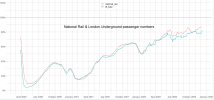
And that's even with the extra national rail passengers the Elizabeth line core section has stolen from LU/DLR.
I don't think the data quite supports this - definitely looks like LU plateaued in the months following EL opening and then through running, but doesn't look like it dropped off. Might be different if you looked specifically at Jubilee & Central line data though!
 

Attachments

  • National Rail vs Tube usage.png
    National Rail vs Tube usage.png
    119.9 KB · Views: 60

yorksrob

Veteran Member
Joined
6 Aug 2009
Messages
44,361
Location
Yorks
Also interesting that Spanish flu, a far more dangerous pandemic, hardly put a dint in the figures.

It is, but then again, there were probably fewer alternative options. If you weren't taken by the flu (or WW1 for that matter) you probably got back on the train.
How about the market share of rail among all transport? It must have dropped a lot compared to a century ago as people travel lots more
total.

Indeed, although I think that market share is less important a concept as the larger the overall total, the more difficult it becomes to accommodate passengers of one mode in another
 

Robert Ambler

Member
Joined
12 Feb 2019
Messages
72
How about the market share of rail among all transport? It must have dropped a lot compared to a century ago as people travel lots more in total.
I am not sure that people travel lots more but there are lots more people! The UK Population was 39 million in 1918 but was 67 million in 2020.
 

The Ham

Veteran Member
Joined
6 Jul 2012
Messages
12,036
Trouble is, over most of the country public transport use is so low that even a proportionately large - and very expensive - increase would have minimal effect on road traffic volumes, which were growing at around one per cent a year (pre- Covid, admittedly).

It most certainly wouldn't have a minimal impact on traffic congestion even if it had a (say) 2% impact on total number of trips by road.

However, whilst rail only accounts for 2% of all trips, rail accounts for 10% of miles traveled.

Now whilst there's like to be some reduction due to rail use switching to coaches it should be noted that 2% of total trips it's more than 2% of road trips, so any reduction of total trips due to such a switch may result in similar car trips.

Now daily variations (so those days where you feel that you get to work with no traffic vs those days where you take an age for no apparent reason) is 2%.

Now if we add 2% to 100 (assuming the average is 99 to 101) the best day on the future would be the same as the worst day beforehand, with the new worst day being worse.

The problem is that extra 2% is likely to overload a number of junctions in many areas, no one junction with longer queues can queue back through other junctions. As such even small changes can have bigger impacts than would be expected.

That's if we just look at the number of trips, if we look at 10% extra (the difference in miles), then the situation would be much worse.

10% is the difference that (non tourist hotspots) many areas see between school holidays (90%) and term time. Now compare your trips to work during those times, where is likely that there's almost no traffic delays during school holidays and circa +50% delay during term time.

Now if we see an extra 10%, that +50% dealt then becomes the school holiday journey, whilst the term time traffic could well be a nightmare (think what happens when a motorway or A road is closed due to a fatality or when it snows unexpectedly in the middle of the afternoon).

How about the market share of rail among all transport? It must have dropped a lot compared to a century ago as people travel lots more in total.

Indeed, however as I've highlighted above that doesn't stop the closure of railways potentially having a significant impact on other traffic.

It's why those who feel that it would be better if we only had cars and didn't have any public transport (and the associated presumed support cost savings) may actually be better off with more (other) drivers using other modes of transport - resulting in it being easier for them to drive about.
 

mrmartin

Established Member
Joined
17 Dec 2012
Messages
1,294
At the end of the day for journies in and out of big cities rail is the only option that allows any growth to happen really. Putting 100k+/day cars on the M1 because there was no service out of Euston alone would not work. That would require probably doubling the capacity of M1 - and that's just from no service from Euston alone.

This is really what is hard for people to get. If you look at a photo of highway 401 in canada, which is 16 lanes wide in places, it's still only doing 400k vehicles/day - similar to just the central line alone in London. You'd probably need something like 200 lanes of motorway to replace the tube + rail volumes in London, never mind the parking etc. You could literally tarmac most of Zone1 so there was nothing but roads and you'd still have capacity problems without rail!

While rail use is very low in many areas of the country (and it will continue to be - nothing beats roads for small town/suburb trips), it is impossible to replace it in bigger cities.
 

Thirteen

Established Member
Joined
3 Oct 2021
Messages
1,898
Location
London
The UK cities simply couldn't cope without railways and public transport in general. One of the reasons the congestion charge was introduced in Central London and other places was to reduce the number of cars on the road.
 

The Ham

Veteran Member
Joined
6 Jul 2012
Messages
12,036
The UK cities simply couldn't cope without railways and public transport in general. One of the reasons the congestion charge was introduced in Central London and other places was to reduce the number of cars on the road.

Indeed, however for those willing to pay the charge it also meant that their personal journeys improved as there was less traffic on the roads and their journeys were much faster.

I once drive through central London, traffic was a nightmare up to the congestion charge boundary and then it was a breeze, with no congestion and only limited delays due to traffic lights.

There's a challenge that I like to set people, look at the dream car companies sell - when watching an advert for cars how many vehicles are seen?

The vast vast majority only show the car being sold driving through city streets with no congestion, there are a few which will show 2 or 3 however there's no traffic, rarely parked cars, etc.

The inferred message is that this car will give you the freedom to drive. The reality is far far from this picture perfect city (or even country side) where you can drive and it's enjoyable.

The reality is that for the vast majority of people driving a car is a chore, one which a few times a year may well fun, however one which comes at a cost which few fully account for as they never fully count up the cost.

You put in £40 here, £50 there for fuel, you pay £165 for VED, you pay £2 here £4 there for parking, you servicing is £165 in one month, you pay £80 for a new tyre several months later, after selling your old car your new car cost £5,000, you'll repeat this again in 3 years time. Whilst the last cost is thought about a lot it is seen as a sunk cost which means the rest of your travel is less.

However, whilst that maybe true for the fuel costs, often the other costs soon add up, meaning the average car costs over £3,500 a year (source for this is below):


Whilst you may disagree with some of the costs, the two largest amounts are:

Purchase/Depreciation per year£1,104
Petrol and Diesel£1,435

Whilst it is possible to reduce either of these by some margin, you either run the risk of higher maintenance costs or you're doing less than the average number of miles.

On the £3,500 figure the typical per mile cost is 50p, however if you reduce the purchase cost to £500/year and the fuel costs to £750 (reducing the total to £2,150) but with 3,500 numbers traveled then the cost per mile actually increases to 60p per mile.

However at 3,500 numbers a year that's about 16 miles a day (assuming only commuting use) which is starting to be the point where using an ebike may well be a cheaper option (and as someone who walks to work the number of days or trains is quite a lot higher than the number of days that it rains on me - even then sometimes when it rains it's just heavy enough to need cars to have their wipers on constant but still not enough for me to bother print a coat on as my jumper won't be wet by the time I get to work).

 

158756

Established Member
Joined
12 Aug 2014
Messages
1,629
A business that had that kind of attitude would probably find themselves out of business

Businesses which fail to adapt to changes in the economy and plough ever increasing amounts of money into services with falling demand also find themselves out of business

To maintain the current level of service provision, the railway either needs to generate much higher revenues (without the business travellers and season ticket holders who kept everything going in the past) or to find a way to provide the same service at a lower cost. Either that or have to compete with much bigger priorities for a slice of the strained government finances.
 

The Ham

Veteran Member
Joined
6 Jul 2012
Messages
12,036
Businesses which fail to adapt to changes in the economy and plough ever increasing amounts of money into services with falling demand also find themselves out of business

To maintain the current level of service provision, the railway either needs to generate much higher revenues (without the business travellers and season ticket holders who kept everything going in the past) or to find a way to provide the same service at a lower cost. Either that or have to compete with much bigger priorities for a slice of the strained government finances.

The problem is that if we cut services there's a risk that harms the economy and therefore it's more pressure on the strained government finances.

If you choose a line which most had summer tourists, but they maintain some business and allow a couple to commute for work, the loss in taxes and the extra needed in benefits could be far worse than the cost of the railways.
 

philosopher

Established Member
Joined
23 Sep 2015
Messages
1,513
Businesses which fail to adapt to changes in the economy and plough ever increasing amounts of money into services with falling demand also find themselves out of business

To maintain the current level of service provision, the railway either needs to generate much higher revenues (without the business travellers and season ticket holders who kept everything going in the past) or to find a way to provide the same service at a lower cost. Either that or have to compete with much bigger priorities for a slice of the strained government finances.
Businesses that for whatever reason suddenly have a reduced market have two choices.

First is to spend money to try and win back customers, perhaps through reducing prices or improving your product, the second is to raise prices or cut quality in attempt to maintain profit margins. The problem with the second suggestion is that it risks driving more customers away, so putting you in a position where you have to increase prices or reduce quality further. Therefore in my view reducing services on the railways in attempt to save money will backfire on the railways and may not actually save the treasury money.

Despite what many think, I think there is room for the railways to attract new customers. For example I still know of some people who drive into Central London who could be attracted onto the railways. An improved railway service would also delay the point where people buy a car, whereas a worse railway would do the opposite.
 

Bald Rick

Veteran Member
Joined
28 Sep 2010
Messages
35,823
First is to spend money to try and win back customers, perhaps through reducing prices or improving your product, the second is to raise prices or cut quality in attempt to maintain profit margins. The problem with the second suggestion is that it risks driving more customers away, so putting you in a position where you have to increase prices or reduce quality further. Therefore in my view reducing services on the railways in attempt to save money will backfire on the railways and may not actually save the treasury money.

Whilst this is true at broad level, the ‘risk of driving customers away’ is variable.

For example there are lines out there that bring in less revenue than 10% of their marginal operating cost. In broad terms if you halve the service, you save 50% of that marginal cost. Even if you lost all the revenue you would still save net 40% of that cost. so you are still much better off in cash terms than you were before. (In reality you wouldn’t lose all the revenue, or even half of it.)

In a way the strikes have (unfortunately) helped to illustrate this. On RMT strike days typically only 20% of the service runs, and yet around 40% of the revenue still comes in. And this is on days with services for only 11 hours, and a clear ‘travel only if necessary‘ message which will naturally put off many intending passengers. There is a potential scenario where a network a little larger than what is provided on RMT strike days, and open for the full day, would bring in around 70-80% of revenue but reduce costs by about 50%. I must stress that I do not advocate this in any way, but you can see how that line of thinking can develop, unfortunately (and unintentionally) assisted by the unions.

There are of course broader socio-economic reasons why it is not desirable to reduce services, and that must also be taken into account in any decision process. As will politics.
 

XIX7007177

Member
Joined
6 Jun 2018
Messages
85
In regards to tickets, sell them cheap and stack them high.

Lumo are running at a profit aren’t they?
 

yorksrob

Veteran Member
Joined
6 Aug 2009
Messages
44,361
Location
Yorks
Whilst this is true at broad level, the ‘risk of driving customers away’ is variable.

For example there are lines out there that bring in less revenue than 10% of their marginal operating cost. In broad terms if you halve the service, you save 50% of that marginal cost. Even if you lost all the revenue you would still save net 40% of that cost. so you are still much better off in cash terms than you were before. (In reality you wouldn’t lose all the revenue, or even half of it.)

In a way the strikes have (unfortunately) helped to illustrate this. On RMT strike days typically only 20% of the service runs, and yet around 40% of the revenue still comes in. And this is on days with services for only 11 hours, and a clear ‘travel only if necessary‘ message which will naturally put off many intending passengers. There is a potential scenario where a network a little larger than what is provided on RMT strike days, and open for the full day, would bring in around 70-80% of revenue but reduce costs by about 50%. I must stress that I do not advocate this in any way, but you can see how that line of thinking can develop, unfortunately (and unintentionally) assisted by the unions.

There are of course broader socio-economic reasons why it is not desirable to reduce services, and that must also be taken into account in any decision process. As will politics.

That ignores the fact that vast swathes of the country have no service at all on strike days. It's not a scenario where everyone gets 20% of the train service.
 

Killingworth

Established Member
Joined
30 May 2018
Messages
6,480
Location
Sheffield
In regards to tickets, sell them cheap and stack them high.

Lumo are running at a profit aren’t they?

That will depend on how you calculate profit. Covering costs of crews, track access, power. and marketing maybe. Capital and maintenance costs for the trains will be spread over an assumed life be they owned or leased. Overall it appears from outside to look good but only First will know the truth.
 

HSTEd

Veteran Member
Joined
14 Jul 2011
Messages
20,330
In regards to tickets, sell them cheap and stack them high.

Lumo are running at a profit aren’t they?
Only because Lumo are provided with heavily subsidised track access.

We have no idea what would be happening if they paid the fully burdened commercial costs of their paths.
 

ChrisC

Established Member
Joined
7 Oct 2018
Messages
2,262
Location
Nottinghamshire
That ignores the fact that vast swathes of the country have no service at all on strike days. It's not a scenario where everyone gets 20% of the train service.
Resulting in cities like Lincoln having had so many days without trains during the last few months. In addition to all the National strikes there have been numerous more localised strikes when no EMR trains have run to Lincoln including during the Christmas Market.
 

yorksrob

Veteran Member
Joined
6 Aug 2009
Messages
44,361
Location
Yorks
Resulting in cities like Lincoln having had so many days without trains during the last few months. In addition to all the National strikes there have been numerous more localised strikes when no EMR trains have run to Lincoln including during the Christmas Market.

Indeed.

Across the North you have these different problems compounding eachother.
 

Watershed

Veteran Member
Associate Staff
Senior Fares Advisor
Joined
26 Sep 2020
Messages
16,719
Location
UK
In regards to tickets, sell them cheap and stack them high.

Lumo are running at a profit aren’t they?
On a 'marginal cost' basis, yes. But their track access charges come nowhere close to covering their fair share of NR's costs in keeping the ECML open.
 

Bald Rick

Veteran Member
Joined
28 Sep 2010
Messages
35,823
That ignores the fact that vast swathes of the country have no service at all on strike days. It's not a scenario where everyone gets 20% of the train service.

It doesn’t ignore it at all, hence the last sentence of my post.
 

chorleyjeff

Member
Joined
3 May 2013
Messages
677
Two TOCs, who between them provided 2.5% of rail services in the country before Covid, are having a bad time. What about the rest?
But these are heavily subsidised companies and the tipping point of reducing the number of their trains to a minimum cost basic service must be getting closer.
 

SamYeager

Member
Joined
20 Mar 2014
Messages
352
As an interesting thought experiment I wonder how much it would cost to revert to say 120% of the service provided by BR just before privatisation with current pro rata staffing and say double the average capital & maintenance funding over the the five years before privatisation.

From the point of view of the average punter I suspect the passenger railway is viewed as consuming far more dosh than its relative transport percentage deserves. Even if we consider CO2 emissions a fully electrified rail network is unlikely to reduce UK emissions by more than 3%. From a straight value for money (VFM) viewpoint it's difficult to make the case for more funds for the railway. Even considering the social component why should the railway receive more funds rather than reducing existing frequencies to better match essential demaind rather than leisure demand?
 

jagardner1984

Member
Joined
11 May 2008
Messages
763
As an interesting thought experiment I wonder how much it would cost to revert to say 120% of the service provided by BR just before privatisation with current pro rata staffing and say double the average capital & maintenance funding over the the five years before privatisation.

From the point of view of the average punter I suspect the passenger railway is viewed as consuming far more dosh than its relative transport percentage deserves. Even if we consider CO2 emissions a fully electrified rail network is unlikely to reduce UK emissions by more than 3%. From a straight value for money (VFM) viewpoint it's difficult to make the case for more funds for the railway. Even considering the social component why should the railway receive more funds rather than reducing existing frequencies to better match essential demaind rather than leisure demand?

Surely it's all just about messaging.

In the context of Climate emergency,

Big shiny tube with electricity wires going in, leaf logos on the side and lots of seats = good

Small boxy thing with diesel fumes coming out and one seat occupied = bad.

Written in politician speak.

They can't really claim to be serious about removing the latter, whilst also reducing the resource of the former, however disconnected those two things are in reality.

Proper per mile road pricing, and massive investment in free/massively reduced public transport (to meet European relative costs) is really the only way of achieving the seismic modal shift required.
 

gabrielhj07

Established Member
Joined
5 May 2022
Messages
1,619
Location
Herts
Surely it's all just about messaging.

In the context of Climate emergency,

Big shiny tube with electricity wires going in, leaf logos on the side and lots of seats = good

Small boxy thing with diesel fumes coming out and one seat occupied = bad.

Written in politician speak.

They can't really claim to be serious about removing the latter, whilst also reducing the resource of the former, however disconnected those two things are in reality.

Proper per mile road pricing, and massive investment in free/massively reduced public transport (to meet European relative costs) is really the only way of achieving the seismic modal shift required.
Removing diesel services from the rails will have virtually no impact on CO2 levels in the UK, so I very much doubt they are serious about getting rid of them.
 

Bald Rick

Veteran Member
Joined
28 Sep 2010
Messages
35,823
Surely it's all just about messaging.

In the context of Climate emergency,

Big shiny tube with electricity wires going in, leaf logos on the side and lots of seats = good

Small boxy thing with diesel fumes coming out and one seat occupied = bad.

Where does a large, or small, boxy thing with rubber tyres and a battery feature in the good - bad scale? Because in the next 3+5 years that is going to be the comparison. Sales of pure EVs have outsold diesel cars by 3:2 this year.
 

Horizon22

Established Member
Associate Staff
Jobs & Careers
Joined
8 Sep 2019
Messages
11,003
Location
London
Yes, it's easy to run a reliable service when there are barely any passengers.

Barely any passengers AND trains. Passenger behaviour related delays are less common than train related delays, in addition to the knock-on impacts caused by congestion. More slack by not eeking out every inch of capacity - as per peak 2019 - leads to less disruption and more reliability.
 

gabrielhj07

Established Member
Joined
5 May 2022
Messages
1,619
Location
Herts
Where does a large, or small, boxy thing with rubber tyres and a battery feature in the good - bad scale? Because in the next 3+5 years that is going to be the comparison. Sales of pure EVs have outsold diesel cars by 3:2 this year.
Awful I should imagine - takes up valuble road space and contributes negativley towards the environment.
 

DerekC

Established Member
Joined
26 Oct 2015
Messages
2,438
Location
Hampshire (nearly a Hog)
Where does a large, or small, boxy thing with rubber tyres and a battery feature in the good - bad scale? Because in the next 3+5 years that is going to be the comparison. Sales of pure EVs have outsold diesel cars by 3:2 this year.
Here's a comparison done a couple of years ago which suggests that rail can stay ahead of a BEV in the decarbonisation stakes, but only for electric traction. As I recall, the grams per passenger km figures used average seat occupancies (pre-Covid, of course).

1672517244311.png
 
Status
Not open for further replies.

Top