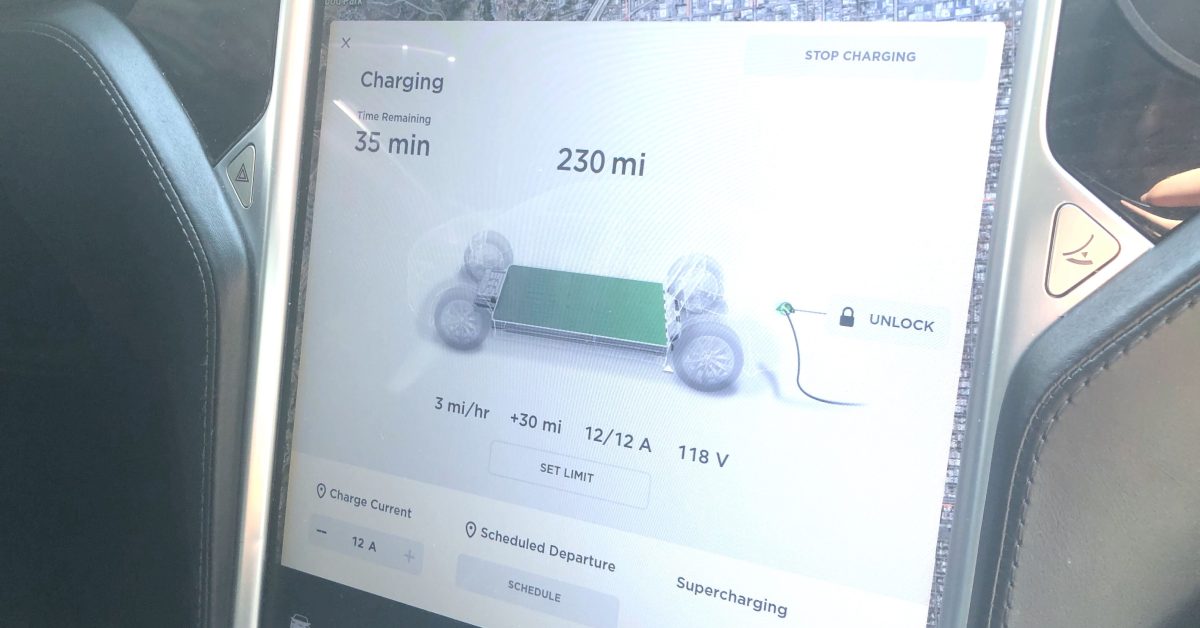
This Model X got a battery replacement under warranty at 317,000 miles. That’s more than half a million kilometers.
Interestingly, the original battery pack wasn’t replaced due to battery degradation but because of an even greater problem with the pack.
Once the state-of-charge would reach around 40%, which normally would mean still over 90 miles of range, the capacity would quickly drop to 0.
As you can imagine, that’s a major issue and Tesla quickly proceeded with a free battery replacement under warranty, which is an 8-year and unlimited mileage warranty for the powertrain of this 2016 Model X.
While it was a major issue, it’s still impressive that the original battery lasted over 300,000 miles or 500,000 km.
Now the second battery pack on this Model X has almost 100,000 miles (160,000 km) on it and as previously mentioned, it is seeing a roughly 10% battery degradation.
I feel like 10% is high for ~100,000 miles.
Looking at the overall data, it looks like the average Tesla owner is at around 5% around the same number of cycles.
I know that there are several factors that can affect battery capacity, like how often you charge it to 100% or how often you DC fast-charge the vehicle, and since this vehicle was used by Tesloop for 400,000 miles, I am sure that it was heavily Supercharged to 100%.
That said, the overall dataset seems to be pointing to Tesla’s 90 kWh battery packs performing badly in general.