
I would say that the matter was definitively settled - at the time. However, things have changed a lot since then.Out of interest, if you think that 55%/45% doesn't definitively settle the matter, would you argue the same thing the other way round?

-
Our new ticketing site is now live! Using either this or the original site (both powered by TrainSplit) helps support the running of the forum with every ticket purchase! Find out more and ask any questions/give us feedback in this thread!
You are using an out of date browser. It may not display this or other websites correctly.
You should upgrade or use an alternative browser.
You should upgrade or use an alternative browser.
SNP to launch fresh Scottish independence campaign
- Thread starter najaB
- Start date
- Status
- Not open for further replies.
Sponsor Post - registered members do not see these adverts; click here to register, or click here to log in
R
RailUK Forums
I think the main problem to me is to do with the exact terms of a 2nd referendum TBH, the SNP was fortunate to dictate the terms of it last time (timing, question, franchise etc al) rather than by some outside body.
I'd have preferred it if Theresa May had called the SNPs bluff in 2017. A snap indyref in late 2017 might have even produced a 60% no vote then but we are where we are.
I'd be OK with a very quick repeat indyref this year as I think it would produce the exact same result again as the latest yougov poll has suggested but the whining of the SNP (and the Greens) that they can dictate all the terms is annoying.
I'm increasingly convinced there won't be another indyref though. I don't believe Sturgeon has been serious since at least 2017 now and this is about party management, in order to stay in power as long as possible at Holyrood. I don't underestimate her ability to do that, although all the SNP is completely reliant on the Scottish Greens now.
An attempt at a ref not sanctioned by Westminster would also produce lots of LOLS with a majority of councils refusing to take part.
I'd have preferred it if Theresa May had called the SNPs bluff in 2017. A snap indyref in late 2017 might have even produced a 60% no vote then but we are where we are.
I'd be OK with a very quick repeat indyref this year as I think it would produce the exact same result again as the latest yougov poll has suggested but the whining of the SNP (and the Greens) that they can dictate all the terms is annoying.
I'm increasingly convinced there won't be another indyref though. I don't believe Sturgeon has been serious since at least 2017 now and this is about party management, in order to stay in power as long as possible at Holyrood. I don't underestimate her ability to do that, although all the SNP is completely reliant on the Scottish Greens now.
An attempt at a ref not sanctioned by Westminster would also produce lots of LOLS with a majority of councils refusing to take part.
windingroad
Member
- Joined
- 16 Jun 2022
- Messages
- 234
It isn't true that the SNP were able to "dictate" the question wording. The Electoral Commission approved the final wording (and made a change to it) to ensure neutrality.I think the main problem to me is to do with the exact terms of a 2nd referendum TBH, the SNP was fortunate to dictate the terms of it last time (timing, question, franchise etc al) rather than by some outside body.
Specifically, the question proposed by the Scottish Government was:It isn't true that the SNP were able to "dictate" the question wording. The Electoral Commission approved the final wording (and made a change to it) to ensure neutrality.I think the main problem to me is to do with the exact terms of a 2nd referendum TBH, the SNP was fortunate to dictate the terms of it last time (timing, question, franchise etc al) rather than by some outside body.
The Electoral Commission concluded, correctly, that the phrase "Do you agree.." is leading. The question that they proposed, and which was put to the electorate was:Do you agree that Scotland should be an independent country?
Though, as usual, I don't really expect facts to stop a good rant.Should Scotland be an independent country?
windingroad
Member
- Joined
- 16 Jun 2022
- Messages
- 234
Twas it ever thus!Though, as usual, I don't really expect facts to stop a good rant.

DynamicSpirit
Established Member
The referendum result doesn't conflict with anything in the SNP's manifesto though. If the SNP had a commitment to unilateral independence without a further vote, I might agree with you, but all they're doing is committing to giving the Scottish people a further opportunity to express their view on that issue. The SNP and Greens were elected on a commitment to do so, so there's no reasonable or democratic argument against that.
The reasonable democratic argument is that it's completely one-sided: Keep having referenda until you get the result that the SNP wants, and then that's it! No more referenda! That's not a level playing field in terms of letting people choose. Scotland had a referendum relatively recently. The terms of that referendum were clear, the timescale of 'once in a generation' was very well advertised and I'm pretty sure most people voted and made their choice with that understanding. It's not democratic to turn round and say in effect, 'We didn't like the result. Let's re-run it' (And for all the comments about Brexit, it's very obvious that Brexit here is mostly just a convenient excuse for not accepting the 2014 result). It's also very noticeable that, of all those in this thread arguing to re-run the referendum, no-one has yet said that they'd be willing to re-run the referendum if it had been a 'yes' vote.
Why on this one single issue are the public not permitted to exercise democracy for 25 years? If 60% of people wanted another vote prior to this, would you allow it? What about 70, or 80, or 90? What if voters change their mind and decide they want to change the period the original referendum was "scoped for"? Are they permitted to do so, and if so, when?
It's not particularly on this issue; It's the fact that a referendum was held. In normal circumstances, I'd say the same thing about a referendum on any other topic. I voted Remain in the Brexit referendum and was very sad about the result. But I also accept that it's not appropriate to have another referendum to try to overturn that result. I could throw your question back to you and say, why are you reluctant to accept the result of the last referendum?
I won't speak for @windingroad but I would have favoured a confirmatory referendum once the terms of leaving had been agreed. I know people who voted "Leave" because they believed what they were told during the referendum campaign, for example that there was no way we would leave the Common Market.I could throw your question back to you and say, why are you reluctant to accept the result of the last referendum?
windingroad
Member
- Joined
- 16 Jun 2022
- Messages
- 234
I'm trying to be reasonable here but this is nonsense. If Scotland became independent there is absolutely nothing stopping any political party from running on a referendum to rejoin the UK, and if that party formed the government they could then do so. Of course the SNP would stop campaigning for referenda after independence. It would be utterly bizarre if they didn't!The reasonable democratic argument is that it's completely one-sided: Keep having referenda until you get the result that the SNP wants, and then that's it! No more referenda! That's not a level playing field in terms of letting people choose.
Why isn't that democratic? If the voters decide they didn't like the result and they want to run it again, by voting in a government that pledges to do just that, that is by definition democracy.It's not democratic to turn round and say in effect, 'We didn't like the result. Let's re-run it'
If the Scottish people voted for a party which pledged to hold a referendum to rejoin the UK, and that party won a majority, of course I'd support their democratic right to do so. It's not about being "willing", it's about enough people voting for a unionist administration.It's also very noticeable that, of all those in this thread arguing to re-run the referendum, no-one has yet said that they'd be willing to re-run the referendum if it had been a 'yes' vote.
This same exact point keeps being raised, and keeps being responded to in detail. Every single person absolutely "accepts" the referendum result, which is why Scotland is not independent. We just didn't like the result, which is why we're campaigning for a different result in future. Which is exactly and precisely what happens in every single democracy in the world.I could throw your question back to you and say, why are you reluctant to accept the result of the last referendum?
This notion that you have to shut up about the result of a referendum, simply because it was a referendum, is bizarre. The point of democracy is not that it starts and ends on election day. The day after you lose an election you start figuring out how to win the next one, because democracy isn't static.
The outcome was democratic. It was a simple majotrity of the UK, not little bits of it.
I agree that the future is uncertain. I would not want Scotland to fail, but I have not seen the evidence of how it will be an economic success. Perhaps you can enlighten me. Just a few examples will do. e.g. monetary policy, addressing the budget deficit, job creation etc.
So why did Wales, England, NI, and Gibraltar all get what they voted for, or specific compromises? Why is Scotland the only part not catered for? If it was one big vote then surely every single bit of the UK should have been treated the same?
The main theme of the anti-independence members in this, and probably every other outlet seems to be "Scotland is not good enough" to go it alone. If We are deemed "not good enough" while in this apparently beneficial union, why on Earth should we keep the status quo? Why can't Scotland aim for better and be fully in charge of its own affairs? Maybe, just maybe, we may make a better job of it?
Another tired line trotted out is "Nicola should respect the result of 2014! We voted No!". Correct. We did vote no. In 2014. Scotland did not declare independence in 2014. That result has been and will always be respected forevermore. If, however, we have another vote in say, 2023, and the result is Yes, we will become independent. That still means the 2014 result is respected. If Scotland ever becomes independent, it will never be as a result of the 2014 referendum.
Last edited:

gabrielhj07
Established Member
If Scotland is to be deemed fit enough to 'go it alone' (and I am sure it would be), then surely this ought to be as a result of the comprehensive case for independence and the detailed plan for the future of Scotland yet to be presented by the SNP?The main theme of the anti-independence members in this, and probably every other outlet seems to be "Scotland is not good enough" to go it alone. If We are deemed "not good enough" while in this apparently beneficial union, why on Earth should we keep the status quo? Why can't Scotland aim for better and be fully in charge of its own affairs? Maybe, just maybe, we may make a better job of it?
I would very much like to avoid another Brexit-like scenario, where emotions come before sense and rational thought, and where the details are left to be worked out later. If Scotland is to become independent then we should learn these lessons.
The SNP respected the 2014 result in that it did not start making Scotland independent, but is it really respecting the result to be pushing for another vote simply because the first one gave the 'wrong' answer?Another tired line trotted out is "Nicola should respect the result of 2014! We voted No!". Correct. We did vote no. In 2014. Scotland did not declare independence in 2014. That result has been and will always be respected forevermore. If, however, we have another vote in say, 2023, and the result is Yes, we will become independent. That still means the 2014 result is respected. If Scotland ever becomes independent, it will never be as a result of the 2014 referendum.
I agree with the sentiment expressed a short while ago in this thread that the 'situation has changed' argument cannot be fully trusted, as the SNP would certainly not be pushing for a second vote if the answer had gone the 'right' way.
It is obvious that Gibraltar has a specific need for some compromise with the EU, but about the other nations mentioned, what compromises did they get? Not a trick question, I would genuinly like to know.So why did Wales, England, NI, and Gibraltar all get what they voted for, or specific compromises? Why is Scotland the only part not catered for? If it was one big vote then surely every single bit of the UK should have been treated the same?
So why did Wales, England, NI, and Gibraltar all get what they voted for, or specific compromises? Why is Scotland the only part not catered for? If it was one big vote then surely every single bit of the UK should have been treated the same?
Another tired line trotted out is "Nicola should respect the result of 2014! We voted No!". Correct. We did vote no. In 2014. Scotland did not declare independence in 2014. That result has been and will always be respected forevermore. If, however, we have another vote in say, 2023, and the result is Yes, we will become independent. That still means the 2014 result is respected. If Scotland ever becomes independent, it will never be as a result of the 2014 referendum.
Every single bit of the UK was treated the same - we left the EU. NI always had the Good Friday Agreement, but that was in place before the referendum.
The original referendum was 'once in a lifetime'. Nine years is not a lifetime. The argument is that Brexit changed things. Suppose there was another referendum after Brexit and the Union was upheld. The next cry would be that Covid changed everything - let's have another referendum. Then the war in Ukraine - let's have another referendum. You can't go on indefinitely. I have no problems with a referendum in 2039 or even 2034 at a pinch - that is reasonable - but not nine years.
There are papers coming out with all these details. A vote hasn't even been announced yet, can we maybe just give those proposing change to come up with their plans!?If Scotland is to be deemed fit enough to 'go it alone' (and I am sure it would be), then surely this ought to be as a result of the comprehensive case for independence and the detailed plan for the future of Scotland yet to be presented by the SNP?
I would very much like to avoid another Brexit-like scenario, where emotions come before sense and rational thought, and where the details are left to be worked out later. If Scotland is to become independent then we should learn these lessons.
Of course, they wouldn't. I'm not sure why that needs to be stated. Had YES won in 2014 the SNP would have very little reason to push for independence as we would have it already. Had Remain won, their case for this new push would be very much weakened? But the simple fact is, that a new vote is needed and every election since then has kept parties pushing for independence in power. I don't understand the confusion here. They aren't proposing another vote because 2014 was NO, they are prosing another one because the UK is heading down a path that Scotland simply doesn't want to go down. There is much talk in this thread about "why should Scotland have a bigger say than it does" due to our size. Well, exactly. We cannot and will never, nor should we, dictate how the UK is run in its current format, so why be part of it? Until a party comes out and supports full federalism then why does Scotland have to accept being part of a country it has no say in the running of?The SNP respected the 2014 result in that it did not start making Scotland independent, but is it really respecting the result to be pushing for another vote simply because the first one gave the 'wrong' answer?
I agree with the sentiment expressed a short while ago in this thread that the 'situation has changed' argument cannot be fully trusted, as the SNP would certainly not be pushing for a second vote if the answer had gone the 'right' way.
I said Got what they voted for (in the case of England and Wales that was fully leaving the EU, or in the case of NI and Gib, compromise to respect their remain votes. Scotland got nothing.It is obvious that Gibraltar has a specific need for some compromise with the EU, but about the other nations mentioned, what compromises did they get? Not a trick question, I would genuinly like to know.
Bletchleyite
Veteran Member
I said Got what they voted for (in the case of England and Wales that was fully leaving the EU, or in the case of NI and Gib, compromise to respect their remain votes. Scotland got nothing.
It was not "to respect their remain votes", it was to avoid something worse - a hard border.
windingroad
Member
- Joined
- 16 Jun 2022
- Messages
- 234
This thread is a danger to my sanity.
There is absolutely nothing undemocratic or immoral about a democratically elected majority government, which ran on holding another independence referendum, following through on its manifesto policy.
If nobody wants the referendum, as some people here keep telling us, unionists will win it, so what's there to be afraid of?
There is absolutely nothing undemocratic or immoral about a democratically elected majority government, which ran on holding another independence referendum, following through on its manifesto policy.
If nobody wants the referendum, as some people here keep telling us, unionists will win it, so what's there to be afraid of?
Scotland has seats at Westminster, arguably more than they should since their constituencies have fewer voters than in England or elsewhere. Indeed, Scottish MPs can vote on issues only affecting England, but English MPs cannot vote on any of the devolved services. Scotland also has its own Parliament - England doesn't.Until a party comes out and supports full federalism then why does Scotland have to accept being part of a country it has no say in the running of?
Scotland runs several services - the health service, education, transport etc - but all have problems. E.g. the building of the ferries, the drug misuse problem, worsening educational standards.
It is simply not true to say Scotland has no say in its running.
It did result in Scotland being the only part of the voting compliment which was shafted though, did it not? Can you not even see how it appears to a lot of Scots? Why are we the only ones with the complete oppiste to what we wanted? How can we be told we are a valued part of the UK when the reality is we have been left in this situation? It simply doesn't add up.It was not "to respect their remain votes", it was to avoid something worse - a hard border.
Absolutely spot on. It is fear driving the reluctance towards this absolutely acceptable and completely democratic referendum.This thread is a danger to my sanity.
There is absolutely nothing undemocratic or immoral about a democratically elected majority government, which ran on holding another independence referendum, following through on its manifesto policy.
If nobody wants the referendum, as some people here keep telling us, unionists will win it, so what's there to be afraid of?
"Arguably more than it should". There in lies the problem. We are part of a union that we have no say in because we are outnumbered polticially 10 times over and yet people still think we should have even less of a say. Indeed we are due to lose sats anyway! Why are we even in the Union? Scottish MPs can vote on English meters, the vast majority of Scottish MPs do not, though. Only on extremely rare occasions and on unimportant (in the grand scheme of things) votes, on things such as Sunday Tradnig laws, have Scottish MPs really ever affected a vote in WM. Without us, almost everything would still pass just the same! There is talk of perpetual Tory rule for England if Scotland leaves. You'll get it anyway! England is due to get more seats in WM, Scotland less, and the seat changes mean more tory safe seats for decades to come. Scotland is completely irrelevant to English electoral outcomes and has been for decades.Scotland has seats at Westminster, arguably more than they should since their constituencies have fewer voters than in England or elsewhere. Indeed, Scottish MPs can vote on issues only affecting England, but English MPs cannot vote on any of the devolved services. Scotland also has its own Parliament - England doesn't.
Scotland runs several services - the health service, education, transport etc - but all have problems. E.g. the building of the ferries, the drug misuse problem, worsening educational standards.
It is simply not true to say Scotland has no say in its running.
The things you mention are devolved, I was speaking specifically about how much influence Scotland has in the apparent Union of Equals. That said, even if we did have equal status, surely that's unfair on much larger England? The UK is simply not fit for purpose.
gabrielhj07
Established Member
Which is exactly why the argument is flawed. The situation would still have changed regardless of the 2014 vote, it is opportunist for the SNP to use it as an excuse.Of course, they wouldn't. I'm not sure why that needs to be stated. Had YES won in 2014 the SNP would have very little reason to push for independence as we would have it already.
Obviously Northern Ireland and Gibraltar have a more pertinent interest in relations with the EU. Not sure what the sought-after level of compromise would have been for Scotland here.I said Got what they voted for (in the case of England and Wales that was fully leaving the EU, or in the case of NI and Gib, compromise to respect their remain votes. Scotland got nothing.
Bletchleyite
Veteran Member
It did result in Scotland being the only part of the voting compliment which was shafted though, did it not? Can you not even see how it appears to a lot of Scots? Why are we the only ones with the complete oppiste to what we wanted? How can we be told we are a valued part of the UK when the reality is we have been left in this situation? It simply doesn't add up.
It absolutely does. Allowing Scotland to remain would have required England to remain, or required a hard customs border, the avoidance of which was the whole reason for what happened in NI and Gib. It would have had the opposite effect and would have knackered Brexit.
(Yes, I would love Brexit to have been knackered, or a "soft Brexit" of EEA or EFTA membership,but that was not a tenable Government approach).
It is NOT that England has it in for Scotland. We simply do not.
gabrielhj07
Established Member
It does bewilder me that this view is held.It is NOT that England has it in for Scotland. We simply do not.
windingroad
Member
- Joined
- 16 Jun 2022
- Messages
- 234
It is NOT that England has it in for Scotland. We simply do not.
Where did anyone say England "has it in for" Scotland? I don't think anyone is saying it's a grand conspiracy, just that the United Kingdom as it currently exists doesn't serve Scotland very well politically. Scotland is irrelevant in national elections and referenda, because what England votes for determines the result. That's important, because Scotland votes very differently and has for some time now, so that disconnect is exacerbated.It does bewilder me that this view is held.
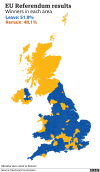
On the Brexit point, it couldn't really be more stark. It's not like Scotland voted marginally for Remain, or that the Remain vote was especially concentrated in certain areas. Every single constituency voted Remain. Every single one! Just look at the map: the Remain vote literally stops at the border. That is a symptom of a country that is moving in a different direction from England and I don't think it's very surprising to see a certain amount of resentment arise from that.
Attachments
Bletchleyite
Veteran Member
Where did anyone say England "has it in for" Scotland?
The poster talked about being "shafted". That is a phrase used to describe wilful disregard.
Not less of a say, but an equal say. Why should Scotland, or one area of England, say, have more influence per head of population than another?"Arguably more than it should". There in lies the problem. We are part of a union that we have no say in because we are outnumbered polticially 10 times over and yet people still think we should have even less of a say. Indeed we are due to lose sats anyway!
Your view seems to everyone is out to get the Scots. I'm sure some English, Welsh or NI MPs hold the same view as the Scottish MPs on some issues.
windingroad
Member
- Joined
- 16 Jun 2022
- Messages
- 234
Well, to some extent that's a true description. But it's not that Scotland has been shafted by England; it's been shafted by the system.The poster talked about being "shafted". That is a phrase used to describe wilful disregard.
While I do agree that there wasn't any workable way for Scotland to be an exception, I don't believe the people who pushed for a hard Brexit cared in the slightest how this might affect Scotland, or that a strong majority there voted for Remain. I don't even think they thought about Scotland at all. The whole thing is a thoroughly English project. And I am English!
That's exactly the problem though. Inherent in the union is a huge power imbalance due to England's size, and there's no way around that. At least in the US this is partially remedied through the Senate, though that comes with its own issues.Not less of a say, but an equal say. Why should Scotland, or one area of England, say, have more influence per head of population than another?
This feeling that England dominates is never going to go away, so how do you propose we solve that?
gabrielhj07
Established Member
This is no more true for Scotland than it is for, say Hackney. Those who pushed for a hard Brexit will not have cared in the slightest about representing the 48% vote, no matter where it came from.I don't believe the people who pushed for a hard Brexit cared in the slightest how this might affect Scotland
By acting and treating ourselves as what we are, a United Kingdom first and foremost, constituent nations second. We are not a loose confederation of warring tribes, we are one, and have been so for over 300 years.This feeling that England dominates is never going to go away, so how do you propose we solve that?
Bletchleyite
Veteran Member
While I do agree that there wasn't any workable way for Scotland to be an exception, I don't believe the people who pushed for a hard Brexit cared in the slightest how this might affect Scotland, or that a strong majority there voted for Remain. I don't even think they thought about Scotland at all. The whole thing is a thoroughly English project. And I am English!
It was provincial English plus Welsh (which voted heavily Leave). London voted heavily for Remain.
windingroad
Member
- Joined
- 16 Jun 2022
- Messages
- 234
This is the mistake people keep making in this thread. People in Scotland (and this applies to unionists too) simply do not view themselves as a region; they see themselves as a country. And every single county within that country voted for Remain, without exception. Hackney is a silly example and not at all comparable.This is no more true for Scotland than it is for, say Hackney. Those who pushed for a hard Brexit will not have cared in the slightest about representing the 48% vote, no matter where it came from.
Superb argument. Why should Scotland remain part of the United Kingdom? Because it's a United Kingdom. Brilliant.By acting and treating ourselves as what we are, a United Kingdom first and foremost, constituent nations second.
Scotland didn't unanimously vote remain despite what the SNP and posters on here seem to want people to believe.
The vote in Scotland was 62% to 38%. Over a million Scots voted to leave that's more than the entire vote cast in Northern Ireland and more than either the Remain or Leave vote in Wales.
If the special measures had been put in place to not shaft the 1.7 remain voters would you not be shafting the 38% (over a million) leavers?
The vote in Scotland was 62% to 38%. Over a million Scots voted to leave that's more than the entire vote cast in Northern Ireland and more than either the Remain or Leave vote in Wales.
If the special measures had been put in place to not shaft the 1.7 remain voters would you not be shafting the 38% (over a million) leavers?
gabrielhj07
Established Member
The point I make in response to your earlier claim is that hard-brexiteers did not consider the effect of Brexit on any particular part of the United Kingdom. No-one disputes the fact that Scotland is a country in it's own right, just that it was not 'singled out' by England.This is the mistake people keep making in this thread. People in Scotland (and this applies to unionists too) simply do not view themselves as a region; they see themselves as a country. And every single county within that country voted for Remain, without exception. Hackney is a silly example and not at all comparable.
As noted by @tomuk, this isn't true. Many people from all parts of the United Kingdom voted to leave; on balance, less so in Scotland. You write as though Brexit was an English plan to subvert the Scottish people, which isn't true in the slightest. The Scottish votes in 2016 were counted with equal weight to English, Welsh & Irish votes - to say that Scotland's will has somehow been undermined is wrong, as it was a UK-wide vote.The whole thing is a thoroughly English project.
windingroad
Member
- Joined
- 16 Jun 2022
- Messages
- 234
That's true in terms of the results, but I'd still say that the driving force behind the vote happening was a version of English nationalism. I don't say that to imply that it's a sinister English plot against Scotland (as some people will immediately claim) just that it has its roots in those traditions.It was provincial English plus Welsh (which voted heavily Leave).
Nobody has ever claimed Scotland voted "unanimously" for Remain. It is true though that every single council area voted Remain, so that is in a sense unanimous. The reason that's important is that it shows a universal difference in attitudes (versus the rest of the UK) across Scotland. Even the more conservative areas (ie. the Borders) differed from English counties mere miles away.Scotland didn't unanimously vote remain despite what the SNP and posters on here seem to want people to believe. The vote in Scotland was 62% to 38%. Over a million Scots voted to leave that's more than the entire vote cast in Northern Ireland and more than either the Remain or Leave vote in Wales.
Of course plenty of people did vote for Brexit, but the point is that they did so at significantly lower rates than elsewhere. Comparing votes in absolute terms to Northern Ireland or Wales isn't really useful given the population differences.
DynamicSpirit
Established Member
As noted by @tomuk, this isn't true. Many people from all parts of the United Kingdom voted to leave; on balance, less so in Scotland. You write as though Brexit was an English plan to subvert the Scottish people, which isn't true in the slightest. The Scottish votes in 2016 were counted with equal weight to English, Welsh & Irish votes - to say that Scotland's will has somehow been undermined is wrong, as it was a UK-wide vote.
Indeed. It's also worth pointing out that, if the Remain campaign had been just slightly more effective - enough to sway an extra 1.9% of voters across the country into voting Remain, then the result would have been an overall vote to Remain, despite England and Wales voting Leave. In that situation (a perfectly plausible situation, but which didn't happen in the end), it would have been Scotland (plus a small contribution from Northern Ireland) that caused England and Wales to remain. And that would've been perfectly democratic because it was a UK-wide vote on what the UK would have done. It's a pretty fair bet that, in that situation, almost no-one in mainstream politics (bar a few extremists) would have been complaining that Scotland had shafted England or that Scotland didn't care about England etc. (Though I'm pretty sure the SNP would still have found some other excuse to complain that Scotland wasn't being treated fairly and call for another Independence referendum).
And looking to the future, it's very plausible that the next general election may produce a result in which the Conservatives have a majority of English/Welsh/NI seats, but are unable to form a Government because, when Scottish seats are added into the mix, Labour/the LibDems/the SNP have more seats, and the SNP opts to support a Labour minority administration. Scotland's 8-ish% of the population really does give it the chance to have a huge influence across the UK - if the rest of the UK is sufficiently evenly split (Obviously, much less so if the rest of the UK votes heavily one way or the other, as was the case in the EU referendum and in the 2019 election).
Last edited:
- Status
- Not open for further replies.