• Our new ticketing site is now live! Using either this or the original site (both powered by TrainSplit) helps support the running of the forum with every ticket purchase! Find out more and ask any questions/give us feedback in this thread!

Russia invades Ukraine

DustyBin

Established Member
Joined
20 Sep 2020
Messages
3,927
Location
First Class

Another potential motivator for the Ukrainians on BBC News -
apparently Russia's Moskva cruiser is on fire and in a bad way with Ukraine saying sorry not sorry.

From what I can gather this is one of two ships that attacked snake island earlier in the super special war operation thingy, with the other reported damaged earlier in the super special war operation thingy but later disputed

Apparently it has actually now sunk (or as one Twitter user put it, is on a special underwater operation). I’d await official confirmation, but there are reports that Turkey has rescued some crew members so it certainly appears to have been severely damaged.

In addition the Russians rather stupidly occupied the Chornobaivka airfield (near Kherson) yet again. Unsurprisingly they’re occupation was short lived.
 
Sponsor Post - registered members do not see these adverts; click here to register, or click here to log in
R

RailUK Forums

Yew

Established Member
Joined
12 Mar 2011
Messages
7,243
Location
UK
Apparently it has actually now sunk (or as one Twitter user put it, is on a special underwater operation). I’d await official confirmation, but there are reports that Turkey has rescued some crew members so it certainly appears to have been severely damaged.

In addition the Russians rather stupidly occupied the Chornobaivka airfield (near Kherson) yet again. Unsurprisingly they’re occupation was short lived.
Fortunately, this is not a Kirov class nuclear-powered battle cruiser.
 

DustyBin

Established Member
Joined
20 Sep 2020
Messages
3,927
Location
First Class
Your mention of Afghanistan reminds me of this: it took only 3 weeks in Ukraine for Russia to suffer the same number of casualties as that suffered by the Soviet army in 10 years in Afghanistan. Of course the other way in which Russian public opinion might change a little would be if the physical conflict started to affect actual Russian territory. So far the only apparent instance of that was the attack on a fuel depot in Belgorod but even though the Russians were happy to blame Ukraine rather than "unknown terrorists" given that no residential property was affected it seems not to have moved the public opinion needle at all. Essentially Putin has convinced the masses to take on a siege mentality when it comes to the "west" (meaning all nations, except Belarus, geographically west of Russia) and therefore he can do no wrong regardless of what is actually happening on the ground.

This is interesting from the BBC website:

'I see signs of fatigue' with conflict in Russia, says commentator​

Andrey Kortunov, director general of the Russian International Affairs Council and a former adviser to the committee on international relations in Russia's parliament, has spoken to Radio 4's Today programme about how President Vladimir Putin may proceed with the war.
Putin needs something he can present at home as a victory, he says. "The question is how much is enough?"
If you follow his most recent statements, says Kortunov, just two days ago, he made the argument that the sole mission of the operation in Ukraine was to protect the people of Donbas. This implies it's not about regime change in Ukraine - but rather about securing the gains that Russia has achieved in the east of the country, he says.
Kortunov also believes any escalation might require some kind of mobilisation and the "political risk for the Russian leadership will increase".
"People in Russia do not really want to go fighting against Ukrainians.
"Public support for the leadership might go down if this whole thing escalates or if this whole thing lasts for too long."
He adds: "I see signs of fatigue... Maybe it's too early to say that the Russian public is changing its views on the conflict, but definitely it cannot last for too long."


== Doublepost prevention - post automatically merged: ==

Fortunately, this is not a Kirov class nuclear-powered battle cruiser.

Apologies if this is a silly question, but would that make a “mess”?
 

birchesgreen

Established Member
Joined
18 Aug 2015
Messages
7,673
Location
Solihull
Apologies if this is a silly question, but would that make a “mess”?
We've yet to find out what happens to a nuclear powered warship that is blown up in war, i suspect the reactor would end up scrammed and become yet more seabed junk but its best we avoid finding out.
 

Bletchleyite

Veteran Member
Joined
20 Oct 2014
Messages
113,598
Location
"Marston Vale mafia"
We've yet to find out what happens to a nuclear powered warship that is blown up in war, i suspect the reactor would end up scrammed and become yet more seabed junk but its best we avoid finding out.

Given that nuclear material is stored underwater I suspect it wouldn't look much different from a diesel ship being blown up, it could even be less polluting.
 

ainsworth74

Forum Staff
Staff Member
Global Moderator
Joined
16 Nov 2009
Messages
31,110
Location
Redcar
Apologies if this is a silly question, but would that make a “mess”?
Not silly at all and the answer is likely to be "maybe but probably not"?

We don't know as, so far, no nuclear warship has ever been lost in combat. A few nuclear submarines have been lost to accidents, some extremely violent (Russian submarine Kursk was likely lost to an ammunition explosion for instance), but none to combat. None of those accidents have resulted in significant, or even sometimes detectible, levels of radioactivity being released into the environment. I mean I agree with @birchesgreen that it would be best not to find out but I wouldn't be losing sleep over it personally.
 

Iskra

Established Member
Joined
11 Jun 2014
Messages
10,713
Location
West Riding
Not silly at all and the answer is likely to be "maybe but probably not"?

We don't know as, so far, no nuclear warship has ever been lost in combat. A few nuclear submarines have been lost to accidents, some extremely violent (Russian submarine Kursk was likely lost to an ammunition explosion for instance), but none to combat. None of those accidents have resulted in significant, or even sometimes detectible, levels of radioactivity being released into the environment. I mean I agree with @birchesgreen that it would be best not to find out but I wouldn't be losing sleep over it personally.
Umm...


Norway has found a radiation level 800,000 times higher than normal at the wreck of a Russian navy submarine.
The Komsomolets sank in the Norwegian Sea in 1989 after a fire on board killed 42 sailors.
A sample showed radioactive caesium leaking from a ventilation pipe, but researchers said it was "not alarming", as the Arctic water quickly diluted it.
The Soviet-era sub is also deep down, at 1,680m (5,512ft), and there are few fish in the area, they added.
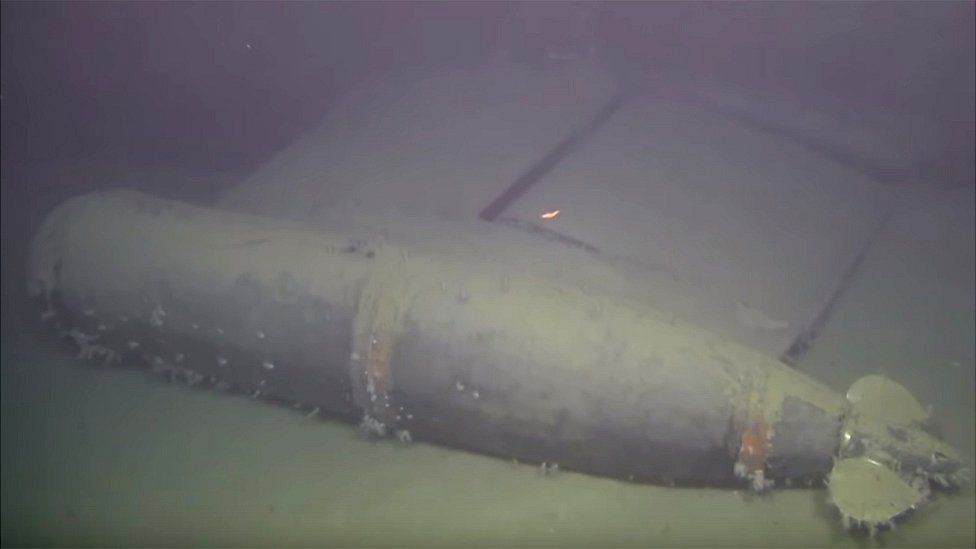
For the first time a Norwegian remotely-operated vehicle (ROV) examined and filmed the Komsomolets on 7 July, revealing severe damage.
The submarine is also known as K-278 in Russia, and it sank carrying two nuclear torpedoes with plutonium warheads.
Its front section has six torpedo tubes, and the sub could also launch Granit cruise missiles.
Komsomolets wreckage, filmed by ROV
IMAGE SOURCE,IMR
Image caption,
This appears to be part of the auxiliary diesel system, revealed by the ROV
The news comes just over a week after fire swept through a Russian nuclear-powered submersible in the Barents Sea, killing 14 naval officers.
The survivors managed to get the mini-sub back to its Arctic base.

Reactor shutdown​

Norway's Radiation and Nuclear Safety Authority (DSA) says the pressurised water reactor powering K-278 in April 1989 shut down quickly when the fire broke out in another compartment.
Twenty-seven sailors survived - they were eventually picked up by two Soviet ships.
Arctic map showing submarine location

The radiation leak found this week came from a pipe near the reactor. It was 800Bq (becquerels) per litre, while the normal level in the Norwegian Sea is about 0.001Bq.
However, some other water samples from the wreck did not show elevated levels.
The 42 sailors who died in the disaster succumbed to toxic fumes or froze in the icy Arctic waters after the K-278 had surfaced briefly.
The commander managed to send a distress call about an hour after the fire broke out, but he and four others died when their emergency capsule sank. The submarine was doomed when the fire spread, fuelled by compressed air from a damaged pipe, Russia's RIA news agency reported.
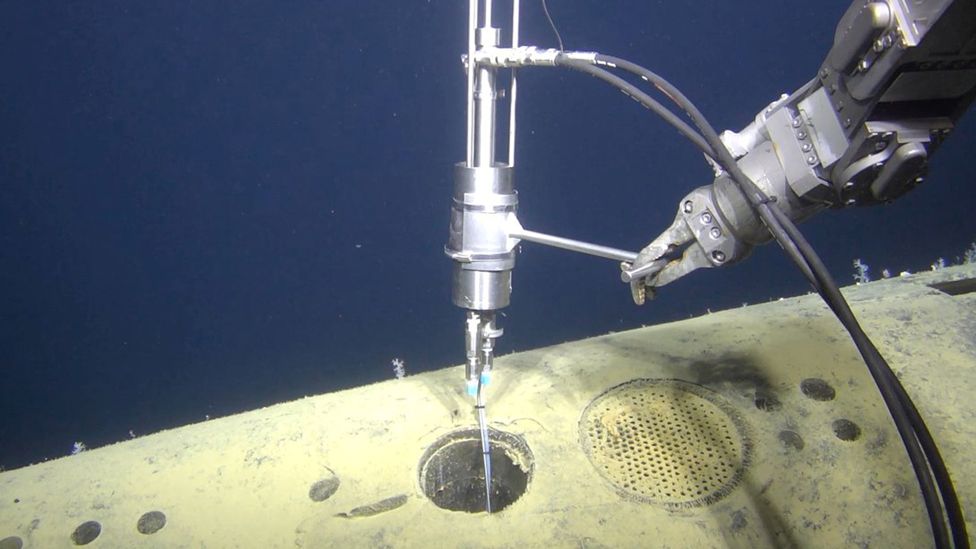
Komsomolets wreckage, filmed by ROV
IMAGE SOURCE,IMR
Image caption,
The ROV is shown here collecting samples from inside the titanium hull
Russia has previously examined the wreck with a manned submersible, and found radiation leaking from the same section.
The Norwegian radiation specialists and marine researchers were accompanied by experts from Russia's Typhoon Research and Production Association.
"We took water samples from inside this particular duct because the Russians had documented leaks here both in the 1990s and more recently in 2007," said Hilde Elise Heldal, the expedition leader. "So we weren't surprised to find high levels here.
"The levels we detected were clearly above what is normal in the oceans, but they weren't alarmingly high," she said.
Norway and Russia have been monitoring radiation in the area regularly since the disaster, sometimes on joint expeditions.

The Komsomolets was launched in 1983, was 117m (385ft) long and could dive to a maximum depth of 1,250m. Its maximum speed was 30 knots (56km/h).

But yes, your general point is correct that it is much better for radiation to be released deep at the bottom of the sea than into the atmosphere.
 

najaB

Veteran Member
Joined
28 Aug 2011
Messages
33,709
Location
Scotland
Apologies if this is a silly question, but would that make a “mess”?
It would not result in a nuclear explosion. The level of enrichment in a typical naval reactor (c. 25-40%) is nowhere near that of a nuclear weapon (> 80%), and there's simply no way to get a supercritical mass. Designing something that will go "boom" is very, very hard.

However, it is capable of sustained reaction (obviously) and the by products can be pretty nasty. So the "messiness" would depend entirely on (a) if the reactor was scrammed (a process where control rods are inserted so that the chain reaction is slowed/stopped entirely), and (b) if the reactor compartment retained integrity.

If both of these were true then, as @Bletchleyite says it would no more harmful than a non-nuclear vessel.

On the other hand, if the reactor wasn't shut down then a lot of very nasty radionucleotides would continue to be produced for quite some time (years/decades), and worse still would be if the reactor was breached - meaning that those products would be released into the environment.
 

DustyBin

Established Member
Joined
20 Sep 2020
Messages
3,927
Location
First Class
Thank you all who have replied re the nuclear aspect. I'm fairly familiar with the Chernobyl disaster so I appreciate that a reactor is different to a bomb, but clearly there is at least some risk of a "mess" for want of a better word. It's interesting actually that with so many variables involved we can't be sure!
 

Iskra

Established Member
Joined
11 Jun 2014
Messages
10,713
Location
West Riding
Glory be !! The Moskva has sunk.
This is strategically important as with its anti-air missiles it was preventing Ukrainian air sorties over Southern Ukraine. Plus the immense political and humiliation value too of course.
 

ainsworth74

Forum Staff
Staff Member
Global Moderator
Joined
16 Nov 2009
Messages
31,110
Location
Redcar
Umm...


But yes, your general point is correct that it is much better for radiation to be released deep at the bottom of the sea than into the atmosphere.
Clearly when I read up on this previously the comment:

but they weren't alarmingly high

Is the bit that stuck and got parsed in my head to mean something a little different! :lol: :oops:
 

DynamicSpirit

Established Member
Joined
12 Apr 2012
Messages
9,213
Location
SE London
This is strategically important as with its anti-air missiles it was preventing Ukrainian air sorties over Southern Ukraine. Plus the immense political and humiliation value too of course.

Does Russia have any other ships in the Black Sea with similar capabilities?

I'm guessing the humiliation value will be the reason that Russia is maintaining it was just a fire, not a missile attack.

I'm curious why it's only been attacked now. Ukraine is claiming to have used Ukrainian-built missiles, which would presumably mean they had those missiles throughout the war. I wonder therefore what has changed that allowed them to attack it now, rather than some weeks ago.

Excellent news though for Russia to lose a ship like this.
 

najaB

Veteran Member
Joined
28 Aug 2011
Messages
33,709
Location
Scotland
I'm curious why it's only been attacked now. Ukraine is claiming to have used Ukrainian-built missiles, which would presumably mean they had those missiles throughout the war. I wonder therefore what has changed that allowed them to attack it now, rather than some weeks ago.
Maybe they only just got the opportunity.
 

ainsworth74

Forum Staff
Staff Member
Global Moderator
Joined
16 Nov 2009
Messages
31,110
Location
Redcar
Does Russia have any other ships in the Black Sea with similar capabilities?
Not especially. The remaining surface elements of the Black Sea Fleet are a five frigates which should be able to protect themselves from air attack and provide some local air defence as well, especially if operating in a group of a few ships. But none of them have the true long range air defence capabilities that Moskva had. That being said the some of the frigates (and submarines) are probably more effective as they're capable of launching the Kalibr cruise missiles that we've been hearing so much about recently. Moskva didn't have that capability. It does also put a big dent in their anti-ship missile launch capability. That was her main mission, carry a plenty of very large anti-ship missiles (possibly her downfall in the end as well). The frigates have some as well so it's not a total gap in capability but it's still a big hole.

So it's a little bit swings and roundabout. Losing Moskva is a huge blow to the Russian Navies overall capability (she's also basically irreplaceable, the Russians haven't built large surface warships since the late 90s), it's a huge hit to their prestige (I've already seen one person joke that the Russians tried to take Kyiv and lost Moscow instead) and certainly makes it more difficult for them to operate close to Ukraine. So on that side it's a huge win for Ukraine, huge. But the heavy lifting so far will have been done by ships and submarines that remain in service (those that can fire the cruise missiles).
Arguably, losing a ship due an accident would be more embarrasing.
I think that's the fascinating part. They ended up deciding that it was more acceptbale to say it was lost to an accident than to enemy action. The mental gymnastics to make that be your preferred story are gold medal worthy.
 

AlterEgo

Verified Rep - Wingin' It! Paul Lucas
Joined
30 Dec 2008
Messages
29,525
Location
LBK
Great news that heap of a ship was sunk. How embarrassing. They haven’t lost a ship like that since they got hammered in the Russo-Japanese war. Clowns.
 

DynamicSpirit

Established Member
Joined
12 Apr 2012
Messages
9,213
Location
SE London
Maybe they only just got the opportunity.

Yeah possible, though I wonder what would count as an opportunity.

Reading around, I see another plausible speculative suggestion: Maybe Ukraine had so few anti-ship missiles earlier in the war that they were strictly saving them for emergencies (such as the amphibious assault on Odesa that seemed likely early in the war). But now, possibly they've received enough anti-ship missiles from the West that they can afford to start risking them on attacks like this. It's also been suggested that the same stormy weather that ultimately sunk the Moskva might have also provided radar cover for the missile attack (which perhaps could be the opportunity you're referring to)
 

GusB

Established Member
Joined
9 Jul 2016
Messages
8,160
Location
Elginshire
Yeah possible, though I wonder what would count as an opportunity.

Reading around, I see another plausible speculative suggestion: Maybe Ukraine had so few anti-ship missiles earlier in the war that they were strictly saving them for emergencies (such as the amphibious assault on Odesa that seemed likely early in the war). But now, possibly they've received enough anti-ship missiles from the West that they can afford to start risking them on attacks like this. It's also been suggested that the same stormy weather that ultimately sunk the Moskva might have also provided radar cover for the missile attack (which perhaps could be the opportunity you're referring to)
I can't for the life of me remember where I read it (it was only about half an hour ago, so I'll have a look through my browser history), but apparently those missiles are a development of a Soviet design and actually made in Ukraine.
 

Annetts key

Established Member
Joined
13 Feb 2021
Messages
3,816
Location
West is best
I can't for the life of me remember where I read it (it was only about half an hour ago, so I'll have a look through my browser history), but apparently those missiles are a development of a Soviet design and actually made in Ukraine.
Wikipedia maybe… link
R-360 Neptune
Neptune (Ukrainian: Р-360 «Нептун», romanized: R-360 "Neptun") is a Ukrainian anti-ship cruise missile developed by Luch Design Bureau.

Type: Anti-ship missile Cruise missile
Place of origin: Ukraine
Service history: In service, 2021–present
Used by: Ukrainian Navy
Wars: Russo-Ukrainian War
Designer: Luch Design Bureau[1]
Specifications
Mass: 870 kg (1,920 lb)[1]
Operational range: 300 km (190 mi)[1]
Maximum speed: Subsonic[1]

Neptune's design is based on the Soviet Kh-35 anti-ship missile, with substantially improved range and electronics.[2] The system is designed to defeat surface warships and transport vessels with a displacement of up to 5,000 tons, either in convoys or moving individually.

The system entered service with the Ukrainian Navy in March 2021.[3]


Development

The missile was first revealed in the "Weapons and Security 2015" exhibition in Kyiv.[4]

According to information from open sources, the first flight samples of the cruise missile were manufactured in the spring of 2016. Production of advanced missile systems took place in cooperation with other Ukrainian enterprises, including Artem Luch GAhK, Kharkiv State Aircraft Manufacturing Company [uk], Motor Sich (MS-400 turbofan engine), Pivdenne YuMZ PivdenMash, Lviv LORTA [uk] and other radar electronics, Vyshneve ZhMZ Vizar Kyiv, Radionics (seeker), Arsenal SDP SE (navigation system) and others.[citation needed]

The first tests of the system were conducted on 22 March 2016, attended by Secretary of the National Security and Defense Council (NSDC) Oleksandr Turchynov. In mid-2017, Neptune missiles were tested concurrently with trials of the Vilkha missile complex. However, unlike the Vilkha, the test results and capabilities of the Neptune were not publicised.[5] According to the press service of the NSDC, the first successful flight tests of the system took place on 30 January 2018.[6] On 17 August 2018, the missile successfully hit a target at a range of 100 kilometres (62 mi) during test firings in southern Odesa Oblast.[7] On 6 April 2019, the missile was again successfully tested, hitting targets during tests near Odesa. According to President Petro Poroshenko, Neptune system would be delivered to the Ukrainian military in December 2019.[8]

After the withdrawal of both the United States and the Russian Federation from the Intermediate-Range Nuclear Forces Treaty, Ukraine announced that it was considering developing intermediate-range cruise missiles. Analysts considered an extended-range Neptune missile to be a candidate for such an effort.[9]

Ukraine signed a memorandum with Indonesia on concluding a contract for the supply of a number of Neptune missiles, first reported in December 2020.[10] Thus, Indonesia may become the first foreign buyer of Neptune, according to Defense Express [uk] with reference to the Ukrainian special exporter State Enterprise (SE) "Progress".

In March 2021, the Ukrainian Navy obtained the first units of the RK-360MC Neptune.[3]

Operational history

On 13 April 2022, during the Russian invasion of Ukraine, Ukrainian sources claimed the Russian cruiser Moskva was hit by two Neptune missiles, resulting in an ammunition explosion.[11] The Russian Ministry of Defence stated, without discussing the cause, that a fire had caused munitions to explode and the crew had been fully evacuated.[12][13][14] Russia reported the vessel as still being afloat later in the day of the fire, but Russian state media reported that it had sunk in inclement weather while being towed.[15][16]

When deployed, a Neptune coastal defence system comprises a USPU-360 truck-based mobile launcher, four missiles, a TZM-360 transport/reload vehicle, a RCP-360 command and control vehicle, and a special cargo vehicle. The system is designed to operate up to 25 kilometres (16 mi) inland of the coastline.[3]

A Neptune missile including rocket motor is 5.05 metres (16 ft 7 in) in length, with a cross-shaped hard wing. Neptune missiles are designed to be housed in transport and launch containers (TLC) with dimensions 5.30 by 0.60 by 0.60 metres (209 in × 24 in × 24 in). The system has a maximum range of about 300 kilometres (190 mi).[17][18] A single missile weighs 870 kilograms (1,920 lb), of which 150 kilograms (330 lb) is the warhead.[3]
 

Shaw S Hunter

Established Member
Joined
21 Apr 2016
Messages
3,497
Location
Over The Hill
There was a bit of an accident involved, they were apparently trying to tow it back to shore but rough seas helped sink it.
Same fate befell the Sheffield in the South Atlantic though I don't recall onboard munitions exploding as having been a factor. Just a very big hole after fire enlarged the initial missile damage. Can any "expert" here make a comparison between the Exocet missile of that era with today's Neptun or similar anti-ship missiles?
 

birchesgreen

Established Member
Joined
18 Aug 2015
Messages
7,673
Location
Solihull
I can't for the life of me remember where I read it (it was only about half an hour ago, so I'll have a look through my browser history), but apparently those missiles are a development of a Soviet design and actually made in Ukraine.
Ironically the updated Moscova was a development of a Soviet design made in Ukraine too.
 

DynamicSpirit

Established Member
Joined
12 Apr 2012
Messages
9,213
Location
SE London
It's probably not just the embarrassment factor: The Russian Government are after all still claiming that what's going on in Ukraine is just a special military operation, and not a war. But it could occur to some of Putin's loyal citizens back in Russia to wonder what kind of not-a-war can cause your Black Sea flagship to get sunk by the enemy! Claiming it was an accident is probably a bit easier to square with the official line.
 
Last edited:

DustyBin

Established Member
Joined
20 Sep 2020
Messages
3,927
Location
First Class
Same fate befell the Sheffield in the South Atlantic though I don't recall onboard munitions exploding as having been a factor. Just a very big hole after fire enlarged the initial missile damage. Can any "expert" here make a comparison between the Exocet missile of that era with today's Neptun or similar anti-ship missiles?

I’m not an expert by any means but I believe they are, on the face of it, fairly comparable certainly in terms of speed, size and weight although the Exocet carries a slightly larger warhead. I’m sure somebody more knowledgable can provide a more detailed comparison.

On the subject of the Sheffield, I once read that the Exocet warhead didn’t actually detonate on impact and became detached, and that it was the “body” of the missile that penetrated the hull through pure kinetic energy. Can anybody confirm if this is actually true?
 

Top