
In her defence (somewhat), it appeared to be working through the early 2010s. Russia (that is to say Putin) seemed to be mainly content staying in what he perceived as his sphere of influence. Had he not been so successful in meddling in the Brexit referendum and US 2016 presidential election cycles I doubt he would have started to believe the myth of his invincibility.A positive legacy from Merkel should be well and truly shattered, she was essentially the successor face of neoliberalism, after its founders Thatcher and Reagan, but dug herself too far down the hole of believing trade encourages peace.

-
Our new ticketing site is now live! Using either this or the original site (both powered by TrainSplit) helps support the running of the forum with every ticket purchase! Find out more and ask any questions/give us feedback in this thread!
You are using an out of date browser. It may not display this or other websites correctly.
You should upgrade or use an alternative browser.
You should upgrade or use an alternative browser.
Russia invades Ukraine
- Thread starter kristiang85
- Start date
Sponsor Post - registered members do not see these adverts; click here to register, or click here to log in
R
RailUK Forums

Indeed, it reminds me of some green campaigners suggesting that we switch off coal plants immediately; they often lack a clear picture of how we are supposed to meet baseline loads on the grid.Imagine if Norway and Qatar went rogue (not difficult to imagine with Qatar) and the UK said no more gas from those places. It isn't as simple as pressing a button and suddenly you get gas from another source you know?
The gas network across Europe is very complex, but is for the most part designed to shift gas from east to west, especially across Central Europe.
Germany have since announced a new LNG terminal is to be built and that they have binned Nord Stream 2, so I think criticism of Germany is a little unfair.

A positive legacy from Merkel should be well and truly shattered, she was essentially the successor face of neoliberalism, after its founders Thatcher and Reagan, but dug herself too far down the hole of believing trade encourages peace.
Change through trade was the mantra.
The only problem being that badly run countries tend to accept the trade, but don't bother with the change.
Most Western countries have believed in this to one extent or another.
It would appear not.I note that in some more recent videos he appears to be in front of a 'green/blue screen' chroma key system. (Think weather forecasts)
So I wonder if he has sensibly moved out of Kyev.
President Zelensky visits Bucha
Ukrainian President Volodymyr Zelensky is visiting Bucha, as more evidence of atrocities near Kyiv continues to emerge.
He inspected the road on which a Russian column was ambushed and spoke to local residents. He reiterated that Russia had carried out war crimes and genocide in Ukraine.
That certainly tallies with my understanding. Heck in some areas you don't even need to be there for a limited time as the radiation levels are no different to anywhere else. But you do need to be careful as there are areas where the radiation is higher than would be wise to be exposed to for more than a short period of time. You also need to be careful to avoid eating or drinking things which might have become contaminated (for instance from dirt or dust). Try to avoid inhaling that same dust as well. Effectively just take basic precautions to avoid either exposing yourself to higher levels of radiation or to avoid getting radioactive material inside your body. Would I want to live in Pripyat? No, but I'd have no qualms with visiting it a day or two. Indeed whilst Pripyat is abandoned there are still villages within the Exclusion Zone in which people have lived for decades without seemingly ill effect (at least from the radiation).
Tomorrow's World Audit is a podcast and Youtube channel which picks through old episodes of Tomorrow's World. This one was broadcast a week after the Chernobyl exposion (the podcast episode is 3 hours long!). Its by 2 people who work in the nuclear industry and visited Chernobyl a few years ago.
At 6 minutes, they say:
"... we had this kind of safety lecture - and the only, truly i'm not lying, the only thing that they were trying to get the fear of God into us is you must not step on the moss." "Yeah do not step on on the moss absolutely because it was like the moss has absorbed all the radiation."
There was quite the OpEd in RIA Novosti yesterday titled "What should Russia do with Ukraine":
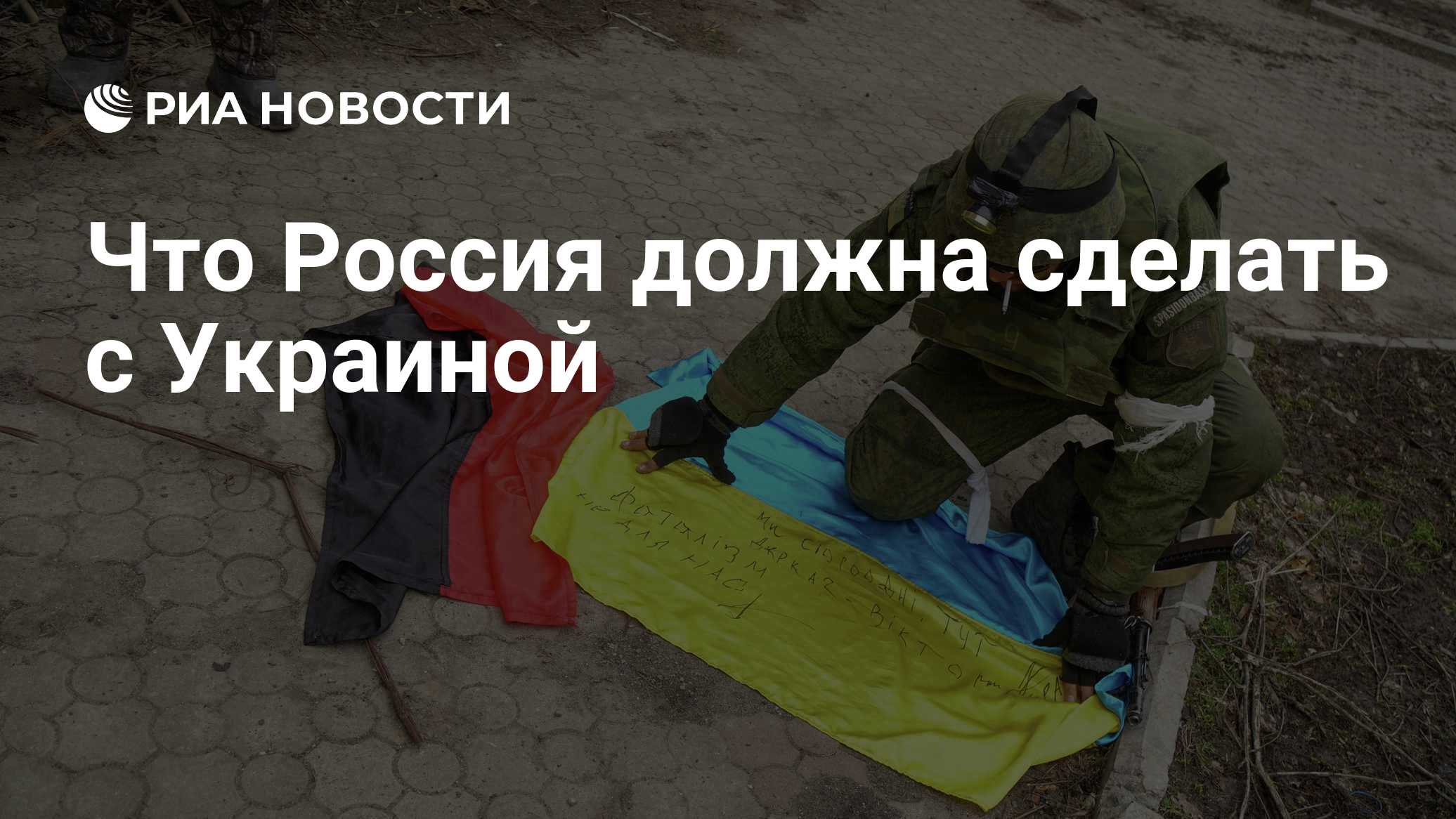
 ria.ru
(In Russian but most browsers should be able to offer a translation, in Chrome right clicking brings up a translate button for instance).
Some 'highlights' via Google translate:
But yes, it's the West and the "Western Coup" in 2014 that are the real problem...
Okay fine the above isn't from a Russian government official but it's worth noting that RIA Novosti is owned by the Russian State via the Rossiya Segodnya media group (which includes Sputnik) which itself is headed by Dmitry Kiselyov chief propagandist for one V Putin. You don't get to publish an article like that unless the Russian Government are happy for you to do so.
Что Россия должна сделать с Украиной
Еще в апреле прошлого года мы писали о неизбежности денацификации Украины. Нацистская, бандеровская Украина, враг России и инструмент Запада по уничтожению... РИА Новости, 05.04.2022
(In Russian but most browsers should be able to offer a translation, in Chrome right clicking brings up a translate button for instance).
Some 'highlights' via Google translate:
...
Denazification is necessary when a significant part of the people - most likely the majority - has been mastered and drawn into the Nazi regime in its politics. That is, when the hypothesis "the people are good - the government is bad" does not work. Recognition of this fact is the basis of the policy of denazification, of all its measures, and the fact itself is its subject matter.
Ukraine is in just such a situation. The fact that the Ukrainian voter voted for the "peace of Poroshenko" and "peace of Zelensky" should not be misleading - the Ukrainians were quite satisfied with the shortest path to peace through the blitzkrieg, which the last two Ukrainian presidents transparently hinted at when they were elected. It was this method of "appeasement" of internal anti-fascists - through total terror - that was used in Odessa, Kharkov, Dnepropetrovsk, Mariupol, and other Russian cities. And this quite suited the Ukrainian man in the street. Denazification is a set of measures in relation to the nazified mass of the population, which technically cannot be subjected to direct punishment as war criminals.
The Nazis who took up arms should be destroyed to the maximum on the battlefield. No significant distinction should be made between APU [Armed Forces of Ukraine] and the so-called national battalions, as well as the territorial defense that joined these two types of military formations. All of them are equally involved in extreme cruelty against the civilian population, equally guilty of the genocide of the Russian people, do not comply with the laws and customs of war. War criminals and active Nazis should be exemplarily and exponentially punished. There must be a total lustration. Any organizations that have associated themselves with the practice of Nazism have been liquidated and banned. However, in addition to the top, a significant part of the masses, which are passive Nazis, accomplices of Nazism, are also guilty. They supported and indulged Nazi power. The just punishment of this part of the population is possible only as bearing the inevitable hardships of a just war against the Nazi system, carried out with the utmost care and discretion in relation to civilians. Further denazification of this mass of the population consists in re-education, which is achieved by ideological repression (suppression) of Nazi attitudes and strict censorship: not only in the political sphere, but also necessarily in the sphere of culture and education. It was through culture and education that a deep mass nazification of the population was prepared and carried out, secured by the promise of dividends from the victory of the Nazi regime over Russia, Nazi propaganda, internal violence and terror, as well as an eight-year war with the people of Donbass who rebelled against Ukrainian Nazism.
Denazification can only be carried out by the winner, which implies (1) his absolute control over the denazification process and (2) the power to ensure such control. In this respect, a denazified country cannot be sovereign. ...
The terms of denazification can in no way be less than one generation, which must be born, grow up and reach maturity under the conditions of denazification. The nazification of Ukraine continued for more than 30 years, beginning at least in 1989, when Ukrainian nationalism received legal and legitimate forms of political expression and led the movement for "independence" towards Nazism.
...
The name "Ukraine" apparently cannot be retained as the title of any fully denazified state entity in a territory liberated from the Nazi regime. The people's republics newly created in the space free from Nazism should and will grow from the practice of economic self-government and social security, restoration and modernization of the life support systems of the population.
In fact, their political aspirations cannot be neutral - expiation of guilt before Russia for treating it as an enemy can be realized only by relying on Russia in the processes of restoration, revival and development. No "Marshall Plans" should be allowed for these territories. There can be no "neutrality" in the ideological and practical sense, compatible with denazification. The cadres and organizations that are the instrument of denazification in the newly denazified republics cannot but rely on Russia's direct military and organizational support.
Denazification will inevitably also be a de-Ukrainization - a rejection of the large-scale artificial inflation of the ethnic component of self-identification of the population of the territories of historical Little Russia and New Russia, begun by the Soviet authorities. Being an instrument of the communist superpower, after its fall, artificial ethnocentrism did not remain ownerless. In this official capacity, he passed under the authority of another superpower (the power standing over the states) — the superpower of the West. It must be returned to its natural boundaries and deprived of political functionality.
Unlike, say, Georgia and the Baltic countries , Ukraine, as history has shown, is impossible as a nation state, and attempts to "build" one naturally lead to Nazism. Ukrainism is an artificial anti-Russian construction that does not have its own civilizational content, a subordinate element of an alien and alien civilization. Debanderization by itself will not be enough for denazification - the Bandera element is only a performer and a screen, a disguise for the European project of Nazi Ukraine, therefore the denazification of Ukraine is also its inevitable de-Europeanization.
The Bandera elite must be liquidated, its re-education is impossible. The social "bog", which actively and passively supported it by action and inaction, must survive the hardships of the war and assimilate the experience as a historical lesson and atonement for its guilt. Those who did not support the Nazi regime, suffered from it and the war unleashed by him in the Donbass, must be consolidated and organized, must become the pillar of the new government, its vertical and horizontal. Historical experience shows that the tragedies and dramas of wartime benefit peoples who have been tempted and carried away by the role of an enemy of Russia.
Denazification as the goal of a special military operation within the framework of this operation itself is understood as a military victory over the Kiev regime, the liberation of territories from armed supporters of the Nazis, the elimination of implacable Nazis, the capture of war criminals, and the creation of systemic conditions for the subsequent denazification in peacetime.
...
All of the above means that in order to achieve the goals of denazification, the support of the population is necessary, its transition to the side of Russia after liberation from terror, violence and ideological pressure of the Kiev regime, after the withdrawal from informational isolation. Of course, it will take some time for people to recover from the shock of hostilities, to be convinced of Russia's long-term intentions - that "they will not be abandoned." It is impossible to foresee in advance exactly in which territories such a mass of the population will constitute a critically needed majority. The "Catholic province" (Western Ukraine as part of five regions) is unlikely to become part of the pro-Russian territories. The line of alienation, however, will be found empirically. Behind it will remain hostile to Russia, but forcibly neutral and demilitarized Ukraine with formally banned Nazism. The haters of Russia will go there. The guarantee of the preservation of this residual Ukraine in a neutral state should be the threat of an immediate continuation of the military operation in case of non-compliance with the listed requirements. Perhaps this will require a permanent Russian military presence on its territory. From the exclusion line to the Russian border there will be a territory of potential integration into Russian civilization, which is anti-fascist in its internal nature.
...
Everything that Russia has done for the West, it has done at its own expense, by making the greatest sacrifices. The West ultimately rejected all these sacrifices, devalued Russia's contribution to resolving the Western crisis, and decided to take revenge on Russia for the help that it selflessly provided. Further, Russia will go its own way, not worrying about the fate of the West, relying on another part of its heritage - leadership in the global process of decolonization.
As part of this process, Russia has a high potential for partnerships and allies with countries that the West has oppressed for centuries and which are not going to put on its yoke again. Without Russian sacrifice and struggle, these countries would not have been liberated. The denazification of Ukraine is at the same time its decolonization, which the population of Ukraine will have to understand as it begins to free itself from the intoxication, temptation and dependence of the so-called European choice.
But yes, it's the West and the "Western Coup" in 2014 that are the real problem...
Okay fine the above isn't from a Russian government official but it's worth noting that RIA Novosti is owned by the Russian State via the Rossiya Segodnya media group (which includes Sputnik) which itself is headed by Dmitry Kiselyov chief propagandist for one V Putin. You don't get to publish an article like that unless the Russian Government are happy for you to do so.

Giugiaro
Established Member
Tomorrow's World Audit is a podcast and Youtube channel which picks through old episodes of Tomorrow's World. This one was broadcast a week after the Chernobyl exposion (the podcast episode is 3 hours long!). Its by 2 people who work in the nuclear industry and visited Chernobyl a few years ago.
At 6 minutes, they say:
Just out of curiosity I went and searched on Google for "radioactive moss" and this was the first thing I came across:

Radiotrophic fungus - Wikipedia
Absolutely bonkers.
This one sentence says all that needs to be said about this...Some 'highlights' via Google translate:
It was this method of "appeasement" of internal anti-fascists - through total terror - that was used in Odessa, Kharkov, Dnepropetrovsk, Mariupol, and other Russian cities.
I know of a young nuclear medicine technician who thought the recent BBC TV series about Chernobyl was science fiction!I must admit to being astonished that there are people in 2022 who haven’t heard of the Chernobyl 1986 accident. Even in Russia surely it has become common knowledge between the fall of Communism, and more recent closing / censorship of society?

Annetts key
Established Member
Well, you can just switch off an electrical generator from the grid (although it’s more complex with a nuclear plant). But load shedding would be needed, and that would not be popular…Indeed, it reminds me of some green campaigners suggesting that we switch off coal plants immediately; they often lack a clear picture of how we are supposed to meet baseline loads on the grid.
Of course if the people in power had taken notice of what had been said more than THIRTY YEARS ago, things would have been a darned sight easier. And what were these ‘radical ideas’? Super insulate buildings to reduce the need for energy to heat them. How many buildings have been built or renovated in the last thirty years? A significant opportunity missed.
Less gas, coal, oil needed for providing heating, means less fossil fuel imports.
And the worst part is, changing the relevant building regulations would have cost the taxpayer very little. Plus a grant system (for homeowners) could have been put in place by taxing fossil fuels.
What is even worse, is that there is still not much talk or discussion, let alone action on the subject of super insulating buildings even now.
There are still plenty of other ideas to help save energy or to generate renewable energy. But a lot of small schemes are ignored.
PV Solar is clearly not a total solution in most parts of north Europe. But even so, if even one third of the roofs of existing buildings had them fitted, that could made a significant difference in reducing day time running in summer of fossil fuel plants.
And solar to preheat the water for a buildings ‘domestic’ hot water can help too.
Back to present day, now is the time for people to hold their governments and politicians to account. But will people see energy efficiency and energy diversity as important, or will they just talk about rising prices only?
If people don’t know that there are alternatives to our current system, will they think outside the box?
So - massacre soldiers, exemplary punishment for political leaders, forced labour for government officials (if not imprisoned or executed), reeducation for everyone else lasting 25-30 years. A neutral Western Ukraine for the incorrigible Russia-haters, possibly with a Russian army of occupation. The rest of Ukraine can be integrated into Russian 'civilisation'.Some 'highlights' via Google translate:
The author is described as a 'political technologist', a sort of Russian Dominic Cummings, also as a philosopher.
Last edited:
Oh, it's taken seeing mass executions to do this, and not the wholesale shelling and laying siege to entire cities?
Germany can do one. They have been warned for years about their energy policy, but no, no, Germany knew better. Wouldn't even let the RAF fly weapons over their airspace to the Ukrainians to defend themselves.
It's good that Germany are gradually coming round to the sort of long term economic blockade that will be needed to severely weaken Russia's capabilities into the future.
The country (Russia) needs to be made to undergo a permanent downgrading of status of the sort that the European powers (including us) had to undergo after Empire.
Whatever mistakes have been made in the past, the real objective of the West going forward must be to isolate and grind down Russia in the long term.
Last edited:
I agree that the Russian political and economic systems need to change, but I'm not sure that "grinding them down" is the most effective way to do so. History has shown that the ground tend to hold grudges towards the grinders.Whatever mistakes have been made in the past, the real objective of the West going forward must be to isolate and grind down Russia in the long term.
I agree that the Russian political and economic systems need to change, but I'm not sure that "grinding them down" is the most effective way to do so. History has shown that the ground tend to hold grudges towards the grinders.
Rolling over doesn't seem to have worked either.
So perhaps, as always, the answer is neither black nor white but a shade of grey.Rolling over doesn't seem to have worked either.
So perhaps, as always, the answer is neither black nor white but a shade of grey.
The answer is to have as little to do with the enemy as possible.
The article quoted above shows a high, not to say irrational, level of existing grievance against the west, so it's a bit late now to worry about hurting their feelings. But don't let's be beastly to the Russians (Noel Coward's lyrics are quite apposite).I agree that the Russian political and economic systems need to change, but I'm not sure that "grinding them down" is the most effective way to do so. History has shown that the ground tend to hold grudges towards the grinders.
And confirming that their belief that we in the West hate them helps the situation how, exactly?The article quoted above shows a high, not to say irrational, level of existing grievance against the west, so it's a bit late now to worry about hurting their feelings.
And confirming that their belief that we in the West hate them helps the situation how, exactly?
Who cares what they believe. They will believe it anyway. The key is to protect the Western economy and the Western way of life from enemy interference.
That attitude - not caring about Russian sensibilities - is exactly what got us (and more importantly Ukraine) into the situation it's in now.Who cares what they believe. They will believe it anyway. The key is to protect the Western economy and the Western way of life from enemy interference.
I'm not saying that we need to pander to them, but we do need to take their reaction into consideration when acting.
That attitude - not caring about Russian sensibilities - is exactly what got us (and more importantly Ukraine) into the situation it's in now.
I'm not saying that we need to pander to them, but we do need to take their reaction into consideration when acting.
Pandering to Russian sensibilities, and it's Imperial delusions is what's got us into the current situation. If they wish to persist with them, keep the bear within its borders and keep the missiles trained on them.
I thought it was expanding NATO and the EU eastward against Russia's wishes is what got us into the current situation.Pandering to Russian sensibilities, and it's Imperial delusions is what's got us into the current situation.
I thought it was expanding NATO and the EU eastward against Russia's wishes is what got us into the current situation.
Then you thought wrong. It was a big country thinking it has the right to dictate the foreign policy of its neighbours that has got us into this mess. Individual countries can chose to join NATO or the EU. If a country can't accept that outside its borders, it is a threat.
It wasn't me who thought that. It was a view that was espoused by several posters earlier in the thread.Then you thought wrong.
So now we've had some posters saying that it was ignoring Russian feelings that got us here, and others saying that it was pandering to Russian feelings that got us here.
It wasn't me who thought that. It was a view that was espoused by several posters earlier in the thread.
So now we've had some posters saying that it was ignoring Russian feelings that got us here, and others saying that it was pandering to Russian feelings that got us here.
Then they thought wrong.
It was pandering to Russian delusions that has got us here.

Strathclyder
Established Member
They tried to deny it/cover it up in the first few days after the fact, but they couldn't indefinitely as the radioactive cloud was carried across Europe by the prevailing wind/weather. The Soviets eventually admitted to a accident occuring after increased raditation levels set off alarms at the Forsmark Nuclear Power Plant in Sweden - over 1,000km, or 620 miles away from the Chernobyl plant - on the morning of 28th April. Quoting Wikipedia (with all the usual caveats) on this below:Apparently not. I imagine that has something to do with, the Soviets were keen to cover it up and so never really publicised it to their own people at the time. And then I guess for the few years when Russia did have a free press, maybe there wasn't any particular reason for Chernobyl to come up in the news much - it was, after all by then a historical event in what had become a foreign country.
Evacuation began one and a half days before the accident was publicly acknowledged by the Soviet Union. In the morning of 28 April, radiation levels set off alarms at the Forsmark Nuclear Power Plant in Sweden, over 1,000 kilometres (620 mi) from the Chernobyl Plant. Workers at Forsmark reported the case to the Swedish Radiation Safety Authority, which determined that the radiation had originated elsewhere. That day, the Swedish government contacted the Soviet government to inquire about whether there had been a nuclear accident in the Soviet Union. The Soviets initially denied it, and it was only after the Swedish government suggested they were about to file an official alert with the International Atomic Energy Agency, that the Soviet government admitted that an accident had taken place at Chernobyl.
At first, the Soviets only conceded that a minor accident had occurred, but once they began evacuating more than 100,000 people, the full scale of the situation was realized by the global community. At 21:02 the evening of 28 April, a 20-second announcement was read in the TV news programme Vremya: "There has been an accident at the Chernobyl Nuclear Power Plant. One of the nuclear reactors was damaged. The effects of the accident are being remedied. Assistance has been provided for any affected people. An investigative commission has been set up."
This was the entire announcement, and the first time the Soviet Union officially announced a nuclear accident. The Telegraph Agency of the Soviet Union (TASS) then discussed the Three Mile Island accident and other American nuclear accidents, which Serge Schmemann of The New York Times wrote was an example of the common Soviet tactic of whataboutism. The mention of a commission, however, indicated to observers the seriousness of the incident, and subsequent state radio broadcasts were replaced with classical music, which was a common method of preparing the public for an announcement of a tragedy.
Last edited:
How, specifically, did we pander to Russian delusions? Just curious how you came to a view diametrically opposite to that laid out earlier in the thread.It was pandering to Russian delusions that has got us here.
How, specifically, did we pander to Russian delusions? Just curious how you came to a view diametrically opposite to that laid out earlier in the thread.
We've let them into the very furthest. corners of our economy while they've maintained an enemy state poisoning people on British soil, interfering in Western elections. Russia has had access to Western economies like a Western nation while behaving like the Russian empire.
The West dealt and traded in with Russia like an equal. We even let them into the G8. All we got was Putin's FSB state.
It's the West who've been taken for fools here. We need to put a stop to it.
But how was that pandering to Russia? We got a lot more out of the relationship than Russia did. Pre-invasion the balance of trade between Russia and the West was very much in our favour - we bought their raw commodities and they bought our finished goods. We bought their titanium and then leased them the aircraft that we made from it.Russia has had access to Western economies like a Western nation while behaving like the Russian empire.
Russia were invited as an observer to the G7 under Yeltsin, not Putin. They didn't become full members until 1998 and they were excluded from 2014.The West dealt and traded in with Russia like an equal. We even let them into the G8. All we got was Putin's FSB state.
Again, I can't see how this can be described as pandering. At the time that they were invited in, the trajectory of the Russian economy and state appeared to be headed in a more western, free market direction. Remember, that the late 90's into the early 2000s were the time of the BRIC states.
But how was that pandering to Russia? We got a lot more out of the relationship than Russia did. Pre-invasion the balance of trade between Russia and the West was very much in our favour - we bought their raw commodities and they bought our finished goods. We bought their titanium and sold them the aircraft that we made from it.
Russia were invited as an observer to the G7 under Yeltsin, not Putin. They didn't become full members until 1998 and they were excluded from 2014.
Again, I can't see how this can be described as pandering. At the time that they were invited in, the trajectory of the Russian economy and state appeared to be headed in a more western, free market direction. Remember, that the late 90's into the early 2000s were the time of the BRIC states.
We accepted a state that purported to be westernised but wasn't and proceeded to use is position to embed itself in Western economies whilst undermining Western values. The interference in elections, the poisoning of dissidents on British streets. These are the actions of an enemy power.