• Our new ticketing site is now live! Using either this or the original site (both powered by TrainSplit) helps support the running of the forum with every ticket purchase! Find out more and ask any questions/give us feedback in this thread!

The legacy of the Scottish Bus Group

Status
Not open for further replies.
Joined
31 Dec 2021
Messages
834
Location
Glasgow
pre-privatisation, individual Ltd companies operated public buses much in the same separated operations you see today, albeit many who remember these days will likely say it was “simply better”.

Between Glasgow City Council and SPT there are separate ideas and voices about what should happen with public transport in the West-Central Scotland area specifcially and it may seem as though there is underlying squabbling over who should take jurisdiction with those public transport services in the future, a separate thread has of course all ready been created on this matter, my honest fear is that both entities want to use this as a stream of revenue, much like the way Edinburgh City Council has used Lothian Buses profits, yet very little to no cash seems to have made it back to the benefit of the local bus service itselfs, with regards to it prioritisation etc.

My view becomes tainted of these authorities when you realise that municipal operators may be able to offer disproportionate advantages that many other areas may miss out on simply because of the higher population in urban areas and the subsequent revenue that can be taken there but also because they still favour private motorists, additionally because many who outlay an urban area often commute to work into a city centre via train, creating something which is disadvantageous to those living rurally and especially as the cost of both bus & especially train usage continues to increase as does the cost of living in general.

With Low Emission Zones bearing down on several cities in Scotland do we think that the current infrastructure including public transport fares will support any further restrictions governement or Local Authorities intend to impose?

When you look back during the Pre-Privatised era, many of those nationalised & regulated operators were surely bound by better funding giving that all services were regulated of course and that revenue generated was placed back into maintaining sustainability, the current situation within the industry cannot be healthy nor sustainable in the long run for buses to be maintained.

Is the legacy of bus services something that is marked to eventually end?

Discuss.
 

Attachments

  • Screenshot_20220220-180908_meWho Lite2022.jpeg
    Screenshot_20220220-180908_meWho Lite2022.jpeg
    263.1 KB · Views: 68
Sponsor Post - registered members do not see these adverts; click here to register, or click here to log in
R

RailUK Forums

Jordan Adam

Established Member
Joined
12 Sep 2017
Messages
5,656
Location
Aberdeen
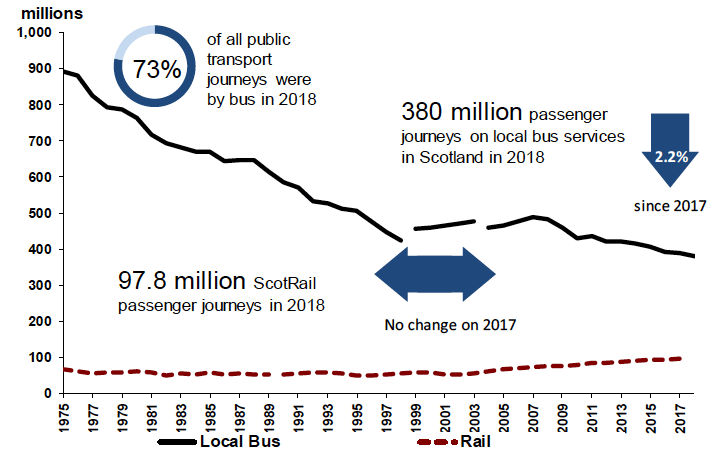
One interesting point i've noticed is that when politicians and councillors talk about the decline in public transport usage they often site privatisation as the blame and will only ever quote figures in the last 20 years or so, however when you actually look at the figures the bulk of the decline happened prior to deregulation.

Below is a graph showing bus and rail passenger numbers in Scotland from 1975 to 2018.
sct02200758021_g06.gif

Source: https://www.transport.gov.scot/publ...38-2019-edition/summary-transport-statistics/

My own personal opinion doesn't really swing favourably in either direction. In the ideal world public transport should be managed by the local authorities and bus/rail should be fully integrated, however in reality i'm not sure the "state" could be trusted to oversee this, nor do i think bringing buses back under public ownership would solve all the issues of today as many people often think.

I've seen this mentioned elsewhere on here however i think one of the failures of private operators has been the focus on core high frequency corridor routes to city centres and the negligence of orbital services. You also saw this happening quite a bit with First's "Overground" concept which saw many less frequent "residential" or circular routes being cut in favour of higher frequency cross-city corridor routes. Their argument would be that a high frequency trunk/corridor route is more convenient, however the reality has often been that it just alienates car users who previously may have commuted by bus because it stopped near to where they lived. Realistically very few car users are going to pick the bus over their car if their nearest service is a 5-10 minute walk away, and this becomes even more true if they need to commute in to the city centre and then catch a second bus to get to their destination when the same journey in a car only takes 10-15 minutes.

As for things being "better" prior to deregulation, there probably are aspects of this that are true however i think lots of people have a rose tinted perception of the past, many of the issues faced by public transport today are not really because of deregulation but other factors, notably poor bus priority, cheap (or sometimes free...) city centre parking and the decline of off-peak shoppers caused by the increase in online shopping.
 

TheGrandWazoo

Veteran Member
Joined
18 Feb 2013
Messages
23,032
Location
Somerset with international travel (e.g. across th
And here was me looking at the title of the thread, thinking @GusB would be thinking of Y types or hexagonal destination screens... or the Citylink network!

@Jordan Adam is absolutely right to highlight that things were pretty awful in terms of ridership from the 1960s. Increased car ownership was allied to a bus industry that was hamstrung by some very conservative management (when did SBG subsidiaries stop buying Y types for urban work?) and some very restrictive IR issues.

There's also been a very car centric approach to urban planning especially in Glasgow. For me, this preCovid shot sums it up. A major city centre thoroughfare and no bus priority but plenty of on street car parking. Jordan is also right to highlight social changes in that period - bus services reflect the societal changes from car ownership to what's happening now.

1645400575349.png
 

Swanny200

Member
Joined
18 Sep 2010
Messages
680
I always found Glasgow odd in that respect, next to no bus priority at all, it is all well and good sticking something on the back of the bus to say (please let me out) but then for that bus to sit in the same traffic jam it is a bit useless yet look at Aberdeen and Edinburgh and although they are not perfect, have a better handle on it
 

GusB

Established Member
Joined
9 Jul 2016
Messages
8,196
Location
Elginshire
when did SBG subsidiaries stop buying Y types for urban work?

Probably when Alexander ceased production of Y types!

The last operators that bought Y-types for mainly urban work would probably have been Central, Western (Leopards) and Eastern (Seddons). Other operators would have had a fair amount of rural work included.

Central's last Y-type Leopard was registered in 1983 and they persisted with manual transmissions much later than the others (until 1979), Western's last was registered in 1980 and Eastern's last Seddon was registered in 1982.

The last Y-types were all on Y-plates.

I've perhaps mentioned this before, but I once had a memorable journey from Glasgow to Coatbridge on one of Central's T-plate Leopards - that gearbox was shown absolutely no mercy!
 

tbtc

Veteran Member
Joined
16 Dec 2008
Messages
18,064
Location
Reston City Centre
I suppose that the SBG companies made more sense in the era where there were nice big "regions" to mirror (Northern were the main operator in Grampian, Strathtay in Tayside... you probably don't need me to tell you who the main operators were in the Highlands or Fife... the only confusing thing was that the main operator in Central Region was Midland rather than Central!)

It must have been hard for some of them to adapt to a world of New Towns, given how "car friendly" places like Glenrothes/ Livingston/ Cumbernauld were - urban operation in 1990s Aberdeen/ Dundee/ Glasgow/ Edinburgh probably wasn't that different to urban operation in 1960s Aberdeen/ Dundee/ Glasgow/ Edinburgh, so the "municipals" didn't have to evolve so much, whereas the SBG companies needed to try to adjust to the roundabouts and modern housing developments that were becoming the norm - a lot harder for buses to be competitive in somewhere like East Kilbride than a "traditional" town

Similarly, the end of heavy industry must have hit hard in a few areas; I don't remember seeing any timetables for the Steelworks of Lanarkshire, but I remember seeing ones for Rosyth Dockyard which could soak up several double deckers when the shifts switched, which was probably revenue that could sustain a bus for much of the rest of the day

It may sound like a minor thing, but having a "fair fortnight" (in each city/region) must have made income more reliable for fifty weeks of the year

I suppose one reason it's hard to form a view of the SBG is that none of the companies were still independent a few years after privatisation (was CityLink the last one to be taken over?) - whereas some English NBC companies remained independent for a long time and even became the "buyers" rather than the "bought" - so there's not really a fair example of how an SBG company's management would have coped longer term

However I blame the competition authorities for that - whilst they insisted that SYT/ Mainline divest of some of the companies that they'd taken over in Sheffield, they seemed relaxed about First operating the Lowland/ Eastern/ Midland/ Central/ Kelvin/ Strathclyde companies, which seemed more of a monopoly than just one English city!

Some of the SBG companies seemed to be innovating, before being taken over, laying the foundations for what was to come - in my mind an independent Eastern Scottish could have worked well once they'd made peace with LRT - I might have the dates mixed up, but I think the "Diamond" services were a pre-GRT innovation? Same with the minibus networks and Routemasters that other companies were trying, before becoming part of UK-wide conglomerates.

The industrial relations of the time didn't help either - essentially the reason for the demise of both Kelvin and Central - can't blame the authorities/ Souter/ Government for that!
 

Stan Drews

Established Member
Joined
5 Jun 2013
Messages
2,157
I suppose that the SBG companies made more sense in the era where there were nice big "regions" to mirror (Northern were the main operator in Grampian, Strathtay in Tayside... you probably don't need me to tell you who the main operators were in the Highlands or Fife... the only confusing thing was that the main operator in Central Region was Midland rather than Central!)

Did ‘Midland’ on buses, not pre-date the invention of Central Region?
 

GusB

Established Member
Joined
9 Jul 2016
Messages
8,196
Location
Elginshire
It may sound like a minor thing, but having a "fair fortnight" (in each city/region) must have made income more reliable for fifty weeks of the year
The "fair fortnight" provided a great deal of work. In a book that I have (Northern Scottish Buses, Peter Findlay) there is one photograph of 6 Northern T-types all lined up at Blackpool, and all had been "hired" to Western for "Bucket and Spade Express" work.

I suppose one reason it's hard to form a view of the SBG is that none of the companies were still independent a few years after privatisation (was CityLink the last one to be taken over?) - whereas some English NBC companies remained independent for a long time and even became the "buyers" rather than the "bought" - so there's not really a fair example of how an SBG company's management would have coped longer term
Citylink was one of the first to be sold (Dates grabbed from Wikipedia, so subject to the usual caveats about the accuracy of said site!)

Citylink08-1990
Lowland08-1990
Midland09-1990
Kelvin Central02-1991
Northern03-1991
Strathtay05-1991
Fife07-1991
Highland08-1991
Western / Clydeside10-1991

However I blame the competition authorities for that - whilst they insisted that SYT/ Mainline divest of some of the companies that they'd taken over in Sheffield, they seemed relaxed about First operating the Lowland/ Eastern/ Midland/ Central/ Kelvin/ Strathclyde companies, which seemed more of a monopoly than just one English city!
There were some restrictions imposed on the initial sale. No more than two companies were supposed to be sold to the same buyer, and no buyer was allowed to purchase neighbouring companies. I do have a source for this somewhere, but not to hand - I'll see if I can find it.

Did ‘Midland’ on buses, not pre-date the invention of Central Region?
It did. W Alexander & Sons was split up in 1961 and Central Region came about as a result of the 1974 local government re-organisation.
 
Joined
31 Dec 2021
Messages
834
Location
Glasgow
I suppose that the SBG companies made more sense in the era where there were nice big "regions" to mirror (Northern were the main operator in Grampian, Strathtay in Tayside... you probably don't need me to tell you who the main operators were in the Highlands or Fife... the only confusing thing was that the main operator in Central Region was Midland rather than Central!)
It depends on what you personally view as the Central Region nowadays, Central SMT only ever had its own ”area” within South Lanarkshire & Motherwell Depot in North Lanarkshire irregardless of the local authority region itself, By the same measure Central SMT also had a small depot in Old Kilpatrick, well out of its usual operating area, subsequently this depot became part of Kelvin Scottish, a previous depot apart of Central SMT.

Not that I was born then of course, but my grandad was a conductor at W Alexander & Sons Kilsyth depot. Later, when it had adopted “Midland” as an operating name, my uncle also worked as a conductor at Kirkintilloch Depot when he was only young. They always referred to these old operations as “Alexander’s”. I was always fond of the stories they told, although unfortunately both aren’t around any more to repeat those stories.

“Northern” of course was simply an eventual by-product of Alexander’s as it expanded from small beginnings.
 
Last edited:

DunsBus

Established Member
Joined
12 Jan 2013
Messages
1,822
Location
Duns
The "fair fortnight" provided a great deal of work. In a book that I have (Northern Scottish Buses, Peter Findlay) there is one photograph of 6 Northern T-types all lined up at Blackpool, and all had been "hired" to Western for "Bucket and Spade Express" work.


Citylink was one of the first to be sold (Dates grabbed from Wikipedia, so subject to the usual caveats about the accuracy of said site!)

Citylink08-1990
Lowland08-1990
Midland09-1990
Kelvin Central02-1991
Northern03-1991
Strathtay05-1991
Fife07-1991
Highland08-1991
Western / Clydeside10-1991


There were some restrictions imposed on the initial sale. No more than two companies were supposed to be sold to the same buyer, and no buyer was allowed to purchase neighbouring companies. I do have a source for this somewhere, but not to hand - I'll see if I can find it.


It did. W Alexander & Sons was split up in 1961 and Central Region came about as a result of the 1974 local government re-organisation.
Lowland was the first to be privatised (08-1990) with Citylink following early the following month. It was actually originally further down the batting order as Strathtay was to have been the first sale.

I do recall that after First's acquisition of Strathclyde in 1996 the competition authorities felt that having one group running buses in an area stretching from Glasgow to Berwick was a bit excessive and ordered First to sell Midland, along with one of Strathclyde's depots. As we know, this ultimately never happened.
 

Strathclyder

Established Member
Joined
12 Jun 2013
Messages
3,853
Location
Clydebank
The last operators that bought Y-types for mainly urban work would probably have been Central, Western (Leopards) and Eastern (Seddons). Other operators would have had a fair amount of rural work included.

Central's last Y-type Leopard was registered in 1983 and they persisted with manual transmissions much later than the others (until 1979), Western's last was registered in 1980 and Eastern's last Seddon was registered in 1982.

The last Y-types were all on Y-plates.

I've perhaps mentioned this before, but I once had a memorable journey from Glasgow to Coatbridge on one of Central's T-plate Leopards - that gearbox was shown absolutely no mercy!
Further to this, the last-ever Y-Type body was fitted to a Volvo B57 (XSA 5Y), which spent time with Northern as a demostrator (numbered NA1) alongside a similarly bodied Dennis Lancet (XSA 4Y/ND1). Out of the two, Nothern ended up plumping for the Lancet with 5 more - numbered ND2-6 - being delivered in March 1984 with P-Type bodywork (best described aesthetically as a flying brick lol).


(linked images copyright of Flickr's William Walker & eb2010 respectively)
 
Last edited:

Tom Gallacher

Member
Joined
19 Mar 2021
Messages
276
Location
Glasgow
It depends on what you personally view as the Central Region nowadays, Central SMT only ever had its own ”area” within South Lanarkshire & Motherwell Depot in North Lanarkshire irregardless of the local authority region itself, By the same measure Central SMT also had a small depot in Old Kilpatrick, well out of its usual operating area, subsequently this depot became part of Kelvin Scottish, a previous depot apart of Central SMT.

Not that I was born then of course, but my grandad was a conductor at W Alexander & Sons Kilsyth depot. Later, when it had adopted “Midland” as an operating name, my uncle also worked as a conductor at Kirkintilloch Depot when he was only young. They always referred to these old operations as “Alexander’s”. I was always fond of the stories they told, although unfortunately both aren’t around any more to repeat those stories.

“Northern” of course was simply an eventual by-product of Alexander’s as it expanded from small beginnings.
As a product of that big housing scheme in the west of Glasgow we had the pleasure of three operating companies plying for our trade. As we were simple folk only capable of one or two syllables we simply called them the blue, red or corpy buses.
 

Swanny200

Member
Joined
18 Sep 2010
Messages
680
Further to this, the last-ever Y-Type body was fitted to a Volvo B57 (XSA 5Y), which spent time with Northern as a demostrator (numbered NA1) alongside a similarly bodied Dennis Lancet (XSA 4Y/ND1). Out of the two, Nothern ended up plumping for the Lancet with 5 more - numbered ND2-6 - being delivered in March 1984 with P-Type bodywork (best described aesthetically as a flying brick lol).


(linked images copyright of Flickr's William Walker & eb2010 respectively)
Yes the A-GSA batch that Northern got, which as far as I am aware, wasn't a popular model (with that front end anyway) the Badgerline D-GHY batch looked a little bit smarter. I know Strathtay had some P types but whether that was the Northern batch ending up elsewhere I don't know
 

TheGrandWazoo

Veteran Member
Joined
18 Feb 2013
Messages
23,032
Location
Somerset with international travel (e.g. across th
The last operators that bought Y-types for mainly urban work would probably have been Central, Western (Leopards) and Eastern (Seddons). Other operators would have had a fair amount of rural work included.

Central's last Y-type Leopard was registered in 1983 and they persisted with manual transmissions much later than the others (until 1979), Western's last was registered in 1980 and Eastern's last Seddon was registered in 1982.

The last Y-types were all on Y-plates.

I've perhaps mentioned this before, but I once had a memorable journey from Glasgow to Coatbridge on one of Central's T-plate Leopards - that gearbox was shown absolutely no mercy!
Thanks for that - means the last ones for Central were these (courtesy of David Devoy)


The use of T type (for a bit of luxury) and Y type wasn't perhaps exactly equipping the SBG for the competitive world. That said, they were capable of ordering some very intriguing vehicles; remember having a trip c.1997 on a TS bodied (?) Dennis Dorchester. I remember that my dad's firm acquired some ex SBG Leopards and the shock that they had crash gearboxes - something that only the veteran drivers (like my Dad) had any experience off. Fine machines on the open road but for urban stuff... Same with the Seddons that Eastern had. They were lovely for trundling around the Borders but less so when grinding around Dalkeith. Mind you, I was travelling on LHs across Teesside so I'm being a tad harsh!
 

Strathclyder

Established Member
Joined
12 Jun 2013
Messages
3,853
Location
Clydebank
Yes the A-GSA batch that Northern got, which as far as I am aware, wasn't a popular model (with that front end anyway) the Badgerline D-GHY batch looked a little bit smarter. I know Strathtay had some P types but whether that was the Northern batch ending up elsewhere I don't know
4 of the Strathtay P-Types (all Leyland Tigers from the A-ESA batch) came from Northern in 1987, being swapped like-for-like for Nationals.

The use of T type (for a bit of luxury) and Y type wasn't perhaps exactly equipping the SBG for the competitive world. That said, they were capable of ordering some very intriguing vehicles; remember having a trip c.1997 on a TS bodied (?) Dennis Dorchester. I remember that my dad's firm acquired some ex SBG Leopards and the shock that they had crash gearboxes - something that only the veteran drivers (like my Dad) had any experience off. Fine machines on the open road but for urban stuff... Same with the Seddons that Eastern had. They were lovely for trundling around the Borders but less so when grinding around Dalkeith. Mind you, I was travelling on LHs across Teesside so I'm being a tad harsh!
Central took a total of 15 TE-bodied Dorchesters in 1983-84, with 3 groups of 5 representing a TE variant. These were:

A101-105 RGE (DD1 thru 5; the TS aka 'service' variant)
A106-100 UYS (DD6 thru 10; the TE aka 'express' variant)
A202-206 UYS (C2 thru 6; the TC aka 'coach' variant)

After Central shifted allegiance from Leyland to Gardner for powering their Tigers (barring 5 Duple 340-bodied Tiger coaches bought in 1987 & the Duple Dominant III-bodied example inherited in 1985 from Eastern Scottish), no more Dorchesters were bought. For reference, LT1 thru 20 were Leyland-powered, while LT21 and up were Gardner-powered.
 
Last edited by a moderator:

TheGrandWazoo

Veteran Member
Joined
18 Feb 2013
Messages
23,032
Location
Somerset with international travel (e.g. across th
4 of the Strathtay P-Types (all Leyland Tigers from the A-ESA batch) came from Northern in 1987, being swapped like-for-like for Nationals.


Central took a total of 15 TE-bodied Dorchesters in 1983-84, with 3 groups of 5 representing a TE variant. These were:


View attachment 110683
A101-105 RGE (DD1 thru 5; the TS aka 'service' variant)

View attachment 110684
A106-100 UYS (DD6 thru 10; the TE aka 'express' variant)

View attachment 110685
A202-206 UYS (C2 thru 6; the TC aka 'coach' variant)

After Central shifted allegiance from Leyland to Gardner for powering their Tigers (barring 5 Duple 340-bodied Tiger coaches bought in 1987 & the Duple Dominant III-bodied example inherited in 1985 from Eastern Scottish), no more Dorchesters were bought. For reference, LT1 thru 20 were Leyland-powered, while LT21 and up were Gardner-powered.

(most info & all attached images drawn from the excellent centralsmt.co.uk site. All image copyrights remain with their respective owners)
Very interesting to see that.

The SBG did, of course, have some Leyland Nationals (Mk 1 and 2). Again, I think I can recall some being moved down to Galashiels from somewhere like Airdrie, which seemed odd when there were plenty of Seddons on urban work.

To get back on the thread, just my view but I always felt the NBC firms were, in general but not all, a bit better prepared for deregulation. Lots of investment in minibuses in 1984-6, better marketing, etc. It's a bit of a moot point but you do wonder how things might have turned out had it not been for the major incursions against Strathclyde and Lothian (and the later First offensive against Lothian)?

In terms of Strathclyde, they might have been better served not having that battle and instead defending their own patch against incomers in Lanarkshire and Inverclyde though they may have still ended up like the Wild West
 
Last edited:

Swanny200

Member
Joined
18 Sep 2010
Messages
680
4 of the Strathtay P-Types (all Leyland Tigers from the A-ESA batch) came from Northern in 1987, being swapped like-for-like for Nationals.
Were these the Nationals that were then used on the local rather than rural services that Northern gained that used the Grampian Scottish brand
 

tbtc

Veteran Member
Joined
16 Dec 2008
Messages
18,064
Location
Reston City Centre
Did ‘Midland’ on buses, not pre-date the invention of Central Region?

I don't know TBQH, both names were already in use before my time, it was just the oddity that "Fife Scottish were the main operator in Fife" and "Highland Scottish were the main operator in the Highlands" but "Central Scottish" didn't even operate in what was called Central Region for decades

The "fair fortnight" provided a great deal of work. In a book that I have (Northern Scottish Buses, Peter Findlay) there is one photograph of 6 Northern T-types all lined up at Blackpool, and all had been "hired" to Western for "Bucket and Spade Express" work

It must have been quite an exodus - I remember seeing pictures of fairly "common or garden" SBG vehicles that had Blackpool on their blinds along with the general "Town Service" etc, just in case they were pressed into service during Fair Fortnight!

Citylink was one of the first to be sold (Dates grabbed from Wikipedia, so subject to the usual caveats about the accuracy of said site!)

Citylink08-1990
Lowland08-1990
Midland09-1990
Kelvin Central02-1991
Northern03-1991
Strathtay05-1991
Fife07-1991
Highland08-1991
Western / Clydeside10-1991

Sorry, I should have been clearer, I meant that "it feels significant that none of the nine/ten/eleven SBG companies survived as independent operators for particularly long" (before being acquired by Grampian/ Stagecoach/ British Bus/ Strathclyde Buses/ Yorkshire Traction etc) and that I thought that CityLink were the last one to lose their independence (about 1993, I was still living in Scotland at the time), by which time every other company had either been bought directly by a group or the initial management buy out had sold the business on to a group

Whereas in England, some companies remained independent through out and others lasted at leat a decade before selling out to a big group

By the same measure Central SMT also had a small depot in Old Kilpatrick, well out of its usual operating area

That was an odd one, but then I suppose that it'd have still been a bit of an outlier even if operated by Midland (given their Milngavie operations)

To get back on the thread, just my view but I always felt the NBC firms were, in general but not all, a bit better prepared for deregulation. Lots of investment in minibuses in 1984-6, better marketing, etc

Some operators embraced minibuses better than others.

Fife converted most of their "town services" to Buzz Bus operation, the "seventy something" in Dunfermline becoming the "D something" etc

Eastern bought loads of minibuses but mainly/only for their competitive routes in Edinburgh rather than their own turf

Strathay/ Kelvin/ Clydeside went for Routemasters instead - it'd have been interesting to see whether these operations would have survived longer in Glasgow if the companies hadn't been taken over (Strathtay retained the conductor on their Ninewells - Broughty Ferry corridor for decades - I think they only replaced them during Covid lockdowns?)

It's a bit of a moot point but you do wonder how things might have turned out had it not been for the major incursions against Strathclyde and Lothian (and the later First offensive against Lothian)?

In terms of Strathclyde, they might have been better served not having that battle and instead defending their own patch against incomers in Lanarkshire and Inverclyde though they may have still ended up like the Wild West

The frustrating thing is that Eastern made peace with LRT in about 1994 (when one cut back on the "City Sprinter" network and the other left West Lothian) and had carved out a decent presence on key corridors during the 1990s under First - they were still running a few services entirely within Edinburgh and their low floor buses felt light years ahead of the Atlantean-dominated LRT - a number of the services that First ran were "similar but different", i.e. they ran from Seaton Sands into the city but the 129 extended to the Western General Hospital/ Silverknowes so offered something different to LRT's Season Sands services which ran to Haymarket/ Corstorphine... similarly the First C70 from Loanhead ran via Princes Street/ Haymarket on its way to Wester Hailes whereas the LRT 87 skirted the city centre as it ran from North Bridge down Leith Walk... so it felt like there was room for both of them

Then in about 2000, the renamed Lothian Buses sharpened things up, simplified a lot of their corridors (without particularly increasing the competition with First, more a case of beefing up certain routes instead of running a few different routes in an area, e.g. everything on the 5/51 corridor became a 5, and diverting a few routes away from the Royal Mile/ Mound/ George Street onto Princes Street)...

...I don't know whether First were over-confident after their Glasgow Overground and wanted to replicate it in Edinburgh, or thought they could blow Lothian out of the water before any renaissance, but they made a massive gamble, tried to compete directly, thought that a £1 flat fare would convert people and it backfired badly

Meanwhile in Glasgow... there seemed to be a bit of a mess... the three SBG companies (Central/ Clydeside/ Kelvin) all chose cross city corridors that they wanted to compete on but it didn't feel particularly co-ordinated or logical IMHO - about the only cross city route that seemed to work was the Kelvin 5/5A from Old Kilpatrick to Easterhouse, which must have been a nightmare to keep to time, and horrible for the conductors in the winter as the wind whipped in from the Clyde through the rear of the Routemasters!

In short, the SBG's competition in Glasgow didn't feel very sustainable (a lot of it was making existing routes from Renfrewshire/ Lanarkshire etc unreliable as they were extended to some random housing scheme on the other side of Glasgow), but in the mid 1990s it felt like the old Eastern Scottish had a sustainable presence on most busy Edinburgh corridors - another great business decision by First, which ultimately saw them give up on anything in East Lothian/ Midlothian/ Borders!
 

DunsBus

Established Member
Joined
12 Jan 2013
Messages
1,822
Location
Duns
I don't know TBQH, both names were already in use before my time, it was just the oddity that "Fife Scottish were the main operator in Fife" and "Highland Scottish were the main operator in the Highlands" but "Central Scottish" didn't even operate in what was called Central Region for decades


It must have been quite an exodus - I remember seeing pictures of fairly "common or garden" SBG vehicles that had Blackpool on their blinds along with the general "Town Service" etc, just in case they were pressed into service during Fair Fortnight!


Sorry, I should have been clearer, I meant that "it feels significant that none of the nine/ten/eleven SBG companies survived as independent operators for particularly long" (before being acquired by Grampian/ Stagecoach/ British Bus/ Strathclyde Buses/ Yorkshire Traction etc) and that I thought that CityLink were the last one to lose their independence (about 1993, I was still living in Scotland at the time), by which time every other company had either been bought directly by a group or the initial management buy out had sold the business on to a group

Whereas in England, some companies remained independent through out and others lasted at leat a decade before selling out to a big group


That was an odd one, but then I suppose that it'd have still been a bit of an outlier even if operated by Midland (given their Milngavie operations)


Some operators embraced minibuses better than others.

Fife converted most of their "town services" to Buzz Bus operation, the "seventy something" in Dunfermline becoming the "D something" etc

Eastern bought loads of minibuses but mainly/only for their competitive routes in Edinburgh rather than their own turf

Strathay/ Kelvin/ Clydeside went for Routemasters instead - it'd have been interesting to see whether these operations would have survived longer in Glasgow if the companies hadn't been taken over (Strathtay retained the conductor on their Ninewells - Broughty Ferry corridor for decades - I think they only replaced them during Covid lockdowns?)


The frustrating thing is that Eastern made peace with LRT in about 1994 (when one cut back on the "City Sprinter" network and the other left West Lothian) and had carved out a decent presence on key corridors during the 1990s under First - they were still running a few services entirely within Edinburgh and their low floor buses felt light years ahead of the Atlantean-dominated LRT - a number of the services that First ran were "similar but different", i.e. they ran from Seaton Sands into the city but the 129 extended to the Western General Hospital/ Silverknowes so offered something different to LRT's Season Sands services which ran to Haymarket/ Corstorphine... similarly the First C70 from Loanhead ran via Princes Street/ Haymarket on its way to Wester Hailes whereas the LRT 87 skirted the city centre as it ran from North Bridge down Leith Walk... so it felt like there was room for both of them

Then in about 2000, the renamed Lothian Buses sharpened things up, simplified a lot of their corridors (without particularly increasing the competition with First, more a case of beefing up certain routes instead of running a few different routes in an area, e.g. everything on the 5/51 corridor became a 5, and diverting a few routes away from the Royal Mile/ Mound/ George Street onto Princes Street)...

...I don't know whether First were over-confident after their Glasgow Overground and wanted to replicate it in Edinburgh, or thought they could blow Lothian out of the water before any renaissance, but they made a massive gamble, tried to compete directly, thought that a £1 flat fare would convert people and it backfired badly

Meanwhile in Glasgow... there seemed to be a bit of a mess... the three SBG companies (Central/ Clydeside/ Kelvin) all chose cross city corridors that they wanted to compete on but it didn't feel particularly co-ordinated or logical IMHO - about the only cross city route that seemed to work was the Kelvin 5/5A from Old Kilpatrick to Easterhouse, which must have been a nightmare to keep to time, and horrible for the conductors in the winter as the wind whipped in from the Clyde through the rear of the Routemasters!

In short, the SBG's competition in Glasgow didn't feel very sustainable (a lot of it was making existing routes from Renfrewshire/ Lanarkshire etc unreliable as they were extended to some random housing scheme on the other side of Glasgow), but in the mid 1990s it felt like the old Eastern Scottish had a sustainable presence on most busy Edinburgh corridors - another great business decision by First, which ultimately saw them give up on anything in East Lothian/ Midlothian/ Borders!
Without a doubt, it was the decision to compete directly against Lothian in Edinburgh which proved terminal for First. The MD at Lothian then was Neil Renilson, whose strategy was "turn up the heat until the opposition wilts", a strategy which had already worked in Perth when he was at Stagecoach. First abandoning the Penicuik corridor to Lothian, in 2001, set the tone for what was to follow over the next 15 years.
 

TheGrandWazoo

Veteran Member
Joined
18 Feb 2013
Messages
23,032
Location
Somerset with international travel (e.g. across th
Some operators embraced minibuses better than others.

Fife converted most of their "town services" to Buzz Bus operation, the "seventy something" in Dunfermline becoming the "D something" etc

Eastern bought loads of minibuses but mainly/only for their competitive routes in Edinburgh rather than their own turf

Strathay/ Kelvin/ Clydeside went for Routemasters instead - it'd have been interesting to see whether these operations would have survived longer in Glasgow if the companies hadn't been taken over (Strathtay retained the conductor on their Ninewells - Broughty Ferry corridor for decades - I think they only replaced them during Covid lockdowns?)
I guess that's part of the point - Eastern and Kelvin did introduce minis at de-reg and on competitive services, rather than the conversion of their traditional networks, whilst Routemasters were introduced for other competitive ventures. Fife didn't convert those routes until 1987 but at least they did; I may well be wrong but it felt a bit like pursuing the competitive attractions of new territory whilst leaving the back door open for others to come in.

Whilst not uniform within the NBC (such as Trent or Wilts and Dorset), there were plenty of instances of minis being deployed well before deregulation. Think the conversions in places like Worcester and Weston were in 1985, with Exeter being earlier.
 

DunsBus

Established Member
Joined
12 Jan 2013
Messages
1,822
Location
Duns
I guess that's part of the point - Eastern and Kelvin did introduce minis at de-reg and on competitive services, rather than the conversion of their traditional networks, whilst Routemasters were introduced for other competitive ventures. Fife didn't convert those routes until 1987 but at least they did; I may well be wrong but it felt a bit like pursuing the competitive attractions of new territory whilst leaving the back door open for others to come in.

Whilst not uniform within the NBC (such as Trent or Wilts and Dorset), there were plenty of instances of minis being deployed well before deregulation. Think the conversions in places like Worcester and Weston were in 1985, with Exeter being earlier.
Two of Eastern's minibus services were conversions from full-size buses - the C2 (in 06/87) and C1, which then became the C1 and C11 (in 11/87). The conversion of the C2 was a last throw of the dice, as the service had been running at a loss up until then.
 

tbtc

Veteran Member
Joined
16 Dec 2008
Messages
18,064
Location
Reston City Centre
Whilst not uniform within the NBC (such as Trent or Wilts and Dorset), there were plenty of instances of minis being deployed well before deregulation. Think the conversions in places like Worcester and Weston were in 1985, with Exeter being earlier.

(genuine question because I don't know) could this be because those companies were privatised earlier, so had the "new broom" approach sooner?

Two of Eastern's minibus services were conversions from full-size buses - the C2 (in 06/87) and C1, which then became the C1 and C11 (in 11/87). The conversion of the C2 was a last throw of the dice, as the service had been running at a loss up until then.

Interesting; I thought that the C2 must have done well since it forced LRT to penetrate Granton properly rather than just running along Boswell Parkway (i.e. must have attracted a few passengers)
 

DunsBus

Established Member
Joined
12 Jan 2013
Messages
1,822
Location
Duns
(genuine question because I don't know) could this be because those companies were privatised earlier, so had the "new broom" approach sooner?


Interesting; I thought that the C2 must have done well since it forced LRT to penetrate Granton properly rather than just running along Boswell Parkway (i.e. must have attracted a few passengers)
It did, but not enough to make the C2 viable using big buses. The conversion to minibus, plus an increased frequency, proved to be a big success. So much so that, within 18 months, it had gone back to being run with big buses, though on minibus frequencies over the East Pilton-St Andrew Square section and retaining hail-and-ride operation on parts of the route. It wasn't until 1989 when LRT retailated by introducing the 20 and diverting the 22/25 to Granton Crescent.
 

Tom Gallacher

Member
Joined
19 Mar 2021
Messages
276
Location
Glasgow
4 of the Strathtay P-Types (all Leyland Tigers from the A-ESA batch) came from Northern in 1987, being swapped like-for-like for Nationals.


Central took a total of 15 TE-bodied Dorchesters in 1983-84, with 3 groups of 5 representing a TE variant. These were:

A101-105 RGE (DD1 thru 5; the TS aka 'service' variant)
A106-100 UYS (DD6 thru 10; the TE aka 'express' variant)
A202-206 UYS (C2 thru 6; the TC aka 'coach' variant)

After Central shifted allegiance from Leyland to Gardner for powering their Tigers (barring 5 Duple 340-bodied Tiger coaches bought in 1987 & the Duple Dominant III-bodied example inherited in 1985 from Eastern Scottish), no more Dorchesters were bought. For reference, LT1 thru 20 were Leyland-powered, while LT21 and up were Gardner-powered.
I think it was Leylands reluctance to offer the Gardner engine in the Tiger that led to Dennis developing the Dorchester at the request of the SBG. After Leyland changed its mind sales of the Dorchester dropped off but most of the chassis then became the Javelin albeit this time with a Cummins engine. With nearly 2500 sales over a 30 year lifespan it was a shrewd move.
 

TheGrandWazoo

Veteran Member
Joined
18 Feb 2013
Messages
23,032
Location
Somerset with international travel (e.g. across th
(genuine question because I don't know) could this be because those companies were privatised earlier, so had the "new broom" approach sooner?


Interesting; I thought that the C2 must have done well since it forced LRT to penetrate Granton properly rather than just running along Boswell Parkway (i.e. must have attracted a few passengers)
The first NBC subsidiary privatised was in Sep 1986 (Devon General) and the last was in c.March 1988.
 

Strathclyder

Established Member
Joined
12 Jun 2013
Messages
3,853
Location
Clydebank
Two of Eastern's minibus services were conversions from full-size buses - the C2 (in 06/87) and C1, which then became the C1 and C11 (in 11/87). The conversion of the C2 was a last throw of the dice, as the service had been running at a loss up until then.
Would the wee Dodge S56 currently being restored at Lathalmond have been used on any of these services prior to their conversions to full-size buses?
 

DunsBus

Established Member
Joined
12 Jan 2013
Messages
1,822
Location
Duns
I think it was Leylands reluctance to offer the Gardner engine in the Tiger that led to Dennis developing the Dorchester at the request of the SBG. After Leyland changed its mind sales of the Dorchester dropped off but most of the chassis then became the Javelin albeit this time with a Cummins engine. With nearly 2500 sales over a 30 year lifespan it was a shrewd move.
And, of course, it was a similar refusal by Leyland to fit Gardner engines to Leopards which led to the Seddon Pennine 7 being built, some of which went on to have very long service lives.
 

DunsBus

Established Member
Joined
12 Jan 2013
Messages
1,822
Location
Duns
Would the wee Dodge S56 currently being restored at Lathalmond have been used on any of these services prior to their conversions to full-size buses?
Yes it was, even though it was one of those which were branded for the C5. The conversion of the C2 also introduced City Sprinter operation on Sundays, as the C5 didn't gain a Sunday service until a few months later.
 

Strathclyder

Established Member
Joined
12 Jun 2013
Messages
3,853
Location
Clydebank
Yes it was, even though it was one of those which were branded for the C5. The conversion of the C2 also introduced City Sprinter operation on Sundays, as the C5 didn't gain a Sunday service until a few months later.
Ah yes, now I remember that it had route branding for the C5. Was just double-checking, so cheers for that. :)

OT, but whenever I see the 'City Sprinter' name, my mind inevitably finds itself bringing a certain erstwhile independent operator that competed with First in Glasgow for a number of years back to the fore... ;)
 
Status
Not open for further replies.

Top