
-
Our new ticketing site is now live! Using either this or the original site (both powered by TrainSplit) helps support the running of the forum with every ticket purchase! Find out more and ask any questions/give us feedback in this thread!
You are using an out of date browser. It may not display this or other websites correctly.
You should upgrade or use an alternative browser.
You should upgrade or use an alternative browser.
First Greater Glasgow
- Thread starter KGGXXXY
- Start date
Sponsor Post - registered members do not see these adverts; click here to register, or click here to log in
R
RailUK Forums
Scotstoun depot operates the 2 and would need charging points installed first?I wish the 2 were getting new EVs. Hopefully if the 77 gets new EVs the deckers from there can cascade on to the 2.
Have Caley depot stopped operating their half of the 2?Scotstoun depot operates the 2 and would need charging points installed first?
JumpinTrainz
Established Member
- Joined
- 30 Jul 2018
- Messages
- 1,929
I know I just mean in the near future.Scotstoun depot operates the 2 and would need charging points installed first?
They will be branded ones already arrived with a green front similar to that of kings coaches.I believe that is their intended route but they won’t be branded so they can be used on other routes.
I wish the 2 were getting new EVs. Hopefully if the 77 gets new EVs the deckers from there can cascade on to the 2.
According to the Glasgow Bus Website there are 23 buses branded for the 2 and all are at ScotstounHave Caley depot stopped operating their half of the 2?
== Doublepost prevention - post automatically merged: ==
I read in Buses magazine recently F Glasgow MD saying the costs of getting additional depots hooked up to the grid are "eye watering" and I think he mentioned something about having a site or sites identified but set up costs were a challenge. It wasn't clear if he was talking about upgrading existing depots or identifying new sites. He did mention that overnight charging of buses enables the charging points to be used during the day by other users (although it wasn't clear who those users may be) but that Caley had the space to do so. And that if they could rent some of that space during the day it would help influence the cost effectiveness of adding charging points to other depots.I know I just mean in the near future.
Last edited:
JumpinTrainz
Established Member
- Joined
- 30 Jul 2018
- Messages
- 1,929
It’ll be interesting to see what they do as eventually all routes will have to go electric as time goes on. You have longer routes like the 1, 2 and Lanarkshire routes which may be a challenge with charge range. Not an easy task to achieve.According to the Glasgow Bus Website there are 23 buses branded for the 2 and all are at Scotstoun
== Doublepost prevention - post automatically merged: ==
I read in Buses magazine recently F Glasgow MD saying the costs of getting additional depots hooked up to the grid are "eye watering" and I think he mentioned something about having a site or sites identified but set up costs were a challenge. It wasn't clear if he was talking about upgrading existing depots or identifying new sites. He did mention that overnight charging of buses enables the charging points to be used during the day by other users (although it wasn't clear who those users may be) but that Caley had the space to do so. And that if they could rent some of that space during the day it would help influence the cost effectiveness of adding charging points to other depots.
== Doublepost prevention - post automatically merged: ==
Do you have a link?I have seen a photo of one with a green front, which looks like the 7/7A colour.
Last edited:
Yes, perhaps they might need to install charging points at some termini points but not sure how much of a "boost" that would give with relatively short lay over times. Would a ~15 minute boost be enough at each end? But if a bus is running late then that compromises things, with a higher risk of delays on longer routes.It’ll be interesting to see what they do as eventually all routes will have to go electric as time goes on. You have longer routes like the 1, 2 and Lanarkshire routes which may be a challenge with charge range. Not an easy task to achieve.
Trnsprt4Sctlnd
Member
What they need is at least 5-6minutes using high power Pantographs installed.Yes, perhaps they might need to install charging points at some termini points but not sure how much of a "boost" that would give with relatively short lay over times. Would a ~15 minute boost be enough at each end? But if a bus is running late then that compromises things, with a higher risk of delays on longer routes.
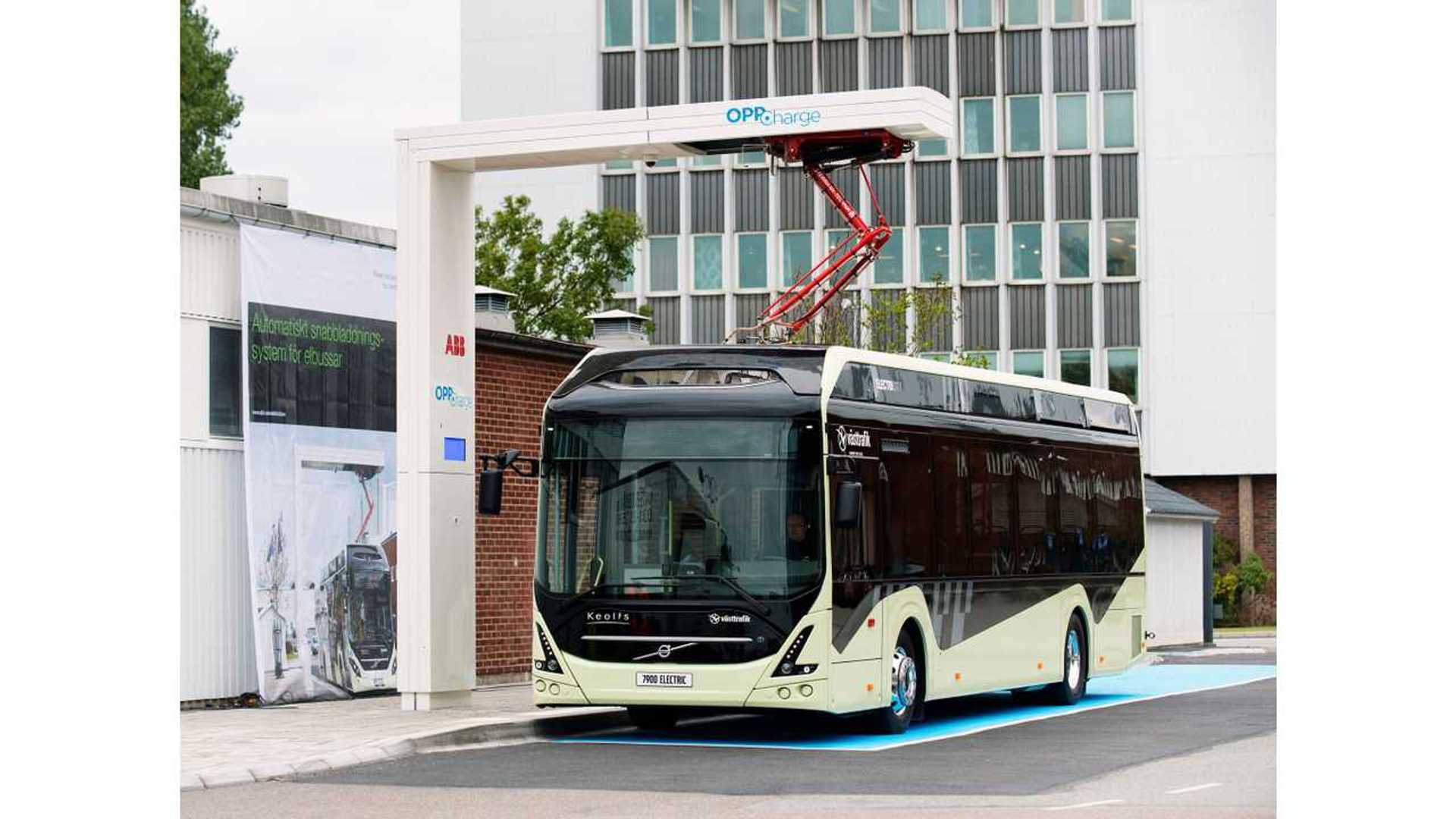
ABB And Volvo Debut 450 kW OppCharge Charging Station For Buses On The Fly
ABB and Volvo Buses launched the first electric bus charge station based on the new open interface OppCharge, 450 kW charging en route now available for all

ScotRail158725
Established Member
- Joined
- 27 Nov 2018
- Messages
- 2,662
Route branding is the same as the rear of the Aberdeen liveryI have seen a photo of one with a green front, which looks like the 7/7A colour.
Glasgowbusguy
On Moderation
- Joined
- 21 Feb 2019
- Messages
- 544
I wonder if SPT would install charge points at Buchanan bus station. Maybe in the central reservation or the tour stands where there is shore power already; it could allow drivers to swap buses by placing one on charge and taking one off charge.
Last edited by a moderator:

cnjb8
Established Member
Not my photoI have not seen one in the public domain.

Jarcoed
Member
That green looks decent on those EV's, glad it's darker than the lime green livery for the 2 or there would be confusion for passengers - and that's definently the 7/7A livery because on the network map that route has the same colour
JumpinTrainz
Established Member
- Joined
- 30 Jul 2018
- Messages
- 1,929
It looks like a similar colour to the Overground 88 colour. I wonder if we have more routes to be done. There’s not been a light pink, dark orange or purple yet but they’ve explored most shades of blue and green.
Trnsprt4Sctlnd
Member
If these are for the 7, by God its gonna look like a cram packed sardine tin on wheels!!That green looks decent on those EV's, glad it's darker than the lime green livery for the 2 or there would be confusion for passengers - and that's definently the 7/7A livery because on the network map that route has the same colour
ScotRail158725
Established Member
- Joined
- 27 Nov 2018
- Messages
- 2,662
They areIf these are for the 7, by God its gonna look like a cram packed sardine tin on wheels!!

Bus Lightyear
Member
- Joined
- 16 Nov 2018
- Messages
- 542
I don't see why that should be an issue. The 7 has been single deck operated for years.If these are for the 7, by God its gonna look like a cram packed sardine tin on wheels!!
Busman84
Member
The 7 should really be deckers. I think all the core routes should be double deckers. There are more routes that are now decker routes however all these routes have seen service levels reduced over the years. Singles create longer journeys when busy as people standing, so does mean it’s longer to board and get off.. The 2 and 3 are other services that should have deckers although you do see the 2 on a Sunday being mainly deckers.
JumpinTrainz
Established Member
- Joined
- 30 Jul 2018
- Messages
- 1,929
Since the start of the pandemic the 2 has been mainly deckers. It’s always confused me as to why First have always been determined to make this a single deck route. The 2 has been virtually unchanged over the years and sees very good passenger numbers. It would really benefit from deckers.
If the 77 does go to Caley and get electric stock it would be nice if the current branded 77 E400MMCs went on the 2 and even had a mixture of E300s and E400MMCs. The 2 hasn’t had new buses in a while now for such a core route.
If the 77 does go to Caley and get electric stock it would be nice if the current branded 77 E400MMCs went on the 2 and even had a mixture of E300s and E400MMCs. The 2 hasn’t had new buses in a while now for such a core route.
computerSaysNo
Established Member
- Joined
- 14 Dec 2018
- Messages
- 1,666
Do deckers cost much more to operate than single-deck vehicles? Obviously they cost more to purchase but I wouldn't think they would cost much more to run on relatively low-speed city routes?Since the start of the pandemic the 2 has been mainly deckers. It’s always confused me as to why First have always been determined to make this a single deck route. The 2 has been virtually unchanged over the years and sees very good passenger numbers. It would really benefit from deckers.

I would assume higher fuel consumption (or charge usage) but you could run the same route capacity with less vehicles and right now - critically -less drivers.Do deckers cost much more to operate than single-deck vehicles? Obviously they cost more to purchase but I wouldn't think they would cost much more to run on relatively low-speed city routes?
JumpinTrainz
Established Member
- Joined
- 30 Jul 2018
- Messages
- 1,929
Routes like the 46 and 19 can run half empty with B7TLs which I think rules that out. The 2 is a busy route which would actually require the extra capacity. This route used to have a mixture of deckers and singles and also bendy buses at one time.
Jarcoed
Member
The 46 is usually more popular in the evening, I find. I usually catch the 16.15 from Easterhouse and it tends to get busy around the Parkhead area of the journey, though doesn't need deckers.Routes like the 46 and 19 can run half empty with B7TLs which I think rules that out. The 2 is a busy route which would actually require the extra capacity. This route used to have a mixture of deckers and singles and also bendy buses at one time.
Stan Drews
Established Member
- Joined
- 5 Jun 2013
- Messages
- 2,140
The average fuel consumption is lower, probably around 5-6 mpg on intensive urban work, when some single decks may be in the region of 7-8 mpg. That might not sound significant, but is around a 25-30% increase in fuel cost.Do deckers cost much more to operate than single-deck vehicles? Obviously they cost more to purchase but I wouldn't think they would cost much more to run on relatively low-speed city routes?
I don’t have equivalent figures for electric buses, but they will certainly use more juice than single deckers, and I wouldn’t be surprised if the % was similar to that for diesel buses.
Trnsprt4Sctlnd
Member
Of course diesel DD vehicles cost more to run. Their driveline and engine layout is usually transverse through an angle drive into the gearbox; extra mechanicals alone lead to lower fuel economy.Do deckers cost much more to operate than single-deck vehicles? Obviously they cost more to purchase but I wouldn't think they would cost much more to run on relatively low-speed city routes?
Single deckers generally use an inline layout without the need for such extra equipment.
Keep in mind that the likes of an E200MMC is 8 tons is using a 4 cylinder vs an E400MMC being around 10-11tons driven via a 6 cylinder.
Comparing DDs against heavy weight singles like a Volvo B8RLE or Scania's new Fencer is harder to justify on your question, given that they can be almost as heavy as Doubles.

The route still has loads of B7s & B9 Deckers, as well as E400MMCs because of how busy it is again.Routes like the 46 and 19 can run half empty with B7TLs which I think rules that out. The 2 is a busy route which would actually require the extra capacity. This route used to have a mixture of deckers and singles and also bendy buses at one time.
Also, back when it was the 62, even more buses were needed as the route was extended to Airdre & at peak times, to Maximum Park. This continued into the early 2 days, until 2017/18, when they decided to scrap the extension services for some reason, and replaced that extension service with the 202 (I mistakenly said the 242).
Last edited:

TheGrandWazoo
Veteran Member
The average fuel consumption is lower, probably around 5-6 mpg on intensive urban work, when some single decks may be in the region of 7-8 mpg. That might not sound significant, but is around a 25-30% increase in fuel cost.
I don’t have equivalent figures for electric buses, but they will certainly use more juice than single deckers, and I wouldn’t be surprised if the % was similar to that for diesel buses.
All very trueOf course diesel DD vehicles cost more to run. Their driveline and engine layout is usually transverse through an angle drive into the gearbox; extra mechanicals alone lead to lower fuel economy.
Single deckers generally use an inline layout without the need for such extra equipment.
Keep in mind that the likes of an E200MMC is 8 tons is using a 4 cylinder vs an E400MMC being around 10-11tons driven via a 6 cylinder.
Comparing DDs against heavy weight singles like a Volvo B8RLE or Scania's new Fencer is harder to justify on your question, given that they can be almost as heavy as Doubles.
As well as purchase costs, the fuel costs are a significant on-cost though some heavyweight single decks were remarkably bad on fuel (i.e. B7Ls). There are other hidden costs such as vandalism being more prevalent and also, dwell time at stops as being ascend/descend to/from the top deck. Hence why operators don't naturally default to deckers, despite that being the preferred choice of the enthusiast!
However, it may well be that with ongoing staff shortages, there may be a widening of headways and a greater reliance on deckers.
The 2 extension was replaced by the 202 not the 242.The route still has loads of B7s & B9 Deckers, as well as E400MMCs because of how busy it is again.
Also, back when it was the 62, even more buses were needed as the route was extended to Airdre & at peak times, to Maximum Park. This continued into the early 2 days, until 2017/18, when they decided to scrap the extension services for some reason, and replaced that extension service with the 242.
Going by my 2 this morning there definitely needs to be more double deckers. One late because of the 20 min gap to the one infront and another caught up instantly but both ended up full at Scotstoun. Yes there were school kids on both but even by Thornwood the buses were both still pretty busy.