
• Our new ticketing site is now live! Using either this or the original site (both powered by TrainSplit) helps support the running of the forum with every ticket purchase! Find out more and ask any questions/give us feedback in this thread!

Tram track Explanation Single track auto divert to twin station /passing point

Status
Not open for further replies.

stuetor

New Member
Joined
8 Aug 2021
Messages
3
Location
London
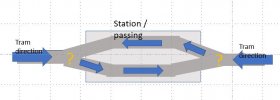
Hello guys Can anyone explain how a tram is auto diverted to one side or other of a passing point ? > Track controls > Is it so there is a single sprung blade on one side ?
Diagram with arrows much appreciated
If it is a single sprung rail/blade are there any safeguards to ensure it is in not blocked ? ( stiletto heel in gap etc ? )
Is there any ingenious idea to have a completely fixed track system to achieve no moving parts ? ( frogs etc ? )
Building a garden tramway O gauge Crodon Tramway base

stueter
 

Attachments

  • tram turn out.JPG
    tram turn out.JPG
    35 KB · Views: 32
Sponsor Post - registered members do not see these adverts; click here to register, or click here to log in
R

RailUK Forums

ALEMASTER

Member
Joined
18 Aug 2011
Messages
493
typically they are spring return points. There is usually a points indicator signal to confirm the points are fully across and making contact but the secondary safeguard is a visual check by the driver as they approach as such locations are low speed.
 

Waldgrun

Member
Joined
13 Oct 2011
Messages
306
Gauntleted track is not ideal for vehicles to pass on! I recall reading a rule book London trams and they use an electrical contact system, it worked by having a section of overhead near the points, which if the tram was taking power set the road for one track, or if coasting the other!
 

507 001

Established Member
Joined
3 Dec 2008
Messages
2,178
Location
Huyton
For simplicity such an arrangement would likely use sprung points. Modern systems would indeed have a Points Position Indicator (Metrolink speak) to prove the points are in the correct position.
 

edwin_m

Veteran Member
Joined
21 Apr 2013
Messages
28,774
Location
Nottingham
Gauntleted track is not ideal for vehicles to pass on! I recall reading a rule book London trams and they use an electrical contact system, it worked by having a section of overhead near the points, which if the tram was taking power set the road for one track, or if coasting the other!
To be clear, that's the historic London Trams. On Tramlink, the points are actuated by a beacon on the bottom of the tram interacting with a loop between the rails.

Tramlink does have two sections of gauntlet (or interlaced) track. One is in Mitcham where the former double track railway formation is partly blocked by a big concrete block which I assume was put there to stop the cutting wall collapsing. Having interlacing instead of a short section of conventional single line avoids the need for moving parts, reducing maintenance and safety risk. The other is on Church Street, which avoids having to put a motorised switch in the middle of a highway.
 

Alfonso

Member
Joined
22 Jul 2017
Messages
595
Amsterdam has very pleasing gauntleted track down narrow streets widening to passing places on bridges
 

etr221

Established Member
Joined
10 Mar 2018
Messages
1,610
Tramlink points vary. Some - facing points needing to be often changed (e.g. that at Church Street) - are controlled (changed) by some sort of driver initiated beacon signal from the tram (one of the rules I think is that he has to check that the point can change safely). Trailing points, and those which in facing mode are always set one way, are normally sprung, and uncontrolled. Less frequently used facing points (e.g. at East Croydon, to enter the middle track) are worked by a point lever - one is carried in the cab, and driver will get out with it to set the points - or if it's being done a lot (for engineering work), someone will be posted as pointsman.

Sprung points are also widely used at loops on RETB controled sections of the Network Rail, and also at station loops on the Welsh Highland Railway - I gather shunting at Dinas has to be carefully planned to work with this.
 

edwin_m

Veteran Member
Joined
21 Apr 2013
Messages
28,774
Location
Nottingham
Tramlink points vary. Some - facing points needing to be often changed (e.g. that at Church Street) - are controlled (changed) by some sort of driver initiated beacon signal from the tram (one of the rules I think is that he has to check that the point can change safely). Trailing points, and those which in facing mode are always set one way, are normally sprung, and uncontrolled. Less frequently used facing points (e.g. at East Croydon, to enter the middle track) are worked by a point lever - one is carried in the cab, and driver will get out with it to set the points - or if it's being done a lot (for engineering work), someone will be posted as pointsman.
If I recall correctly there are only 11 motorised points on Tramlink, but I think that includes the ones to access the middle track at East Croydon because that's used regularly.
 

_toommm_

Established Member
Joined
8 Jul 2017
Messages
6,310
Location
South West London
I’ve seen a few signs on the Supertram network where it says ‘points not trailable’ (mainly on the street running track). Are trailable points one that can be pushed over by the tram safely?
 

507 001

Established Member
Joined
3 Dec 2008
Messages
2,178
Location
Huyton
I’ve seen a few signs on the Supertram network where it says ‘points not trailable’ (mainly on the street running track). Are trailable points one that can be pushed over by the tram safely?

Yes. Non-trailable points in Metrolink land tend to be motorised or hydraulic points.
 

D365

Veteran Member
Joined
29 Jun 2012
Messages
13,205
I’ve seen a few signs on the Supertram network where it says ‘points not trailable’ (mainly on the street running track). Are trailable points one that can be pushed over by the tram safely?
Where are those? Don't remember seeing those signs at Cathedral or Hillsborough.
 
Status
Not open for further replies.

Top