NotATrainspott
Established Member
- Joined
- 2 Feb 2013
- Messages
- 3,304
The problem: we have towns like Egham:
NR or GBR or whatever body could solve a lot of these problems in one fell swoop if they could use compulsory purchase powers to comprehensively redevelop the town centre around the railway station.
I don't just mean buying a few slivers of land near the railway to deliver some incremental improvement. I mean buying up entire streets next to the railway, knocking them down, and building something better to replace them.
In Egham's case, your best bet at bridging over the railway would be to start the road ramp some distance to the north, and reach as far as the roundabout on the southern side. A simple bridge like this would be incompatible with the housing nearby. Even if there were enough width to build the bridge as well as access roads to the existing properties, they'd be blighted by the massive flyover right on their doorstep.
Doing a much more comprehensive development solves this problem. The places where fixing the level crossings will make the most difference will be the places where land values are highest, and so there is the most profit to be made in building large volumes of new housing.
It's easy for new builds to put the main entrance on a different level. The redeveloped land around the station would mean the streets would end up raised by a few metres to gently clear the railway. Once complete, the redevelopment could look entirely natural, as if there were always a hill there. The back gardens of the replacement properties could still be at the original ground level, below the street. There are plenty of examples of very desirable housing (e.g. in the Edinburgh New Town) built on hills where the back gardens are sometimes several storeys beneath the front door.
Parking could be kept on the natural ground level, but completely decked over to provide nice pedestrianised streets.
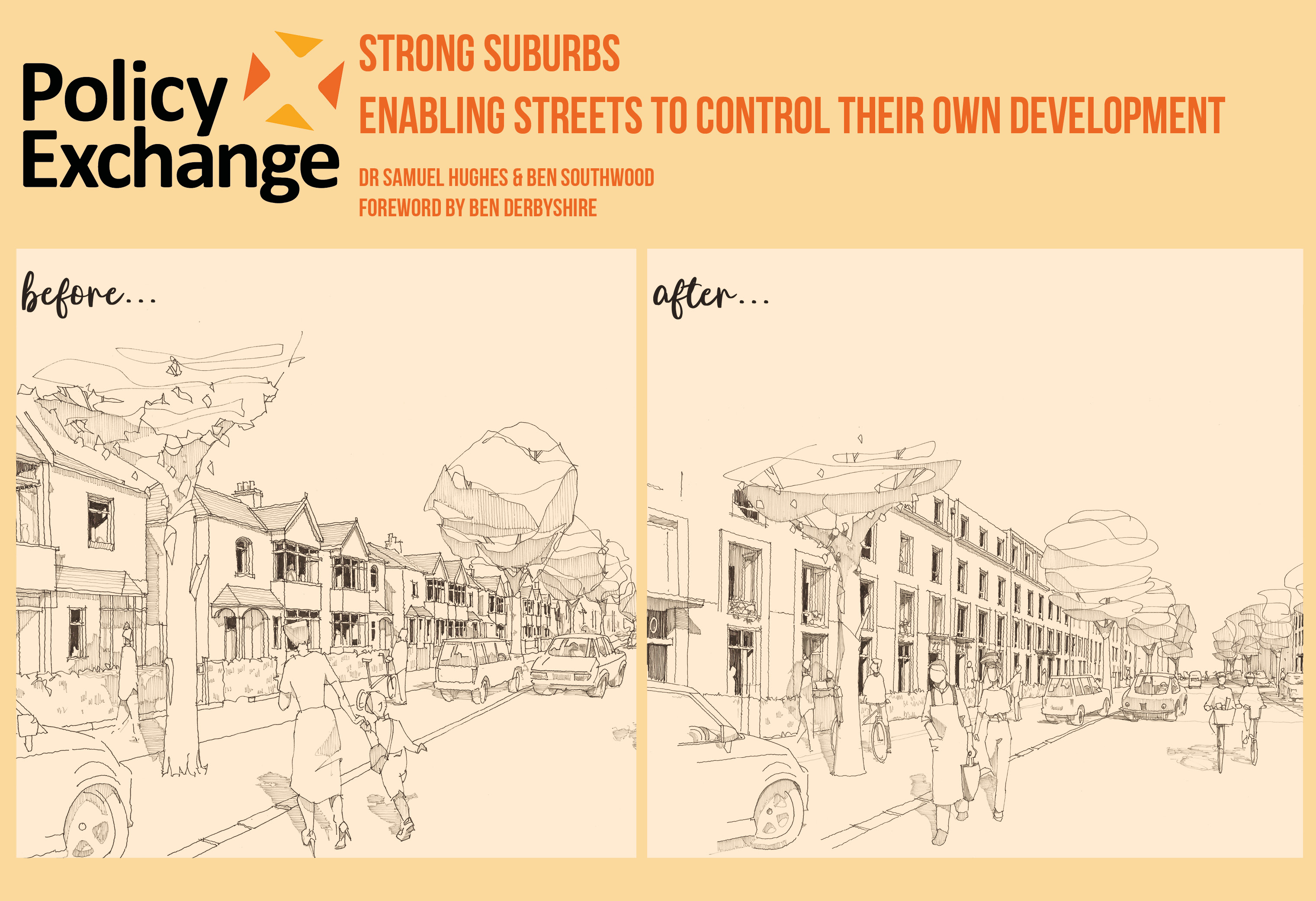
There's no way we can increase the supply of housing without building on the greenbelt unless we start considering schemes like this, to redevelop existing inhabited areas. We're running out of single big brownfield plots. Some think tanks are already starting to propose policies on these lines: Let streets vote to ‘build beautiful’ and create post-Covid housing boom, says Policy Exchange's new report. Having the rail operator kickstart these schemes seems like a very sensible idea, as that's where the most regional and national benefit could be had.
- Cut in half by an at-grade railway line, with no easy opportunity to replace the level crossings with bridges or underpasses
- Level crossings here make a nationally important infrastructure scheme (Southern Rail Access to Heathrow) difficult, as well as general rail service improvements
- Existing town road and development layout makes a simple bridge or underpass very difficult. Roads and suburban homes are too close to the railway.
- Located on a major London commuter route, so there is intense demand for housing
- Little or no land available for more housing. Greenbelt development is very unpopular, and adding more suburban sprawl to outskirts puts too much pressure on small town centre infrastructure (e.g. road widths, parking at train station.
NR or GBR or whatever body could solve a lot of these problems in one fell swoop if they could use compulsory purchase powers to comprehensively redevelop the town centre around the railway station.
I don't just mean buying a few slivers of land near the railway to deliver some incremental improvement. I mean buying up entire streets next to the railway, knocking them down, and building something better to replace them.
In Egham's case, your best bet at bridging over the railway would be to start the road ramp some distance to the north, and reach as far as the roundabout on the southern side. A simple bridge like this would be incompatible with the housing nearby. Even if there were enough width to build the bridge as well as access roads to the existing properties, they'd be blighted by the massive flyover right on their doorstep.
Doing a much more comprehensive development solves this problem. The places where fixing the level crossings will make the most difference will be the places where land values are highest, and so there is the most profit to be made in building large volumes of new housing.
It's easy for new builds to put the main entrance on a different level. The redeveloped land around the station would mean the streets would end up raised by a few metres to gently clear the railway. Once complete, the redevelopment could look entirely natural, as if there were always a hill there. The back gardens of the replacement properties could still be at the original ground level, below the street. There are plenty of examples of very desirable housing (e.g. in the Edinburgh New Town) built on hills where the back gardens are sometimes several storeys beneath the front door.
Parking could be kept on the natural ground level, but completely decked over to provide nice pedestrianised streets.
There's no way we can increase the supply of housing without building on the greenbelt unless we start considering schemes like this, to redevelop existing inhabited areas. We're running out of single big brownfield plots. Some think tanks are already starting to propose policies on these lines: Let streets vote to ‘build beautiful’ and create post-Covid housing boom, says Policy Exchange's new report. Having the rail operator kickstart these schemes seems like a very sensible idea, as that's where the most regional and national benefit could be had.