Why only 1tp isn't the full TPE timetable based on 2tph that will be Bi-mode.For the foreseeable future up to 1tph passing through Church Fenton will be capable of using the AC.

-
Our new ticketing site is now live! Using either this or the original site (both powered by TrainSplit) helps support the running of the forum with every ticket purchase! Find out more and ask any questions/give us feedback in this thread!
You are using an out of date browser. It may not display this or other websites correctly.
You should upgrade or use an alternative browser.
You should upgrade or use an alternative browser.
Transpennine Route Upgrade and Electrification updates
- Thread starter GRALISTAIR
- Start date
Sponsor Post - registered members do not see these adverts; click here to register, or click here to log in
R
RailUK Forums
The problem was never about how to stick a post in the ground.
That's what the report says was the root of the problems.
WAO

Why only 1tp isn't the full TPE timetable based on 2tph that will be Bi-mode.
I was under the impression that it's 1tph bi-mode (Liverpool-Newcastle/Edinburgh) and 1tph LHCS (Manchester Airport - Middlesborough/Redcar)
That's what the report says was the root of the problems.
WAO
The low productivity of the piling system was arguably the root cause of the programme overrun. That manages to completely overlook the fact that the assumptions made about the capacity of the piling system did not match the reality, which is arguably more of a root cause (and also helpfully applies to a lot more than just the actual piling!)
I was under the impression that it's 1tph bi-mode (Liverpool-Newcastle/Edinburgh) and 1tph LHCS (Manchester Airport - Middlesborough/Redcar)
There is 1tph Manchester Airport-Newcastle as well which is mainly 802, ok that isn't running at the moment but presumably will be restored at some point.
"Great reliance was placed on the High Output System (the HOPS and the OLE) to deliver electrification quickly, efficiently and with the minimum possible disruption to passengers and freight. This was a very laudable objective, but the outputs assumed in the programme were not achieved in practice. The greatest difficulty was with the productivity of the piling system to which the overlong piles were a significant contributory factor. This is arguably the root cause of all cost and programme overrun on GWEP, once the piling output fell behind and gaps were left requiring return visits the programme, which lacked resilience, rapidly became unrecoverable. "
(ECC Rport, RIA p52)
WAO
(ECC Rport, RIA p52)
WAO
Again, I disagree with the assertion that it is the root cause. If you can ask and get an answer to the question "why" then something isn't a root cause
Q. Why did they have to keep returning to sites to finish the piling work, having failed to do it during the planned time
A. Because the planning relied on all matter of assumptions, most of which were seemingly plucked from thin air and subsequently turned out to be unachievable
It's not that NR couldn't drive piles into the ground, it's that they couldn't drive the piles into the ground quickly enough to meet the schedule, for a whole host of reasons that would have been flagged up with better planning as detailed in the report. Sure they can install the posts in the ground fairly quickly if conditions are right, but it's getting to the position where they can install the posts that is the difficult bit
Q. Why did they have to keep returning to sites to finish the piling work, having failed to do it during the planned time
A. Because the planning relied on all matter of assumptions, most of which were seemingly plucked from thin air and subsequently turned out to be unachievable
It's not that NR couldn't drive piles into the ground, it's that they couldn't drive the piles into the ground quickly enough to meet the schedule, for a whole host of reasons that would have been flagged up with better planning as detailed in the report. Sure they can install the posts in the ground fairly quickly if conditions are right, but it's getting to the position where they can install the posts that is the difficult bit

Philip Phlopp
Established Member
- Joined
- 31 May 2015
- Messages
- 3,003
"Great reliance was placed on the High Output System (the HOPS and the OLE) to deliver electrification quickly, efficiently and with the minimum possible disruption to passengers and freight. This was a very laudable objective, but the outputs assumed in the programme were not achieved in practice. The greatest difficulty was with the productivity of the piling system to which the overlong piles were a significant contributory factor. This is arguably the root cause of all cost and programme overrun on GWEP, once the piling output fell behind and gaps were left requiring return visits the programme, which lacked resilience, rapidly became unrecoverable. "
(ECC Rport, RIA p52)
WAO
Overlong piles is a simplistic and flawed answer. You need to look at why we were using such lengthy piles in the first place.
1. To support masts moved clear of the typical location of signalling and power cables in the cess, and,
2. To provide a more robust foundation than the in-situ cast concrete foundations previously used with the Mark 3 OLE system.
I can also give you a catalogue of problems with the HOPS system - even without the overlong piles, the Movax plant fitted to HOPS would struggle to drive home the piles sufficiently, a point that can easily be demonstrated by reviewing the thousands of photographs taken during piling works which show hundreds of foundations sticking out of the ground by metres, and when the team had given up on the pile they were working on, it would take them far too long to move around within the possession to get to the next site.
The piles left incomplete weren't always left because the Movax couldn't finish the job, some piles were stopped when signalling cables were encountered, or the signalling system failed during piling. The signalling system would often fail afterwards, as vibration from piling damaged already pretty much life expired insulation and all manner of earth faults occurred.
I've probably discussed this at quite some length previously (it is a long time now) but the loss of precise signal cabling data (do we blame Railtrack or Racal) and the way in which S&T had been forced into burying cabling runs to try and prevent theft is really the start of the foundation issue. There were points during the 2000's when it felt it would be easier just to give criminals the cash they would have got from stealing signalling cable, saving S&T the trouble of tramping around in the cess laying new cable runs every night. I think many people have forgotten just how bad cable theft was (very much me not blaming S&T here).
To try and avoid all of those buried cable runs, a conscious decision was made to move masts further from the track, this has the unfortunate side effect of needing significantly deeper foundations to resist the greater leverage force acting on top of the mast by the cantilever structure and catenary wiring (which itself was heavier per metre due to the higher tension needed).
The best suggestion in the RIA report isn't to do with foundations. It's to do with troughing signalling cables and tidying up cabling runs generally prior to piling.

LNW-GW Joint
Veteran Member
In a table I read of actual route electrification costs, the NW Manchester-Blackpool route cost the most per stkm.
This was more than the GW scheme and about triple the estimate. The HOPS train was not used on that scheme.
I don't know if the Farnworth tunnel scheme, or Blackpool remodelling, were part of those costs or not.
This was more than the GW scheme and about triple the estimate. The HOPS train was not used on that scheme.
I don't know if the Farnworth tunnel scheme, or Blackpool remodelling, were part of those costs or not.
Iirc that was mostly to do with the old mine workings every 3 feet along the Manchester to Preston bit, and the fact that most of the posts had to be individually analysed, carefully positioned, and in some cases set on massive concrete rafts. I suspect if they'd costed it properly in the first place rather than assuming in the early stages that the magic HOPS train could sort it in a jiffy then they might not have bothered with itIn a table I read of actual route electrification costs, the NW Manchester-Blackpool route cost the most per stkm.
This was more than the GW scheme and about triple the estimate. The HOPS train was not used on that scheme.
I don't know if the Farnworth tunnel scheme, or Blackpool remodelling, were part of those costs or not.
Philip Phlopp
Established Member
- Joined
- 31 May 2015
- Messages
- 3,003
In a table I read of actual route electrification costs, the NW Manchester-Blackpool route cost the most per stkm.
This was more than the GW scheme and about triple the estimate. The HOPS train was not used on that scheme.
I don't know if the Farnworth tunnel scheme, or Blackpool remodelling, were part of those costs or not.
There were noted problems with ground conditions and foundations on the NW project, the loss of Balfour Beatty (who had completed some foundation work, with which problems were discovered) and the switch to Carillion, who themselves were replaced with Amey, of course wasn't entirely helpful. The burst pipe at Moses Gate was a kick in the teeth too.
Farnworth Tunnel was ready to fall down and would have needed some remedial work not much later than the re-boring scheme anyway, but that was a painful experience with a lack of solid ground in places to tunnel through.
I hear criticism of the costings, but that particular project threw up pretty much every problem you could have. If it could go wrong, it pretty much did go wrong.
LNW-GW Joint
Veteran Member
Without knowing any of the details, you'd maybe expect the TP conditions would be somewhat similar to Manchester-Blackpool.
Plenty of old mine workings and structures through the complex Pennine geology, and soft ground over the Yorkshire coalfield to the east.
Plenty of old mine workings and structures through the complex Pennine geology, and soft ground over the Yorkshire coalfield to the east.

themiller
Established Member
I think that the problem with the mine workings was not that they were mines as are normally accepted (long tunnels cut through the coal seams) but 'bell pits' which are a small hole at the surface which open out into a bell shaped chamber. These were normal in centuries gone by and pre-date mapping of them. They were often a family enterprise which were just abandoned when they became exhausted or too big to be stable. Because of that, trial pits wouldn't have found problems unless they dug at the site of the entrance holes. http://www.dmm.org.uk/pitwork/html/history1.htm gives an explanation and illustration of bell pits.Iirc that was mostly to do with the old mine workings every 3 feet along the Manchester to Preston bit, and the fact that most of the posts had to be individually analysed, carefully positioned, and in some cases set on massive concrete rafts. I suspect if they'd costed it properly in the first place rather than assuming in the early stages that the magic HOPS train could sort it in a jiffy then they might not have bothered with it
edwin_m
Veteran Member
There's a map of areas of risk from historic coal mining at https://mapapps2.bgs.ac.uk/coalauthority/home.htmlWithout knowing any of the details, you'd maybe expect the TP conditions would be somewhat similar to Manchester-Blackpool.
Plenty of old mine workings and structures through the complex Pennine geology, and soft ground over the Yorkshire coalfield to the east.
The highest part of the Pennines, where most of the tunnel would be, isn't a coalfield.

Killingworth
Established Member
Plenty of old mine workings and structures through the complex Pennine geology, and soft ground over the Yorkshire coalfield to the east.
There are indeed and most have been mapped to a greater or lesser extent depending on age. There's an excellent interactive map on the Coal Authority's website. You can drill down to a very detailed view, although not sufficiently accurate to help the positioning of individual masts. See; http://mapapps2.bgs.ac.uk/coalauthority/home.html
edwin_m
Veteran Member
The very same map I linked to two hours previously, where I also point out there is no suggestion of any coal mining in the Pennines themselves where most of the tunnel would be.There are indeed and most have been mapped to a greater or lesser extent depending on age. There's an excellent interactive map on the Coal Authority's website. You can drill down to a very detailed view, although not sufficiently accurate to help the positioning of individual masts. See; http://mapapps2.bgs.ac.uk/coalauthority/home.html
Killingworth
Established Member
The very same map I linked to two hours previously, where I also point out there is no suggestion of any coal mining in the Pennines themselves where most of the tunnel would be.
My apologies, I was preparing my input earlier in the day and got carried away with a sidetrack before submitting

edwin_m
Veteran Member
No problem.My apologies, I was preparing my input earlier in the day and got carried away with a sidetrack before submitting
Gentle prod to ask that we try and stick to the topic at hand which is the Transpennine Route Upgrade. There's been some posts of late which have rather taken us away from that 
WideRanger
Member
- Joined
- 15 Jun 2016
- Messages
- 398
It is great to see you back!You've all missed the announcement of electrification between Colton Junction and Church Fenton, as far as I can tell.
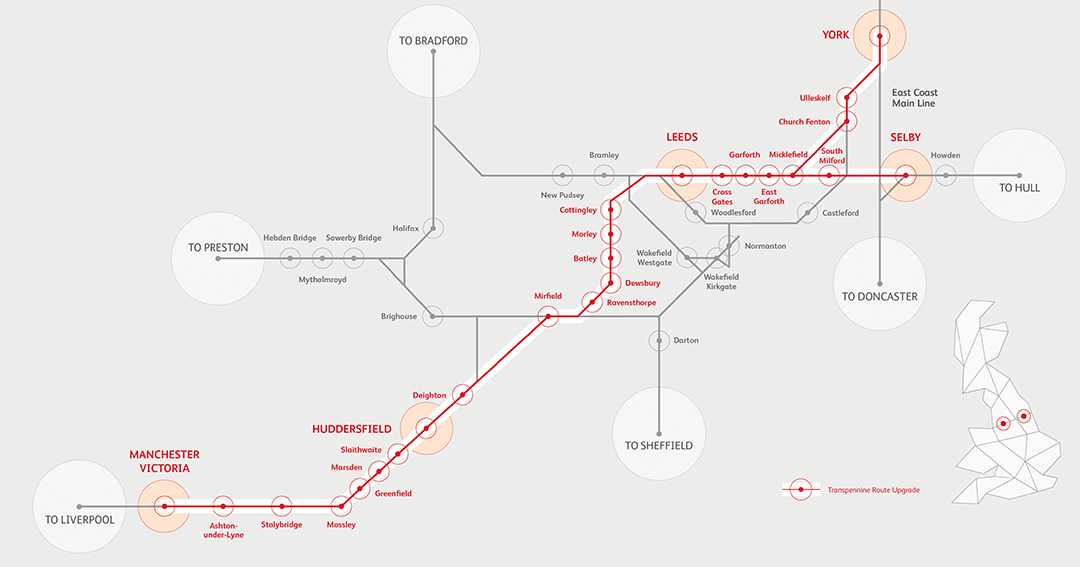
Transpennine Route Upgrade - Network Rail
The Transpennine Route Upgrade (TRU) is a multi-billion pound, long-term railway infrastructure programme that will improve connectivity.www.networkrail.co.uk
WatcherZero
Established Member
- Joined
- 25 Feb 2010
- Messages
- 10,272
Supposedly going to be a £6bn rail funding for the North announcement this week of projects to quickly get started on as economic stimulus including funding for the TPU. My bet would be Wednesday to try and take the headlines away from the publication on Tuesday of the report into Russian intervention in UK politics that the Governments been trying to avoid releasing since before the last election.
Supposedly going to be a £6bn rail funding for the North announcement this week of projects to quickly get started on as economic stimulus including funding for the TPU. My bet would be Wednesday to try and take the headlines away from the publication on Tuesday of the report into Russian intervention in UK politics that the Governments been trying to avoid releasing since before the last election.
Yes you're correct - wrong day though.
My bet would be Wednesday to try and take the headlines away from the publication on Tuesday of the report into Russian intervention in UK politics that the Governments been trying to avoid releasing since before the last election.
Heavens above; surely not!!

However I would thought that a bit of investment in t'north would be trumped in the London-centric press by a national Government issue such as the Russian report. Mind you, haven't the relevant Committee (not under the control of Mr F Grayling
 ) the power to set the time when the Russian report will be issued? They could manoeuvre to outsmart the Government's timing, especially as the chairman is no longer in the Tory party.
Anyway it will be good to hear what is proposed and more importantly a timescale for completion.
Last edited:

LOL The Irony
Established Member
Would this be for just NPHR/TPE upgrade, or all of the north?Supposedly going to be a £6bn rail funding for the North announcement this week of projects to quickly get started on as economic stimulus including funding for the TPU. My bet would be Wednesday to try and take the headlines away from the publication on Tuesday of the report into Russian intervention in UK politics that the Governments been trying to avoid releasing since before the last election.
WatcherZero
Established Member
- Joined
- 25 Feb 2010
- Messages
- 10,272
Principally TPE (which would be between a third and half of the total) but also other shovel ready projects being greenlit.
nr758123
Member
Expected to be announced on Thursday, according to a press release from Transport for the North.
Link is https://transportforthenorth.com/empowerment-must-be-next-for-the-norths-one-voice-on-transport/
“our first statutory advice in September 2018 was to urge the Government to fast-track investment in the Transpennine Route Upgrade and give us a strengthened role in its delivery. Back then, we made clear Government should green light the full ambitions to electrify the route mooted now a decade previously, not a cut price partial option. It’s expected to be finally announced on Thursday, and our recommendations are now being given an airing. We’ve made similar calls to just get on with the Castlefield corridor interventions through Manchester after a decade-long back-and-forth on the best solution.”
Link is https://transportforthenorth.com/empowerment-must-be-next-for-the-norths-one-voice-on-transport/
Expected to be announced on Thursday, according to a press release from Transport for the North.
Link is https://transportforthenorth.com/empowerment-must-be-next-for-the-norths-one-voice-on-transport/
That press release is dynamite!

ABB125
Established Member
Do you mean the one quoted or the one due on Thursday? (or both!)That press release is dynamite!
Do you mean the one quoted or the one due on Thursday? (or both!)
The one quoted. Very rarely do you get the Chief Exec of a Govt agency openly criticise the department that funds it. Usually it’s called a ‘resignation speech’.
ABB125
Established Member
Ok, thanks. I agree, it is rather unusual!The one quoted. Very rarely do you get the Chief Exec of a Govt agency openly criticise the department that funds it. Usually it’s called a ‘resignation speech’.

squizzler
Established Member
Whilst I approve of any rail body giving the DfT a pummelling, whatever happened to the idea a press release should be short and snappy?