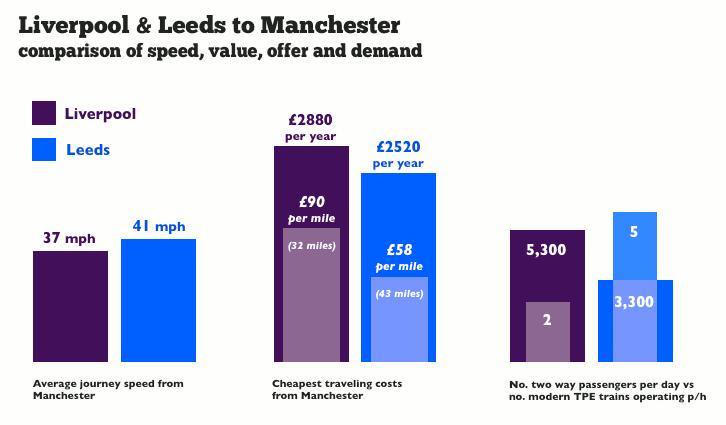
Of course many figures can be produced to prove all sorts of things but most of us don't have accurate data specific to particular routes. Anecdotally I can say that use of the Sheffield - Manchester trains had been increasing by big margins over the last 20 years - or it was until March 2020!
I can produce figures from the ORR to show usage of services on that line from Dore & Totley in 2008/9 and 2018/9 when it went from 82,802 to 198,948, an increase of 140%. (That was after almost doubling in the previous 10 years.) Numbers using Sheffield station for all destinations are much bigger but have only gone up about 25%. I'd contend that the figure for the Manchester route will have been bigger than 25%. Someone must know a more accurate figure.
My gripe is that capacity is needed within the north and all other regions if we are ever to dent the dominance of the London magnet. That's not a London prejudice. It's recognition of what happens anywhere and everywhere. Birmingham, Manchester and Leeds are smaller magnets, as are Liverpool and Newcastle. Go to the North Cape of Norway where the 6.9km Nordkapp road tunnel 230m below the sea has brought wealthy citizens from Oslo and Bergen to their midnight sun summer homes - and the young people from the area have fled in the opposite direction leaving new homes and schools deserted!
The story of human civilisation suggests such trends are inevitable, but better regional links can slow them down. Which brings me back to topic. We need to reinforce what we have in the regions more. If the Norwegians can build tunnels in inhospitable and sparsely populated places as they do, why can't we get digging and better connect much bigger and closer places?
The regional growth figures are taken from ORR data, in fact are just this table but with the years between taken out (and those regions which are not key HS2 markets) and the annual growth figure replaced with the overall growth:
I fully agree that extra capacity within the North is required, it's why I also support NPR and would welcome future investment in the existing network within the region. As such in glad that the Transpennine Upgrade is progressing and look forwards to what the full scheme will deliver.
However HS2 will create extra capacity, for instance (whichever scheme at Manchester proceeds) the removal of long distance services from the existing platforms at Piccadilly would create extra platform capacity for local services.
The removal of 1 Avanti service from one platform would allow the following to happen:
- 2 services to be placed on that platform
- both those services could be up to 6x20m coaches long (subject to safe wirking gaps)
- the released platform capacity from the repositioning of those services could allow other services to be lengthened, that's at least a further 2 which can be lengthened.
Of you can remove 2 services, then not only does this double the number of services lengthened from 4 to 8, but due to the ability to turn regional trains around in ~20 minutes rather than ~30 minutes for intercity services there's scope that could be more services still, quite possibly up to an extra 50%.
Therefore by the removal of 2 full length long distance services it's possible to create platform capacity for extending 8 to 12 services.
However that should be in partnership with local projects which create extra capacity in advance of that.
Especially given that, if we are serious about reaching net zero a significant increase in rail capacity will be needed if we are ever going to reduce our use of the car.
As I've said, is be quite happy for the station at Manchester to become a through station, however this should be in addition to the Eastern Arm of HS2 so that the East Midlands sees the same regional improvements which Manchester could.
I also think that NPR (partly due to tying in to the original HS2 layouts) perhaps wasn't ambitious enough.
I also would suggest that further high speed lines would likely be needed, at the very least one up the East Coast & one serving Wales and the West Country. The latter of which could even pick up some South Coast locations.
I do wonder if a better proposal would be to build through platforms underground for HS2, with some more regional platforms (maybe with an area of concourse with shops) at ground level and then the development over that, rather than the development starting at ground level. As that would create even more capacity for rail services.
Again, following the pattern of released capacity, two new platforms could allow the lengthening of up to 12 regional services.
Given that they would be above 400m long platforms it would be possible to mirror at ground level what's happening underground, (so four extra platforms is it?) whilst providing 50m of concourse and 330m long platforms allowing a pair of 6*26m trains to use the platforms to use each platform.
Probably more likely a 7*26m 80x (TPE services lengthened from their existing 5 coach length with broadly the same number of passengers as a 9 coach 390) plus a 6*20m regional service on the same platform.
Better still see if it's possible to design the ground level platforms to be 400m long so as to provide as much extra capacity as possible (400m would fit a 9 coach and a 5 coach 80x trains, or a pair of 9*20m trains or even a trio of 6*20m trains).
The extra cost of doing so, even taking into account the lost development area, would be fairly cheap but would significantly (& by many factors more than most other schemes) increase capacity at Piccadilly.
Of course if it were possible to create more through platforms then that would be better still, however I would suggest that's unlikely unless you could safeguard enough of a surface route to get you clear of the HS2 tunnels to then start tunneling generally westwards which could even provide a sub surface station for Media City. In fact, if there's 4 platforms that could also allow 2 sub surface lines under the city West and North West picking up areas which would otherwise be some distance from their closest station.