• Our new ticketing site is now live! Using either this or the original site (both powered by TrainSplit) helps support the running of the forum with every ticket purchase! Find out more and ask any questions/give us feedback in this thread!

Rival Manchester Piccadilly proposal

Status
Not open for further replies.

HSTEd

Veteran Member
Joined
14 Jul 2011
Messages
20,311
But you're also devoting a lot of capacity to Leeds that is currently earmarked for other places in the north west and Scotland. There would be losers from this idea (I won't mention Liverpool here).
I'm not sure how much extra capacity is "devoted" to Leeds though.

Birmingham-Leeds/NE trains don't take any extra paths in this system because they are the Birmingham-Manchester trains.
I suppose the chief determinant is how high the London-Manchester-Leeds-(NE) frequency has to be to cover demand.

3 400m trains is probably too small, but I think the 7.5-8 that would be implied by adding HS2 trains to NE, Leeds and Manchester today is excessive.
 
Sponsor Post - registered members do not see these adverts; click here to register, or click here to log in
R

RailUK Forums

Glenn1969

Established Member
Joined
22 Jan 2019
Messages
1,983
Location
Halifax, Yorks
I think the losers in the S Plan are the East Midlands, Sheffield and most of Yorkshire

How does journey time of Leeds via this route stack up against ECML and doesn't it render the plans for Midlands Engine and Midlands Connect dead in the water?
 

HSTEd

Veteran Member
Joined
14 Jul 2011
Messages
20,311
I think the losers in the S Plan are the East Midlands, Sheffield and most of Yorkshire
Well that depends, if we abandon the East branch entirely, sure.

But most of the negative impacts can be ameliorated by building a stub to Toton I think.

How does journey time of Leeds via this route stack up against ECML and doesn't it render the plans for Midlands Engine and Midlands Connect dead in the water?

It still absolutely thrashes the ECML, after all London to Manchester is predicted at ~1hr08 after HS2-2.

Also I've not seen anything about those schemes at all outside this forum and even then only briefly.
I dont think they really matter at all.
 

HSTEd

Veteran Member
Joined
14 Jul 2011
Messages
20,311
The cost saving in this plan only happens if the East branch is abandoned

Going to Toton would cost dramatically less than the East Branch as currently envisaged though.
It's about 60km out of 160-170km for the entire Eastern branch.
 

Camden

Established Member
Joined
30 Dec 2014
Messages
1,949
The wonderful thing about modelling current traffic flows is that it shows just that. It doesn't show traffic flows that would occur if changes were made to speed those flows.
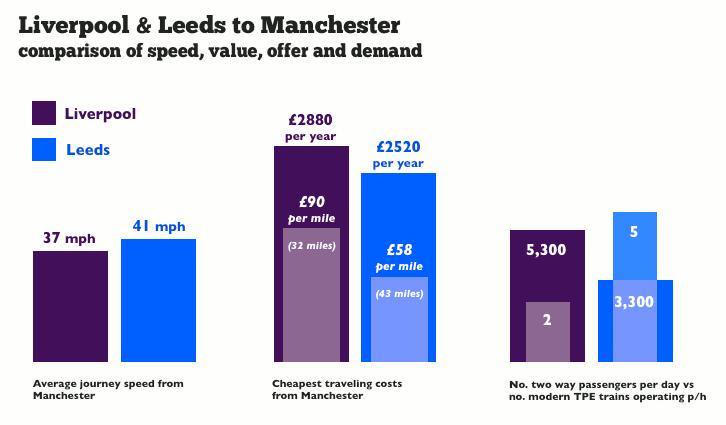
Quite possibly, and this was actually the first rolled out rationale for the Manchester-Leeds link. While other cities were incorrectly told they didn't have enough custom to be worth the bother of connecting to HS2, it was conversely argued (in writing!) that the NPR HS3 link must happen between Manchester-Leeds because travel flows are magnitudes lower than expected for cities of such size.

The argument wasn't helped by facts noted at the time, though, which begged the question "what more could you possibly want?"

DH2sx0YXgAE97yK


Of course the real problem was policy wonks expecting to see travel demand between, by their reckoning, a city of 2.7m and a city of 3m, with the reality coming nowhere close. Instead the city they consider doesn't even figure is the one with 2m scale figures, with half the service!

I think Sheffield can forget HS2, and if it becomes easier to get to Manchester at all, it will only be via Leeds. It doesn't have to make sense. The arguments supporting it just have to scrape through at the time.
 

adamedwards

Member
Joined
4 Apr 2016
Messages
796
A connnection to the eastern arm of HS2 where it crosses the Cross Country route south of Tamworth would enable XC trains to go on to the new line up to Sheffield and York, massively improving XC speeds. This of course has to be balanced against the paths needed and weather Birmingham to Leeds on HST2 takes sufficeint traffic to make this irrelevent. XC would need new trains capable of higher speeds, which would need to be factored into the replacement trains being ordered by the next concession (assuming franchises are dead). They would need to be a bit like the 395s on HS1, able to get out of the way of the Classic Compatibles in acceleration, if not top speed.
HST2 East needs to be seen as a combined new ECML, Midland ML and XC Main line, not simply a replacement for the ECML. If nothing else it kicks the Digswell Viaduct doubling a long way into the future.
But I am taking us a long way from Manchester Picc....
 

Gareth

Established Member
Joined
10 Mar 2011
Messages
1,505
Quite possibly, and this was actually the first rolled out rationale for the Manchester-Leeds link. While other cities were incorrectly told they didn't have enough custom to be worth the bother of connecting to HS2, it was conversely argued (in writing!) that the NPR HS3 link must happen between Manchester-Leeds because travel flows are magnitudes lower than expected for cities of such size.

Yes, I noticed that reverse logic too. The simple fact is they do what they want and don't do what they don't want. They build the case to support the conclusion they're looking for.

And yes, Sheffield's getting jack. It's not Whitehall's administrave capital for its Yorkshire and the Humber region (which is Leeds) so it may as well not exist. That said, I'm note sure we'll see any significant NPR infrastructure (and, for the record, I do think the East-West Piccadilly tunnel would be a worthy project). We've utterly crashed the economy with this lockdown thing. I don't think people generally realise how much this is going to cost us. HS2 will be prioritised and I'm not sure I can see even that being built in full (for better or worse).

If we get the transpennine route electrified within the next decade then we'll be doing very well indeed.
 

The Ham

Veteran Member
Joined
6 Jul 2012
Messages
12,036
Whilst a through station in Manchester, at least at first glance, would appear to be a good idea I would suggest that such a through station shouldn't be at the expense of other routes.

In fact it should be part of a wider network of High Speed lines, as if we are going to teach net zero then we're going to need a LOT more rail travel. Due to the way we travel a 6.25% shift from road to rail would mean that the number of miles traveled by rail would increase by 50%.

Therefore, even with significant reductions in travel and much more travel by cycle (to get to HALF of the average distance cycled by people in 1950 we'd need to increase cycling by a factor of 2.4) the use of rail is likely to increase significantly.

The average distance traveled per person (total miles divided by total population) is just over 7,000 miles a year. 6.25% of this is about 440 miles a year, I can do way more than that on just one trip to see one part of my family, even another part of my family (which are fairly local to me) I could do that many miles by setting them about once a fortnight.

Whilst I'm not that normal (& before anyone comments you can read that however you like!) I'm not so abnormal that the vast majority of people wouldn't easily be able to do 440 miles by rail each year of they were serious about cutting their carbon emissions.

Before anyone suggests that this could be achieved by switching to EV's, emissions from all rail (including diesel trains) when averaged to 10,000 miles creates 0.59 tonnes of CO2, whilst EV's create 0.60 tonnes.

Whilst the greening of the generation grid would reduce the figure for EV's faster than rail, rail can (and is) able to reduce faster still by reducing the number of miles undertaken by diesel. This includes more electrification, bimodal trains, battery trains and hydrogen trains. Of course the building of new high speed lines also aids with this by increasing the number of passengers carried by EMU and needing more of the network to be electrified.
 

Purple Orange

On Moderation
Joined
26 Dec 2019
Messages
3,459
Location
The North
We've utterly crashed the economy with this lockdown thing. I don't think people generally realise how much this is going to cost us. HS2 will be prioritised and I'm not sure I can see even that being built in full (for better or worse).

If we get the transpennine route electrified within the next decade then we'll be doing very well indeed.

Whatever the future months and years bring us, we can not under any circumstances accept more austerity. It was proven to have been unnecessary the last time and we must go for a different model this time. Invest our way out of this problem and rebuild the economy faster than we did under Cameron.
 

The Ham

Veteran Member
Joined
6 Jul 2012
Messages
12,036
Whatever the future months and years bring us, we can not under any circumstances accept more austerity. It was proven to have been unnecessary the last time and we must go for a different model this time. Invest our way out of this problem and rebuild the economy faster than we did under Cameron.

Indeed, if government spends money a chunk of it comes straight back to our in taxes and yet more comes back to our in associated taxes (i.e. I'm taxed then I spend money which results in others being taxed who then spend and that results in yet others being taxed, etc.)
 

Camden

Established Member
Joined
30 Dec 2014
Messages
1,949
Indeed, if government spends money a chunk of it comes straight back to our in taxes and yet more comes back to our in associated taxes (i.e. I'm taxed then I spend money which results in others being taxed who then spend and that results in yet others being taxed, etc.)
That's only true if the BCR is well above 1, adjusted for inflation.

Going ahead with HS2 at the expense of other things might keep HS2 in work, but it would represent very poor value for the money spent.

For only a portion of the budget, you could instead create hefty direct-spend multi-billion Pound stimulus packages for each of the major cities, plus TPE electrification and Piccadilly platform 15 thrown in for good measure.

Given the conversation on this actual topic (rival HS2 proposal) has shone a light on various shortcomings of the project and how it is variously concocted to benefit some while short-change others, it seems strange to start a conversation defending it as an example of "build our way out of recession". It might provide mild stimulus to a couple of locations, but for some areas it looks to do the exact opposite.
 

HSTEd

Veteran Member
Joined
14 Jul 2011
Messages
20,311
I'd prefer the reverse S solution, especially with a stub east branch to the current Y model.

But I must say my current model involves turning Manchester Airport railway station into some sort of High Speed Clapham Junction, being used as the core for a network of routes stretching over most of the country.
 

The Ham

Veteran Member
Joined
6 Jul 2012
Messages
12,036
That's only true if the BCR is well above 1, adjusted for inflation.

Going ahead with HS2 at the expense of other things might keep HS2 in work, but it would represent very poor value for the money spent.

For only a portion of the budget, you could instead create hefty direct-spend multi-billion Pound stimulus packages for each of the major cities, plus TPE electrification and Piccadilly platform 15 thrown in for good measure.

Given the conversation on this actual topic (rival HS2 proposal) has shone a light on various shortcomings of the project and how it is variously concocted to benefit some while short-change others, it seems strange to start a conversation defending it as an example of "build our way out of recession". It might provide mild stimulus to a couple of locations, but for some areas it looks to do the exact opposite.

Two things, firstly BCR values are much higher when passenger numbers are +16% over predictions.

Those predictions were based on +2.5%/year, so between 2009 and 2019 that would have resulted in +28% growth.

Actual average growth can be seen from this table:
Screenshot_20200414-102620.png

Assuming a baseline of 100 in 2009 we should be at 128 and the actual is 153.7, which is 20% above predictions. Well above the +16% cited for bettering the business case.

Secondly, and this graph really is a problem for those who say that we should be investing in the existing network and where HS2 would result in a loss of investment to the existing network, over the last decade there's been about £30bn and if we continue the current annual spend of £4bn/year between 2009 and 2040 we'll have spent £110bn on enhancements to the existing network.

Screenshot_20200113-033521.png

As much as the likes of StopHS2 repeat the same lines, unfortunately often there's little which holds up when compared to the actual facts.

I'm happy to provide sources for this information as it's all publicly available, I'm also happy for you to seek help from whomever you like to come back on any of the points raised. However I suspect that you'll be on your own, with the likes of StopHS2 not having an answer to the points raised.
 

Camden

Established Member
Joined
30 Dec 2014
Messages
1,949
An original budget of circa £35bn ballooning to £100bn plus, for one railway line, amid a sea of cities going wanting for transformative low billions worth of investment isn't something which can really be wiped away with a PR post.

The fact remains that this thread is to discuss the revised Manchester plans put forward and their implications, not to be a HS2 fan club.
 

The Ham

Veteran Member
Joined
6 Jul 2012
Messages
12,036
An original budget of circa £35bn ballooning to £100bn plus, for one railway line, amid a sea of cities going wanting for transformative low billions worth of investment isn't something which can really be wiped away with a PR post.

The fact remains that this thread is to discuss the revised Manchester plans put forward and their implications, not to be a HS2 fan club.

The rival plan is still for the Western arm of HS2 to go ahead, it's just suggesting instead of the Eastern Arm that there's a different way to get to Leeds whilst also making an improvement to the station at Manchester by providing a through station.

I'm happy to admit that there's stuff which could be done to improve HS2, however I'm also aware that if we want to be net carbon neutral then we need to significantly stop using cars (even EV), yet to do so we'd likely need much more rail capacity. As such the altered station at Manchester and the Eastern Arm and probably in due course HS East.

Why? Due to the simple fact that 80% of miles traveled are by cars and about 10% are by rail. This means that even if 6.25% of car travel shifted to rail that rail use would increase by 50%. How would we cater for that if not by the building of a new line on some of the busiest passenger flows.

To put that in perspective the average person travels just over 7,000 miles a year, 6.25% of that is about 440 miles. Most people, if they had limited access to a car in their household let alone no access to a car, would easily installed that many miles by rail.

That would still be the case of 100% of their work was done by working from home and most of the rest of their travel was by walking/cycling.

Even a switch to EV would still not beat the current average emissions of rail, including all the diesel trains which run. As rail is 0.59 tonnes/passenger/10,000 miles whilst EV's are 0.60. As such EV's can reduce their emissions by:
- Greening the grid
Rail can reduce their emissions by:
- Greening the grid
- Running bimodal trains to remove under wire diesels
- electrify more of the network
- use battery/hydrogen trains

On the cost much of the increase is down to inflation, the adding of more tunnels and the inclusion of the cost of the rolling stock. It should also be noted that construction inflation typically runs higher than general inflation which would reduce the gap further.

Of course for Manchester to be a through station there had to be somewhere worthwhile to go to. The problem is that for the London services there's not a lot of demand for cross Manchester services. Unless you divert the Leeds trains to go that way, that benefits Liverpool/Leeds passengers and so such a scheme could be part of the NPR scheme, just built early so that HS2 didn't block it from happening by building a terminus.

As I've said I'd be happy for the through station to go ahead, however it would have to stand/fall on its own merits, with the cancellation of the Eastern Arm (either in full or in part) being part of that calculation. What is unlikely to do is alter the likelihood of phase 1 being built.

---------------------------------------------------------------

Just for the record I have never worked for HS2, nor have I been employed by a company that worked for HS2 whilst I worked there (as far as I know, and given I've only worked for companies of <20 people I'm fairly confident in that statement) in fact my day job is designing roads & I'm not in PR.
 

Killingworth

Established Member
Joined
30 May 2018
Messages
6,465
Location
Sheffield
Two things, firstly BCR values are much higher when passenger numbers are +16% over predictions.

Those predictions were based on +2.5%/year, so between 2009 and 2019 that would have resulted in +28% growth.

Actual average growth can be seen from this table:
View attachment 80505

Assuming a baseline of 100 in 2009 we should be at 128 and the actual is 153.7, which is 20% above predictions. Well above the +16% cited for bettering the business case.

Secondly, and this graph really is a problem for those who say that we should be investing in the existing network and where HS2 would result in a loss of investment to the existing network, over the last decade there's been about £30bn and if we continue the current annual spend of £4bn/year between 2009 and 2040 we'll have spent £110bn on enhancements to the existing network.

View attachment 80506

As much as the likes of StopHS2 repeat the same lines, unfortunately often there's little which holds up when compared to the actual facts.

I'm happy to provide sources for this information as it's all publicly available, I'm also happy for you to seek help from whomever you like to come back on any of the points raised. However I suspect that you'll be on your own, with the likes of StopHS2 not having an answer to the points raised.

Of course many figures can be produced to prove all sorts of things but most of us don't have accurate data specific to particular routes. Anecdotally I can say that use of the Sheffield - Manchester trains had been increasing by big margins over the last 20 years - or it was until March 2020!

I can produce figures from the ORR to show usage of services on that line from Dore & Totley in 2008/9 and 2018/9 when it went from 82,802 to 198,948, an increase of 140%. (That was after almost doubling in the previous 10 years.) Numbers using Sheffield station for all destinations are much bigger but have only gone up about 25%. I'd contend that the figure for the Manchester route will have been bigger than 25%. Someone must know a more accurate figure.

My gripe is that capacity is needed within the north and all other regions if we are ever to dent the dominance of the London magnet. That's not a London prejudice. It's recognition of what happens anywhere and everywhere. Birmingham, Manchester and Leeds are smaller magnets, as are Liverpool and Newcastle. Go to the North Cape of Norway where the 6.9km Nordkapp road tunnel 230m below the sea has brought wealthy citizens from Oslo and Bergen to their midnight sun summer homes - and the young people from the area have fled in the opposite direction leaving new homes and schools deserted!

The story of human civilisation suggests such trends are inevitable, but better regional links can slow them down. Which brings me back to topic. We need to reinforce what we have in the regions more. If the Norwegians can build tunnels in inhospitable and sparsely populated places as they do, why can't we get digging and better connect much bigger and closer places?
 

The Ham

Veteran Member
Joined
6 Jul 2012
Messages
12,036
Of course many figures can be produced to prove all sorts of things but most of us don't have accurate data specific to particular routes. Anecdotally I can say that use of the Sheffield - Manchester trains had been increasing by big margins over the last 20 years - or it was until March 2020!

I can produce figures from the ORR to show usage of services on that line from Dore & Totley in 2008/9 and 2018/9 when it went from 82,802 to 198,948, an increase of 140%. (That was after almost doubling in the previous 10 years.) Numbers using Sheffield station for all destinations are much bigger but have only gone up about 25%. I'd contend that the figure for the Manchester route will have been bigger than 25%. Someone must know a more accurate figure.

My gripe is that capacity is needed within the north and all other regions if we are ever to dent the dominance of the London magnet. That's not a London prejudice. It's recognition of what happens anywhere and everywhere. Birmingham, Manchester and Leeds are smaller magnets, as are Liverpool and Newcastle. Go to the North Cape of Norway where the 6.9km Nordkapp road tunnel 230m below the sea has brought wealthy citizens from Oslo and Bergen to their midnight sun summer homes - and the young people from the area have fled in the opposite direction leaving new homes and schools deserted!

The story of human civilisation suggests such trends are inevitable, but better regional links can slow them down. Which brings me back to topic. We need to reinforce what we have in the regions more. If the Norwegians can build tunnels in inhospitable and sparsely populated places as they do, why can't we get digging and better connect much bigger and closer places?

The regional growth figures are taken from ORR data, in fact are just this table but with the years between taken out (and those regions which are not key HS2 markets) and the annual growth figure replaced with the overall growth:


I fully agree that extra capacity within the North is required, it's why I also support NPR and would welcome future investment in the existing network within the region. As such in glad that the Transpennine Upgrade is progressing and look forwards to what the full scheme will deliver.

However HS2 will create extra capacity, for instance (whichever scheme at Manchester proceeds) the removal of long distance services from the existing platforms at Piccadilly would create extra platform capacity for local services.

The removal of 1 Avanti service from one platform would allow the following to happen:
- 2 services to be placed on that platform
- both those services could be up to 6x20m coaches long (subject to safe wirking gaps)
- the released platform capacity from the repositioning of those services could allow other services to be lengthened, that's at least a further 2 which can be lengthened.

Of you can remove 2 services, then not only does this double the number of services lengthened from 4 to 8, but due to the ability to turn regional trains around in ~20 minutes rather than ~30 minutes for intercity services there's scope that could be more services still, quite possibly up to an extra 50%.

Therefore by the removal of 2 full length long distance services it's possible to create platform capacity for extending 8 to 12 services.

However that should be in partnership with local projects which create extra capacity in advance of that.

Especially given that, if we are serious about reaching net zero a significant increase in rail capacity will be needed if we are ever going to reduce our use of the car.

As I've said, is be quite happy for the station at Manchester to become a through station, however this should be in addition to the Eastern Arm of HS2 so that the East Midlands sees the same regional improvements which Manchester could.

I also think that NPR (partly due to tying in to the original HS2 layouts) perhaps wasn't ambitious enough.

I also would suggest that further high speed lines would likely be needed, at the very least one up the East Coast & one serving Wales and the West Country. The latter of which could even pick up some South Coast locations.

I do wonder if a better proposal would be to build through platforms underground for HS2, with some more regional platforms (maybe with an area of concourse with shops) at ground level and then the development over that, rather than the development starting at ground level. As that would create even more capacity for rail services.

Again, following the pattern of released capacity, two new platforms could allow the lengthening of up to 12 regional services.

Given that they would be above 400m long platforms it would be possible to mirror at ground level what's happening underground, (so four extra platforms is it?) whilst providing 50m of concourse and 330m long platforms allowing a pair of 6*26m trains to use the platforms to use each platform.

Probably more likely a 7*26m 80x (TPE services lengthened from their existing 5 coach length with broadly the same number of passengers as a 9 coach 390) plus a 6*20m regional service on the same platform.

Better still see if it's possible to design the ground level platforms to be 400m long so as to provide as much extra capacity as possible (400m would fit a 9 coach and a 5 coach 80x trains, or a pair of 9*20m trains or even a trio of 6*20m trains).

The extra cost of doing so, even taking into account the lost development area, would be fairly cheap but would significantly (& by many factors more than most other schemes) increase capacity at Piccadilly.

Of course if it were possible to create more through platforms then that would be better still, however I would suggest that's unlikely unless you could safeguard enough of a surface route to get you clear of the HS2 tunnels to then start tunneling generally westwards which could even provide a sub surface station for Media City. In fact, if there's 4 platforms that could also allow 2 sub surface lines under the city West and North West picking up areas which would otherwise be some distance from their closest station.

 
Status
Not open for further replies.

Top