As a kid I was captivated by Eric Laithwaite's Christmas lectures on TV and later saw him give a live demonstration of his linear levitating motors. It's not that I don't think the technology is interesting; it's that I don't think it makes sense as an overall solution for transport.
I hope you forgot all the stuff about gyroscopes!
I agree the technology is interesting; it's very whizzy and sci-fi to be able to make a plain simple metal plate hover in the air and move about with nothing touching it. Trouble is (as is often the case when some whizzy sci-fi concept turns out to actually be possible in reality) it's next to useless for any purpose other than showing off how whizzy and sci-fi you are. In the case of maglev, this is because it's a solution to a problem which not only has already been solved, but has been solved so long ago that the existing solution has been implemented on a national or international scale, and the old and new solutions are entirely incompatible. In the case of maglev
in the UK, it's also particularly prominent that any advantage the new solution does have over the old is rendered nugatory by the small and crowded nature of the country, and the same factor makes the disadvantage of incompatibility all that much the more significant.
High speed transport is a waste of energy. That maglev has less loss from track-interaction drag than wheels on rails does not significantly change this. At the kinds of speeds that "high speed" refers to in this kind of discussion, the loss from air resistance is so large that it swamps everything else. For a journey of a given distance, the energy lost to air resistance rises as the square of the speed (and the power required as the cube) - ie. to do it in half the time requires four times as much fuel (and an engine eight times as powerful). So "high speed" means that any claim about rail being "green transport" goes right out the window before you even start.
Nor is there any need for rail to keep increasing speed in order to match speed increases of alternative methods of transport - because there aren't going to be any. There's no chance that either the statutory 70mph national maximum road speed limit or the effective 40mph single-carriageway limit are going to increase, but congestion
will increase, so roads are only going to get slower. Aircraft speeds, if anyone cares, are what they are because they have already hit practical limits imposed by physics, so no increase there either.
And in the UK, journey distances are too small for there to be any point increasing public transport speeds anyway. All that happens is that the total journey time comes to be dominated by the time spent getting to and from the stations at either end. We're already well into this region with HS2, where for all the masturbating over knocking a few minutes off the time spent on the train, it makes a lot less difference, proportionally, to the
total journey time even in the most favourable cases, and does nothing at all for the majority of the population, who don't live within a few miles of its measly handful of stations. (And all the more so when the difficulty in finding suitable station sites means they end up being put in unsuitable places instead, like Toton, ffs, yes it may be half way between Derby and Nottingham but that just means it serves neither of them, not both.)
A totally incompatible system just makes things even worse because
everything has to be new, and yet still somehow fit in with all the stuff we have already. The only thing it
can be is an isolated point-to-point system, unintegrated with existing transport and with even more awkwardly-sited endpoints - yet still trying to serve those routes which are already the best provided for by existing facilities. It would basically be an utter waste of resources that are much better spent on improving those areas where the existing facilities
don't provide a good, or any, service.
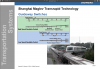
And that's all before even getting as far as considering the specific system this thread is about - ie. "Transrapid". This is one of the stupidly-resource-intensive maglev configurations where instead of putting all the electrical parts on board the vehicle and keeping the track as simple as possible, it's done the other way round so the whole flipping track is a traction motor. How anyone can be dumb enough to even consider this for any scale larger than a laboratory experiment is beyond me. It's bad enough for small local shuttles, but we're being asked to consider it for inter-city distances. Hundreds of miles of great big copper coils - hundreds of thousands of miles of wire - and most of the time it isn't even doing anything, just sitting there waiting to wake up for a second or so when a train comes past. Copper is a finite resource and there is already concern that it will run out - on a much shorter timescale than other finite resources like oil that there is much more fuss about - and while there are many alternative sources of energy, most of them are electrical, so they depend on copper, and there is no alternative to that (perhaps aluminium, but it's a poor substitute, and not suitable for most uses). An electricity-dependent society trying to get by without copper is a worse mess than an oil-dependent society trying to get by without oil, and when it's the same society in both positions at the same time...