ScouserGirl
Member
- Joined
- 28 Dec 2015
- Messages
- 219
TGS at the rear on this occasion. No different for dispatch though.
Yeah it's still the rear of the train...

TGS at the rear on this occasion. No different for dispatch though.
As an outsider, I'd expect that stations will be given Big Red Buttons™ to allow them to stop the job in an emergency without having to place a call to the signallers. Though, admittedly, that still involves a delay in getting the button pressed.Unless I've missed a really big development, dispatch staff are not routinely equipped with GSM-R handsets, and therefore it is likely that an emergency call to the signaller will need to take place over whatever the nearest handset is (which could involve running down to the end of the platform or to a control panel half way along).

Also, I am aware that it would require one emergency call Dispatcher to Signaller from the nearest telephone and one REC broadcast.

One emergency phone call that would go*:
Find a phone and dial TVSC.
Signaller: "Hello, Thames Valley Signalling Centre"
Dispatcher: "This is an emergency call. This is y, of GWR/NR, at Paddington station. Am I talking to the controlling signaller of platform 2 at Paddington station? over"
S: "Yes, this is the controlling signaller of platform 2 at Paddington. over"
D: "Train 1C81 has derailed upon dispatch from platform 2, stop the train and all trains on the lines for platform 2 and platform 1 at Paddington station. Repeat back, over"
S: "1C81 has derailed upon dispatch at platform 2, you want the train stopped and platform 1 and 2 blocked. over"
D: "correct over"
S: "Confirmed trains stopped and platforms 1 and 2 blocked. Do you require the emergency services? over"
D: "I will require x ambulances for potential walking wounded. over"
S: "Ambulance for x walking wounded to be called. Do you require anything else?
D: "No. over"
S: "No further assistance required. Signaller out"
*The first 6 lines are protocol that must be followed, the rest circumspect as the signaller controls the conversation from that point.
No doubt that by line 4 the GSM-R REC call would have been made, but not guaranteed, by which time the train would have travelled more that 1 coach length.
One emergency phone call that would go*:
As an outsider, I'd expect that stations will be given Big Red Buttons to allow them to stop the job in an emergency without having to place a call to the signallers. Though, admittedly, that still involves a delay in getting the button pressed.

Do newer trains have some kind of sensor system that can notify the driver when a (partial) derailment occurs?
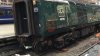
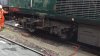
OOC, what is the device visible in this photo with (mostly) pink cabling apparently attached to the far side of the de-railed unit?

Would the TM have immediate access to either an emergency stop button/handle or to the passcomm from where they'd be on the train to dispatch from Paddington?
Tempting fate, perhaps I shouldn't have posted last week that the number of railway breakdown cranes had massively reduced since BR days, because derailments were so rare now...


OOC, what is the device visible in this photo with (mostly) pink cabling apparently attached to the far side of the de-railed unit?
One emergency phone call that would go*:
Find a phone and dial TVSC.
Signaller: "Hello, Thames Valley Signalling Centre"
Dispatcher: "This is an emergency call. This is y, of GWR/NR, at Paddington station. Am I talking to the controlling signaller of platform 2 at Paddington station? over"
S: "Yes, this is the controlling signaller of platform 2 at Paddington. over"
D: "Train 1C81 has derailed upon dispatch from platform 2, stop the train and all trains on the lines for platform 2 and platform 1 at Paddington station. Repeat back, over"
S: "1C81 has derailed upon dispatch at platform 2, you want the train stopped and platform 1 and 2 blocked. over"
D: "correct over"
S: "Confirmed trains stopped and platforms 1 and 2 blocked. Do you require the emergency services? over"
D: "I will require x ambulances for potential walking wounded. over"
S: "Ambulance for x walking wounded to be called. Do you require anything else?
D: "No. over"
S: "No further assistance required. Signaller out"
*The first 6 lines are protocol that must be followed, the rest circumspect as the signaller controls the conversation from that point.
No doubt that by line 4 the GSM-R REC call would have been made, but not guaranteed, by which time the train would have travelled more that 1 coach length.
Where does the train manager dispatch an HST from at Paddington?
Tm is at the back of the set so in the first class carriage if in normal formation
One emergency phone call that would go*:
Find a phone and dial TVSC.
Signaller: "Hello, Thames Valley Signalling Centre"
Dispatcher: "This is an emergency call. This is y, of GWR/NR, at Paddington station. Am I talking to the controlling signaller of platform 2 at Paddington station? over"
S: "Yes, this is the controlling signaller of platform 2 at Paddington. over"
D: "Train 1C81 has derailed upon dispatch from platform 2, stop the train and all trains on the lines for platform 2 and platform 1 at Paddington station. Repeat back, over"
S: "1C81 has derailed upon dispatch at platform 2, you want the train stopped and platform 1 and 2 blocked. over"
D: "correct over"
S: "Confirmed trains stopped and platforms 1 and 2 blocked. Do you require the emergency services? over"
D: "I will require x ambulances for potential walking wounded. over"
S: "Ambulance for x walking wounded to be called. Do you require anything else?
D: "No. over"
S: "No further assistance required. Signaller out"
*The first 6 lines are protocol that must be followed, the rest circumspect as the signaller controls the conversation from that point.
No doubt that by line 4 the GSM-R REC call would have been made, but not guaranteed, by which time the train would have travelled more that 1 coach length.

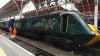
Currently at Paddington on the 2003 to Weston-super-Mare. Can confirm engineers are still working on 43188.
To clarify, I was pointing out that it would have been quicker than inferred in the original post. As I also said, the Guard was certainly in the best position to stop the train in this circumstance. Also, I am aware that it would require one emergency call Dispatcher to Signaller from the nearest telephone and one REC broadcast.
In terms of the 'quality' and mindset of platform staff, those who are safety critical and are actually concerned in the train dispatch process should know that safety takes priority over performance and will have had he various means of stopping trains in an emergency drilled into them, assessed and re-assessed.
You can get hand held devices that have the big red scary thing on it. Give one to every member of staff involved in the dispatch process.
I think pigs will grow jet packs and fly before anything like that happens.
True, if the guard and platform staff are aware at the same time. There are circumstances where the platform staff may spot the problem before a guard would be aware.Regardless of the quality and training of the platform staff, they will not be able to get the message relayed to the driver faster than a guard. It's not even worth trying to pretend otherwise.
Surprised they haven't closed the station and declared a 10 mile exclusion zone.


I'm not so sure text book answers generally happen in real life...
Surely the driver would have noticed the jolt when it happened and stopped anyway.The TM would have noticed the derailment and signalled one bell to the driver to stop, which would have been significantly quicker than the despatcher making a call to control, control to the TVSC and TVSC to the driver.
It'll be okay though DOO is 100% safe after all....

Oh they do, especially now that EVERYTHING is recorded and we get marked very critically on Safety Comms!