• Our new ticketing site is now live! Using either this or the original site (both powered by TrainSplit) helps support the running of the forum with every ticket purchase! Find out more and ask any questions/give us feedback in this thread!

Would a not-for-profit TOC work?

Status
Not open for further replies.

Broken Viking

On Moderation
Joined
23 Oct 2006
Messages
1,666
Location
some place west of France
Hail all! <D
I've recently found myself thinking about how TOCs are operated in a commercial sense, and - Despite knowing nothing about economics (Hey, I'm being honest here! :D) - I've been wondering if a TOC working on a not-for-profit basis could exist? :?:

From my limited understanding of the current setup, all mainline TOCs are profit driven companies, and therefore their aim is to generate as much profit as possible whilst minimising operating expenses and costs. Of course, this means most companies might avoid making any expenses that they don't have to make (Upgrading and refurbishing Pacer fleets, for example) unless it's clear that the expense is needed to retain or increase current profits. :(

On the other hand; A non-profit TOC (NP-TOC) might only seek to reclaim its day-to-day operating and staff costs from ticket sales and other income, with the TOC diverting any surplus "profit" back into improving it's rolling stock, infrastructure (Via Network Rail) and operational processes. :)

What I'd like to ask and discuss is if a not-for-profit TOC could:
  • Operationally exist; Could it keep itself going and above water without Govt. handouts?
  • Commercially exist; Could an NP-TOC compete fairly with current TOCs offering similar services?
  • Practically exist; If someone tried to start an NP-TOC or NP-OA operation on the NR network, what kind of hurdles might they run into beyond those of a profit driven TOC?
Farewell for now, and looking forward to reading other people's thoughts on the subject! <D
>> Death <<
 
Last edited by a moderator:
Sponsor Post - registered members do not see these adverts; click here to register, or click here to log in
R

RailUK Forums

Shrub Hill

Member
Joined
26 Aug 2009
Messages
112
Location
london
if you were to start a not for profit TOC you would have to fund it entirely out of your own pockets as no one is going to invest in your company,
 

WatcherZero

Established Member
Joined
25 Feb 2010
Messages
10,272
Essentially yes, while a not-for-profit could exist and operate even without that ruthless streak to maximise efficency in the name of profits the biggest hurdle would be finance. If you had the money to invest yourself it wouldnt be a problem but if you needed shareholder investment or bank loans they would have to evaluate your ability to repay and the chances of you defaulting. Likewise the government while willing to take the risk on an open operator would be far more hesitant to take the risk of a financial collapse on a primary franchise. In part to prevent this the government requires that the winning Toc put up a bond of several tens of millions (hundreds in some cases) that will be lost if the franchise fails. For s small company or not for profit without shareholders willing to take the risk and put up the bond the impossibility of financing that prevents them from running the service.
 

Invincibles

Member
Joined
12 Jul 2009
Messages
511
Location
Suzhou, Jiangsu, China
Ignoring the role of subsidies and the lack of real profit in the industry I can see why the idea might be appealing.

However there are a few more issues that I have thought of:

If a firm is not-for-profit what is the motivation?
Would a not-for-profit firm introduce loss-making services?
How much contingency should the TOC build in for cash flow?

I am sure there are many more that I would think of, but as I am in the UK at the moment it is a bit early in the morning.

The first issue is key, if you are going to improve stock there has to be a motivating factor to get the operating profit to fund it. Without clear motivation the firm will produce less profit and potentially less reinvestment than a private company that only puts in a percentage of the total operating profit and takes the rest for dividends.

The second problem is another interesting one. Virgin for example like to introduce headline times and regular service to ensure that the marketing is good despite many of the Manchesters running quite empty. This is a good strategy to encourage people on to the train and generate future profit but is it something a not for profit TOC would do as it clearly prevents the money being used for the other stated aims. If not then clearly the rail industry misses out on potential future growth.

We have gone through a period where demand fell because of the recession, or more recently because of the snow and associated disruption. For a firm with profit reserve that is OK but for a not-for-profit that again means diverting funds from the other stated aims to keep ready for this eventuality. It may be that unexpected surges would match over time, but it is unclear and would have to be considered.

Overall I just think that these other uses for money that the profit making TOCs have can create them profit that a not-for-profit would not get access to without failing its other aims.

As I say I like the idea but there are a lot of questions...

Maybe if improved infastructure could be linked to improved performance and improved profitability and TOCs were allowed to realise the gains of investment over a longer period... I think that is what we are more likely to see in the new franchise model along the Chiltern lines (as many posters on here often say)
 

krus_aragon

Established Member
Joined
10 Jun 2009
Messages
6,105
Location
North Wales
Yes, the first problem is capital. I'm told that franchise applicants have to be able to provide a bond of umpteen million to the DfT as a deposit in case you walk away from your franchise commitments if things go bad. Gathering that much capital is tricky to do without any shareholders, who will expect dividends and profits.

If you could get enough money gathered for a bond, without any external commitments, I don't see why you couldn't promise to reinvest all profits in your franchise application.

The ability to run a franchise without any governent subsidy will depend on which franchise it is.
 

colpepper

Member
Joined
17 Jan 2011
Messages
199
Location
West Yorks
The government, via BR, used to run a not for profit TOC. It ceased because of a temporary fashion for believing rail transport had nothing to do with wider economic success. Allied to the notion was a flawed belief that you could build your way out of road transport difficulties by laying more tarmac, when sensible commentators knew vehicles increase exponentially to fit the road.

We now have the worst of both worlds, jammed roads and share holders demanding ever higher profits. Britain only does joined up thinking in a war and then quite successfully.
 

Clip

Established Member
Joined
28 Jun 2010
Messages
10,821
As others have said - All about finance. As soon as things go wrong then your money is going to be eaten up. Operating a TOC is really not just as straight forward as you may think..

Would outside operators for things you need give you enough credit? What would you then do if you didnt have enough to pay the bills one month? Would you be able to use them or anyone else again..

you would need heavy cash reserves just to keep you head above water for the first year and whilst its nice in theory in practice i just cant see it working.
 

andyfrommk

Member
Joined
12 Jan 2011
Messages
202
Look! and Know
OK , so they're not a NP TOC but a co-operative is between a not-for-profit and a heartless shareholder TOC.

you can either take your dividends(when GOCO actually start a service) or you can reinvest it back into the Co-op.
 

deltic

Established Member
Joined
8 Feb 2010
Messages
3,713
Depends what you mean by a "not for profit company". Not for profit companies do make profits but the difference with a normal company is how the profit is distributed. Normally profit goes to the owner but with a not for profit company the money is usually reinvested back into the business or refunded back to customers.

A TOC can easily be a "not for profit company" and would in reality operate not much different than any other TOC
 

colpepper

Member
Joined
17 Jan 2011
Messages
199
Location
West Yorks
The reality is train operation will only attract corporate sensibilities whose credit is good enough globally to allow government to let them loose at the reins. Such people will be used to exploiting profitable avenues in a what appear to be a financially borderline operations.

TOCs are given a sweetener of routes with potential profit to sugar the pill of those lines that aren't. Without those handcuffs operators would strip back all but the most advantageous routes. IMHO, if you're going to allocate operation in that way without a free market you may as well bring the whole thing back in house to the advantage of the economy and the travelling public.

The motivation for the current system is 99% ideological and 1% pragmatism.
 

ChrisCooper

Established Member
Joined
7 Sep 2005
Messages
1,787
Location
Loughborough
Not for profit only really works when either government (or local government) backed, or for fairly small companies, in all cases usually relying heavily on volenteers and donations. Most are charities. Investment will come from those who will see a benefit in other ways beyond financial, with or without ever getting the money back. Transport preservation provides good examples, in many cases you can invest in a particular project or group and gain benefits such as free or cheap usage of their services, contributing towards something you feel is worthwhile and a level of control over the project or group. Many of us I'm sure are in this position when it comes to membership of various transport organisations.

At the end of the day, any commercial business is going to be operated on a for profit basis, as has been said people invest and want a return on that. The big difference is how much profit is skimmed off and how much is re-invested. Of cource governments (again national or local) can themselves profit in more ways that direct finance, for example having a good local or national transport infrastructure grows the national or local economy. It can also be the best way of fulfilling social obligations.

Perhaps the big problem with the current set up with the railways is that it's too big and national, which works fine for Intercity but not for more local services. Local councils and businesses should maybe invest more in local railways and services, and be given more control. PTEs for example should have more power to invest in rail and boost the local economy. County Councils too. There was an element of it around privatisation, Norfolk County Council funded extra night trains on the Norwich to Sherringham route, and Leicestershire County Council put a lot of money into the Ivanhoe line. I suppose it doesn't help that on a local level as much as national, the social and economic benefits of rail (and a lot of other investment) is not taken into account. Even more so now.
 

Zoe

Established Member
Joined
22 Aug 2008
Messages
5,905
We now have the worst of both worlds, jammed roads and share holders demanding ever higher profits.
Remember also that there are many gaps that still exist in the road network where a high quality dual carriageway is reduced to a single carriageway road and goes through a village.
 

DaveNewcastle

Established Member
Joined
21 Dec 2007
Messages
7,387
Location
Newcastle (unless I'm out)
Ask Cross Country, they've not made a profit yet !
If 'Not-for-Profit' = No Profit, then there's been some excellent examples in recent years operating on the EastCoast Mainline and on the Wrexham & Shropshire route to London!

Its worth noting that a great many of the Companies which developed the UK's railway network in the 19th century also failed to make profits. Perhaps there was simply too much unrestrained competition for a growing but finite market.
But they did manage to raise the vital finance (or most of them did) by virtue of the POSSIBILITY that they might reach profitability. If that possibility wasn't on offer, then they simply couldn't have started any operations at all.
 

colpepper

Member
Joined
17 Jan 2011
Messages
199
Location
West Yorks
Remember also that there are many gaps that still exist in the road network where a high quality dual carriageway is reduced to a single carriageway road and goes through a village.
That's because some damned fool built a motorway that encouraged private and commercial vehicle drivers to believe they could go where they wanted without a traffic jam.
 

Zoe

Established Member
Joined
22 Aug 2008
Messages
5,905
That's because some damned fool built a motorway that encouraged private and commercial vehicle drivers to believe they could go where they wanted without a traffic jam.
Yes but they didn't finish the job and so traffc still has to go through villages in many cases. Do you really think our railway network could cope if cars were banned?
 

colpepper

Member
Joined
17 Jan 2011
Messages
199
Location
West Yorks
Yes but they didn't finish the job and so traffc still has to go through villages in many cases. Do you really think our railway network could cope if cars were banned?
It did for about a hundred years. I'm not saying cars should be banned, I think people have to learn to live with the consequences of having them around without believing they can be pushed onto someone else's patch.
 

Zoe

Established Member
Joined
22 Aug 2008
Messages
5,905
It did for about a hundred years. I'm not saying cars should be banned, I think people have to learn to live with the consequences of having them around without believing they can be pushed onto someone else's patch.
So you think that bypasses shouldn't be built and villages should have to put of with trucks passing through them 24/7?
 

chuckles1066

Member
Joined
24 Nov 2010
Messages
361
Hail all! <D
I've recently found myself thinking about how TOCs are operated in a commercial sense, and - Despite knowing nothing about economics (Hey, I'm being honest here! :D) - I've been wondering if a TOC working on a not-for-profit basis could exist? :?:

From my limited understanding of the current setup, all mainline TOCs are profit driven companies, and therefore their aim is to generate as much profit as possible whilst minimising operating expenses and costs. Of course, this means most companies might avoid making any expenses that they don't have to make

You mean like putting one coach on a Gloucester - Swindon commuter service and pretending they didn't have enough serviceable rolling stock to provide more, things like that?
--- old post above --- --- new post below ---
How is traffic passing around a village on a bypass a problem?

The M25 is one big bypass - if you go and ask your question to the many thousands of commuters who sit in jams every morning and night I suspect you'll get a smack in the mouth within about thirty seconds :)
 

colpepper

Member
Joined
17 Jan 2011
Messages
199
Location
West Yorks
How is traffic passing around a village on a bypass a problem?
The problem is the idea there's a pain free road 'network'. Sooner or later the main road has to run out. I've lived in villages with artics going past the front door day and night, it's no fun but they've generally been directed there by a previous motorway. I'd get freight back on the railways, as it was till the 1960s.
--- old post above --- --- new post below ---
The M25 is one big bypass

I was hitch hiking when they were building the M25 and got a lift of a cabbie. I asked him what he thought of the idea. 'A farce', he said, 'it'll be gridlocked as soon as it's finished'.
 

Zoe

Established Member
Joined
22 Aug 2008
Messages
5,905
The problem is the idea there's a pain free road 'network'. Sooner or later the main road has to run out. I've lived in villages with artics going past the front door day and night, it's no fun but they've generally been directed there by a previous motorway. I'd get freight back on the railways, as it was till the 1960s.
But there are many cases where you have a high quality road both sides of the village but the government don't want to pay for a bypass.
 

Broken Viking

On Moderation
Joined
23 Oct 2006
Messages
1,666
Location
some place west of France
Hail again! <D
I might have to dash out in a second so I'll have to be very quick with this one alas. :|

I suppose one of the biggest problems for an NP-TOC would be the initial finance required - Not just the mandatory "assurance" required by Government, but also enough finance to cover the TOCs running costs for the first 1-3 months. Personally, I don't like working "in defecit" (I.E: Using loans to back the above finance) prefering instead to work "in credit".
I'm getting the impression that such an "in credit" approach couldn't work under any business model though...Is that correct? :?:

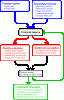
In the meantime though, here's a simple diagram demonstrating how (Bearing in mind my lack of business and financial knowhow) I think the cash-flow in my hypothetical NP-TOC might work:
attachment.php
Thinking briefly about how I would want to go about running such a thing (Not that I would step up for that...I'd be useless at the job) I would be considering using the first 1-2 years of routine operation to build up the financial reserve, using surplus extrapolated from fares - Which would be kept at the current level initially to maximise surplus whilst meaning the passenger pays no more than they currently do - And any other available revenue, possibly by borrowing ideas out of the Ryanair book where they can be applied without going to daft proportions (I.E: There wouldn't be any fees for buying tickets at the station, carrying baggage, checking-in for trains etc! :)).

Eventually, the reserve should reach a suitable level to allow for re-investment whilst at the same time providing a sufficient "buffer" of funds to cover at least three months routine operation at all times - Meaning that whenever there is surplus beyond that point, the NP-TOC would be able to guarentee commitments (Advance tickets etc) three months ahead of the current point. This would also allow the NP-TOC to give everyone sufficient advance notice in the event that it had to cease trading, allowing another operator to negotiate for the franchise and allowing passengers to make alternative arrangements if necessary. :)

Assuming the NP-TOC kept going and made it through the first couple of years without too much trouble, then re-investment would commence and soon become noticable. This might include lower fares, reduction of journey times through faster operation, refurbished/new/improved rolling stock (Can anyone say "New fleet of APT-Ps"? ;)), and extra services - Possibly including "budget" services run using Pacers etc. where standard returns would be roughly the same as an equivalent VCS Advance fare. :shock:8-)

That said, I suppose it all boils down to that initial investment problem. Even if one could get a loan of the £600,000,000 that they'd need to get started, the interest due on that loan even over a very short space of time would completely usurp (And most likely exceed) any surplus revenue gained from routine operation. :(

Any further thoughts? :?:<D
 

Attachments

  • NP-TOC_finance_model.gif
    NP-TOC_finance_model.gif
    12 KB · Views: 87

Malderon

Member
Joined
28 Oct 2010
Messages
81
I'm really playing devils advocate here and its not entirely my viewpoint but certainly when I was studying economics there was a viewpoint that Not-for-profits can end up being run for the benefit of their staff. As its staff that are making decisions about reinvestment, whether to open an unprofitable route etc etc or they could pay themselves more. Obviously a simplistic viewpoint but you need to have some sort of body whether its shareholders or a board of members or a government you have to have someone.

On a similar note without profit determining decisions how do you make them. You could replace pacers, or you could make more money and use that money to run a rural service. Who decides which is better?
 

deltic

Established Member
Joined
8 Feb 2010
Messages
3,713
The organisation that is proposing to buy the Humber Bridge for £100m is a not for profit company that will repay the loan required by revenues earned by the toll. Once that has been done the toll will be set at a rate to meet the cost of maintenance.

The only issue for a not for profit TOC is ensuring it has credibility with all the partners it has to deal with DfT, ROSCOs and NR. In reality if it has it with DfT it has it with everyone else as well. Given that the TOC would be earning money from day 1 cash flow issues are unlikely to be a major problem unless you are a TOC with a very seasonal revenue profile and you take it over at the wrong time of year.

So, for example, if Co-Op bank is prepared to back a bid by an organisation that is able to attract senior rail staff with the required expertise in running a passenger railway then there is no reason why it could not successfully bid for a rail franchise. Virtually all TOCs make a profit (with or without revenue support from DfT) - those profits could be reinvested in the business rather than being paid out in dividend.

To avoid profits being "captured" by staff through higher wages the organisation's Memorandum of Association could set out the maximum proportion of costs that wages could constitute and where profits should be invested.
 

Zoe

Established Member
Joined
22 Aug 2008
Messages
5,905
The organisation that is proposing to buy the Humber Bridge for £100m is a not for profit company that will repay the loan required by revenues earned by the toll. Once that has been done the toll will be set at a rate to meet the cost of maintenance.
The Dartford Crossing tolls were supposed to be removed once it had been paid for and a maintenance fund had generated. In the end they decided to retain the tolls.
 

HST-DAVE

Member
Joined
1 Mar 2010
Messages
59
Another route in for a NP-TOC could be via Micro-Franchising? If this option is available it could give a small NP-TOC time to prove itself, gain credibility and hopefully turn a positive balance sheet. Then the small company could bid for another micro-franchise and so on 'til it evolves into a regional and/or mainline venture....
 

Flamingo

Established Member
Joined
26 Apr 2010
Messages
6,806
Remember also that there are many gaps that still exist in the road network where a high quality dual carriageway is reduced to a single carriageway road and goes through a village.

Ah, you have been to Norwich! As once said by Jo Brand, all it needs is a farmer with a wide load and an attitude and it's cut off from the rest of the country.
 
Status
Not open for further replies.

Top