• Our new ticketing site is now live! Using either this or the original site (both powered by TrainSplit) helps support the running of the forum with every ticket purchase! Find out more and ask any questions/give us feedback in this thread!

Wind Power and UK Energy Use

CdBrux

Member
Joined
4 Mar 2014
Messages
924
Location
Munich
Some might but again it's the fluctuations that cause most problems and those using electric could either install their own generation or power purchasing agreement to buy at less than the market rate which many already do.

It's the fluctuations AND the overall cost. I doubt all but a very few large energy consuming industrial companies will make the investments you glibly say. I happen to work for one, we would be better off importing our products with a long term high price vs even some European countries
 
Sponsor Post - registered members do not see these adverts; click here to register, or click here to log in
R

RailUK Forums

Bald Rick

Veteran Member
Joined
28 Sep 2010
Messages
35,895
Various reporting sites need to get a move on and work out how to report battery data if we're already at that level. I don't know what peak discharge rates you can get, but if most large-scale installations discharge almost all capacity over a few hours, that's 3-4GW in the peak periods, large enough that it's comparable with import/exports with France (I assume they'll charge up more slowly to avoid suddenly overloading the grid, like the West Ealing battery bank for the 230).

The last I saw was 8GW / 12 GWh, but both numbers are increasing rapidly. There is around 22GWh in construction, and a further c150GWh in the pipeline already granted planning consent. Not all of this will be built, but most of it will be, over the next 5 years.

Add to that about 80GWh of pumped storage with planning and awaiting the outcome of the cap and floor assessments (due in a couple of months); my guess is that at least half of it will be approved this time and in servicewithin 5-8 years.

All in we will have over 200GWh storage by the early 2030s, plus more on the domestic side of the meter.

Various schemes to co locate BESS to reduce curtailment are also in advanced stages of planning.

Both these measures should see gas use drop significantly over the next few years.

It will see gas use reduce this summer, to almost nil on many days. I wouldnt be surprised if NESO went for a ‘Carbon free day’ at some point this year.
 
Last edited:

The Ham

Veteran Member
Joined
6 Jul 2012
Messages
12,036
and even more industry would close down and off shore

It depends, as it's entirely possible to have different energy prices for businesses and homes.

One way you could make the shift would be too reduce the standing charge and then put up the cost of each unit. If you set it at the right level those who were high (residential) users would find their bills would go up and so the benefit of investing in solar would increase.

Likewise, an increase in the gas standing charge could encourage more people to shift from gas (last year my standing charge each month was between 1/5 and 1/2 of my gas bill), currently (based on £120 standing charge and 30p per kWh for electricity) after the comparable gas unit rate charge, if the energy increase was 400kWh or less then there's little point in having gas.

Having said that, I still struggle to understand why those with fuel oil or get gas delivered by tanker haven't already made the switch if it was at all possible.
 

Bald Rick

Veteran Member
Joined
28 Sep 2010
Messages
35,895
Well over 12GW of solar at peak today. And it is still officially winter!

Safe to say various solar generation records will be smashed this year.
 

brad465

Veteran Member
Joined
11 Aug 2010
Messages
11,521
Location
Taunton or Kent
Well over 12GW of solar at peak today. And it is still officially winter!

Safe to say various solar generation records will be smashed this year.
A clear sunny day across the UK near the June solstice, with a temperature range of 20-25C, could well blow the record out the park.
 

The exile

Established Member
Joined
31 Mar 2010
Messages
9,439
Location
Somerset
Having said that, I still struggle to understand why those with fuel oil or get gas delivered by tanker haven't already made the switch if it was at all possible.
Quite a lot will be on it because it’s not possible to switch (at least not practical).
Then add in those for whom the upheaval is too much (if you’re in your 80s and can still afford it, for example), or who don’t have the final say…
 

quantinghome

Established Member
Joined
1 Jun 2013
Messages
2,899
The last I saw was 8GW / 12 GWh, but both numbers are increasing rapidly. There is around 22GWh in construction, and a further c150GWh in the pipeline already granted planning consent. Not all of this will be built, but most of it will be, over the next 5 years.

Add to that about 80GWh of pumped storage with planning and awaiting the outcome of the cap and floor assessments (due in a couple of months); my guess is that at least half of it will be approved this time and in servicewithin 5-8 years.

All in we will have over 200GWh storage by the early 2030s, plus more on the domestic side of the meter.
This is good and will largely sort out the day-to-day balancing. But it doesn't solve the "Dunkelflaute" situation of persistently low renewables output which can occur for an extended period of a couple of weeks. For that we will need around 10TWh storage capacity, which is unlikely to be battery storage.

It will see gas use reduce this summer, to almost nil on many days. I wouldnt be surprised if NESO went for a ‘Carbon free day’ at some point this year.
I understand this is more difficult to do with existing CCGT units which are designed to operate at high efficiency for continuous operation. Hence why electricity output from gas doesn't drop below a certain level even on days that are very good for renewables. The proposal to use green hydrogen as a long duration storage option would use open-cycle gas turbine units which are less efficient but can be used for rapid cycling.
 

brad465

Veteran Member
Joined
11 Aug 2010
Messages
11,521
Location
Taunton or Kent
I understand this is more difficult to do with existing CCGT units which are designed to operate at high efficiency for continuous operation. Hence why electricity output from gas doesn't drop below a certain level even on days that are very good for renewables. The proposal to use green hydrogen as a long duration storage option would use open-cycle gas turbine units which are less efficient but can be used for rapid cycling.
Sounds like a gas-free day will be part of a gas-free week, where enough wind and solar, along with nuclear and various storage, is enough to shut down all gas generation for a while.
 

Trainbike46

Established Member
Joined
18 Sep 2021
Messages
4,376
Location
belfast
This is good and will largely sort out the day-to-day balancing. But it doesn't solve the "Dunkelflaute" situation of persistently low renewables output which can occur for an extended period of a couple of weeks. For that we will need around 10TWh storage capacity, which is unlikely to be battery storage.
Pumped hydro is part of the solution for that, as is the connections with other European countries - due to the climate patterns bad weather for energy would not normally cover all of Europe, so that allows surpluses elsewhere to cover those situations.

The remaining gas fleet will also play a role during those situations, especially if they last longer.
 

JamesT

Established Member
Joined
25 Feb 2015
Messages
4,899
Pumped hydro is part of the solution for that, as is the connections with other European countries - due to the climate patterns bad weather for energy would not normally cover all of Europe, so that allows surpluses elsewhere to cover those situations.

The remaining gas fleet will also play a role during those situations, especially if they last longer.
There's only so much you can do with interconnections, especially when your nearest neighbours are likely to have similar weather to you. Pumped storage is good for short-term drops in supply, but to cover a dunkelflaute you're talking needing several hundred times our current capacity.

Events that cover a majority of the continent and last more than two days happen about once every five years, Bunsen said.

Some of the existing gas fleet is coming to the end of its life. The question is how to make it worthwhile to build replacements to cover these periods if they're going to spend most of their life idle.
 

quantinghome

Established Member
Joined
1 Jun 2013
Messages
2,899
Sounds like a gas-free day will be part of a gas-free week, where enough wind and solar, along with nuclear and various storage, is enough to shut down all gas generation for a while.
The issue is you can't really 'shut down' the current CCGT fleet for a short amount of time. We have already had periods when all gas stations could have been shut down, but they have continued to operate at its minimum level for technical reasons.

== Doublepost prevention - post automatically merged: ==

Some of the existing gas fleet is coming to the end of its life. The question is how to make it worthwhile to build replacements to cover these periods if they're going to spend most of their life idle.
The talk is of moving from CCGT to OCGT. They are less efficient but cheaper to build (important for stations used only intermittently) and can operate more easily as a peaking plant.
 

brad465

Veteran Member
Joined
11 Aug 2010
Messages
11,521
Location
Taunton or Kent
There's only so much you can do with interconnections, especially when your nearest neighbours are likely to have similar weather to you. Pumped storage is good for short-term drops in supply, but to cover a dunkelflaute you're talking needing several hundred times our current capacity.


Some of the existing gas fleet is coming to the end of its life. The question is how to make it worthwhile to build replacements to cover these periods if they're going to spend most of their life idle.
This is where these nuclear SMRs have a role, which I wish could pickup pace a bit. If we could also replicate the geothermal plant brought online in Cornwall in other parts of the UK, this would go someway too, including potentially meeting all the UK's heating demand if developed to max potential.
 

Bald Rick

Veteran Member
Joined
28 Sep 2010
Messages
35,895
But it doesn't solve the "Dunkelflaute" situation of persistently low renewables output which can occur for an extended period of a couple of weeks. For that we will need around 10TWh storage capacity, which is unlikely to be battery storage.

It doesn’t solve it, but it certainly helps manage the peaks in such situations.


I understand this is more difficult to do with existing CCGT units which are designed to operate at high efficiency for continuous operation. Hence why electricity output from gas doesn't drop below a certain level even on days that are very good for renewables.

But we routinely have occasions where the entire CCGT fleet is generating less than 2GW, Sunday last for example. I accept that some may still been running but not generating.
 

Class 317

Member
Joined
7 Jul 2020
Messages
569
Location
Cotswolds
The issue is you can't really 'shut down' the current CCGT fleet for a short amount of time. We have already had periods when all gas stations could have been shut down, but they have continued to operate at its minimum level for technical reasons.

== Doublepost prevention - post automatically merged: ==


The talk is of moving from CCGT to OCGT. They are less efficient but cheaper to build (important for stations used only intermittently) and can operate more easily as a peaking plant.
There is also the option of Jenharber gas powered engines. This are used in a combined installation with BESS at Thurrock and are operating with high efficiency around 50%, have quick start up and shutdown times and a large ability to vary output to meet demand due to the modular nature of many engines being connected together. If memory serves me correctly it's 90 or so at Thurrock.
 

bspahh

Established Member
Joined
5 Jan 2017
Messages
2,441

The Ham

Veteran Member
Joined
6 Jul 2012
Messages
12,036
This is where these nuclear SMRs have a role, which I wish could pickup pace a bit. If we could also replicate the geothermal plant brought online in Cornwall in other parts of the UK, this would go someway too, including potentially meeting all the UK's heating demand if developed to max potential.

Likewise there's some existing tidal lagoons (there's a fairly large one in Hayle, Cornwall) which could fairly easily have some turbines added which would add some fairly cheap to install tidal power which whilst it wouldn't be significant it would add some extra capacity to cover long periods of low renewables.

Of course, even cloudy winter days will generate some solar, and with the rise of EV's the maths to install solar (and often batteries) to a home gets better. Whilst each home isn't going to be adding a lot (especially during the winter) each one will likely cover a lot of their out to work power usage (fridge, freezer, router, things on standby, etc.) meaning that if there's a lot of them that there's more power usable to charge grid storage.

Quite a lot will be on it because it’s not possible to switch (at least not practical).
Then add in those for whom the upheaval is too much (if you’re in your 80s and can still afford it, for example), or who don’t have the final say…

I may not have been clear, I was talking about switching from fuel oil to an electric only house, as the economics of them having solar panels and batteries is likely to be clearer than shifting away from gas due to the slightly higher costs and slightly lower boiler efficiency (especially as they age).

Yes rural homes are likely to be less well insulated (however again the cost payback would likely be a little quicker to fixing that) and are more likely to be larger (but that would typically allow more panels and they are not the expensive part of a solar installation).
 

quantinghome

Established Member
Joined
1 Jun 2013
Messages
2,899
But we routinely have occasions where the entire CCGT fleet is generating less than 2GW, Sunday last for example. I accept that some may still been running but not generating.
That's true, and looking at the details at that time most gas generators were at zero, with only a few running:

https://renewables-map.robinhawkes.com/?date=2026-03-15T13:00:00.000Z#5/55/-3.2

1773913659794.png

Reasons why a few gas generators might still be needed are:

1. Grid constraints - typically affecting wind generated in Scotland, meaning gas is still needed to supply demand in southern England. The next HVDC offshore link is due to come online only in 2029.
2. Emergency back-up - I assume it takes some time to restart a gas power station, so you need something available to increase supply if there is a failure elsewhere. Of course this can be covered by batteries in the future.
 

HSTEd

Veteran Member
Joined
14 Jul 2011
Messages
20,348
If we could retrofit gas and oil fired heating systems with a secondary electric heating element, perhaps in the water return line of water-based central heating, it would allow us to substitute a lot of gas with electricity that would otherwise be constrained.

And since the existing system would remain intact, we would not have to commit to always providing sufficient inexpensive electricity to those households.
 

Nottingham59

Established Member
Joined
10 Dec 2019
Messages
3,341
Location
Nottingham
Jenbacher has a 53MW gas generator in Saarbrücken. I can't see any quotes for the budget for that. It could switch to run on Hydrogen in the future.

However, a 30 year old used 2MW generator is €45,500. If you could buy 500 of them, that would be £20m for 1GW of generator capacity.
So even if new gas generators were £100,000 for 1MW that's still cheap.

Windfarms seem to be £1-5M / MW, so a new 1GW windfarm is £1Bn to 5Bn, depending on location and water depth etc.
And a new 1GW windfarm with 1GW of gas generator backup would be £1.1Bn to £5.1Bn.

So generator backup will cost between 10% and 2% of the capital cost of the windfarm itself. And if it runs only one week a year, emissions will be insignificant. And could run on biomethane accumulated during the rest of year when the generators are not running.

Site the generators next to hospitals and grid feeder stations, and they could double up as un-interruptible supply too.
 

HSTEd

Veteran Member
Joined
14 Jul 2011
Messages
20,348
Site the generators next to hospitals and grid feeder stations, and they could double up as un-interruptible supply too.
If they are dispersed they will need a dispersed supply of fuel.
It won't be long before network costs kill the gas system. Decarbonisation of heat will rapidly cut the amount of gas delivered and the network will be unable to amortise it's fixed costs.

Natural gas fired generators would only be practical adjacent to gas fields or import terminals.

A gas system used only in extreme weather or grid emergencies would end up with a delivered gas cost well above £1/kWh. I modelled this exact scenario a couple of years ago in my research.

You'd switch to propane or oil long before that.
Biomethane is more or less a dead letter for the same reason, beyond small on site generators burning it as it is made.
 

brad465

Veteran Member
Joined
11 Aug 2010
Messages
11,521
Location
Taunton or Kent
If they are dispersed they will need a dispersed supply of fuel.
It won't be long before network costs kill the gas system. Decarbonisation of heat will rapidly cut the amount of gas delivered and the network will be unable to amortise it's fixed costs.

Natural gas fired generators would only be practical adjacent to gas fields or import terminals.

A gas system used only in extreme weather or grid emergencies would end up with a delivered gas cost well above £1/kWh. I modelled this exact scenario a couple of years ago in my research.

You'd switch to propane or oil long before that.
Biomethane is more or less a dead letter for the same reason, beyond small on site generators burning it as it is made.
Are there any serious efforts being made to reducing gas-based heating of homes/property?
 

Trainbike46

Established Member
Joined
18 Sep 2021
Messages
4,376
Location
belfast
Are there any serious efforts being made to reducing gas-based heating of homes/property?
I guess it depends what you define as "serious", but the Boiler Upgrade Scheme (BUS) exists, and has recently been expanded to cover more low-carbon technologies, for that exact purpose. BUS is an England and Wales scheme, but there is a similar scheme in Scotland. I'm not aware of anything like it in NI.

Press release from 18 November about the addition of Air-to-Air heatpumps and heat batteries linked below.


And here is a link to the energy savings trust page about the BUS: https://energysavingtrust.org.uk/grants-and-loans/boiler-upgrade-scheme/
 

Nottingham59

Established Member
Joined
10 Dec 2019
Messages
3,341
Location
Nottingham
If they are dispersed they will need a dispersed supply of fuel.
It won't be long before network costs kill the gas system.
So diesel generators, then. Diesel will keep almost indefinitely at minimal cost. You can't beat fossil fuels for energy content for those once-per-year needs.
 

N1

Member
Joined
10 Aug 2022
Messages
385
So diesel generators, then. Diesel will keep almost indefinitely at minimal cost. You can't beat fossil fuels for energy content for those once-per-year needs.
You need to polish it every 6 months, and HVO keeps better and is more energy dense than ultra low sulphur diesel. You could also put your gas generators near anaerobic digesters that cureently supply into gas grid.
 

HSTEd

Veteran Member
Joined
14 Jul 2011
Messages
20,348
So diesel generators, then. Diesel will keep almost indefinitely at minimal cost. You can't beat fossil fuels for energy content for those once-per-year needs.
Dispersing them will add serious costs compared to positioning them near their fuel supplies though. As noted, diesel will eventually go bad and it may go missing unless the sites are kept tightly under control.

Centralisation of generators is going to be cheaper, if no other reason than it would make maintenance much easier.
 

Bald Rick

Veteran Member
Joined
28 Sep 2010
Messages
35,895
Very interesting development in long term electricity storage, with Form Energy (a US company) announcing an investment in Ireland for a low power (10MW) but big storage (1GWh) iron-air battery. I guess we will see how practical that is, and what the cost is - it’s promised to be much cheaper than Lithium based batteries. Google have already committed to a project thstos 30 times the size for a new data centre in Minnesota. And no, it’s not 12 days early!


Form Energy, which has developed what it calls a 'multi-day' duration battery energy storage system (BESS) is commercialising its proprietary iron-air battery, designed to deliver around a 100-hour duration of discharge at full rated power.

In very simple terms, the system operates through the reversible oxidation (rusting) of iron, as explained in a 2021 Energy-Storage.news interview with CEO Jaramillo.

Form Energy said this week (18 March) that a 10MW/1,000MWh project is planned in Ireland, through a partnership with developer FuturEnergy Ireland.
 
Last edited:

HSTEd

Veteran Member
Joined
14 Jul 2011
Messages
20,348
Very interesting development in long term electricity storage, with Form Energy (a US company) announcing an investment in Ireland for a low power (10MW) but big storage (1GWh) iron-air battery. I guess we will see how practical that is, and what the cost is - it’s promised to be much cheaper than Lithium based batteries. Google have already committed to a project thstos 30 times the size for a new data centre in Minnesota. And no, it’s not 12 days early!

Metal Air batteries will beat lithium-ion, but I am not sure they will really be able to fundamentally change the economics of batteries. Even with access to very cheap chinese iron.

If they can get Magnesium-Air batteries to work properly without fancy electrolytes, that will be important.
After all, magnesium is the second most common metal in seawater, so a magnesium air battery could be used on an airliner, with expended cells (which are heavier than fresh ones) jettisoned in midocean to save weight!
 

AndrewE

Established Member
Joined
9 Nov 2015
Messages
7,350
Metal Air batteries will beat lithium-ion, but I am not sure they will really be able to fundamentally change the economics of batteries. Even with access to very cheap chinese iron.

If they can get Magnesium-Air batteries to work properly without fancy electrolytes, that will be important.
After all, magnesium is the second most common metal in seawater, so a magnesium air battery could be used on an airliner, with expended cells (which are heavier than fresh ones) jettisoned in midocean to save weight!
Sodium batteries are already here. Wikipedia says
Companies around the world develop commercially viable sodium-ion batteries, mainly in China.[100] A 2-hour 5 MW/10 MWh grid battery was installed in China in 2023.[101] By 2025, sodium-ion battery packs remained 30% more expensive than LFP due to scaling.[84]

A 2025 report from the International Renewable Energy Agency (IRENA) suggested that sodium-ion battery cell costs could drop to $40/kWh, while LFP fell [but only] as far as $70/kWh.[102]

Energy storage manufacturer Pylontech obtained the first sodium-ion battery certificate[clarification needed] from TÜV Rheinland.[103]
and (although some electricians/firms refuse to install Pylontech batteries "because they are Chinese," I was told) they have a very good reputation amongst users here in the UK so I think this is an indication of what is on the way.
 

brad465

Veteran Member
Joined
11 Aug 2010
Messages
11,521
Location
Taunton or Kent
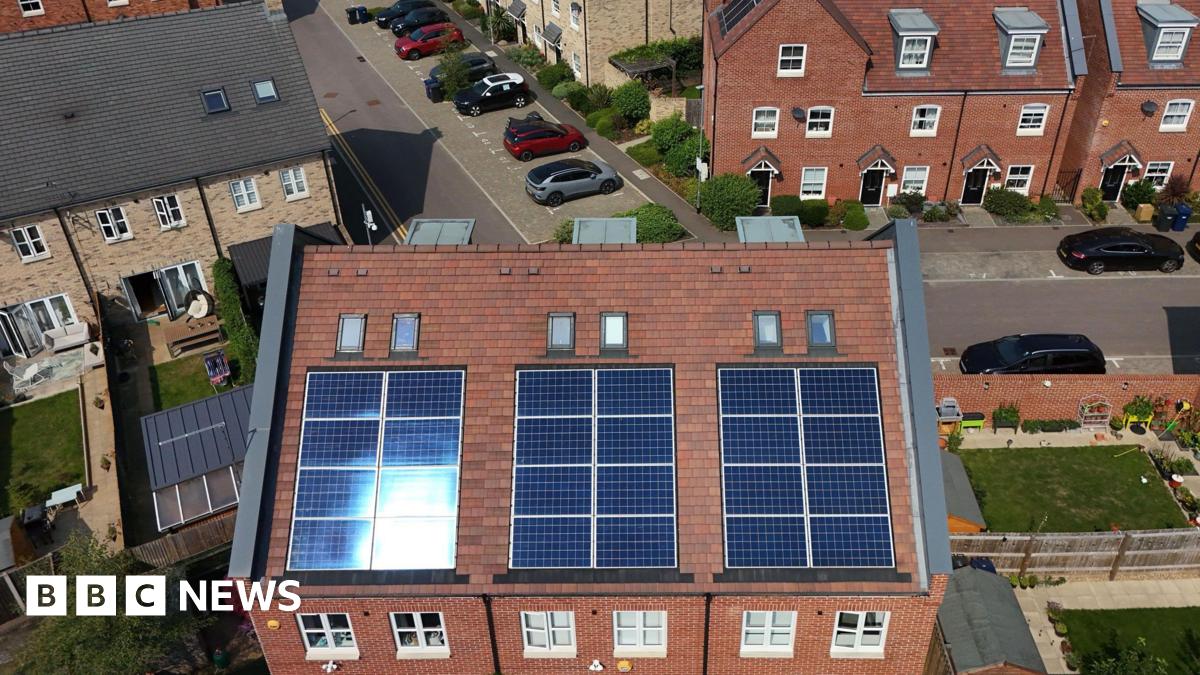
A long overdue policy announcement - all new homes to have solar panels and heat pumps installed, and also interestingly "plug-in" solar panels are set to be available in supermarkets in the UK soon:


Developers will be required to install solar panels and heat pumps in all new homes in England as part of updated planning requirements published by the government.

It also said plug-in panels that homeowners can self-install on balconies would be available in supermarkets in the coming months.

These small versions of the green tech are already deployed across Europe but are not currently sold in the UK due to safety regulations.

Announcing the raft of measures to ramp up solar, the energy secretary said the Iran war had shown clean power was "essential".

The move has been welcomed by some energy companies but developers have raised concerns about the scale of solar required.

For the last decade, successive governments have been trying to develop the Future Homes Standard - an update to the way that new homes have to be designed in England.

The guidance published on Tuesday means that from 2028, no new homes will be on the gas network - and will instead be on a heat network or get a heat pump - and they must have solar panels on their roofs covering an area equivalent to 40% of the ground floor space.

"The Iran war has once again shown our drive for clean power is essential for our energy security so we can escape the grip of fossil fuel markets we don't control," said Energy Secretary Ed Miliband.

The announced changes have been welcomed by the energy industry and those working in green technology for providing certainty that heat pumps and solar panels are worth investing in.

"It's going to give clarity to the UK market, installers, builders, manufacturers, that there's a significant market that's there," said Garry Felgate, CEO of MCS Foundation, which certifies installers of low carbon heating systems.

The changes in building requirements are estimated to add an additional £10,000 onto the cost of the home for developers, but over the long term will likely bring down the cost of energy bills for customers.

The savings could be significantly increased where homes have batteries, but the government opted not to include those as a requirement.

Hannah McCarthy, head of partnerships for new homes at Octopus Energy, told the BBC: "Decarbonising the new housing stock is a fantastic step - batteries would take that a step further."

Although the Home Builders Federation (HBF) said the additional cost that developers now face from the changes was "not welcome at any time", it said the industry had been given a lot of forewarning.

But Neil Jefferson, CEO of HBF, said the size of the solar panels mandated for each home was unexpected.

"The government has really pushed the number of solar panels that are required on rooftops right to the limit, we think 60% of homes can't actually reach that standard," he said.

There are exemptions to the requirement, such as when the design does not give enough space for the solar panels.

But Mr Jefferson said: "Each home will have to be looked at individually.

"There are some challenges within the process [and] we don't want bottlenecks."

The government has a target to build 1.5m homes by 2029 - but in December the housing secretary, Steve Reed, told the BBC there would need to be a surge in building after rates of construction appeared to drop.

 

Top