• Our new ticketing site is now live! Using either this or the original site (both powered by TrainSplit) helps support the running of the forum with every ticket purchase! Find out more and ask any questions/give us feedback in this thread!

Why were the class 46 locos withdrawn so soon?

Status
Not open for further replies.

70014IronDuke

Established Member
Joined
13 Jun 2015
Messages
4,094
BR moved away from CP because they couldn't deliver to the timescales that BR wanted. The CP works (and those of their sub contractors) had a full order book at the time.

Let's hope that was the real reason, and not something more ... corrupt.

In 1972 Holbeck had a minority allocation of class 46 locos but it wasn't a significant number. The point about different depots having different duties is well made but the procedures should be the same as all ER depots should have been working to the same book of maintenance procedures, albeit with items tailored for specific classes. The casualty system was one way of getting troublesome items included or the frequency of inspections changed.

The casualty system at the time exposed not only design failings but also depot failings. Which trades the depot was short of could get mercilessly exposed as well as the depots capacity for qualitative fault finding.

At KX DME we used the casualty analysis that I have just done to confirm how many staff we needed for fault finding or preventative routines on our own (& likely others) fleet and in those pre TOPS days making sure we planned our own fleet maintenance for the following week with enough potential repairs arising time included.

Time allowed on depot is crucial to minimising casualties and if your duty cycle doesn't allow much of it or your locos are working to depots that are only too happy to sent stuff back unrepaired "FHD", you are on to a loser.

Having said all that the ER 45/46 comparison is a valid one because it exposes not only what was going wrong with the components but also what was going on at the two depots. The latter part of the analysis is where I am heading now.

All very interesting stuff. Thanks for looking into this. I wonder why nobody did at the time - unless they did and nothing came of it, of course.
 
Sponsor Post - registered members do not see these adverts; click here to register, or click here to log in
R

RailUK Forums

70014IronDuke

Established Member
Joined
13 Jun 2015
Messages
4,094
....

As a contrast the 14 ER Deltics did an average of 152420 miles that year with a mpc of 14616. They achieved an average time between casualties of 35 days.

14? So the other 8 were at Haymarket, ScR, I assume.

Now were their MPC figures significantly different? And if they were, then ........ ? (for when you have got to the bottom of the Cl 45 vs 46 debate :) )
 

Taunton

Veteran Member
Joined
1 Aug 2013
Messages
12,343
The duty cycle must have an impact on the MPC figures. A Class 46 could happily be assigned to freight diagrams for days awaiting a boiler repair, a Deltic could not.
 

DarloRich

Veteran Member
Joined
12 Oct 2010
Messages
32,960
Location
Fenny Stratford
What "hard" life? I mean, in what way was it any harder than for Cl 45s or 47s or even 40s?

If the decision was taken to ETH the Cl 45s in c 1969 (at a guess), I assume that it was already clear that the 46s were an inferior locomotive. In view of this, it is possible that the 46s were given lighter overhauls, I suppose. If so, then yes, I suppose they might have been more 'knackered' - but that would be by design, rather than by any extra-hard workings.

it may be my misunderstanding but I assumed the 46's were used (and flogged) on heavy long distance NE/SW passenger turns, Trans Pennine ( where I saw most) and secondary ECML turns along with longer distance freight work. I also assumed that with an aging fleet not destined for longer life the maintenance regimen was run down
 

70014IronDuke

Established Member
Joined
13 Jun 2015
Messages
4,094
The duty cycle must have an impact on the MPC figures. A Class 46 could happily be assigned to freight diagrams for days awaiting a boiler repair, a Deltic could not.

I am quite aware of the operational differences. I meant compare the MPC figures for ScR Deltics with those of the English-based locomotives, not with Cl 46s.
 

70014IronDuke

Established Member
Joined
13 Jun 2015
Messages
4,094
it may be my misunderstanding but I assumed the 46's were used (and flogged) on heavy long distance NE/SW passenger turns, Trans Pennine ( where I saw most) and secondary ECML turns along with longer distance freight work. I also assumed that with an aging fleet not destined for longer life the maintenance regimen was run down

A Cl 45 working Midland semi-fasts typically meant winding up the power handle for anything from 7 to 10 minutes to 90 mph, with a minute or two on 1/2 power, before shutting off for another stop (average distance between stops of about 12-15 miles). Even the fasts kept hitting significant speed restrictions (think Spondon, Trent, Wigston Magna, Market Harborough, Wellngborough, with niggling 80 mph restrictions at St Albans, Luton and Kettering) almost as much, often followed by a stiff climbs. These locomotives were continually being driven on full power, followed by idle time - the worst kind of conditions in terms of temperature induced stresses.

I'd wager the Class 45s were worked equally as hard (in terms of the cycles the power units had to go through) as any Class 46 on the ECML and NE-SW services, and probably more so over a life-time.
 

DarloRich

Veteran Member
Joined
12 Oct 2010
Messages
32,960
Location
Fenny Stratford
A Cl 45 working Midland semi-fasts typically meant winding up the power handle for anything from 7 to 10 minutes to 90 mph, with a minute or two on 1/2 power, before shutting off for another stop (average distance between stops of about 12-15 miles). Even the fasts kept hitting significant speed restrictions (think Spondon, Trent, Wigston Magna, Market Harborough, Wellngborough, with niggling 80 mph restrictions at St Albans, Luton and Kettering) almost as much, often followed by a stiff climbs. These locomotives were continually being driven on full power, followed by idle time - the worst kind of conditions in terms of temperature induced stresses.

I'd wager the Class 45s were worked equally as hard (in terms of the cycles the power units had to go through) as any Class 46 on the ECML and NE-SW services, and probably more so over a life-time.

I am not disagreeing and my "knowledge" is based on nothing more than a being a young observer. The 46's always looked knackered, tatty, messy, dirty etc so I assumed they had been flogged into the ground.

The Deltics always looked like racing cars to me and so I assumed they were cared for and cosseted and looked after better.
 
Last edited:

Clarence Yard

Established Member
Joined
18 Dec 2014
Messages
3,278
it may be my misunderstanding but I assumed the 46's were used (and flogged) on heavy long distance NE/SW passenger turns, Trans Pennine ( where I saw most) and secondary ECML turns along with longer distance freight work. I also assumed that with an aging fleet not destined for longer life the maintenance regimen was run down

I said this earlier but not in 1972 they weren't. They were shopped on a similar periodicity to the cl.45 locos and there was no skimping on the maintenance regime. Indeed from about then to right up to the end of shopping in 1980 the ER class 46 locos were on a roughly 3 year cycle between classified overhauls.
 

DarloRich

Veteran Member
Joined
12 Oct 2010
Messages
32,960
Location
Fenny Stratford
I said this earlier but not in 1972 they weren't. They were shopped on a similar periodicity to the cl.45 locos and there was no skimping on the maintenance regime. Indeed from about then to right up to the end of shopping in 1980 the ER class 46 locos were on a roughly 3 year cycle between classified overhauls.

like i said - young, non technical observer. Happy to be proved wrong. PS 1972 was before i was born ;)
 

Cowley

Forum Staff
Staff Member
Global Moderator
Joined
15 Apr 2016
Messages
18,963
Location
Devon
like i said - young, non technical observer. Happy to be proved wrong. PS 1972 was before i was born ;)

Same here (I was born a year later), I do remember the 46s though and they always seemed shabbier than the 45s from what I remember, although that's probably partly due to the fact that I can only remember them just before withdrawal.
Interesting thread though.
 

DarloRich

Veteran Member
Joined
12 Oct 2010
Messages
32,960
Location
Fenny Stratford
Same here (I was born a year later), I do remember the 46s though and they always seemed shabbier than the 45s from what I remember, although that's probably partly due to the fact that I can only remember them just before withdrawal.
Interesting thread though.

i think you might have hit on the issue for me. My memories are from a period when they looked shabby. Is it odd only 3 made it to preservation?
 

Cowley

Forum Staff
Staff Member
Global Moderator
Joined
15 Apr 2016
Messages
18,963
Location
Devon
i think you might have hit on the issue for me. My memories are from a period when they looked shabby. Is it odd only 3 made it to preservation?

I suppose there were less of them and they were withdrawn earlier than most of the 45s, I think Swindon cut most of them up and fairly rapidly too. In fact by 1987 it seems that there were only 4 left, 2 of which we can thank the RTC for.
When the 45s were finally withdrawn in 1988 a lot of them ended up stored at March for a long time and some of them had just been switched off and parked up. I think that definitely contributed to the amount that ended up in preservation.

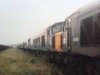
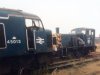
Here's a photo of many tons of dead Peak at March sometime around 87/88, taken by my stepbrother when we were up there. 45013 still looking smart with various details picked out in white. :)
 

Attachments

  • IMG_1661.jpg
    IMG_1661.jpg
    88 KB · Views: 48
  • IMG_1662.jpg
    IMG_1662.jpg
    102.3 KB · Views: 61

edwin_m

Veteran Member
Joined
21 Apr 2013
Messages
28,767
Location
Nottingham
i think you might have hit on the issue for me. My memories are from a period when they looked shabby. Is it odd only 3 made it to preservation?

They never seemed a particularly well-regarded class (my memories also from the 80s) and they didn't have the fan base of the hydraulics or the Deltics or the 50s. With diesel preservation being in its infancy and the very similar 45s remaining in service, I'm surprised as many as three survived.
 

61653 HTAFC

Veteran Member
Joined
18 Dec 2012
Messages
19,375
Location
Yorkshire
I suppose there were less of them and they were withdrawn earlier than most of the 45s, I think Swindon cut most of them up and fairly rapidly too. In fact by 1987 it seems that there were only 4 left, 2 of which we can thank the RTC for.
When the 45s were finally withdrawn in 1988 a lot of them ended up stored at March for a long time and some of them had just been switched off and parked up. I think that definitely contributed to the amount that ended up in preservation.

Here's a photo of many tons of dead Peak at March sometime around 87/88, taken by my stepbrother when we were up there. 45013 still looking smart with various details picked out in white. :)

I remember seeing what seemed like loads of 45s parked up outside the Avesta Steelworks, just south of the Tinsley Viaduct on the M1. They were there for several years, or at least that's what my vague memories tell me...
 

Cowley

Forum Staff
Staff Member
Global Moderator
Joined
15 Apr 2016
Messages
18,963
Location
Devon
On the brickwork next to Kennaway Tunnel in Dawlish someone (reputedly a Peak basher) wrote a couple of Peak numbers in yellow paint next to the entrance, they've been there since at least the early 80s as I remember wondering about them when I was little. One of them is a 45 and one is a 46. So definitely one person liked them :lol:.
I'll take a photo of them next time I'm down there. Wouldn't mind finding out what make of paint they used too...
 

Taunton

Veteran Member
Joined
1 Aug 2013
Messages
12,343
The Class 46 were essentially prototypes for the Class 47. Large loco, Sulzer 12LDA engine, Brush electrics. As referred to above, the last 20 Class 46 ordered were changed to the Class 47 design. On the electrics side, there must have been some advantage, when the time came for fitting ETH to 50 Peaks, in putting this on the previous Crompton-fitted locos rather than on the Brush-fitted ones. By the time the ETH project was started in the 1970s, both Brush and Crompton had been merged into the Hawker Siddeley group.
 

70014IronDuke

Established Member
Joined
13 Jun 2015
Messages
4,094
I have been doing a bit of digging through the 1972 ER casualty summaries and the answer to the disparity between the classes lies in a variety of component areas.

The casualties were categorised into 7 main areas (Engine, Transmission, Electrical, Air & Brake, CWA, Body and Running Gear and finally Miscellaneous). They were further split into sub categories.

The engine category is the first where there is a clear disparity. An ER cl.46 would have on average 2.10 engine related casualties that year but a ER cl.45 would only have 1.06. That's a big difference.

Reading this again and thinking about it, this is indeed a major difference on a 'component' - albeit a complex one - which, in theory, should show no difference at all between the 45 and 46!

Furthermore, all these engines were imported from Switzerland, from the same manufacturer, surely?

Engine problems (as I'm sure you know) may be relatively minor, but will often mean some days out of service - maybe weeks if the loco has to go to shops with problems such as cracked cylinder liners and heads.

One has to ask, why would the Cl 46s suffer twice the rate of these problems as the Cl 45s? Very heavy usage could induce such problems, but as I have argued in this thread, I don't believe the 46s were worked harder than the 45s, quite the contrary, in fact.

This is very puzzling.

Getting into the sub categories, the comparison on main components is almost identical - 0.55 for a cl.46 and 0.57 for a cl.45. But when we get to the fuel system the respective comparison is 0.44 vs 0.13, lub oil system is 0.59 vs 0.16 and cooling system is 0.52 vs 0.20.

Well, this only goes to (potentially) back up my thoughts outlined above. Some, possibly many, of the 'engine' problems - if we include faults in the liners and heads here - locos would show up through low oil pressure and oil in coolant. ( A lot would, of course, depend on how the faults were classified. lub oil and coolant failures in pumps would be 'pure' system failures, rather than anything directly to do with the power unit.) But why is the fuel system performance on the Cl 46 so inferior (three times as many faults) to that of the Cl 45? For me, this raises the suspicion of inferior maintenance - a Gateshead problem, perhaps?

And it really raises the next set of questions - how did other classes perform by comparison at the same depots?

The next bit of research I have to do is go through the casualty lists and see what cause all the above they were coded to. There are a number of cause attributions such as Depot, Works, Materials etc. so they will provide a few more answers. I have my own theories, based on my own experience, but I will let the figures do the talking first.

But for the meantime let's look at some other areas of difference. The electrical equipment was another big area of disparity - 2.95 for a cl.46 vs 2.20for a cl.45. In the sub divisions there was a slight advantage in the control equipment for a cl.45 but the biggest difference was in cables - 0.66 for a cl.46vs 0.23 for a cl.45.

Well, if there is a difference between the two classes, it's obviously in the cables and electrical gear - so these figures appear toconfirm what we (and you in particular) have been saying - the Cl 45 CP gear was superior to the Brush stuff on the newer Cl 46s.

But the starkest difference was in the CWA (Boiler, in other words). Most ER cl.46 had the Spanner III where as the ER cl.45 all had the Stones. That showed up as an ER cl.46 loco had an average annual casualty rate for the CWA of 1.58 but for an ER cl.45 loco it was only 0.38.

That is FOUR times the failure rate for the Cl 46 over the Class 45. Nothing to do with the Brush electrics on the locos - it would seem.

Fascinating data. Look forward to the next chapter in your analysis. :D
 

70014IronDuke

Established Member
Joined
13 Jun 2015
Messages
4,094
... By the time the ETH project was started in the 1970s, both Brush and Crompton had been merged into the Hawker Siddeley group.

Interesting, but nothing to do with decision to ETH the 45s over the 46s, as far as I know (in case any readers think this is relevant.)
BR did all the mods to the ETH 45s at Derby c 1970-72.
 

Taunton

Veteran Member
Joined
1 Aug 2013
Messages
12,343
Furthermore, all these engines were imported from Switzerland, from the same manufacturer, surely?
Only the design of the Sulzer engines came from Switzerland. Almost all the ones on BR were built by Vickers at Barrow, who were the licencees for Sulzer.

That's how it was done in those days. Foreign exchange was in short supply and imports seen as unacceptable. The many Sulzers in France were likewise built in the country.

Railway large diesels were an offshoot of designs for diesels in ships, which is how Vickers at their shipyard got involved. The large shipyards had separate diesel assembly shops where they built to various designs.

North British did the same, building in Glasgow to German M.A.N. designs.
 

70014IronDuke

Established Member
Joined
13 Jun 2015
Messages
4,094
Only the design of the Sulzer engines came from Switzerland. Almost all the ones on BR were built by Vickers at Barrow, who were the licencees for Sulzer.
...

Doh! I felt there was something wrong when I typed it out, but couldn't think what it was.

OK, thanks for the correction. But from the pov of the core argument, it doesn't affect things - the Cl 45 and 46 all had engines from the same maker.

Unless, for some reason, the quality control at Vickers deteriorated somehow when it came to doing the Cl 46 power units.
 

edwin_m

Veteran Member
Joined
21 Apr 2013
Messages
28,767
Location
Nottingham
I imagine an electric transmission could obtain the same amount of power from a diesel engine in different ways, for example at lower speed and higher torque or higher speed and lower torque. Rather like a car can be driven at the same speed in different gears, some of which may be better for fuel consumption and engine life than others. Is it possible that the different types of transmission were driving the engine in different ways and that on the Class 46 was hammering the engine more severely?
 

36270k

Member
Joined
7 Jan 2015
Messages
211
Location
Trimley
Hydrostatic fan drives often had problems with oil leaks on 46 and 47
45's had electric fan drives.
 

Taunton

Veteran Member
Joined
1 Aug 2013
Messages
12,343
Hydrostatic fan drives often had problems with oil leaks on 46 and 47
45's had electric fan drives.
Didn't realise this difference. Another aspect where the 46 appears to have prototyped the 47.

In passing, it's surprising how many electric or air powered accessories have over time been replaced by hydraulic ones only to suffer a reduction in reliability. Replacing air brakes with hydraulic, on both locos and heavy road vehicles, is another example. And hydraulic accessories seem incapable of being made leakproof.
 

Rover

Member
Joined
23 Sep 2011
Messages
557
Location
Derbyshire
Was there a difference to driving a class 46 to driving a class 45? Could a driver passed on 45s also drive 46s?
 

70014IronDuke

Established Member
Joined
13 Jun 2015
Messages
4,094
Was there a difference to driving a class 46 to driving a class 45? Could a driver passed on 45s also drive 46s?

I can't say for sure, but I suspect a driver passed for 45s could work 46s and v v - otherwise, I'm sure there would have been mix-ups and trains unable to proceed at places like Leeds, Derby and Birmingham when it was realised that they had the wrong type at the head of a train. And I never heard of this.

In theory, they were both able to handle trains equally (except, of course, if ETH was needed). I honestly forget if I ever rode on a 46, but I do seem to remember drivers saying a Cl 45 was more rugged, eg you could push them into the orange* range on the ammeter when starting without worrying too much about the risk of flashovers. This was not the same on a Cl 46. I think the driver that said this was a Holbeck man, so he had plenty of experience on both types. But this was a long time ago (early 70s) and I could have got it wrong now.

* IIRC, the ammeter in the cab had a green section (Safe), orange (don't keep it in here for too long) and red (definitely reduce power, this is a danger zone). I think the orange started at 2,500 amps - but like I say, it was 40 years ago, I could be wrong.

I forget which way round it was, but the traction motors were wired differently. I think the Cl 45s were all parallel across the generator and the Cl 46 were series-parallel. Again, I've forgotten the supposed pros and cons of both systems. Although officially limited to 90 mph, a Class 45 could definitely get to 100 mph if the driver was prepared to push it, eg with a late running train. Not sure about the Cl 46 - there has to be runs on the GN when they were substituting for Deltics and Cl 47s, so they would have had the excuse.
I've never seen a log with a Cl 44 on a passenger train, at least not one I remember. They were used on the WCML from 1960-62 before all the Class 40s were delivered, but loads tended to be very heavy and the schedules were not too demanding because of electrification works, so I wouldn't expect they reached even 90 mph too often. I suspect in practice there was little difference between them and the Cl 45 that could be noticed in traffic, athough they were, in theory, 10% less powerful than a 45.
 

Taunton

Veteran Member
Joined
1 Aug 2013
Messages
12,343
As I recall Taunton crews were equally qualified on Class 45 and 46 on the NE-SW services. Once the reversal at Gloucester came in then crews from there would work to Taunton and back in a shift, while our crews would work onward to Plymouth and back. I think often you would not know which type it was until it rolled in. Certainly before they were renumbered under TOPS they were all just regarded as "Peaks".

Regarded as not as powerful as even a Warship, but they certainly rode better than one down the twisting descent from Dainton to Totnes.
 

randyrippley

Established Member
Joined
21 Feb 2016
Messages
5,382
Within the context of this thread, something which needs considering is why were Crompton the preferred supplier over Brush? The Brush gear for the class 46 was only ordered as a fall-back after Crompton deliveries fell behind schedule. They couldn't keep up with the body build rate. The 46s were originally supposed to be 45s. Presumably the BRB buyers had a valid reason for specifying Crompton, not Brush when the Peaks were ordered. Were they worried about reliability of the Brush kit at that stage?

Also, comparing the class 46 with the main production 47 isn't fair as in those the diesels were a new iteration of the basic Sulzer design, and the generation kit was different. A better comparison would be between 45/46 and the first 20 class 47. But even that is an unequal comparison as the "generators" were fitted with makeshift ETH kit which could well have affected reliability
 
Status
Not open for further replies.

Top