• Our new ticketing site is now live! Using either this or the original site (both powered by TrainSplit) helps support the running of the forum with every ticket purchase! Find out more and ask any questions/give us feedback in this thread!

Why do “both ways” stops exist?

Status
Not open for further replies.

liamf656

Established Member
Joined
2 Aug 2020
Messages
1,702
Location
Derby
I travel daily between Derby and Ilkeston and the route has a few both ways stops in Spondon village. For those unfamiliar, “both ways” stops will usually have the flag, road markings and timetable on one side of the road and nothing on the other side, despite buses still stopping there both ways. Usually it’s indicated on the flag and timetable that buses do stop on the other side of the road.

I believe this practice is normally used to cut costs in seldom-used areas, but they are also used on busy frequent routes like the route I travel on. I’m curious as to why? Is there any red tape or huge cost to painting it on the road and adding a flag/timetable? I ask this as it’s fairly common that these stops are missed or passengers overcarried
 
Sponsor Post - registered members do not see these adverts; click here to register, or click here to log in
R

RailUK Forums

Dr Hoo

Established Member
Joined
10 Nov 2015
Messages
5,625
Location
Hope Valley
In my experience it is most common where there is only a pavement on one side of the road or a bend that makes it very hard for a driver to observe an intending passenger on the near side in one direction.
 

SCH117X

Established Member
Joined
27 Nov 2015
Messages
1,986
Derby to Ilkeston via Spondon would an interesting route - Stanley perhaps ?
 

WibbleWobble

Member
Joined
19 Aug 2022
Messages
617
Location
.
Sometimes it is down to a lack of available infrastructure, and not being able to get a post installed on the opposite side. In areas where the operator is responsible for the flags, they may not be able to install a post and would then have the challenge of getting an authority to agree to installing one.
 

Man of Kent

Member
Joined
5 Jul 2018
Messages
907
Sometimes it is down to a lack of available infrastructure, and not being able to get a post installed on the opposite side. In areas where the operator is responsible for the flags, they may not be able to install a post and would then have the challenge of getting an authority to agree to installing one.
Spot on, to which other reasons can be added, such as underground infrastructure that prevents a pole being installed; the stop has long existed but cannot be formalised as it does not meet current standards; and occasionally the adjacent property owner objects so much it is easier not to do anything formal.
 

JKP

Member
Joined
3 Jan 2023
Messages
723
Location
SE Scotland
Spot on, to which other reasons can be added, such as underground infrastructure that prevents a pole being installed; the stop has long existed but cannot be formalised as it does not meet current standards; and occasionally the adjacent property owner objects so much it is easier not to do anything formal.
I agree. Sometimes the bus stop pole is removed for pavement repairs and never replaced. Then there are traffic accidents and in one case I remember the stop was removed to build a new house and never replaced. Prior to the NapTAN database being created 20 years ago, many Local Authorities had no database or list showing the locations of bus stops so if one disappeared it went unnoticed unless someone complained.

Sometimes the wording on the bus stop opposite is Both Directions rather than Both Ways. Often though there is no wording. I was on a bus this morning that stopped opposite a bus shelter on the other side of the road and deposited the passenger onto a grass verge.
 

Stan Drews

Established Member
Joined
5 Jun 2013
Messages
2,152
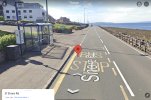
Hopefully this link will work, which shows one of the more scenic examples, in Skelmorlie on the Clyde Coast.
One one side you’ll see the usual shelter and stop with the both ways flag. On the opposite side of the road you can see the yellow Bus Stop markings on the road where there is a small gap in the railings at the top of a set of steps. It is served four times an hour during the day by the Largs - Glasgow services.
I think there are a total of 4 stops like that along that stretch of the road.
 

Attachments

  • BC86A182-F413-450C-9523-28640F35162E.jpeg
    BC86A182-F413-450C-9523-28640F35162E.jpeg
    3 MB · Views: 110

RT4038

Established Member
Joined
22 Feb 2014
Messages
5,455
Spot on, to which other reasons can be added, such as underground infrastructure that prevents a pole being installed; the stop has long existed but cannot be formalised as it does not meet current standards; and occasionally the adjacent property owner objects so much it is easier not to do anything formal.
Yes to all of this, however 'occasionally' adjacent property owners objecting is more often than you might think!
 

61653 HTAFC

Veteran Member
Joined
18 Dec 2012
Messages
19,350
Location
Yorkshire
Sometimes the wording on the bus stop opposite is Both Directions rather than Both Ways. Often though there is no wording. I was on a bus this morning that stopped opposite a bus shelter on the other side of the road and deposited the passenger onto a grass verge.
WYPTE are bad for unhelpful wording. About 20 years ago they redesigned the flags which previously had no destination information on them, and added a list of destinations served from that stop. The exception being stops which served both sides, and previously were just marked "Both Directions" below the bus pictogram. The redesign meant that unidirectional stops said "Buses towards:" followed by a list e.g. Denby Dale, Wakefield. The stops that serve both directions now say "Buses towards: both sides of the road" which is not only almost useless, but conjures (for me at least) that scene in the second Austin Powers movie where Powers tries to painstakingly turn an electric buggy around in a narrow corridor!
 

WatcherZero

Established Member
Joined
25 Feb 2010
Messages
10,272
Usually its because there isnt a pavement on the opposite side of the road, so often seen on country lanes or the outside edge of housing estates.
 

robertclark125

Established Member
Joined
12 Mar 2008
Messages
1,646
Location
Cardenden, Fife
Usually its because there isnt a pavement on the opposite side of the road, so often seen on country lanes or the outside edge of housing estates.
Such an example exists in Cluny, between Cardenden and Kirkcaldy, at the entrance to Coalden Farm. Pavement on one side, but the entrance to the farm is what is used for Cardenden bound buses.
 

Vexed

Member
Joined
12 Jan 2020
Messages
648
Location
Herts / Hants
In St Albans there are a few urban ones where cars park on only one side of the road and the bus stops are only marked on the clear side.

Intalink used the rather lengthy "Both sides of the road" which makes it hard to read at a distance but that's fitting with the other small text on Intalink flags! It's certainly a little blurry on Google Street View.


Screenshot_20230824_072229_Maps.jpg
 

RT4038

Established Member
Joined
22 Feb 2014
Messages
5,455
WYPTE are bad for unhelpful wording. About 20 years ago they redesigned the flags which previously had no destination information on them, and added a list of destinations served from that stop. The exception being stops which served both sides, and previously were just marked "Both Directions" below the bus pictogram. The redesign meant that unidirectional stops said "Buses towards:" followed by a list e.g. Denby Dale, Wakefield. The stops that serve both directions now say "Buses towards: both sides of the road" which is not only almost useless, but conjures (for me at least) that scene in the second Austin Powers movie where Powers tries to painstakingly turn an electric buggy around in a narrow corridor!
Is anybody really confused by this?
 

InOban

On Moderation
Joined
12 Mar 2017
Messages
4,537
Very often in rural areas there will be a shelter on the side of the road where pupils wait for the bus to school (which is often a public service.) Obviously they don't need a shelter when they get off on the return journey.
 

AndrewE

Established Member
Joined
9 Nov 2015
Messages
7,329
Usually its because there isnt a pavement on the opposite side of the road, so often seen on country lanes or the outside edge of housing estates.
In (on?) Guernsey we noticed that besides ony 1 stop sign (and sometimes even where there were 2) it was normal to wait on the side where there was a tiny pedestrian space - and the driver of a bus on the opposite side of the road would check whether you wanted to get on his/her bus.
Does waiting on the wrong side of the road apply in any of the other locations upthread?
 

Solent&Wessex

Established Member
Joined
9 Jul 2009
Messages
2,746
The village where I lived for many years as a kid in North Yorkshire had an odd.

The Village bus route went in a loop round the top end of the village, and always in the same direction.

Part way round the loop there was a "West Yorkshire " branded bus stop sign (the West Yorkshire Road Car company had long since ceased to exist) which was on the opposite side of the road to the way the buses went.

Under the Bus picture, bus stop wording and West Yorkshire NBC logo it said "Other Side of the Road".

It was a small road with street lights only down one side. The sign was fixed to a street light. Obviously that was easier than installing poles or infrastructure on the other side of the road where the bus actually stopped.

Incidentally I occasionally visit the village still and note the old concrete lighting pole was replaced a few years ago with a new pole. The old sign disappeared and a new one has never appeared. The buses still run, stopping at the opposite side of the road. But you'd never know!
 

DunsBus

Established Member
Joined
12 Jan 2013
Messages
1,810
Location
Duns
Here's one which is fairly local to me. Main Street East End, Chirnside.

B6355
 

mangad

Member
Joined
20 Jun 2014
Messages
718
Location
Stockport
In (on?) Guernsey we noticed that besides ony 1 stop sign (and sometimes even where there were 2) it was normal to wait on the side where there was a tiny pedestrian space - and the driver of a bus on the opposite side of the road would check whether you wanted to get on his/her bus.
Does waiting on the wrong side of the road apply in any of the other locations upthread?
This was a question I had when I encountered a Both Sides stop a few years ago. I needed the bus going from the other side of the road to the stop. I'd never used such a bus stop so I simply didn't know what to do, and there was nothing to advise.
There was no pavement on the other side, and the stop was right next to a (minor) road junction. All in all, it was a terrible place for a bus stop and it wasn't really a safe place to wait. But I worried that the bus driver wouldn't spot me if I waited on the pavement.
 

61653 HTAFC

Veteran Member
Joined
18 Dec 2012
Messages
19,350
Location
Yorkshire
Is anybody really confused by this?
They could well be. Not the Austin Powers bit, that was just me being facetious. There are a few stops around the HD8 area (Denby Dale, Clayton West, Skelmanthorpe) where it isn't obvious which side of a road is the Huddersfield-bound side and which is for Denby Dale. With the flags just saying "both sides of the road" it isn't obvious which side to wait on for which destination due to the way the services are routed. There's a very simple solution, which would be for the flag to say "This side: Denby Dale, Wakefield" and "Other side: Holmfirth, Huddersfield".
 

Ken H

Established Member
Joined
11 Nov 2018
Messages
6,718
Location
N Yorks
There is this horror between Settle and Austwick. The main road is the A65, and is the bus route. No flag going North West. The main road is quite a sharp curve there.
Where do you wait for a bus towards Ingleton? In the tree? By the road sign so the bus driver doesnt see you? By the bus stop flag?

.
 

43055

Established Member
Joined
8 Mar 2018
Messages
3,682
I travel daily between Derby and Ilkeston and the route has a few both ways stops in Spondon village. For those unfamiliar, “both ways” stops will usually have the flag, road markings and timetable on one side of the road and nothing on the other side, despite buses still stopping there both ways. Usually it’s indicated on the flag and timetable that buses do stop on the other side of the road.

I believe this practice is normally used to cut costs in seldom-used areas, but they are also used on busy frequent routes like the route I travel on. I’m curious as to why? Is there any red tape or huge cost to painting it on the road and adding a flag/timetable? I ask this as it’s fairly common that these stops are missed or passengers overcarried
Looking at street view I would say, unless I have missed something, there is no real reason there should be a second flag for the stops going out of Derby. On the villager every stop has a flag and timetable even when there is pretty much no pavement at the side of the road.
 

JKP

Member
Joined
3 Jan 2023
Messages
723
Location
SE Scotland
Here's one which is fairly local to me. Main Street East End, Chirnside.

B6355
Yes, I know that stop. I don’t think that there has ever been a sign on the opposite side of the road. East End Garage, the name of the stop has been gone a while now too. I seem to recall that it was home to a fleet of run down Citroen cars.
 

Mwanesh

Member
Joined
14 May 2016
Messages
948
It's just easier to do in some places. There are many things to consider objections planning permission visibility. Try getting planning permission to put or move a stop. The paperwork is just too much.
 

RT4038

Established Member
Joined
22 Feb 2014
Messages
5,455
It's just easier to do in some places. There are many things to consider objections planning permission visibility. Try getting planning permission to put or move a stop. The paperwork is just too much.
Formal 'planning permission' is not required, but your point is nonetheless valid - everyone and their dogs become road safety experts as to why a bus stop should not be placed outside or near their house/premises!
 

JKP

Member
Joined
3 Jan 2023
Messages
723
Location
SE Scotland
It's just easier to do in some places. There are many things to consider objections planning permission visibility. Try getting planning permission to put or move a stop. The paperwork is just too much.
Bus stops surely fall under traffic signs? Have never had to apply for planning permission to erect bus stop poles and signs as the poles are installed through Council roads department. Permission for signs on lamp posts have to be approved by the Council’s street lighting people. Bus shelters too are normally exempt as are installed by the Council unless they carry advertising I.e. Adshel.
 

RT4038

Established Member
Joined
22 Feb 2014
Messages
5,455
Bus stops surely fall under traffic signs? Have never had to apply for planning permission to erect bus stop poles and signs as the poles are installed through Council roads department. Permission for signs on lamp posts have to be approved by the Council’s street lighting people. Bus shelters too are normally exempt as are installed by the Council unless they carry advertising I.e. Adshel.
You are right, but the underlying sentiment about hassle is quite valid.
 

DunsBus

Established Member
Joined
12 Jan 2013
Messages
1,810
Location
Duns
Yes, I know that stop. I don’t think that there has ever been a sign on the opposite side of the road. East End Garage, the name of the stop has been gone a while now too. I seem to recall that it was home to a fleet of run down Citroen cars.
Funnily enough, I passed the site of that garage just last week. It's now the entrance to a new housing estate. I can remember seeing these cars you mentioned along with the disused petrol pumps.
 
Status
Not open for further replies.

Top