Quite. There has to be a question around diminishing returns. The distances between lines involved are trivial, in an already densely served area of central London.In that case…

-
Our new ticketing site is now live! Using either this or the original site (both powered by TrainSplit) helps support the running of the forum with every ticket purchase! Find out more and ask any questions/give us feedback in this thread!
You are using an out of date browser. It may not display this or other websites correctly.
You should upgrade or use an alternative browser.
You should upgrade or use an alternative browser.
Why did they have the DLR , rather than extend the Underground/overground
- Thread starter Simon75
- Start date
- Status
- Not open for further replies.
Sponsor Post - registered members do not see these adverts; click here to register, or click here to log in
R
RailUK Forums
Backroom_boy
Member
I'm convinced that the TFL aspiration to extend the DLR along the old Fleet line safeguarded route was more about keeping the safeguarding alive for the future than a serious suggestion
Yes but to keep safeguarding in Central London for realistic raise routes is entirely worth it, especially as it's going to get very difficult to build any lines after Crossrail 2.I'm convinced that the TFL aspiration to extend the DLR along the old Fleet line safeguarded route was more about keeping the safeguarding alive for the future than a serious suggestion

AlastairFraser
Established Member
- Joined
- 12 Aug 2018
- Messages
- 4,172
The Strand and Ludgate Hill areas are a bit of a walk away from the District down by the Thames by London standards!In that case…
So is Mount Pleasant from Farringdon. Yet in reality we’re talking about 10 minutes or so walk.The Strand and Ludgate Hill areas are a bit of a walk away from the District down by the Thames by London standards!

I remember riding the DLR not long after the opening and being rather struck by the way the destination was changed at the end of a run by a rotating block. However, I've never thought that that the DLR should be extended from Bank and assumed that the line ends where it does for very good reasons.
I've been toying with the idea that the old Jubilee line tunnels should be extended east along the old Fleet Line route as far as Cannon Street and then veer south under the river to serve serve London Bridge, Peckham Rye and points south, maybe opening up as yet unserved areas of south London.
I've been toying with the idea that the old Jubilee line tunnels should be extended east along the old Fleet Line route as far as Cannon Street and then veer south under the river to serve serve London Bridge, Peckham Rye and points south, maybe opening up as yet unserved areas of south London.
The Strand and Ludgate Hill areas are a bit of a walk away from the District down by the Thames by London standards!
I don’t know how often you do it - but I walk up the hill from the Thames at Blackfriars to Ludgate Hill a couple of times a week (including yesterday), and it takes 3 minutes - even though there is a building site in the way now. Embankment to The Strand is quicker still. It is a much shorter walk than, say, St Pancras to the Victoria line.
AlastairFraser
Established Member
- Joined
- 12 Aug 2018
- Messages
- 4,172
In a way they are, but there's congestion relief benefits (Covent Garden in particular has serious issues with station congestion, and won't be easy to fix), plus increased interchange opportunities.Quite. There has to be a question around diminishing returns. The distances between lines involved are trivial, in an already densely served area of central London.
Walking from the DLR to Monument for the District or Circle to Blackfriars in order to reach Thameslink is convoluted, the DLR at City Thameslink opens up a whole world of direct Docklands based opportunities that currently involve a change at Canary Wharf, and reduces interchange traffic at Bank station (which should always be a TfL goal).
The difference is that there isn't much around the Mount Pleasant area of significance AFAIK.So is Mount Pleasant from Farringdon. Yet in reality we’re talking about 10 minutes or so walk.
Probably depends on time of day and direction of travel, I guess.I don’t know how often you do it - but I walk up the hill from the Thames at Blackfriars to Ludgate Hill a couple of times a week (including yesterday), and it takes 3 minutes - even though there is a building site in the way now. Embankment to The Strand is quicker still. It is a much shorter walk than, say, St Pancras to the Victoria line.
All fair, but rapidly reaching into the laws of diminishing returns. If you need to go to DLR from Thameslink, then the Jubilee Line and London Bridge are already straightforward options, whether using Canary Wharf or Canning Town.In a way they are, but there's congestion relief benefits (Covent Garden in particular has serious issues with station congestion, and won't be easy to fix), plus increased interchange opportunities.
Walking from the DLR to Monument for the District or Circle to Blackfriars in order to reach Thameslink is convoluted, the DLR at City Thameslink opens up a whole world of direct Docklands based opportunities that currently involve a change at Canary Wharf, and reduces interchange traffic at Bank station (which should always be a TfL goal).
The difference is that there isn't much around the Mount Pleasant area of significance AFAIK.
Probably depends on time of day and direction of travel, I guess.
AlastairFraser
Established Member
- Joined
- 12 Aug 2018
- Messages
- 4,172
True. I don't regard it as a particularly high priority project, the Bakerloo extension. splitting the Northern line and Crossrail 2 should come first, however an extension to Kings Cross St Pancras is total pie in the sky territory and not a penny of TfL funding should be spent on it.All fair, but rapidly reaching into the laws of diminishing returns. If you need to go to DLR from Thameslink, then the Jubilee Line and London Bridge are already straightforward options, whether using Canary Wharf or Canning Town.
If Canary Wharf really want to pay for it all, fair enough, but it will be horrifically expensive.
Probably depends on time of day and direction of travel, I guess.
Peak time, contra peak direction, ie dodging lots of people coming the other way. It would be quicker off peak.
If Canary Wharf really want to pay for it all, fair enough, but it will be horrifically expensive.
I don’t think there is any real suggestion that Canary Wharf Group will pay for such a link. It would cost more than their entire company is worth.
Last edited:
Gag Halfrunt
Member
- Joined
- 23 Jul 2019
- Messages
- 1,002
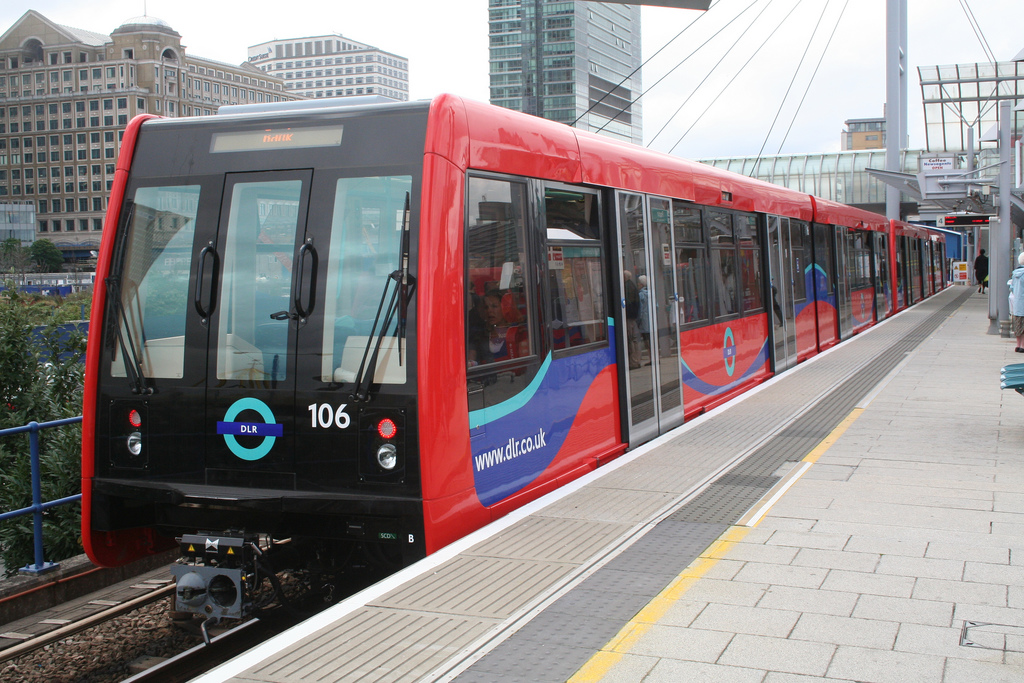
I remember riding the DLR not long after the opening and being rather struck by the way the destination was changed at the end of a run by a rotating block.
IIRC the P86 trains originally had motorised roller blinds, which didn't work properly. The rotating blocks were a temporary substiute.
P86 with a roller blind in use:

File:DLR-WestIndiaDocks-2.jpg - Wikimedia Commons
P86 with the roller blind rolled to a blank white space and a rotating block destination display below it:

File:London Docklands 1991.jpg - Wikimedia Commons
Later they were fitted with flip-dot displays:

File:West India Quay DLR (1991a).jpg - Wikimedia Commons

A very interesting and informative discussion.
Just as a slight deviation, various posters have made reference to the DLR leading the way to development of light rail systems elsewhere; this brought to mind a vague memory (if I recall correctly), wasn't an original DLR unit fitted temporarily with a pantograph and used to demonstrate light rail somewhere in Greater Manchester?
Just as a slight deviation, various posters have made reference to the DLR leading the way to development of light rail systems elsewhere; this brought to mind a vague memory (if I recall correctly), wasn't an original DLR unit fitted temporarily with a pantograph and used to demonstrate light rail somewhere in Greater Manchester?

pokemonsuper9
Established Member
I recall something like that too, if I recall correctly the temporary platform they used was disassembled and is now Hag Fold stationA very interesting and informative discussion.
Just as a slight deviation, various posters have made reference to the DLR leading the way to development of light rail systems elsewhere; this brought to mind a vague memory (if I recall correctly), wasn't an original DLR unit fitted temporarily with a pantograph and used to demonstrate light rail somewhere in Greater Manchester?

A very interesting and informative discussion.
Just as a slight deviation, various posters have made reference to the DLR leading the way to development of light rail systems elsewhere; this brought to mind a vague memory (if I recall correctly), wasn't an original DLR unit fitted temporarily with a pantograph and used to demonstrate light rail somewhere in Greater Manchester?
Yes, Manchester.
Agreed about this being an interesting discussion, one of the best threads I've read for a while.
edwin_m
Veteran Member
I rode on it. 1987 I think. It ran on a closed but still extant bit of the Fallowfield Loop and the platform was next to the A57 at Debdale.
Gag Halfrunt
Member
- Joined
- 23 Jul 2019
- Messages
- 1,002
From Wikipedia:
 en.wikipedia.org
A few photos here:
 commons.wikimedia.org
Vehicle 11 made history several times. It was part of a light rail demonstration at Debdale Park, Manchester for which it had a pantograph fitted by Balfour Beatty. The demonstration took place on 9 February 1987 as evaluation trials for a potential tram system in Manchester. P11 was the last unit to be delivered to the DLR at Poplar on 30 March 1987, without the pantograph. It carried Queen Elizabeth II and the Prince Philip, Duke of Edinburgh during the opening of the DLR on 30 July 1987 from Island Gardens (when originally above ground) to Poplar and then to Tower Gateway. It also operated the first revenue-earning DLR service and was the first to move to Essen in 1991.
Docklands Light Railway rolling stock - Wikipedia
A few photos here:
Category:Project Light Rail DLR demonstration, Debdale Park - Wikimedia Commons
AlastairFraser
Established Member
- Joined
- 12 Aug 2018
- Messages
- 4,172
That sounds highly optimistic for peak walking time, but I'll take your word for it.Peak time, contra peak direction, ie dodging lots of people coming the other way. It would be quicker off peak.
Then it shouldn't be built before 2050 or 2060, unless there are other private funders willing to help.I don’t think there is any real suggestion that Canary Wharf Group will pay for such a link. It would cost more than their entire company is worth.
Cloud Strife
Established Member
- Joined
- 25 Feb 2014
- Messages
- 2,964
However, I've never thought that that the DLR should be extended from Bank and assumed that the line ends where it does for very good reasons.
The reasoning behind Bank was simply because it was connecting the two financial districts up, nothing more. There was no money and no will to extend it further than Bank, as the priority was (and is) to extend the DLR to new areas in the Docklands. The problem is that Bank simply can't cope as a terminal station, so it would make much more sense to terminate elsewhere or even to split into two western sections, which could deliver up to 40 trains per hour through Bank.
I don’t think there is any real suggestion that Canary Wharf Group will pay for such a link. It would cost more than their entire company is worth.
Not all of it, but they're not against paying for some of it, just as they did with the Elizabeth Line station at Canary Wharf. It's often forgotten that the Canary Wharf Group are more than just Canary Wharf these days, so they've got a strong interest in getting the DLR to reach HS1/2 and WCML/ECML.
True. I don't regard it as a particularly high priority project, the Bakerloo extension. splitting the Northern line and Crossrail 2 should come first, however an extension to Kings Cross St Pancras is total pie in the sky territory and not a penny of TfL funding should be spent on it.
It's worth thinking about it in the context of the Docklands as a residential area too, however. There's still a substantial amount of areas next to the river that are screaming for redevelopment, particularly the area between the Woolwich Ferry and the Thames Barrier Park that is currently industrial land. Arguably, the whole riverside towards Dagenham will be converted to residential and light commercial in the coming years, and a DLR extension would increase the viability of these projects further without putting pressure on the rail lines. And who knows what will happen with the low density housing south of South Quay as well, which is showing its age and property developers must be looking at the area with very hungry eyes.
That sounds highly optimistic for peak walking time, but I'll take your word for it.
It’s literally 300 metres!
== Doublepost prevention - post automatically merged: ==
Not all of it, but they're not against paying for some of it, just as they did with the Elizabeth Line station at Canary Wharf.
I think TfLs experience of that would give both parties pause for thought.
Last edited:
AlastairFraser
Established Member
- Joined
- 12 Aug 2018
- Messages
- 4,172
300 metres is further than the distance to change in lots of major stations, but the min interchange time is larger for a reason!It’s literally 300 metres!

RJ
Established Member
All fair, but rapidly reaching into the laws of diminishing returns. If you need to go to DLR from Thameslink, then the Jubilee Line and London Bridge are already straightforward options, whether using Canary Wharf or Canning Town.
The DLR does link with Thameslink at Greenwich, with a little forward planning people can use the Jubilee via West Hampstead or London Bridge to Canning Town, or interchange at the West Ham or the Tower stations and Blackfriars. The Elizabeth Line between Farringdon and Custom House/Stratford is also a useful link. Most of these are more amiable interchanges than trekking through labyrinthine tunnels in Central London. I don't think a Central London interchange between the lines is really necessary, though more options is never a bad thing really.

Dr_Paul
Established Member
- Joined
- 3 Sep 2013
- Messages
- 1,546
Taking the sharpness of many of the curves -- perhaps 'corners' might be a more apposite word -- on the DLR into consideration, I've often wondered why it wasn't built as metre gauge. That it is completely separate from both the main line and Underground would have made this possible.This was arguably a good move to do this even with hindsight. The light rail concept has proved to be "scalable" and now covers many more routes and greater passengers flows than originally expected. It it still more versatile than the Underground in minimum curvature, which helps it fit in at tight spots like Poplar. Yes it ruled out ever extending onto the Waterloo and City, but I don't believe that would ever have been feasible anyway due to the geography of Bank station.
Building something in a non-standard gauge means not only is regular rolling stock incompatible, but also any service vehicles have to be specially made for it.
And I suspect there are plenty of standard-guage tram systems whose corners are just as sharp, if-not sharper than those on the DLR.
And I suspect there are plenty of standard-guage tram systems whose corners are just as sharp, if-not sharper than those on the DLR.
edwin_m
Veteran Member
On a quick measurement from Google, some of the curves round the Poplar "triangle" look to be about 35m radius. Metrolink goes down to 25m, Nottingham tram has an 18m curve and I believe there is a 14m in Berlin. All these are standard gauge, admittedly with a different wheel profile from DLR.Building something in a non-standard gauge means not only is regular rolling stock incompatible, but also any service vehicles have to be specially made for it.
And I suspect there are plenty of standard-guage tram systems whose corners are just as sharp, if-not sharper than those on the DLR.
There's no problem building metre gauge vehicles with similar dimensions to those on DLR. But there is inevitably a greater risk of overturning which might become particularly hazardous when making tight turns on a viaduct as at Poplar, if there is a strong crosswind.
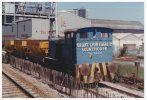
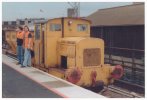
The very first vehicles to run on the DLR were indeed those of its construction contractors. This included a few, onetime BR, traditional 16 ton mineral wagons!Building something in a non-standard gauge means not only is regular rolling stock incompatible, but also any service vehicles have to be specially made for it.

Peter Mugridge
Veteran Member
Et voila!The very first vehicles to run on the DLR were indeed those of its construction contractors. This included a few, onetime BR, traditional 16 ton mineral wagons!
Seen here at Stratford at 14.21 on 14th June 1986, along with the shunter that was also used - first picture.
...and also at Stratford at 12.15 on 9th June 1990 - second picture.

Would anyone know if it was the same shunter repainted or if they had two different shunters involved?
Attachments
- Status
- Not open for further replies.