
-
Our new ticketing site is now live! Using either this or the original site (both powered by TrainSplit) helps support the running of the forum with every ticket purchase! Find out more and ask any questions/give us feedback in this thread!
You are using an out of date browser. It may not display this or other websites correctly.
You should upgrade or use an alternative browser.
You should upgrade or use an alternative browser.
What is this please
- Thread starter nickmn
- Start date
- Status
- Not open for further replies.
Sponsor Post - registered members do not see these adverts; click here to register, or click here to log in
R
RailUK Forums

Mcr Warrior
Veteran Member
- Joined
- 8 Jan 2009
- Messages
- 17,194
Installed to reduce the 'wear and tear' to both rail wheels and the actual track itself, presumably? Are there many such pieces of kit around the GB network, or do they tend to only get installed on certain sections of track with particular characteristics, such as on Barmouth Bridge, where track replacement is maybe trickier?Flange lubricator
swt_passenger
Veteran Member
- Joined
- 7 Apr 2010
- Messages
- 34,257
They’re all over the network. Must be many hundreds if not thousands of them.Installed to reduce the 'wear and tear' to both rail wheels and the actual track itself, presumably? Are there many such pieces of kit around the GB network, or do they tend to only get installed on certain sections of track with particular characteristics, such as on Barmouth Bridge, where track replacement is maybe trickier?
Looking at photos of the refurbished bridge, it seems the track is equipped with heavy-duty check-rails the whole length of the bridge:
Barmouth Bridge

© Copyright Mark Percy and licensed for reuse under this Creative Commons Licence.
hence the flange lubricators at each end. (Click on the photo to go to the larger original on the Geograph website.)
Barmouth Bridge
© Copyright Mark Percy and licensed for reuse under this Creative Commons Licence.
hence the flange lubricators at each end. (Click on the photo to go to the larger original on the Geograph website.)
swt_passenger
Veteran Member
- Joined
- 7 Apr 2010
- Messages
- 34,257
Those are a relatively unusual form of guard rail, (I think using flat bottom rail rotated 90 degrees), and the wheels will not be in contact with them unless a derailment occurs.Looking at photos of the refurbished bridge, it seems the track is equipped with heavy-duty check-rails the whole length of the bridge:
Barmouth Bridge
© Copyright Mark Percy and licensed for reuse under this Creative Commons Licence.
hence the flange lubricators at each end. (Click on the photo to go to the larger original on the Geograph website.)
It's not easy to see from angled views taken from the adjacent walkway exactly how much clearance there is between guard rail and track. I think there is a limited gap, and with the normal degree of 'wander' a wheel-set can have I suspect that contact does occur, hence the lubricators.Those are a relatively unusual form of guard rail, (I think using flat bottom rail rotated 90 degrees), and the wheels will not be in contact with them unless a derailment occurs.

Annetts key
Established Member
Also known as rail greasers, as if you have to work on the track near them, you find yourself absolutely covered in the stuff...Flange lubricator
As said above, there are thousands of them. And various different types exist, from purely mechanical through to solar PV cell electrically powered types.
Normally found on the approach / start of tighter radius curves. Some can be seen from platforms where the station is on or near curved track.
The railway used to have dedicated maintenance staff to look after this type of equipment.
swt_passenger
Veteran Member
- Joined
- 7 Apr 2010
- Messages
- 34,257
I found a couple of videos of trains crossing from after the closure, seems to me there’s loads of clearance. What we really need is a view taken from the middle of the track, or taken from a train cab.It's not easy to see from angled views taken from the adjacent walkway exactly how much clearance there is between guard rail and track. I think there is a limited gap, and with the normal degree of 'wander' a wheel-set can have I suspect that contact does occur, hence the lubricators.
I took a screen shot from Geoff Marshall’s video of the bridge (the picture shows an angled view of the rails and guard rails through the swing bridge section girders:
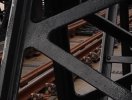
But here’s a link to the complete video, it shows many ‘almost’ views of the track, during a walk over the pedestrian bridge alongside the railway.
Last edited:
Falcon1200
Established Member
The railway used to have dedicated maintenance staff to look after this type of equipment.
I recall a post-privatisation dispute when a train operator alleged that train shortage was caused by excessive flange wear due to Railtrack's failure to maintain lubricators!
How does the grease not end up where you dont want it, making things a bit too slippery?Installed to reduce the 'wear and tear' to both rail wheels and the actual track itself, presumably? Are there many such pieces of kit around the GB network, or do they tend to only get installed on certain sections of track with particular characteristics, such as on Barmouth Bridge, where track replacement is maybe trickier?
Mcr Warrior
Veteran Member
- Joined
- 8 Jan 2009
- Messages
- 17,194
Good question. Had wondered that! Perhaps one of the better informed forum regulars on here might be able to explain this?How does the grease not end up where you dont want it, making things a bit too slippery?
Trainman40083
Established Member
About ten years ago, I could have answered that. Not sure excessive amounts of grease comes out. Presume this might be a treadle operated device. Enough grease to cut out the squealing and excessive wear.How does the grease not end up where you dont want it, making things a bit too slippery?
edwin_m
Veteran Member
However, the rustiness of the rail suggests that such contact is rare if ever.It's not easy to see from angled views taken from the adjacent walkway exactly how much clearance there is between guard rail and track. I think there is a limited gap, and with the normal degree of 'wander' a wheel-set can have I suspect that contact does occur, hence the lubricators.
A check rail is used on tight curves where there is a risk of the opposite wheel "flange climbing" over its rail, and also on points opposite the crossing gap to prevent the opposite wheel going through that gap. A guard rail is much more likely on a bridge - this has a good chance of stopping a derailed train, whatever the cause, going far enough sideways to topple off.
As to the flange lubricators, I suggest they are more to do with the tight curves each end of the bridge. Incidentally the northern end looks to be less than 200m radius (crudely judged from the OS map) so probably has a check rail.
Annetts key
Established Member
Not my area of expertise, but what i do know (having spoken to one of the maintainers in the past) is that the mechanical type applies a set amount of grease to the rail as each wheel goes over the applicator. What I don't know, is if there is any system to reduce the amount for the second and subsequent wheels.About ten years ago, I could have answered that. Not sure excessive amounts of grease comes out. Presume this might be a treadle operated device. Enough grease to cut out the squealing and excessive wear.
The biggest problem with this type, is that for the system to be effective, the grease level should not be allowed to drop to too low a level. If it runs out of grease, the actions of the wheels will cause damage to the lubricator, as there is now no longer any grease to absorb the shock.
The electrical type that I have seen uses electronic wheel sensors (i don't know what technicology they use, but there are no moving parts visible) to detect a train. It then pumps a set amount of grease out. They have some type of timer, as they won't pump again unit some time after the train has passed.
Rather surprisingly, but not much grease ends up on the top of the rail. The vast majority goes on the edge of the rail. The rest ends up on the ballast, sleepers and anything else nearby in the four foot...
Even if some grease does get on the top of the rail, the combination of the pressure from the wheels of trains and the weather quickly breaks it down. So the top of the rail area affected by the grease is not going to be that long a distance. And don't forget, these are only fitted to one rail on a bend.
Last edited:
- Status
- Not open for further replies.