• Our new ticketing site is now live! Using either this or the original site (both powered by TrainSplit) helps support the running of the forum with every ticket purchase! Find out more and ask any questions/give us feedback in this thread!

What counts as a mainline?

Status
Not open for further replies.

A S Leib

Established Member
Joined
9 Sep 2018
Messages
3,279
We'll the 'West Coast Main Line' is usually considered to include both the Trent Valley and Birmingham routes, both routes to Manchester and the Liverpool line....so I would consider the Great Western main line to include Paddington to Swansea - and possibly on to Fishguard - as well as both routes to Bristol and Penzance.

But what about Gloucester and Cheltenham? Hereford via Worcester? These are all served by the IETs and HSTs before them?

Only having an hourly service means I'd call the Cotswolds and Golden Valley lines branches, not part of the Great Western Main Line. On the other hand, I think the Highland Main Line only has an hourly service between Perth and Inverness (I can't remember if it's counted as starting from Perth, Stirling or elsewhere).

But then for many years that would have invalidated the WCML north of Preston (unless you then do count the Transpennine and CrossCountry offerings despite neither being WCML proper)

Hourly also raises questions for how far South the GWML reaches. Even Swansea becomes pushing it on the 1 per hour definition for most of the day (only get extra depot moves in the morning and then some extensions of Cardiff terminators in the evening).

I would be more inclined to say anywhere with a meaningful number of express trains to London* counts. (* perhaps allow long distance trains to Glasgow/Edinburgh for Scotland)

(Above from https://www.railforums.co.uk/threads/favourite-mainline.288243/#post-7342331)

I'd count TPE / CrossCountry services on the northern West Coast Main Line; going back to the Highland Main Line for an example, I wouldn't exclude the LNER services for serving areas hundreds of miles south of it. As far as I'm concerned, Swansea isn't part of the Great Western Main Line either; it's part of the South Wales Main Line.

My general definition of a main line would be one which has a large number of services running across it between large or otherwise significant destinations whilst clearly not being a branch of another line. I don't think there's an easy definition which wouldn't have any exceptions to what I'd describe as a main line; Carlisle to Edinburgh is only an hourly passenger service (albeit mostly shadowed by other services) and is still count that as a main line, whilst Didcot Parkway to Oxford has more trains than to Bristol Parkway and it's the latter which I'd call a main line (well, combinations of main lines).
 
Last edited:
Sponsor Post - registered members do not see these adverts; click here to register, or click here to log in
R

RailUK Forums

Topological

Established Member
Joined
20 Feb 2023
Messages
4,270
Location
Swansea
(Above from https://www.railforums.co.uk/threads/favourite-mainline.288243/#post-7342331)

I'd count TPE / CrossCountry services on the northern West Coast Main Line; going back to the Highland Main Line for an example, I wouldn't exclude the LNER services for serving areas hundreds of miles south of it. As far as I'm concerned, Swansea isn't part of the Great Western Main Line either; it's part of the South Wales Main Line.
My take on the Highland Main Line was that it would fail the requirement for regular express trains to London (since there is 1 + the sleeper), but would clearly have a regular express train to the capital of Scotland. Rather than discounting the London trains, it was more to say that the HML can still be a main line.

It will be interesting to see what definitions emerge in this thread (and more interestingly, how many of those suddenly make secondary routes class as mainlines)
 

WAB

Established Member
Joined
27 Jun 2015
Messages
1,295
Location
Anglia
There are two traincrew depots at Cardiff: mainline and Valleys. Mainline route knowledge includes the Ebbw Vale and Maesteg lines.
 

Zomboid

Established Member
Joined
2 Apr 2025
Messages
2,246
Location
Oxford
A "main line" links major centres and carries a mixture of traffic, including some regular limited stop services. At least as a starting point.
 

D6130

Established Member
Joined
12 Jan 2021
Messages
9,000
Location
West Yorkshire/Tuscany
I think one of the problems with defining what is a main line is that you 'youngsters' are defining lines in terms of the present-day services that run on them.....whereas the commonly-used names were bestowed on them many years ago - in most cases well over a hundred years ago - back in the days of steam.

I would probably agree with @A S Leib regarding the South Wales Main Line'....but by historical definition that also included Swindon-Gloucester-Severn Tunnel Junction, which was known as the South Wales Main Line' prior to the opening of the Severn Tunnel in 1886.

The 'Highland Main Line' is very definitely Perth to Inverness or - to be precise - Stanley Junction to Inverness - as it was the main line of the Highland Railway.....originally running via Grantown and Forres until the cut-off via Slochd was opened in the 1890s.

Likewise the GWR West of England main line was via Bath, Bristol and Highbridge until the opening of the early-1900s cut-offs connected a series of branch and secondary lines to make a new direct route from Newbury to Taunton....and the same company's North West main line to Birkenhead ran via Didcot and Oxford until the new lines from Old Oak to High Wycombe and Princes Risborough to Aynho Junction opened in the same period.

By what historical or modern name do you define a particular route?
 
Last edited:

Topological

Established Member
Joined
20 Feb 2023
Messages
4,270
Location
Swansea
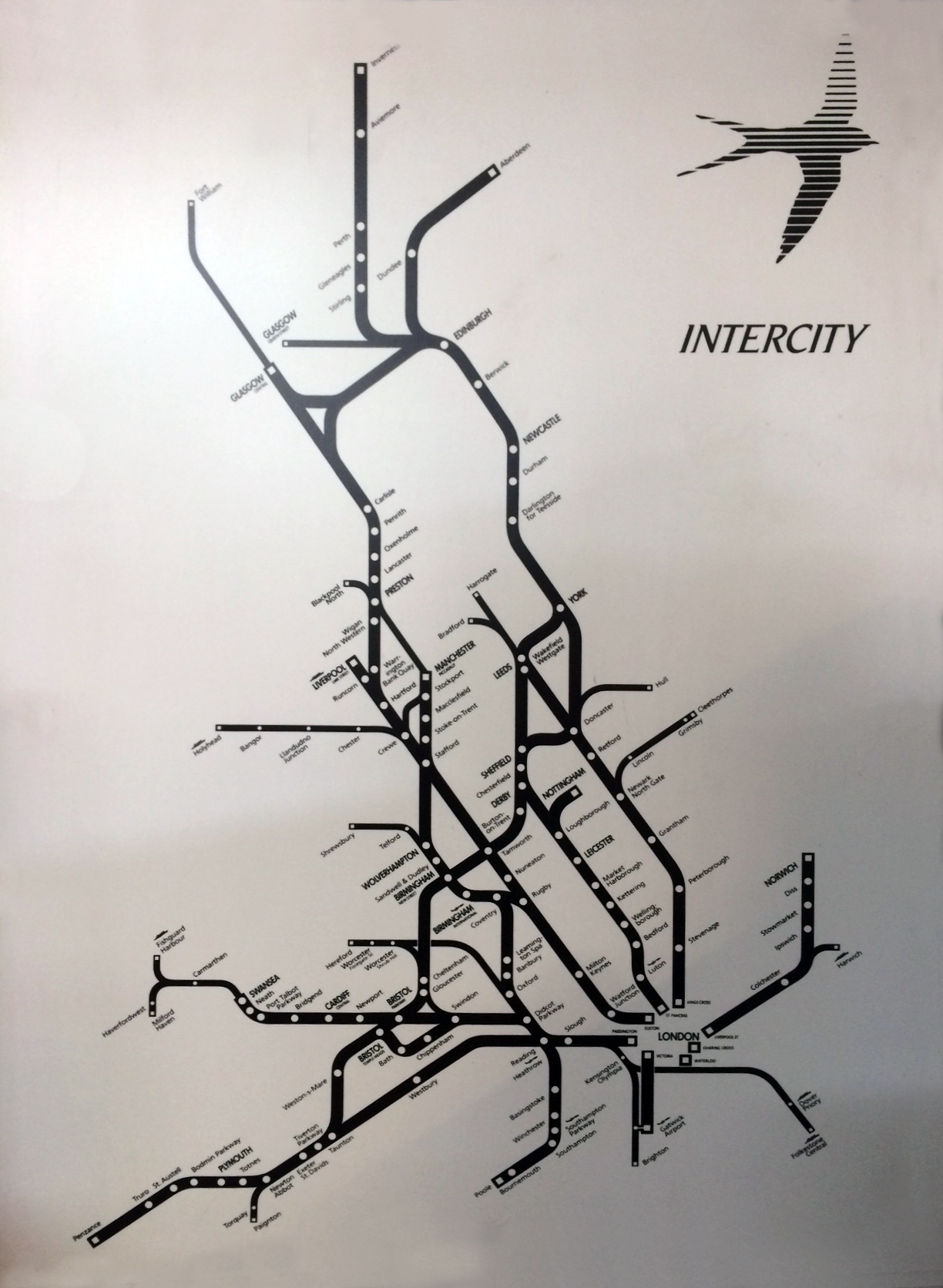
InterCity%20map%201989a.jpg


This image from Project Mapping via the link: https://projectmapping.co.uk/Reviews/britishrailbriti.html
 

LNW-GW Joint

Veteran Member
Joined
22 Feb 2011
Messages
21,904
Location
Mold, Clwyd
Is this an official map from olden times? It has some slightly odd station names like "Darlington for Teesside" and just "Bradford".
It's the route map of trains operated by BR Intercity, in I should think the early 80s (before more ports such as Portsmouth and Newhaven were added to XC services).
That map includes sleepers, Gatwick Express and Norwich, and the then-XC routes.
It excludes any purely NSE (eg Salisbury, Cambridge) and Regional (eg Marches, TP) routes; and HS1/Eurostar didn't exist.
 

flitwickbeds

Member
Joined
19 Apr 2017
Messages
770
It's the route map of trains operated by BR Intercity, in I should think the early 80s (before more ports such as Portsmouth were added to XC services).
That map includes sleepers, Gatwick Express and Norwich, and the then-XC routes.
It excludes any purely NSE (eg Salisbury, Cambridge) and Regional (eg Marches, TP) routes, and HS1/Eurostar didn't exist.
It's also a not particularly useful map, for example it suggests that you can get a direct train from (among others) Fishguard Harbour to Brighton, or Inverness to Poole.
 

jfollows

Established Member
Joined
26 Feb 2011
Messages
10,084
Location
Wilmslow
The West Coast Main Line to me is the line between London Euston and Glasgow Central, that’s it. It’s the main line. Plenty of other lines, the Manchester Evening News thinks the line through Stockport is the West Coast Main Line, but I don’t.

It’s not that I’m right and they’re wrong, it’s just different usage, I don’t care.
 

A S Leib

Established Member
Joined
9 Sep 2018
Messages
3,279
I see Crewe to Manchester and Liverpool, and Doncaster to Leeds, counted as part of the WCML / ECML much more frequently than Manchester and Liverpool to Wigan / Preston or Leeds to York. Is that mostly a consequence of the main intercity operators not (generally) running on the latter?
 

Topological

Established Member
Joined
20 Feb 2023
Messages
4,270
Location
Swansea
Is this an official map from olden times? It has some slightly odd station names like "Darlington for Teesside" and just "Bradford".
Seeing this did make me wonder whether I had accidentally selected an AI generated version instead of the Intercity map I grew up with. However, the spirit would be the same even if the names were wrong. My memory was not good enough to say whether the map ever had "Darlington for Teesside" as a name. Bradford felt right.
 

Taunton

Veteran Member
Joined
1 Aug 2013
Messages
12,245
Gerry Fiennes, in 'I Tried to Run a Railway', from when General Manager Western Region at Paddington, offered advice, presumably after some public/politicians meeting :

"In passing, future GMs WR, never refer to the line from Newton Abbot to Paignton as 'The Branch' ".
 

PLY2AYS

Member
Joined
26 Mar 2024
Messages
518
Location
Montserrat
In terms of licensing, it’s anything outside of depot limits?
In my own head, I see a mainline typically as a multitrack layout, arterial to any major city or town, mixed traffic and which isn’t considered a branch line.
I do realise though, that there probably isn’t a specific definition because terms and TOC specific nuances often get blurred.
 

Annetts key

Established Member
Joined
13 Feb 2021
Messages
3,795
Location
West is best
There is no definition. It isn't worth overthinking. It is the kind of thing you know when you see it.
Exactly as above.

Back in history, a main line was the primary railway line built by the relevant railway company. Once railway companies started buying other railway companies or merging, it got messy. Then we had the groupings ending up with the big four, then nationalisation. Hence there can never be any national agreed definition without upsetting the apple cart somewhere.

When I am writing and attempting to describe a junction, for ease of the description I sometimes use "main line" as short hand for the more important line as opposed to a line branching from it. In other words, the terms "main line" and "branch line" are relative not absolute.

If course, some lines have the word "main" as part of their name, e.g. on Western MLN1, MLN2 etc...

But on signalling plans and signal box diagrams/panels/displays often a lower status line will be labelled as "main", such as Up Main, Down Main or if a single line, Up/Down Main.

Also, if you think you can define what a branch line is, please also define what a branch line is...
 

norbitonflyer

Established Member
Joined
24 Mar 2020
Messages
5,681
Location
SW London
When I am writing and attempting to describe a junction, for ease of the description I sometimes use "main line" as short hand for the more important line as opposed to a line branching from it. In other words, the terms "main line" and "branch line" are relative not absolute.
Quite so - for example between Waterloo and basingstoke it is fairly obvious which is the mai line and whichn then branches. However, the layout at Worting junction would suggest the Salisbury route is the main line, rather than the far busier route to Southampton

== Doublepost prevention - post automatically merged: ==

I see Crewe to Manchester and Liverpool, and Doncaster to Leeds, counted as part of the WCML / ECML much more frequently than Manchester and Liverpool to Wigan / Preston or Leeds to York. Is that mostly a consequence of the main intercity operators not (generally) running on the latter?
Originally the names referred to the rival Anglo-Scottish routes only, which had sight of, respectively, the west and east coasts of England - albeit briefly in one case, and not until well north of Hadrian's Wall in the other.

You certainly don't get to see either coast if travelling to any other of the destinations listed except Liverpool

But it depends on context.
The Festiniog Railway connects with "main line" trains at Blaenau Festiniog and Minfford.
The London Underground connects with "main line" trains at Greenford and Walthamstow Central, for example
If you are at Stourbridge Town, the shuttle connects with the main line at Stourbridge Junction.

But from a Network Rail perspective, none of the Conwy Valley, Cambrian Coast, Castlebar, Chingford or Kidderminster Loop lines would be considered "main lines"
 
Last edited:

devon_belle

Member
Joined
21 Jul 2022
Messages
651
Location
Surrey
However, the layout at Worting junction would suggest the Salisbury route is the main line, rather than the far busier route to Southampton
Which it was – the South Western Mainline diverged from the London to Exeter/Plymouth 'West of England Mainline'. Which is puzzling because the LSWR was originally the London & Southampton Railway.

I agree with other posters that there isn't a set definition, and it has changed through time.
 

Horizon22

Established Member
Associate Staff
Jobs & Careers
Joined
8 Sep 2019
Messages
10,964
Location
London
It definitely depends on context.

For example Southeastern would say that have a Southeastern "Mainline" (essentially Charing Cross to Dover Priory via Tonbridge and Ashford International) and a Chatham "Mainline" (essentially Victoria to Ramsgate via Chatham). This is in opposition to their metro routes (e.g. via Dartford or to Sevenoaks) or more rural routes. But I doubt many on these forums would call it a "main line". Perhaps better stated as a "regional main line".

Personally I generally feel it has to be a four-track railway - for a good chunk of the route at least - with intermediate stops served by relief/slow lines to qualify.

== Doublepost prevention - post automatically merged: ==

But it depends on context.
The Festiniog Railway connects with "main line" trains at Blaenau Festiniog and Minfford.
The London Underground connects with "main line" trains at Greenford and Walthamstow Central, for example
If you are at Stourbridge Town, the shuttle connects with the main line at Stourbridge Junction.

I suppose these are just because "main line" has been transposed for "National Rail services".
 

swt_passenger

Veteran Member
Joined
7 Apr 2010
Messages
34,256
Which it was – the South Western Mainline diverged from the London to Exeter/Plymouth 'West of England Mainline'. Which is puzzling because the LSWR was originally the London & Southampton Railway.

I agree with other posters that there isn't a set definition, and it has changed through time.
That’s possibly puzzling because over 100 years ago, when the line through Basingstoke was yet to be quadrupled, and Battledown flyover had not yet been built, the 2 track flat junction layout did have the Southampton route straight ahead (just as it is now in terms of its general alignment), with the line to Andover being the divergence.

The way the S&C is laid out now, the inner fast line pair connects to both routes, with the Southampton route still being the higher speed. The way it’s usually shown on straight line track diagrams or online maps doesn't reflect the physical layout. It’s the Andover route that has the flashing yellow aspects.
 

Sorcerer

Established Member
Joined
20 May 2022
Messages
2,043
Location
Liverpool
The only definition we can get from Google is "a chief railway line" but that's just as arbitrary as "main line" itself. I'd say something could definitely be called a main line if it's a major trunk railway in which you have many branches stretching from the core. The West Coast Main Line is a fine example because the trunk route between London and Glasgow as multiple branches extending to Manchester via Stoke and Crewe, Liverpool via Weaver Junction, and possibly Edinburgh from Carstairs. But even then it's still kind of arbitrary, especially when the WCML wasn't actually built as a single railway.
 

Zomboid

Established Member
Joined
2 Apr 2025
Messages
2,246
Location
Oxford
That’s possibly puzzling because over 100 years ago, when the line through Basingstoke was yet to be quadrupled, and Battledown flyover had not yet been built, the 2 track flat junction layout did have the Southampton route straight ahead (just as it is now in terms of its general alignment), with the line to Andover being the divergence.

The way the S&C is laid out now, the inner fast line pair connects to both routes, with the Southampton route still being the higher speed. The way it’s usually shown on straight line track diagrams or online maps doesn't reflect the physical layout. It’s the Andover route that has the flashing yellow aspects.
I doubt the LSWR drew such a distinction as to which one was more main than the other - I suspect it was easier to do the flyover on the Southampton route with us being straight without an imminent station or underbridges.

I think of the GWR/GCR between Ruislip, (where the arrangement favoured Paddington) and Ashendon (where the Grendon Underwood route would have been favoured). And if course the routes that actually survived as frequently served passenger lines were the secondary routes at those two junctions.
 

norbitonflyer

Established Member
Joined
24 Mar 2020
Messages
5,681
Location
SW London
Personally I generally feel it has to be a four-track railway - for a good chunk of the route at least - with intermediate stops served by relief/slow lines to qualify.
That rules out much of both the ECML and WCML !

Parts of the Highland Main Line are single track
 

The exile

Established Member
Joined
31 Mar 2010
Messages
9,340
Location
Somerset
That rules out much of both the ECML and WCML !

Parts of the Highland Main Line are single track
And would fail the GWR test - where only two of any four track lines were the “mains”.
Unsurprisingly - the Germans have official definitions…
 

Snex

Member
Joined
20 Jun 2018
Messages
444
Surely it's the lines which have mostly long distance traffic running on them, with at least an hourly service, between the regional capitals and/or urban areas in the UK (500k+) via the quickest route.

The Highland Mainline isn't a main line imo but stuff where Transpennine and Crosscountry run are. Sadly we don't treat them like it and the service is generally dire on them.
 
Last edited:

Krokodil

Established Member
Joined
23 Jan 2023
Messages
6,535
Location
Wales
Personally I generally feel it has to be a four-track railway - for a good chunk of the route at least - with intermediate stops served by relief/slow lines to qualify.
For "Trunk route", possibly. But there are plenty of secondary main lines.
 

Shred Metal

Member
Joined
14 Jul 2020
Messages
124
Location
Nuneaton
Not to offer any sort of real resolution to your question, but I think the etymology of the word ‘main’ would derive from a situation where two or more different ‘things’ existed, and differentiation was needed.

Maybe it’s just a label we use to separate the lesser and the more important - similar to that trivia thread with there being one ‘main’ station.

Perhaps the lowest form of a correctly defined mainline could be somewhere like Wrexham General, or Cardiff Queen Street or even Stourbridge Junction. All places where a short stubby single track branch briefly meanders from the ‘main’ lines.
 
Status
Not open for further replies.

Top