• Our new ticketing site is now live! Using either this or the original site (both powered by TrainSplit) helps support the running of the forum with every ticket purchase! Find out more and ask any questions/give us feedback in this thread!

What could replace franchising?

Status
Not open for further replies.

30mog

Member
Joined
25 Apr 2013
Messages
189
The franchising system of our privatised railway network is often criticised for not giving the traveller and taxpayer value for money. What other way could we do it?

Personally, the only comparison on our shores is the bus industry. They register services they are willing to run commercially (unsubsidised). Then the local transport authority ask them to tender for services they deem necessary but unprofitable. This results in whole routes or extensions to commercial routes being subsidised. Over in Singapore they have a system with the same features but an added option. A bus company can offer to run a commercial service on condition. The condition usually being allowed a monopoly over part of the route.

And from the Singapore bus example I think we have something that could be applied to our railways. For example, two operators offer to run Sheffield-London without subsidy. Realistically, only one can because unlike roads we can't just fill them up with every willing operator. However, one of the bidders demands a Leicester-Bedford monopoly as a condition, while the other asks the same of Derby/Nottingham to Bedford. Most likely they would accept the first bidder as it would be pretty much as now. And allow the OPR, or whoever, more options when coming to the next task of providing unprofitable services where they are necessary. Which are put out to tender. And likely to be tendered for by companies who run commercial services on adjacent parts of the network.

Any other ideas?
 
Sponsor Post - registered members do not see these adverts; click here to register, or click here to log in
R

RailUK Forums

Pugwash

Member
Joined
17 Nov 2011
Messages
336
Running the whole network as one company, allowing long term planning of training of drivers, purchase of rolling stock and maintainence, reverting to self insurance etc etc etc.

In a word re-nationalisation.
 

30mog

Member
Joined
25 Apr 2013
Messages
189
re-nationalisation.

I used to think so. But the good thing about private franchisees is they will do more to attract people to use currently empty seats. Without privatisation, you would not get Norwich-Birmingham via London for £15.50, as I have in a few weeks time. Yes, I am tied to particular trains. But when compared to the price of doing this with walk on fares which admittedly might not be so high under nationalisation but not as little as £15.50.

Remember, the infrastructure was re-nationalised. And is run over by private companies who lease trains from companies owned by merchant banks where a lot of government money is banked on routes they are allowed to run for a fixed term by a government department. So privatisation is either directly or indirectly limited. And in some other countries, Germany for example. Private companies now run some local trains because they have tendered to do so for less than the state owned DB.
 

185

On Moderation
Joined
29 Aug 2010
Messages
5,709
Direct operating contracts. Was dubbed 'Halfway to nationalisation' about 3 years ago.

Companies provide drivers and vehicle maintenance. Government provide booking office, on-board and own the stations and infrastructure. Government also own the rolling stock, which is written into the company's contract.

With booking office, sales and revenue checking all directly owned, all revenue passes through the state with no siphoning of profits away by smaller companies as happens now.

The only down-side seemed to be a staffing monster was created with heavy strike power.
 

Buttsy

Established Member
Joined
20 May 2011
Messages
1,374
Location
Hanborough
The cheap fares you refer to were introduced by BR in the early 90s as APEX fares in order to try and fill seats on trains, so the idea is hardly something that has come about because of privatisation. BR had managers, most of who are still in the industry, that knew moving fresh air around wasn't good for the balance sheet.

There are larger benefits to the railways being run as one company rather than a group of individual TOCs such as the ability to utilise weekend spare stock to provide additional services for major sporting events, the simplification of fare distribution (why have a rail settlement plan when it all goes into the same pocket), rolling stock procurement which takes into account the needs of the network as a whole, rather than specific routes, removing the admin for allocating delay minutes and having to avoid paying TOCs for not being able to run trains becuase work is being carried out for the TOC's benefit.
 

The Ham

Veteran Member
Joined
6 Jul 2012
Messages
12,021
Direct operating contracts. Was dubbed 'Halfway to nationalisation' about 3 years ago.

Companies provide drivers and vehicle maintenance. Government provide booking office, on-board and own the stations and infrastructure. Government also own the rolling stock, which is written into the company's contract.

With booking office, sales and revenue checking all directly owned, all revenue passes through the state with no siphoning of profits away by smaller companies as happens now.

The only down-side seemed to be a staffing monster was created with heavy strike power.

One way around the staffing monster would be to have regions so that it is not too dissimilar to the current franchise maps and/or the old BR regions.

Alternatively roll with the risk that strikes could be called on the whole network and watch the backlash against the unions from the travelling public (who wouldn't understand why, for instance, the sacking of one person in Cornwall was affecting them in wherever else they were in the UK - even if there was a good reason for the strike).

If the unions try to avoid such a back lash by organising strikes to happen more locally to the incident, although there maybe just as many strikes called, it could have less of an impact on passengers than at present.

Also, it is one thing to miss out on a days pay for someone that you know or at least have a good chance of meeting but when it is someone that works far enough away that there is little chance of you working within 100 miles of each other people will be less keen. Which could lead to more union members being more keen to vote against strike action over more minor issues.
 

transmanche

Established Member
Joined
27 Feb 2011
Messages
6,021
A complete restructure for starters.

Network Rail to become a 'railway agency' similar to the Highways Agency, with appropriate funding.

Non InterCity services to operated by regional concessions - similar to London Overground or Merseyrail. Regional public transport authorities to set fares and service levels. Concessions to be rewarded for commercial acumen ; e.g. where better stock utilisation allows for new services/routes.

InterCity services. This is the only place where the franchise system might work, as they should be able to operate without public subsidy - especially with reduced track access charges (as might be available under a new 'railways agency' funding model). And they won't be able to over-bid, as to some extent they'll still face competition from the regional express and 'inter-regio' services run by the regional concessions.
 

NSEFAN

Established Member
Joined
17 Jun 2007
Messages
3,518
Location
Southampton
transmanche said:
A complete restructure for starters.

Network Rail to become a 'railway agency' similar to the Highways Agency, with appropriate funding.

Non InterCity services to operated by regional concessions - similar to London Overground or Merseyrail. Regional public transport authorities to set fares and service levels. Concessions to be rewarded for commercial acumen ; e.g. where better stock utilisation allows for new services/routes.

InterCity services. This is the only place where the franchise system might work, as they should be able to operate without public subsidy - especially with reduced track access charges (as might be available under a new 'railways agency' funding model). And they won't be able to over-bid, as to some extent they'll still face competition from the regional express and 'inter-regio' services run by the regional concessions.
I like this idea, except I would say that Intercity routes should be completely open access in the way that freight is, as they are more suited to "proper" competition compared to captive commuter/regional routes.
 

bicbasher

Established Member
Joined
14 May 2010
Messages
1,835
Location
London
TfL should operate all suburban NR routes within Greater London branded as either London Overground or Crossrail, with a regional 'Network Southeast' matching the old NSE area operated as a concession, like London Overground with uniformed branding and and a required level of tph which is relevant to each line.
 

Darren R

Established Member
Joined
26 Jan 2013
Messages
1,252
Location
Lancashire
Direct operating contracts. Was dubbed 'Halfway to nationalisation' about 3 years ago.

Companies provide drivers and vehicle maintenance. Government provide booking office, on-board and own the stations and infrastructure. Government also own the rolling stock, which is written into the company's contract.

Isn't this similar to how the buses are operated in London on behalf of TfL? In my experience it seems to work well for them and could work for the railways too, appropriately modified of course. In the years since buses were de-regulated bus usage has steadily declined around the country - except in London were they are still planned and co-ordinated as one network (and subsidised too it must be admitted.) I think this is anything but coincidental - it shows that where public transport networks are properly planned and co-ordinated people will happily use them, and it would be the same with the railway network.

One major drawback though - any return of the railway network to a form of public ownership (however that may be achieved) would put control and planning of the railways in the hands of the dear old Department for Transport. Heaven knows they have more than enough control as it is - and don't they do a thoroughly good job of it!:roll:
 

Yew

Established Member
Joined
12 Mar 2011
Messages
7,210
Location
UK
Q: What could replace franchising?

A: British Rail

As much as I would like to see that, I think a more streamlined franchising system is more likely to replace the current system
 
Joined
6 Sep 2011
Messages
989
Location
Blackpool south Shore
My first thought was British Rail. :D
But a 'National Railway' and with standard tickets you can travel on any train in the National timetable, irrespective of liveries.
Advance tickets - the only ticket restricting you to an actual train.
 

Andrewlong

Member
Joined
2 Jan 2013
Messages
373
Location
Earley
A choice of operators on a given mainline so the travelling public had choice of say First or Virgin on the GWML with one offering lower fares and the other offering free wifi or bett seating. At the moment we have FGW on the GWML and that's it.

And if you are looking for an analogy imagine we had franchised supermarkets in our towns and Tesco had a monopoly.
 

LE Greys

Established Member
Joined
6 Mar 2010
Messages
5,389
Location
Hitchin
I'm sure I've posted this before.

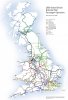
Forget about regionalisation, go for total vertical integration. Firstly, rearrange the franchises so that they are as close to the pre-grouping companies as practically possible. Then sell them off with the proviso that no parent group can own two companies operating out of the same station. Then, divide up the freight companies in the same way and sell them to the passenger operators. Then give them the authority to purchase their own rolling stock, either from ROSCOs or direct from the manufacturer (the idea is ROSCOs out of business within 20 years). Sell them their own track, stations, depots and works. Then shut down DfT Rail, hand over its remaining powers to the ORR and merge with HMRI. You would also need to replace ORCATS with a modern version of the Railway Clearing House, assessing each ticket individually by miles covered rather than anything else. XC services could be run jointly, or by an Amtrak-style government operator. It's technically not legal under EU directives, but by far the most sustainable way to run a railway. Some new developments, such as the big signalling centre at Three Bridges, have probably put the tin lid on this idea for good, since that would need to be taken off-line and replaced with several new ones (you can't have the LBSC signalling GWR trains on a line they don't even own!).
 

Attachments

  • Rail Companies Map (e).jpg
    Rail Companies Map (e).jpg
    101.4 KB · Views: 46

tbtc

Veteran Member
Joined
16 Dec 2008
Messages
18,051
Location
Reston City Centre
Instead of any "good old days" stuff, my answer would be that we move to what we appear to be moving to - a system where...
...the Government* decides on which lines to upgrade (all of the hundreds of miles of electrification in CP5, redoubling some bottlenecks)...
...the Government* decides on new lines to be built (HS2, re-opening the Galashiels route)...
... the Government* organises new trains (whether 345s/ 700s/ IEP or encouraging Southern to get new EMUs to allow others to be cascaded around the country)...
...and the TOCs just stick to the basics of operating a prescribed set of services (much less risk, much less hassle).

A bit like the London Bus model really. You could even do the London Bus thing of insisting that 80% of the livery is a prescribed colour if you want to get excited about such things.

(* - by "Government" I mean Westminster/ Holyrood/ Cardiff Bay/ DfT/ Network Rail/ PTEs - not hung up on the different branches of administration)
 

Gareth

Established Member
Joined
10 Mar 2011
Messages
1,505
I'm sure I've posted this before.

Forget about regionalisation, go for total vertical integration. Firstly, rearrange the franchises so that they are as close to the pre-grouping companies as practically possible. Then sell them off with the proviso that no parent group can own two companies operating out of the same station. Then, divide up the freight companies in the same way and sell them to the passenger operators. Then give them the authority to purchase their own rolling stock, either from ROSCOs or direct from the manufacturer (the idea is ROSCOs out of business within 20 years). Sell them their own track, stations, depots and works. Then shut down DfT Rail, hand over its remaining powers to the ORR and merge with HMRI. You would also need to replace ORCATS with a modern version of the Railway Clearing House, assessing each ticket individually by miles covered rather than anything else. XC services could be run jointly, or by an Amtrak-style government operator. It's technically not legal under EU directives, but by far the most sustainable way to run a railway. Some new developments, such as the big signalling centre at Three Bridges, have probably put the tin lid on this idea for good, since that would need to be taken off-line and replaced with several new ones (you can't have the LBSC signalling GWR trains on a line they don't even own!).

Yes, I think larger companies, running both intercity and local services in their respective areas could be a good way forward, along with vertical integration. For example, a larger West Coast franchise could take in the Virgin, London Midland, and the old First North Western area; perhaps the CrossCountry routes out of Manchester too.
 

LE Greys

Established Member
Joined
6 Mar 2010
Messages
5,389
Location
Hitchin
Instead of any "good old days" stuff, my answer would be that we move to what we appear to be moving to - a system where...
...the Government* decides on which lines to upgrade (all of the hundreds of miles of electrification in CP5, redoubling some bottlenecks)...
...the Government* decides on new lines to be built (HS2, re-opening the Galashiels route)...
... the Government* organises new trains (whether 345s/ 700s/ IEP or encouraging Southern to get new EMUs to allow others to be cascaded around the country)...
...and the TOCs just stick to the basics of operating a prescribed set of services (much less risk, much less hassle).

A bit like the London Bus model really. You could even do the London Bus thing of insisting that 80% of the livery is a prescribed colour if you want to get excited about such things.

(* - by "Government" I mean Westminster/ Holyrood/ Cardiff Bay/ DfT/ Network Rail/ PTEs - not hung up on the different branches of administration)

Isn't that essentially what we have now? The only difference with your version is that the government could not pass the buck to somebody else if they make a mistake. Ministers are not going to want to accept responsibility, although they will certainly take the credit even when it is not due.

Please forgive my cynicism.
 

tbtc

Veteran Member
Joined
16 Dec 2008
Messages
18,051
Location
Reston City Centre
Isn't that essentially what we have now? The only difference with your version is that the government could not pass the buck to somebody else if they make a mistake. Ministers are not going to want to accept responsibility, although they will certainly take the credit even when it is not due.

Please forgive my cynicism.

Basically, yes, but we've moved to this position unoficially - there's still the pretence that TOCs are the ones taking the risk (and therefore "deserving" the reward).

I'm not sure exactly when it started (Adonis?), but the Government seem to be the ones making all of the big decisions now - the idea that another TOC is going to "invest" in an upgrade like Evergreen (or the Virgin ECML "bypass") in the future seems like a distant memory.

I'd like to see this made more official - more prescribed - which would mean franchises would be much simpler, less of the "risk and reward", a simpler management contract for TOCs to live within (and they can worry about marketing cheap tickets etc rather than being the ones responsible for ordering new stock).
 
Status
Not open for further replies.

Top