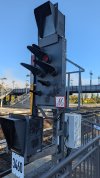
I was in Berlin recently and noticed that on a lot of the signals on the S-Bahn lines there were these strange M signs. I assume they give some sort of information about the operation of the signals - does anyone know what they are for, and why they're presented in such a calligraphic way?

-
Our new ticketing site is now live! Using either this or the original site (both powered by TrainSplit) helps support the running of the forum with every ticket purchase! Find out more and ask any questions/give us feedback in this thread!
You are using an out of date browser. It may not display this or other websites correctly.
You should upgrade or use an alternative browser.
You should upgrade or use an alternative browser.
What are these 'M' signs for?
- Thread starter paulmch
- Start date
- Status
- Not open for further replies.
Sponsor Post - registered members do not see these adverts; click here to register, or click here to log in
R
RailUK Forums

I found this https://www.sh1.org/eisenbahn/snzs.htm#Zs12
Also https://de.wikipedia.org/wiki/M-TafelM-Tafel / "M" board: main signal at danger or defective may be passed also by signalman's verbal permission.
(Otherwise a Zs signal or a written order would be needed)
In Hamburg, also applies to a line-close signal (Sh 0) which is adjacent to the main signal.
(via Google Translate)A white sign with a red "M" in cursive in a red frame
On verbal instruction from the dispatcher, you can drive past the signal Hp 0
This sign is rarely used, mostly found in S-Bahn areas. It allows a train to drive past the stop signal on verbal instruction from the dispatcher (not the guard!). In the area of the former DR, the same rules apply to behavior after the signal has passed as for the replacement signal Zs 1.
In the area of the former DR, the local supervisor can also give the verbal instruction to drive past instead of the dispatcher. In the ex-DB area, the sign has no signal designation, but is only mentioned in implementation regulation 11 of the signal book.
An M-board (Signal Zs 12) is an additional signal used in Germany that can be attached to the mast of a main signal.
The M-board allows the train driver to drive past a main signal that shows a stop or is faulty after a verbal or telephone request from the dispatcher, without a written order having to be issued or a replacement signal being used. A train journey permitted in this way is a train journey with a special order. The M-board is white with a red border and a red M in cursive.[1]
The M-board was introduced by the Deutsche Reichsbahn on January 1, 1931. The signal initially only applied to the electric and steam-powered trains of the Berlin S-Bahn and was only attached to main signals that did not have an Ad signal (from 1935: replacement signal).[2] In 1935, the signal was included in the signal book. It was only used on orders from the respective railway directorate on routes with a close train sequence. The order was given verbally by the responsible train dispatcher or supervisory officer.[3] In 1959, the German Reichsbahn included the M-board in the group of additional signals as signal Zs 2. From 1971, the order was given by telephone.[4] Despite the signal meaning "Pass the main signal showing stop on verbal or telephone order", the signal was also valid when the signal image was extinguished or doubtful. The restriction on use on routes with a close train sequence was lifted.[5] At the German Federal Railway, the M-board was initially equivalent to the mast signs from 1959, the order continued to be given verbally.[6] Only later was the telephone transmission of the order also valid and the M-board became an independent signal as signal Zs 12. Since the signal books of both railways were merged, the West German signal Zs 12 has been used nationwide.[7]
Last edited:

eastwestdivide
Established Member
To expand on the above, M for mündlich, verbal (out of the mouth, Mund)
- Status
- Not open for further replies.