• Our new ticketing site is now live! Using either this or the original site (both powered by TrainSplit) helps support the running of the forum with every ticket purchase! Find out more and ask any questions/give us feedback in this thread!

Wacky formations

Status
Not open for further replies.

py_megapixel

Established Member
Joined
5 Nov 2018
Messages
7,437
Location
Northern England
Always wanted to see a 142+170.
I heard that this particular combination is banned because coupling to a 142 causes some fault with the fire alarms on the 170. That might equally be utter nonsense that somebody made up, though, or I might have misremembered it.
 
Sponsor Post - registered members do not see these adverts; click here to register, or click here to log in
R

RailUK Forums

Tomnick

Established Member
Joined
10 Jun 2005
Messages
5,930
Fairly correct, as I understand it the brake control circuits (supplied by train wire 4) are supplied by the start battery on the rearmost vehicle, unless that start battery is unavailable - in which case the supply is taken from the start battery on the vehicle within the train consist which has the highest voltage. 14x units have smaller batteries and can't supply the same amount of current as 15x units can. The brake control supply has to operate all the Westcode brake control units on the train, and there is one on each vehicle on 14x and 15x units except 153s which have two per vehicle. So in response to the post above I would agree that the middle cars in 3-car 158s or 144s (or 150/0s) still count as a vehicle for maximum formation length purposes. Our official instructions were inconsistent regarding 153s, they either had a maximum formation length of 10 vehicles of 15x if a 153 was included, or they were counted as two vehicles. If a 142/144 was included anywhere in the consist the maximum number of vehicles was limited to 8, and so if a consist had say 142+150+150+153 that was maxed out because the 142 limited it to 8 vehicles and the 153 was counted as two vehicles (going by the most restrictive of the 153 formation instructions we had).

I am aware of an incident a few years ago when a 9-coach rake came off Newton Heath for Manchester Victoria one morning, in the middle was a 3-car 158 and at the rear was a 142. The driver was aware it was four units but didn't realise that the 158 was a 3-car set rather than 2-car as the vast majority are, so he thought he had eight vehicles rather than nine which would've exceeded the maximum.

Mainline drivers don't 'prep' units on Newton Heath, the depot drivers do that, so the mainline driver didn't walk the length of the train, all he had was a prep sheet. These are usually left individually in the Manchester end cab of each unit rather than one prep sheet for the whole rake, because the units are often prepped before they are made up into formations for departure from the depot.

After departing Newton Heath the train had issues with spurious brake applications on its short journey down to Man Vic and I do remembered stopped the job for a while. Driver was absolved from blame for taking an 'illegal' consist because he had no positive indication that he had nine vehicles - not everyone remembers off the top of their head that our 158752-759 are 3-car sets.
Thanks - a very comprehensive answer. Yes, you're right, it is fed from the rearmost vehicle. I'm not sure what happens if that battery's dead - is it fed from elsewhere in the formation, or is it just cross-fed via the remote supply on that unit? To do otherwise would seem to compromise the integrity of train wire 4.

I think I've only ever had one problem with this, on a particularly difficult Boxing Day night with flat batteries all round. Both vehicles on one unit were completely dead - couldn't get a brake when coupled to it, presumably for this very reason. Ended up having to couple mechanically only, isolate the brakes, and shunt it as a swinger to somewhere more convenient for it to be dealt with (not the only time I did it that night!).
 

Bill57p9

Member
Joined
1 Dec 2019
Messages
862
Location
Ayrshire
Another regular ScotRail oddity (in my opinion) is 320+318. They just don't look right together.

Way back in the 90's I was on a WCML working that failed and was assisted by a following working, so into Coventry came a mk 3 DVT, a rake of mk 3s, a 90, another mk 3 DVT, a rake of mk 2s and an 86.
 

Kieran1990

Member
Joined
29 Feb 2016
Messages
420
Location
Leeds
There was a 170+150 formation on the Harrogate loop in the morning peak a while back.
Unsure if it’s still running or not
 

Llama

Established Member
Joined
29 Apr 2014
Messages
1,959
Thanks - a very comprehensive answer. Yes, you're right, it is fed from the rearmost vehicle. I'm not sure what happens if that battery's dead - is it fed from elsewhere in the formation, or is it just cross-fed via the remote supply on that unit? To do otherwise would seem to compromise the integrity of train wire 4.

I think I've only ever had one problem with this, on a particularly difficult Boxing Day night with flat batteries all round. Both vehicles on one unit were completely dead - couldn't get a brake when coupled to it, presumably for this very reason. Ended up having to couple mechanically only, isolate the brakes, and shunt it as a swinger to somewhere more convenient for it to be dealt with (not the only time I did it that night!).
I do remember on a depot isolating the start battery on the end vehicle on two units coupled together years ago with a trainee to try to prove that the train could still be moved because the feed for TW4 would simply be found from elsewhere in the train. I don't think there is necessarily away for us as drivers to know which start battery is being used if the rearmost is unavailable. It also begs the question as to what would happen if the engine on the rear vehicle is shut down and the battery volts dropped, is there a cut-off low voltage? 22.5v low volts protection applies to the auxiliary batteries but I'm not sure about start batteries.

As I understand it, tripping 'remote supply' CB in the rearmost cab should in theory have the same effect as isolating the start battery, but whenever I have done that (with a trainee in the front cab holding the brake in step 1 or 2 to see any effect of me tripping the CB in the rear cab) it has seemingly had no effect.
 

Deepgreen

Established Member
Joined
12 Jun 2013
Messages
7,458
Location
Gomshall, Surrey
These have come up repeatedly on recent threads but these historical examples could be considered unusual, not sure about 'wacky', but definitely unusual.

1700 and 1810 Waterloo to Salisbury/Eastleigh in 1983/84 (Cl.33 + 4TC + 8VEP, splitting at Basingstoke).
1734 Waterloo to Basingstoke/Alton 1983/84 (12HAP, splitting at Woking, 6 to Basingstoke, 6 to Alton)
Also (from a CWN) there was an afternoon Ashford to Charing Cross consisting of 6HAP + 4EPB in 1982/83.
Various '93' Waterloo-Southampton stopping services in 1989 formed of 73 + 4TC or 73 + 8TC.
33 hauling 4VEP, unplanned working, Jan 1987, Portsmouth Direct, due to electrical supply problems in the snow.

The compatibility of the SR stock and locos of the second half of the 20th century could have easily led to all sorts of weird and wonderful combinations. I've never seen any really wacky Sprinter combinations (I've seen 150 + 143, but that doesn't seem too wacky) but again due to their compatibility with each other, I'd imagine it must be pretty frequent.
That's not a regular working as per the OP, but here's a similar one from Feb. 1985 at Ashtead - 33034+EPB+CIG to Dorking.
11995720786_41ff8b93a0_k.jpeg

== Doublepost prevention - post automatically merged: ==

The Brighton to London bike ride return specials used to be 12EPB - six for passengers and six with seat cushions removed to form bike racks, with each coach assiged a station at which to unload. In the 1950s some summer Saturday Victoria to Brighton regular extras were 12SUB.
 
Last edited:

Tomnick

Established Member
Joined
10 Jun 2005
Messages
5,930
I do remember on a depot isolating the start battery on the end vehicle on two units coupled together years ago with a trainee to try to prove that the train could still be moved because the feed for TW4 would simply be found from elsewhere in the train. I don't think there is necessarily away for us as drivers to know which start battery is being used if the rearmost is unavailable.
It has to be fed from the rear of the train, though, surely? That's what ensures the integrity of train wire 4 - the supply from other vehicles in the formation is deliberately cut off when coupled to another vehicle to ensure that it has to come from the rearmost vehicle and that if the train becomes divided then that supply will be lost. My understanding is that the supply is one that can be fed via the remote supply, so if the battery on the rearmost vehicle is dead or isolated then it'll take it from the adjacent vehicle's battery via the jumper cables, but that if both vehicles on the rearmost unit are dead then you're in trouble (as there's no remote supply facility through the BSI coupler, of course).
It also begs the question as to what would happen if the engine on the rear vehicle is shut down and the battery volts dropped, is there a cut-off low voltage? 22.5v low volts protection applies to the auxiliary batteries but I'm not sure about start batteries.
That's exactly the situation that I found myself in with both vehicles on the rear two-car unit completely dead. I don't know if there's low voltage protection (I'm sure there must be?) or whether it was just so far gone that it couldn't even operate the relays in the circuit, but the end result was the same!
 

Llama

Established Member
Joined
29 Apr 2014
Messages
1,959
It has to be fed from the rear of the train, though, surely? That's what ensures the integrity of train wire 4 - the supply from other vehicles in the formation is deliberately cut off when coupled to another vehicle to ensure that it has to come from the rearmost vehicle and that if the train becomes divided then that supply will be lost. My understanding is that the supply is one that can be fed via the remote supply, so if the battery on the rearmost vehicle is dead or isolated then it'll take it from the adjacent vehicle's battery via the jumper cables, but that if both vehicles on the rearmost unit are dead then you're in trouble (as there's no remote supply facility through the BSI coupler, of course).

That's exactly the situation that I found myself in with both vehicles on the rear two-car unit completely dead. I don't know if there's low voltage protection (I'm sure there must be?) or whether it was just so far gone that it couldn't even operate the relays in the circuit, but the end result was the same!
I'm making an assumption here that train wire 4 is a loop around the train capable of being energised by any one of the start batteries on the train - we were told that TW4 was the electrical equivalent of the brake pipe on an air-braked train but I rather think that's too simple a comparison
 

Kieran1990

Member
Joined
29 Feb 2016
Messages
420
Location
Leeds
Someone may remember the exact details and may not deemed wackey but I seem to recall seeing a picture in rail about 15 years ago of mega 158/159 combo that ran to Cardiff or Bristol for the Rugby
Think it was Wessex 158, ATW 158, Central 158 along with SWT 159. I was only about 13-14 years old but the striking liveries makes it stick in my mind
 

Deepgreen

Established Member
Joined
12 Jun 2013
Messages
7,458
Location
Gomshall, Surrey
One occurs to me - there were regular workings on the Mallaig line into the 90s (I think) which had oil tanks attached to the passenger workings. Mixed trains were not unusual in the first part of the 20th century but became very rare indeed late in the second half. My shot of one such working entering Corpach from Mallaig:7131495729_ea109c366d_k.jpeg
 

robert thomas

Member
Joined
2 Jun 2019
Messages
347
Location
Neath
One occurs to me - there were regular workings on the Mallaig line into the 90s (I think) which had oil tanks attached to the passenger workings. Mixed trains were not unusual in the first part of the 20th century but became very rare indeed late in the second half. My shot of one such working entering Corpach from Mallaig:View attachment 110282

== Doublepost prevention - post automatically merged: ==

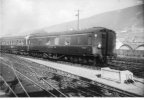
I enclose a photograph I took on 28th February 1964 of 12 wheel sleeper W9083W on the rear of the 2.50 p.m. Swansea to Pembroke Dock DMU. It was presumably en route to Milford Haven to strengthen that nights sleeper to Paddington.The coach is now preserved at Didcot.
 

Attachments

  • XZ14.jpg
    XZ14.jpg
    164.5 KB · Views: 128
Last edited:

Mat17

Member
Joined
17 Aug 2019
Messages
961
Location
Barnsley

Here you go!!
That's cool!

Somehow I misread it originally reading 390 could rescue a 321. That'd look weird.

== Doublepost prevention - post automatically merged: ==

Seen photos of steam engines hauling 303s and 506s though, that does look odd.
 

O L Leigh

Established Member
Joined
20 Jan 2006
Messages
5,609
Location
In the cab with the paper
It has to be fed from the rear of the train, though, surely? That's what ensures the integrity of train wire 4 - the supply from other vehicles in the formation is deliberately cut off when coupled to another vehicle to ensure that it has to come from the rearmost vehicle and that if the train becomes divided then that supply will be lost. My understanding is that the supply is one that can be fed via the remote supply, so if the battery on the rearmost vehicle is dead or isolated then it'll take it from the adjacent vehicle's battery via the jumper cables, but that if both vehicles on the rearmost unit are dead then you're in trouble (as there's no remote supply facility through the BSI coupler, of course).

I don't believe so, but am happy to be proved wrong.

My understanding is that the brake continuity wire maintains a circuit around the entire train from the front to the back and returning to the front again, going between vehicles through the jumper cables and between units in multiple via the coupler connector block. As long as the circuit remained closed you would be able to release the brakes. Where it gets fed from is immaterial because any break in the circuit would result in the entire train wire being de-energised causing a simultaneous emergency brake application on all vehicles.
 

Anonymous10

Established Member
Joined
19 Dec 2019
Messages
2,629
Location
wales

== Doublepost prevention - post automatically merged: ==

I enclose a photograph I took on 28th February 1964 of 12 wheel sleeper W9083W on the rear of the 2.50 p.m. Swansea to Pembroke Dock DMU. It was presumably en route to Milford Haven to strengthen that nights sleeper to Paddington.The coach is now preserved at Didcot.
very interesting as a Pembrokeshire local
 

matchmaker

Established Member
Joined
8 Mar 2009
Messages
1,868
Location
Central Scotland
That's cool!

Somehow I misread it originally reading 390 could rescue a 321. That'd look weird.

== Doublepost prevention - post automatically merged: ==

Seen photos of steam engines hauling 303s and 506s though, that does look odd.
One of the reasons steam locos were used to haul 303s was transfers between Hyndland Depot and the Cathcart Circle. The City Union link was, and still is, unwired. The problem was that in the early days there were no air braked diesels available, so some elderly ex-Caledonian locos were retained for these duties as they still had their Westinghouse brake.
 

Taunton

Veteran Member
Joined
1 Aug 2013
Messages
12,219
When the Southern lines west of Salisbury were transferred to the Western in the 1960s, the services were dieselised promptly with spare WR 3-car dmus, replacing the old, comfortable Bulleid steam-hauled stock. These comprised some WR cross-country units, and some suburban units sent from South Wales. These latter, 3+2 seats, no gangways and no toilets, were mixed in on some lengthy runs, such as Salisbury to Ilfracombe. There were a series of complaints which eventually got to the local MPs, the Minister of Transport, the BR Chairman, and thence down to Paddington with an instruction to Do Something.

So one weekend the sets were all broken up and trailers exchanged between the types. Two of the three cars in the cross-country sets had toilets, so now there was one car in each set with more comfortable seats and toilets. The resulting formations looked ridiculous, cars with different profiles, with the cross-country gangways now hanging loose because they were all next to a suburban non-gangwayed car. Worse, they were halfway through repainting from green into BR corporate at the time, blue for the suburbans and blue/grey for the cross-countries, and there were several 3-car sets with each car in a different colour scheme. They lasted like this for several years.

 
Last edited:

Tomnick

Established Member
Joined
10 Jun 2005
Messages
5,930
I'm making an assumption here that train wire 4 is a loop around the train capable of being energised by any one of the start batteries on the train - we were told that TW4 was the electrical equivalent of the brake pipe on an air-braked train but I rather think that's too simple a comparison

I don't believe so, but am happy to be proved wrong.

My understanding is that the brake continuity wire maintains a circuit around the entire train from the front to the back and returning to the front again, going between vehicles through the jumper cables and between units in multiple via the coupler connector block. As long as the circuit remained closed you would be able to release the brakes. Where it gets fed from is immaterial because any break in the circuit would result in the entire train wire being de-energised causing a simultaneous emergency brake application on all vehicles.
Ta, both. An interesting discussion! I'm certainly in no position to prove anyone wrong, but it would be good if someone has a definitive answer.

All that I can offer in the meantime is this, from an old (but very thorough) traction manual...

20220216_190551.jpg
The electrically-controlled air brake system is of the Westcode type, and the nominal 24 volt electrical supply to the operative brake controller is taken from the battery of the rearmost vehicle on the train along the brake continuity train wire (wire 4). This wire must be energised before the brakes can be released and if it becomes de-energised for any reason the brakes are
applied. This feature replaces the continuous air brake pipe although the main reservoir pipe has been retained.
...and this...
20220216_190640.jpg
...which is a diagram from the associated instructions for the Westcode braking system - a generic document, showing the arrangement what I believe is a DC EMU and where train wire 4 is instead known as train wire 13, but the principle should be the same. It can be seen that the positive and negative supplies from the battery are passed between vehicles in the same unit via the jumper cables (thus if one battery is dead, another on the same unit can supply it instead - is this the 'remote supply' that we're used to?), but that these aren't passed through the couplers between units. The feed from that supply to train wire 4 (or 13!) can only be from the rear vehicle though - at any intermediate cab, the contacts shown as DS34 on the drumswitch will be open (because the couple button has been pressed) thus isolating the feed.

At least I think that's what it says!
 

CR165022

Established Member
Joined
12 Nov 2019
Messages
1,356
Location
Buckinghamshire
not exactly a strange combo but a lot of the Wembley LMD to Marylebone ECS services are 7 coaches and above, ive seen a 10 car before, and im pretty sure sometimes they are a mix of 165s and 168s
 

londontransit

Member
Joined
26 May 2021
Messages
213
Location
London
Just seen this thread - hope the following counts as a wacky formation - its from this thread I replied to.

I remember a Liverpool Street to Norwich express being replaced by a three car DMU with a GUV attached at the rear - and the consist was hauled by a Class 47!!

It wasn't the GUV that was any problem, occasionally DMUs had some other stock behind them in those days (such as a parcels van) but then for the whole thing to be hauled by a 47 as an express service, well that was something else!

It might not have been the early 70s but more likely been 1967, 68 or 69 I can't remember as I was a schoolkid and with my mum.

The one main defining aspect of this particular episode was I simply had to sit right in the front of the DMU, watching the Class 47 through the saloon windows doing this very important job! It was almost like taking a ghost train on the entire GEML to Norwich - there was no driver (or staff) in the DMU cab which definitely made it more exciting!
 

Bikeman78

Established Member
Joined
26 Apr 2018
Messages
6,170
Are you sure? I'm sure I recall a mention that BR units had a maximum of 8 cabs in a formation before they struggled with signal degradation through the couplers.
I'm sure that any train crew can confirm/deny but I always thought 12 cabs was the maximum, reducing to eight cabs for formations including Pacers. I'm not sure why there is a difference. Northern definitely used to have a 4 x 142 set off Newton Heath in the afternoon.

== Doublepost prevention - post automatically merged: ==

1700 and 1810 Waterloo to Salisbury/Eastleigh in 1983/84 (Cl.33 + 4TC + 8VEP, splitting at Basingstoke).
Was the class 33 ever sandwiched between the 4TC and the leading VEP? Must have been surreal siting at the front of the VEP with the 33 thrashing away at 85 mph just outside the window.
 
Last edited:
Status
Not open for further replies.

Top