• Our new ticketing site is now live! Using either this or the original site (both powered by TrainSplit) helps support the running of the forum with every ticket purchase! Find out more and ask any questions/give us feedback in this thread!

Very strange device on class 86 roof.

Status
Not open for further replies.

ChrisCooper

Established Member
Joined
7 Sep 2005
Messages
1,787
Location
Loughborough
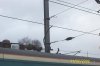
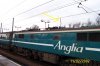
Looking at some old photos I came across these two. I remember the train arrived quite delayed and another train took it's next run out (Anglia used to have quite a layover in Norwich so trains could step up onto an earlier service if needed), and on going up to the loco I noticed the pantograph was down and a strange attachment was going from the wires to the loco. I've highlighted it on one picture, and it's a little clearer on the other. I'm fairly sure the loco had propelled the train like this, I can't remember another loco on the front, and it then hauled the train back to Crown Point.

What is the device, I presume it is some kind of emergency "get you home" thing that can be used in case of pantograph failure? How often would things like this be done? I presume there would be some pretty serious restrictions on use (speeds, perhaps power draw)? Also, I presume it only appears to loop around the wire, as if it did it would get snagged by the droppers, but what would have kept it on the wire? IIRC it was blowing a little in the wind and sparking as it lost contact with the wire.
 

Attachments

  • Picture_0201.jpg
    Picture_0201.jpg
    169.2 KB · Views: 240
  • Picture_0200.jpg
    Picture_0200.jpg
    213.9 KB · Views: 207
Sponsor Post - registered members do not see these adverts; click here to register, or click here to log in
R

RailUK Forums

TGV

Member
Joined
25 Nov 2005
Messages
734
Location
320km/h Voie Libre
It's broken. That's what it is. Part of the 25kV busbar system, it's not actually part of the pantograph. The thing that locks it down is a small latch that's underneath the panhead when the pan is down.

This looks to me like one section of bus-bar tube has become detatched due to bolt failure (the hole on the end still being intact indicates this) or because the insulator it was attached to has become dislodged. Could have been attached to a knife-switch or the other end of the VCB.

It is not a get-home device, simply a failed component.
 
Last edited:

TGV

Member
Joined
25 Nov 2005
Messages
734
Location
320km/h Voie Libre
The VCB performs that function. There is no device that would use something like this (especially given that this was in passenger service at the time). Tt's making contact with the OLE which is a big no-no and would be fouling loading gauge in many places too I'd imagine.

It may look hinged, but I'm certain that is simply the other end is also a bolted joint. It also looks like it's been bent in whatever failure occurred.
 

andyfrommk

Member
Joined
12 Jan 2011
Messages
202
It's broken. That's what it is. Part of the 25kV busbar system, it's not actually part of the pantograph.

This looks to me like one section of bus-bar tube has become detatched due to bolt failure (the hole on the end still being intact indicates this) or because the insulator it was attached to has become dislodged..

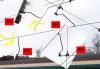
That seems to be the best explanation looking at it (C) in the picture it looks like the bar holding the OHL up (B) with pretty much the same curvature.
(A) and (D) have been flipped and rotated so you can see the curvature is almost the same.

Somebody posted a pdf explaing how OHLE works and its terminology but I can't find it

Does TGV win anything for his answer?
 

Attachments

  • explain.jpg
    explain.jpg
    53.7 KB · Views: 85

captainbigun

Member
Joined
3 May 2009
Messages
977
ABB not VCB! But yes, it is the busbar which connects the breaker to the transformer input bushing. Either a bolt failure, unlikely though, they are enormous, or more likely an argument with something thrown of a bridge or similar.
 

TGV

Member
Joined
25 Nov 2005
Messages
734
Location
320km/h Voie Libre
On our trains they're VCB's. Vacuum circuit breakers. Whatever you call them, they do the same thing in the same place. The size of the bolt is irrelevant. If it has not been properly maintained or installed it can loosen. But yes, an impact is possible too.
 

captainbigun

Member
Joined
3 May 2009
Messages
977
Air Blast Circuit Breaker as opposed to Vacuum Circuit Breaker. Same function but a quite different method.

I'm intimately familiar with the roof setup on an 86, given the nature of the failure, in my opinion there's been a roof strike. The bus bar would not bend in that fashion through an (unlikely) bolt failure.

The only pans with latches are those fitted to AC/DC units. An AMBR Mk1 as fitted to this loco is latch less.
 
Last edited:

rail-britain

Established Member
Joined
12 Aug 2007
Messages
4,102
Presumably the loco was still in use
The pantograph was then put down on arrival
However, current is still flowing down this broken piece of metal
Due to this current it is being held in place, hence with the breeze or wind the sparks appear as it loses contact with the main wire

The only pracitcal solution would be to switch off the electric on the OHLE
Then mount the top of the loco and remove the broken piece of metal

It may also have been possible to use a wooden pole to dislodge the piece of metal, but depending on direction it might have moved back into the same position
 

ChrisCooper

Established Member
Joined
7 Sep 2005
Messages
1,787
Location
Loughborough
If it was a failure it's very suprising the train was allowed to continue in that condition, afterall like I said it was in contact with the OHLE. Must have been a major risk of it getting tangled and bringing the whole lot down, or perhaps even causing a flashover to a limited clearance overhead structure.
 

captainbigun

Member
Joined
3 May 2009
Messages
977
If it was a failure it's very suprising the train was allowed to continue in that condition, afterall like I said it was in contact with the OHLE. Must have been a major risk of it getting tangled and bringing the whole lot down, or perhaps even causing a flashover to a limited clearance overhead structure.

The train can't have been under power in that situation as it is the feed to the transformer that has been cut off.

It's all insulated to earth for 25kV so there's minimal risk of flashover. However the OHL would have been at risk!
 

ChrisCooper

Established Member
Joined
7 Sep 2005
Messages
1,787
Location
Loughborough
I can't remember if it was being dragged, I was under the impression it was not, but might be wrong, afterall it was nearly 10 years ago.

In terms of flashover I was thinking was it to bridge between the OHLE and a structure, as I presume the bus bars are not insulated? Thinking of locations where the clearance is limited and the contact wire would be much lower.
 

TGV

Member
Joined
25 Nov 2005
Messages
734
Location
320km/h Voie Libre
Air Blast Circuit Breaker as opposed to Vacuum Circuit Breaker. Same function but a quite different method.

I'm intimately familiar with the roof setup on an 86, given the nature of the failure, in my opinion there's been a roof strike. The bus bar would not bend in that fashion through an (unlikely) bolt failure.

The only pans with latches are those fitted to AC/DC units. An AMBR Mk1 as fitted to this loco is latch less.


The bending could have been as a result of impact with OLE or bridge after the initial failure also. Failure of bolted joints are not unlikely. Given the evidence here it is impossible to rule out. There is a widespread lack of fundamental understanding of bolted joints in many indusrties and ours is no exception. Judging by the number of times I've seen spring washers on plain washers in my career, its no wonder joints fail more often than desired.

All pans used on our trains have latches and have a VCB between them and the transformer, hence my comments. I've never worked on an 86 so I will take your word on the setup used.
 

captainbigun

Member
Joined
3 May 2009
Messages
977
....more worrying, nice high current joints with a nut and bolt. No washers at all.

I should have said the only AMBR Mk1s with latches are those fitted to AC/DC units. Granted the VCB is the more common breaker these days. The twin bottle GEC variant as fitted to most middle aged UK stock fits in the same hole.
 

TGV

Member
Joined
25 Nov 2005
Messages
734
Location
320km/h Voie Libre
Worrying? I'm not sure what you are referring to, but in my position it is called due care and attention. It's what stops trains failing or people being injured.

There's nothing wrong with the correct washers being used in the correct way.

Whatever caused this damage we will probably never know but the orignal poster has probably had the question answered: it's damage, not an intentional design.
 

captainbigun

Member
Joined
3 May 2009
Messages
977
You referred to the incorrect washers, I was stating that I'd seen worse, i.e. no washers at all!

Nevermind.
 
Status
Not open for further replies.

Top