
Hello,
I am from Germany and like to show you some pictures from several trips to the US (I hope my English is not too bad )
)
My brother went to work in the US for two years. I went over there several times to visit him. On one trip I became a commuter an rode the train into NY for two weeks.
NJ Transit Morris & Essex Line
My brother lived in South Orange, NJ. The commute to Manhattan takes about 45 minutes. South Orange is a station at NJ Transit's Morris & Essex Lines (M&E) . New Jersey Transit (NJ Transit) is the transportation authority of the state of New Jersey. NJ Transit operates several train, light rail and bus routes around the the state.
The trains on the Morris & Essex Lines either run into Penn Station in NYC or they terminate in Hoboken, NJ. The services to Penn station are marketed as "Midtown Direct" trains.
The line is equipped with overhead wiring. It has three tracks along major part of the line. The center track is used for running express trains during rush hour (in the morning inbound to NY, in the afternoon outbound). The train usually consist of 10 multi level coaches build by Bombardier powered by (German) ALP46 locomotives. The locomotives can operate under several different voltage levels. The line joins the Northeast Corridor (NEC) at Kearny Connection. The NEC uses a different voltage level than the M&E.
An NJ Transit Midtown Direct Service entering South Orange, NJ,:


From time to time, single level coaches were used. These got pretty crowded during rush hour

Station South Orange, NJ
The track numbering was a bit unusual. The center track was labeled track 3. The schedule in the station did not list the tracks the trains departed from. Signs on the platform indicated if the trains departing on this platform are inbound (into NY) or outbound trains. Additionally, a note the the waiting area informed about rush hour express trains that departed from the center track. For several outbound trains during the evening rush hour the schedule contained a note that the train may leave ahead of time. This affected mostly outbound express trains, which usually stop to discharge passengers only.
The platforms were not long enough to accommodate a 10 car train. As a result the first and last car did not stop at the platform. Their doors were locked and passenger in these cars had to use other doors to leave the train. The platform were lower than the car. So, there was no step free access from platform to train. To accommodate wheel chairs the platform had a ramp at one end, which allowed step free access to a few doors.
On the weekend trains ran every hour. During the days times between trains varied. In rush hour trains were running every 15 to 20 minutes. The service was running from 05:00 in the morning to 01:00 at night. So I could get home by train after attending a play on Broadway.
On Board
There were round about 5 conductor on the train. As seat has little hook, where you put you ticket. The conductor will pick up the ticket, validate it and keep it. In exchange, he will place a slip of paper on the hook, which indicates where you are going. Only if you have to transfer to another train or got a monthly/weekly pass, you may keep your ticket.
Getting of the train, was king of funny: Each car had doors for high level platform (which will allow step free discharge) and doors for low level platforms. The doors for low level platforms have stairs. But: I door to a low level platform, may be changed to address a high level platform. In order to do so, the conductor will fold a plank over the stairs. Depending on the conductor work ethics in folding, the number of doors opening on the train changed from station to station.
Kearny Connection
The M&E joins the North East Corridor (Route Boston - NY - Philadelphia - Washington) at the Kearny Connection. As the lines use different voltage levels in the overhead the train will pass a powerless section when changing the line. For 30 seconds the air condition was cut off (this reduced the noise level in the car to almost nothing). In the old single level cars the light went out, only emergency lighting was on.
Tunnel into Manhattan
We had to wait a Kearny very often to find a spot to join the traffic. Several line of NJT and Amtrak trains share the tracks into Manhattan. The last section passes under the Hudson river using the North River Tunnels. There is one single track tube for each direction. During rush hour the tunnel are operating at maximum capacity. Usually we picked up delays in this section.
There were plan to build two additional tubes to increase capacity (Projekt ARC - Access to the Regions Core). Works had already started, but the (at this time newly elected) governor canceled the project because he claimed NJ could not pay for the cost overruns. In the mean time several idea emerged to address the situation, these include the extension of a NY subway line into NJ and the Amtrak Gateway Project.
New York Penn Station
The Penn got its name from the Pennsylvania Railroad which build the station. The old building (a master peace of architecture) was torn down in the 60s and replaced by the "Madison Square Garden" event center. Today, the Penn mostly existed below ground. It stretches East to West between 7th and 8th avenue (framed by the subway), and three blocks from North to South.
It is a maze of different corridors and levels. For my taste stairs, platforms and escalators seemed much to small for the huge amount of people. Upon arrival I waited at least 5 minutes before leaving the train. Nevertheless, I was caught in the "traffic jam" on the stairs
Departure platforms are usually announced 10 minutes prior to departure. As a consequence people were lurking in the corridors or waiting area, all staring at the departure board. When the platform was shown the masses started moving. Depending on the waiting area I was in and the platform I had to get to, I had hurry to get to there on time.
In addition to NJ transit, the Penn is also served by Amtrak trains (including Acela to Washington and Boston) and the Long Island Railroad.
Grand Central Terminal
Grand Central Terminal a few blocks north has kept its charm and architectural grandeur. A picture that most train enthusiast take in NY: Rush Hour in Grand Central

John Cage from Ally McBeal might have loved the 4:45pm Metro North Service

Incidents
My two weeks of commute were pretty uneventful. From time to time delays of round about 15 minutes.
One night an Amtrak maintenance engine derailed in on the tunnels. As less than half of the rail capacity into Manhattan was available then, most Midtown Direct were rerouted to Hoboken. In Hoboken I could hop on the PATH train to NY. PATH was accepting NJ transit tickets. At two of 10 turnstiles NJ transit staff was present. You showed them your ticket and they opened turnstile for your. Getting the passengers of 10 multi level cars through two turnstiles took quite some time.
Apart from that, just the usual nuisance: the air condition. It only seemed to have one setting: Arctic.
PATH, WTC, Occupy
The "Occupy Wall Street" protest against capitalism made it into the news in Europe too. Their camp in Zucotty Park was right across from the construction site of the new World Trade Center. The shindig was a mixture of a folk festival and the Hippie movement. On one side of the park the NYPD had setup shop on the other side TV crews from around the world. Tourist were all over the place to have a look.
The protesters had several banner. My personal favorite: "Tear down Wall Street, build factories".
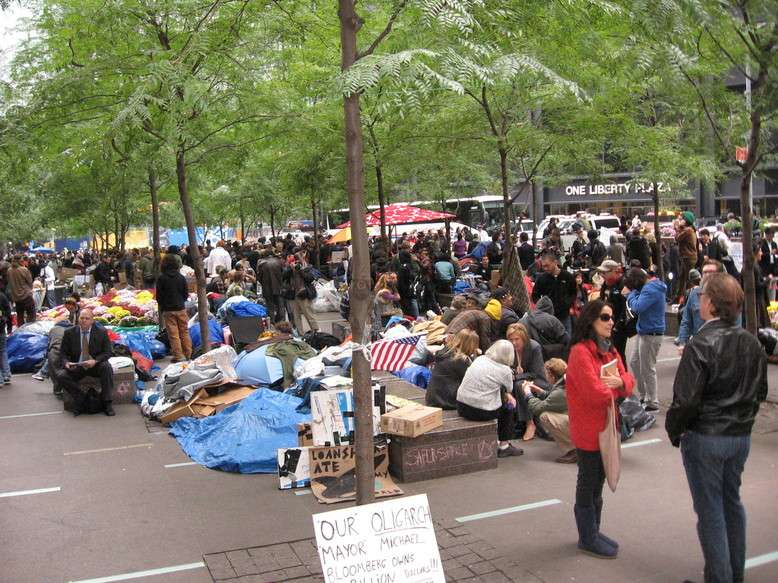
The park is private property but open to the public. In contrast to city parks, it does have any closing time. That is the reason why, the guys could stay there 24/7. Such private parks are quite common, because in return for opening it to the public, the proprietor gets concessions for construction project (e.g. building a high building).
Opposite: Construction of one of the new towers (1 World Trade Center aka Freedom Tower)

From World Trade Center the PATH train runs to Hoboken and Newark in New Jersey. Most parts of the network are underground. Trains are running above ground between Journal Square and Newark only. A train ot the newest rolling stock (PA5) at Journal Sq.

Tickets
I had a NJT weekly pass. These are valid from Saturday to 01:00 on the next Saturday. The price of the weekly pass was about the same as buying single tickets for 4,5 days a week. A commuter who only goes into the city 5 days a week for work, saves a lot of money.
Trivia
And nor for something completely different: some train/rail free stuff
Career-Center at Times Sq. (no comment)

911 is everwhere

The death of Steve Jobs turned the barriers at the Apple-Store on 5th Ave into some kind of shrine with flowers and condolence-post-its

Thats it for today folks. More to come (if you like to see more).
Cheers
Charly
I am from Germany and like to show you some pictures from several trips to the US (I hope my English is not too bad
)My brother went to work in the US for two years. I went over there several times to visit him. On one trip I became a commuter an rode the train into NY for two weeks.
NJ Transit Morris & Essex Line
My brother lived in South Orange, NJ. The commute to Manhattan takes about 45 minutes. South Orange is a station at NJ Transit's Morris & Essex Lines (M&E) . New Jersey Transit (NJ Transit) is the transportation authority of the state of New Jersey. NJ Transit operates several train, light rail and bus routes around the the state.
The trains on the Morris & Essex Lines either run into Penn Station in NYC or they terminate in Hoboken, NJ. The services to Penn station are marketed as "Midtown Direct" trains.
The line is equipped with overhead wiring. It has three tracks along major part of the line. The center track is used for running express trains during rush hour (in the morning inbound to NY, in the afternoon outbound). The train usually consist of 10 multi level coaches build by Bombardier powered by (German) ALP46 locomotives. The locomotives can operate under several different voltage levels. The line joins the Northeast Corridor (NEC) at Kearny Connection. The NEC uses a different voltage level than the M&E.
An NJ Transit Midtown Direct Service entering South Orange, NJ,:
From time to time, single level coaches were used. These got pretty crowded during rush hour
Station South Orange, NJ
The track numbering was a bit unusual. The center track was labeled track 3. The schedule in the station did not list the tracks the trains departed from. Signs on the platform indicated if the trains departing on this platform are inbound (into NY) or outbound trains. Additionally, a note the the waiting area informed about rush hour express trains that departed from the center track. For several outbound trains during the evening rush hour the schedule contained a note that the train may leave ahead of time. This affected mostly outbound express trains, which usually stop to discharge passengers only.
The platforms were not long enough to accommodate a 10 car train. As a result the first and last car did not stop at the platform. Their doors were locked and passenger in these cars had to use other doors to leave the train. The platform were lower than the car. So, there was no step free access from platform to train. To accommodate wheel chairs the platform had a ramp at one end, which allowed step free access to a few doors.
On the weekend trains ran every hour. During the days times between trains varied. In rush hour trains were running every 15 to 20 minutes. The service was running from 05:00 in the morning to 01:00 at night. So I could get home by train after attending a play on Broadway.
On Board
There were round about 5 conductor on the train. As seat has little hook, where you put you ticket. The conductor will pick up the ticket, validate it and keep it. In exchange, he will place a slip of paper on the hook, which indicates where you are going. Only if you have to transfer to another train or got a monthly/weekly pass, you may keep your ticket.
Getting of the train, was king of funny: Each car had doors for high level platform (which will allow step free discharge) and doors for low level platforms. The doors for low level platforms have stairs. But: I door to a low level platform, may be changed to address a high level platform. In order to do so, the conductor will fold a plank over the stairs. Depending on the conductor work ethics in folding, the number of doors opening on the train changed from station to station.
Kearny Connection
The M&E joins the North East Corridor (Route Boston - NY - Philadelphia - Washington) at the Kearny Connection. As the lines use different voltage levels in the overhead the train will pass a powerless section when changing the line. For 30 seconds the air condition was cut off (this reduced the noise level in the car to almost nothing). In the old single level cars the light went out, only emergency lighting was on.
Tunnel into Manhattan
We had to wait a Kearny very often to find a spot to join the traffic. Several line of NJT and Amtrak trains share the tracks into Manhattan. The last section passes under the Hudson river using the North River Tunnels. There is one single track tube for each direction. During rush hour the tunnel are operating at maximum capacity. Usually we picked up delays in this section.
There were plan to build two additional tubes to increase capacity (Projekt ARC - Access to the Regions Core). Works had already started, but the (at this time newly elected) governor canceled the project because he claimed NJ could not pay for the cost overruns. In the mean time several idea emerged to address the situation, these include the extension of a NY subway line into NJ and the Amtrak Gateway Project.
New York Penn Station
The Penn got its name from the Pennsylvania Railroad which build the station. The old building (a master peace of architecture) was torn down in the 60s and replaced by the "Madison Square Garden" event center. Today, the Penn mostly existed below ground. It stretches East to West between 7th and 8th avenue (framed by the subway), and three blocks from North to South.
It is a maze of different corridors and levels. For my taste stairs, platforms and escalators seemed much to small for the huge amount of people. Upon arrival I waited at least 5 minutes before leaving the train. Nevertheless, I was caught in the "traffic jam" on the stairs
Departure platforms are usually announced 10 minutes prior to departure. As a consequence people were lurking in the corridors or waiting area, all staring at the departure board. When the platform was shown the masses started moving. Depending on the waiting area I was in and the platform I had to get to, I had hurry to get to there on time.
In addition to NJ transit, the Penn is also served by Amtrak trains (including Acela to Washington and Boston) and the Long Island Railroad.
Grand Central Terminal
Grand Central Terminal a few blocks north has kept its charm and architectural grandeur. A picture that most train enthusiast take in NY: Rush Hour in Grand Central
John Cage from Ally McBeal might have loved the 4:45pm Metro North Service
Incidents
My two weeks of commute were pretty uneventful. From time to time delays of round about 15 minutes.
One night an Amtrak maintenance engine derailed in on the tunnels. As less than half of the rail capacity into Manhattan was available then, most Midtown Direct were rerouted to Hoboken. In Hoboken I could hop on the PATH train to NY. PATH was accepting NJ transit tickets. At two of 10 turnstiles NJ transit staff was present. You showed them your ticket and they opened turnstile for your. Getting the passengers of 10 multi level cars through two turnstiles took quite some time.
Apart from that, just the usual nuisance: the air condition. It only seemed to have one setting: Arctic.
PATH, WTC, Occupy
The "Occupy Wall Street" protest against capitalism made it into the news in Europe too. Their camp in Zucotty Park was right across from the construction site of the new World Trade Center. The shindig was a mixture of a folk festival and the Hippie movement. On one side of the park the NYPD had setup shop on the other side TV crews from around the world. Tourist were all over the place to have a look.
The protesters had several banner. My personal favorite: "Tear down Wall Street, build factories".
The park is private property but open to the public. In contrast to city parks, it does have any closing time. That is the reason why, the guys could stay there 24/7. Such private parks are quite common, because in return for opening it to the public, the proprietor gets concessions for construction project (e.g. building a high building).
Opposite: Construction of one of the new towers (1 World Trade Center aka Freedom Tower)
From World Trade Center the PATH train runs to Hoboken and Newark in New Jersey. Most parts of the network are underground. Trains are running above ground between Journal Square and Newark only. A train ot the newest rolling stock (PA5) at Journal Sq.
Tickets
I had a NJT weekly pass. These are valid from Saturday to 01:00 on the next Saturday. The price of the weekly pass was about the same as buying single tickets for 4,5 days a week. A commuter who only goes into the city 5 days a week for work, saves a lot of money
.Trivia
And nor for something completely different: some train/rail free stuff
Career-Center at Times Sq. (no comment)
911 is everwhere
The death of Steve Jobs turned the barriers at the Apple-Store on 5th Ave into some kind of shrine with flowers and condolence-post-its
Thats it for today folks. More to come (if you like to see more).
Cheers
Charly
