
• Our new ticketing site is now live! Using either this or the original site (both powered by TrainSplit) helps support the running of the forum with every ticket purchase! Find out more and ask any questions/give us feedback in this thread!

Unidentified viaduct or bridge weight test

Status
Not open for further replies.

lazonbytunnel

Member
Joined
5 May 2023
Messages
97
Location
Huddersfield
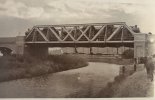
I wonder if anyone can help identify the location in the attached image. Three steam locos are conducting a weight / strength test on a metal bridge span, roughly circa 1910.

A couple of suggestions have been made, one is the River Parrett Viaduct near Langport, Somerset. There are many similarities, but the present River Parrett Viaduct does not have arches on the right hand side unlike the photo.

Another suggestion was Stannals Bridge near Stratford on Avon but the angle at which the bridge crosses the river does not look quite right, nor do some of the architectural details.

Any suggestions welcome!
 

Attachments

  • IMG_5693.jpeg
    IMG_5693.jpeg
    1.2 MB · Views: 218
Sponsor Post - registered members do not see these adverts; click here to register, or click here to log in
R

RailUK Forums

zwk500

Veteran Member
Joined
20 Jan 2020
Messages
18,524
Location
Northampton
The Locos look like a GWR style to my extremely inexpert eye, are they 2-6-2T locos?

Also do you know if this is a 2-track bridge, the abutments look quite wide for just 2?
 

stuu

Established Member
Joined
2 Sep 2011
Messages
3,766
It looks exactly right for the River Parrett at Langport. Looking at contemporary photos, it looks like the eastern approach span has been replaced - the abutments looks much newer than the rest of the structure
 

Gloster

Veteran Member
Joined
4 Sep 2020
Messages
12,980
Location
Up the creek
It does look very like the bridge over the Parrett, although there are small differences. The two sections in the middle with two girders in cross formation appear now to have lost one of each pair, which is the opposite to the norm, where additional strengthening is needed. (Was \\XX//, now \\\/// .) However, there are three now sets of girders across the top from one side to the other.
 

PG

Established Member
Joined
12 Oct 2010
Messages
3,470
Location
at the end of the high and low roads
I wonder if anyone can help identify the location in the attached image. Three steam locos are conducting a weight / strength test on a metal bridge span, roughly circa 1910.
Pardon my ignorance - is this an empirical method of testing the load capability? If so does a failure result in the steam locos suddenly taking a very big drink!

As to the location, I note the beasts on the right of the picture have long horns which doesn't seem like something you'd expect in Somerset back then?
 

zwk500

Veteran Member
Joined
20 Jan 2020
Messages
18,524
Location
Northampton
Pardon my ignorance - is this an empirical method of testing the load capability? If so does a failure result in the steam locos suddenly taking a very big drink!
Even today, a final demonstration is often held with a live weight test. I would presume the engineers have done their calculations before hand but a loaded test run is often done anyway - the Milau viaduct in France (built around 2004) had about a dozen gritting trucks line up on the centre of each span to test the deflection, and that's some 300m above the valley floor so if there'd been a problem they had a long way to fall!
 

lazonbytunnel

Member
Joined
5 May 2023
Messages
97
Location
Huddersfield
Thanks for the comments so far, yes I noticed those differences in the girders too Gloster.

PG - the horns of the cattle don’t look particularly long close up - not Longhorn breed long, anyhow. I have seen quite a few postcards of multiple locos testing bridges in this way so it must have been common practice.


The lie of the land and the river does look like the Parrett viaduct with the sloping land beyond seen through the arch.

I just wasn’t sure how many similar bridges there might be elsewhere. I thus far haven’t found an old photo that could confirm or disprove whether the arches on the right used to be there.
 

Gloster

Veteran Member
Joined
4 Sep 2020
Messages
12,980
Location
Up the creek
Perhaps the cows are the now extinct Somerset Sheeted breed. However, it is not a subject that I know much (anything) about.

The line over the bridge opened on February 12 1906.

I am wondering if the locos are 4-4-2T ‘County’ tanks, although they look a bit small. Otherwise they could be brand new 4500 2-6-2T tanks.
 

stuu

Established Member
Joined
2 Sep 2011
Messages
3,766
I would have said they are 4500s. Perhaps testing new locos on a new line was the thing to do?
 

Ediswan

Established Member
Joined
15 Nov 2012
Messages
3,425
Location
Stevenage
Even today, a final demonstration is often held with a live weight test. I would presume the engineers have done their calculations before hand but a loaded test run is often done anyway - the Milau viaduct in France (built around 2004) had about a dozen gritting trucks line up on the centre of each span to test the deflection, and that's some 300m above the valley floor so if there'd been a problem they had a long way to fall!
Is that a man with a tripod at the base of the abutment (just left of the cow's head) ? Surveyor looking for deflection ? Possibly observing those poles dangling below the bridge.
 

Gloster

Veteran Member
Joined
4 Sep 2020
Messages
12,980
Location
Up the creek
I would have said they are 4500s. Perhaps testing new locos on a new line was the thing to do?

I just thought that getting three of a new type out of Wolverhampton and down to Somerset by the 12 February of the year they were first built would be rather fast going. Still, it is possible that this test was done in the period between opening for goods on 12 February and for passengers on 2 July. Still, it could be checking to see if the passage of goods traffic had had an effect on the bridge.
 

Pigeon

Member
Joined
8 Apr 2015
Messages
1,123
Pardon my ignorance - is this an empirical method of testing the load capability? If so does a failure result in the steam locos suddenly taking a very big drink!

It was standard practice, but the idea wasn't to see if it breaks but just to see if it bends too much. It was deemed to have failed if the spans sagged an excessive amount under the abnormal load. I can't recall off the top of my head any instances where the failure was massive and catastrophic, though no doubt it must have happened occasionally, and there were certainly instances of the thing nevertheless unexpectedly falling down of its own accord shortly after opening having looked fine under test.

Even today, a final demonstration is often held with a live weight test. I would presume the engineers have done their calculations before hand but a loaded test run is often done anyway - the Milau viaduct in France (built around 2004) had about a dozen gritting trucks line up on the centre of each span to test the deflection, and that's some 300m above the valley floor so if there'd been a problem they had a long way to fall!

The tale is that when they tested the Crumlin viaduct they had to get a driver who already had a reputation as a bit of a nutter to drive the test train because nobody else would do it. He prepared himself for the exercise by going round every pub in the district, then instead of creeping the test train across at minimum speed as instructed, he gave it the beans and charged across full pelt, on the basis that if you're about to die you might as well get on with it and not mess about.
 

zwk500

Veteran Member
Joined
20 Jan 2020
Messages
18,524
Location
Northampton
The tale is that when they tested the Crumlin viaduct they had to get a driver who already had a reputation as a bit of a nutter to drive the test train because nobody else would do it. He prepared himself for the exercise by going round every pub in the district, then instead of creeping the test train across at minimum speed as instructed, he gave it the beans and charged across full pelt, on the basis that if you're about to die you might as well get on with it and not mess about.
And people bemoan today's safety culture... :lol:
 

2192

Member
Joined
16 Aug 2020
Messages
372
Location
Derby UK
I am wondering if the locos are 4-4-2T ‘County’ tanks, although they look a bit small. Otherwise they could be brand new 4500 2-6-2T tanks.
Isn't it easier to use whatever locos are spare at nearby Engine Sheds to where the test is needed (Somerset) rather than running locos down from Wolverhampton?
 

Gloster

Veteran Member
Joined
4 Sep 2020
Messages
12,980
Location
Up the creek
Isn't it easier to use whatever locos are spare at nearby Engine Sheds to where the test is needed (Somerset) rather than running locos down from Wolverhampton?

I wondered whether the locos were on Taunton shed on their way to their first allocation further west and the shedmaster preferred to send out locos that weren’t on his books in case there were problems. (This is very much something that is the wandering thought of an idle mind.)
 

mr_towers

Member
Joined
22 Jan 2013
Messages
24
Location
Pitlochry
They did a number of tests on the Forth Road Bridge using loaded gritters to prove the emergency strengthening works had been successful! BBC News
 

Lucan

Established Member
Joined
21 Feb 2018
Messages
1,256
Location
Wales
Pardon my ignorance - is this an empirical method of testing the load capability?
Structural engineer here. Yes, it is an emprical method, but it is in addition to lengthy and detailed calculations and probably equivalent tests on a large scale model. This test would be to confirm those calculations by measuring deflections*. If there were a serious discrepancy between the calculations and the test it would be investigated and the bridge kept closed to traffic until it was resolved.
Even today, a final demonstration is often held with a live weight test. I would presume the engineers have done their calculations before hand but a loaded test run is often done anyway
I do not do bridges myself, but I expect it is a legal requirement. Large pressure vessels (I was involved with power station boilers) are tested to twice the working pressure, but filled with water so that a failure would not be as dramatic as with steam.

* These days local stresses in the metal in critical areas would also be measured by means of strain gauges, but I don't think strain gauges were invented by 1910.
 

randyrippley

Established Member
Joined
21 Feb 2016
Messages
5,382
It does look very like the bridge over the Parrett, although there are small differences. The two sections in the middle with two girders in cross formation appear now to have lost one of each pair, which is the opposite to the norm, where additional strengthening is needed. (Was \\XX//, now \\\/// .) However, there are three now sets of girders across the top from one side to the other.
A number of Somerset bridges on or around the Parrett were weakened and provided with demolition charge chambers during WWII as part of the creation of the Taunton stop line. Some of the road bridges around Langport actually had their stone arches replaced with temporary timbers. I don't believe a definitive list of which bridges were so treated exists
 

Gloster

Veteran Member
Joined
4 Sep 2020
Messages
12,980
Location
Up the creek
As far as I can see the Taunton Stop Line ran further west and only joined the Parrett near Bridgwater, while the GHQ Green Line was further north. However, lots of bridges were prepared for demolition on a ‘just in case’ basis. Certainly, destroying bridges on the Levels would have hindered an attacker.
 

DelW

Established Member
Joined
15 Jan 2015
Messages
5,978
I do not do bridges myself, but I expect it is a legal requirement. Large pressure vessels (I was involved with power station boilers) are tested to twice the working pressure, but filled with water so that a failure would not be as dramatic as with steam.
I don't think there's any requirement for load testing bridges in general. I built quite a few road bridges earlier in my career (1970s & 80s) and no load tests were done on those, though admittedly they were fairly standard designs. I also had some involvement with temporary and permanent railway bridges, and don't recall any load testing of them - there'd have been little time as they were installed in weekend possessions and had to be open to rail traffic by the Monday morning.

I'd agree that it might be appropriate for unusual designs though, to validate design methods.
 

Ken X

Member
Joined
29 Nov 2021
Messages
343
Location
Horsham
I used to work at the Royal Engineers Bridge Test Section. Originally the bridges were tested as below

images.jpg

They then built two test rigs with a combined load capacity of 500 Tons. We regularly witnessed displacements of several feet during testing and often tested to failure which had its moments.:D
 
Status
Not open for further replies.

Top