• Our new ticketing site is now live! Using either this or the original site (both powered by TrainSplit) helps support the running of the forum with every ticket purchase! Find out more and ask any questions/give us feedback in this thread!

Trivia: Ideas and concepts that didn't work out

Status
Not open for further replies.

thenorthern

Established Member
Joined
27 May 2013
Messages
4,714
I remember at some stations on the West Coast Mainline they has the zone signs with colours such as "Gold Zone" which were designed to allow passengers to know where to stand on the platform. Let's face it though very few people actually knew what they were for and very quickly they became useless. The numerical zone on WCML platforms which was introduced by Virgin Trains however does work quite well.

It made me wonder what ideas were there that didn't quite work out. Some others that I could think of are:

  • At seat radios, seemed a good idea at first but very soon they were obsolete with many passengers having iPods and passengers wanting WIFI.
  • VOLO, a similar idea on Great Western which seemed amazing but it didn't work out.
  • Virgin Trains Beam, I understand the reasons behind wanting to give passengers the option to stream things without consuming bandwidth. it seemed a bit late for it's time and was easier to use Netflix.
  • Tilting trains on the Cross Country services, I know that there was a TASS system installed between Banbury and Oxford which I assume has now been ripped up. The Class 221s used by CrossCountry only had their tilt function in use for 5 years which given the cost of installing the tilt system seems a waste of money.
  • Mark 5a coaches, they have now been in storage for over a year and are unlikely to reenter service soon. Their introduction seemed a bit pointless as there were other trains that were better suited for the role.
What other things can you think of that seemed a great idea at the time but never worked out?
 
Sponsor Post - registered members do not see these adverts; click here to register, or click here to log in
R

RailUK Forums

Ghostbus

On Moderation
Joined
17 Sep 2024
Messages
331
Location
England
Charterail?

Specifically, the concept of a joint venture between British Rail and the private sector, which lasted all of two years, rather than the piggyback freight it was engaged in.

Was a potential role for British Rail in the railway post-1992 lost forever here?
 

Alfonso

Member
Joined
22 Jul 2017
Messages
593
1. Regional Eurostar
2. Nightstar
3. Rail Riders club
4. If overseas stuff is allowed the odd "cabine 8" semi couchettes in France.
In the interests of keeping this thread clean, can I suggest that comments on how regional eurostar and overnight services to the continent could work are posted in the interminable threads on the subject in the international section please
 

Snow1964

Established Member
Joined
7 Oct 2019
Messages
11,142
Location
West Wiltshire
Adverts where journey time is shown

eg this one (which also uses words : smooth, comfortable, relaxing, easy)

IMG_2878.jpeg
 

Harvester

Established Member
Joined
9 Nov 2020
Messages
1,762
Location
Notts
In the summer of 1970 and 1971 ‘The Highwayman’ ran between Newcastle and Finsbury Park and vice versa at a bargain price of £2. However the train ran via the Durham coast, had numerous crew changing stops and consisted of old mark 1 stock. It never really caught the public eye, except maybe enthusiasts for the class 40 haulage, and ran for only those two summers.
 

Magdalia

Established Member
Joined
1 Jan 2022
Messages
7,388
Location
The Fens
The cross London Ipswich-Basingstoke trains.

Public telephones on trains for example the Connex class 365s.
 

Dr Day

Member
Joined
16 Oct 2018
Messages
759
Location
Bristol
Great Western motorail - the re-introduction thereof in the first franchise post privatisation
 

Transilien

Member
Joined
10 Mar 2024
Messages
741
Location
Ayrshire
Rail Privatisation as it led to the organisational mess that we have today on the railways and has let politicians intervene much more than previously. HSTs on ScotRail, they were already too old before being put into service and have caused more problems than solutions on the routes that they run.
 

Falcon1200

Established Member
Joined
14 Jun 2021
Messages
6,558
Location
Neilston, East Renfrewshire
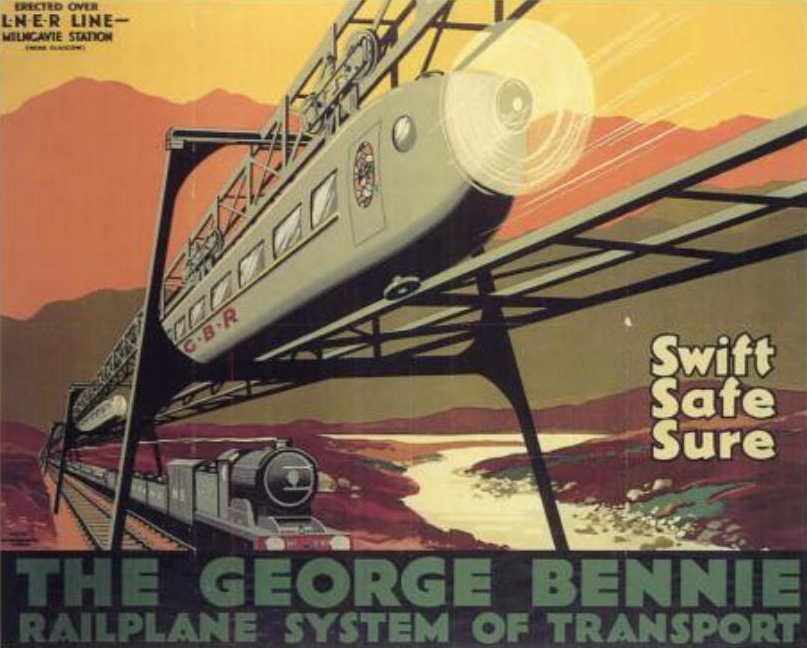
Going back a while, the Bennie Railplane, a test track for which was built near Milngavie, Glasgow, in 1929-30:


The Bennie Railplane was a form of rail transport invented by George Bennie (1891–1957), which moved along an overhead rail by way of propellers.

It seems astonishing now that such a concept was even considered, given the amount of steelwork required for its construction, and its total incompatibility with the existing rail system.
 

Harpo

Established Member
Joined
21 Aug 2024
Messages
3,862
Location
Newport
Adverts where journey time is shown

eg this one (which also uses words : smooth, comfortable, relaxing, easy)

View attachment 172249
That 40-50 year old poster is embarassing and shows the concept of fast GWML travel has been lost.

They’re probably headline timings on the poster but even after billions on electrification, ordinary journey times still can’t touch them.


London to Bath, now 74 minutes
London to Bristol now 95 minutes
London to Cardiff now 108 minutes
Only Swansea is 1 minute quicker:
London to Swansea 162 minutes
 

Harvester

Established Member
Joined
9 Nov 2020
Messages
1,762
Location
Notts
The plan to run the Elizabethan non-stop from Kings Cross to Edinburgh in 1962 with Deltics. The crews objected!
 

GatwickDepress

Established Member
Joined
14 Jan 2013
Messages
2,588
Location
Leeds
Network Rail's venture with Doddle in 2014 to have parcel shops at select stations. I used the one at Milton Keynes Central quite a few times - it was opposite where the Greggs is now - but it was always very quiet and was staffed by two members, which can't have helped the bottom end.

Always wondered if a network of parcel lockers similar to what Amazon and Royal Mail have now could have worked out better.
 

edwin_m

Veteran Member
Joined
21 Apr 2013
Messages
28,665
Location
Nottingham
Tilting trains on the Cross Country services, I know that there was a TASS system installed between Banbury and Oxford which I assume has now been ripped up. The Class 221s used by CrossCountry only had their tilt function in use for 5 years which given the cost of installing the tilt system seems a waste of money.
At the time Cross Country also operated the Birmingham-Glasgow service which made much more use of tilt. I agree having the equipment became uneconomic when that route transferred to the West Coast franchise so XC was left with only Banbury-Oxford. I think it was also impossible to guarantee 221s on that route so it had to be timed for 220s anyway.
Brunel's Broad Gauge ... :)
...and the Atmospheric Railway.
 

stuu

Established Member
Joined
2 Sep 2011
Messages
3,766
That 40-50 year old poster is embarassing and shows the concept of fast GWML travel has been lost.

They’re probably headline timings on the poster but even after billions on electrification, ordinary journey times still can’t touch them.


London to Bath, now 74 minutes
London to Bristol now 95 minutes
London to Cardiff now 108 minutes
Only Swansea is 1 minute quicker:
London to Swansea 162 minutes
Because the demand from intermediate stations has gone up, and there are many, many more trains running. It's not a like for like comparison
 

StephenHunter

Established Member
Joined
22 Jul 2017
Messages
2,917
Location
London
The CIWL Type P. Ironically, some of them are still in use in their converted AB30 form with European Sleeper.
 

Taunton

Veteran Member
Joined
1 Aug 2013
Messages
12,279
Because the demand from intermediate stations has gone up, and there are many, many more trains running. It's not a like for like comparison
I don't believe the intermediate demand has gone up so exponentially while the end-to-end demand has remained static. What has happened is that intermediate stations services have been knocked back or consolidated into the longer-distance operations. To take the Glasgow-Edinburgh service as a similar example, the onetime stopping train which used to follow the high speed non stop services out doesn't run any more, and the main trains now stop at middle-of-nowhere places like Croy, and despite all the electrification expense take longer end-to-end than they did more than 50 years ago.
 

Bertie the bus

Established Member
Joined
15 Aug 2014
Messages
3,216
The cross London Ipswich-Basingstoke trains.
That never seemed like a good idea to me. I used it around London a couple of times for the novelty because I lived locally at the time but trundling round North London and avoiding the centre always seemed pointless and doomed to failure.
 

edwin_m

Veteran Member
Joined
21 Apr 2013
Messages
28,665
Location
Nottingham
I don't believe the intermediate demand has gone up so exponentially while the end-to-end demand has remained static. What has happened is that intermediate stations services have been knocked back or consolidated into the longer-distance operations. To take the Glasgow-Edinburgh service as a similar example, the onetime stopping train which used to follow the high speed non stop services out doesn't run any more, and the main trains now stop at middle-of-nowhere places like Croy, and despite all the electrification expense take longer end-to-end than they did more than 50 years ago.
That's at least partly because the frequency has increased too. There often isn't time to run a stopper that sets out just after a fast, because it is caught up by the next fast before it reaches its destination or somewhere overtaking is possible. So for those travelling centre to centre the fastest train is a bit slower but there is a more frequent service with about that journey time.

The effect on intermediate stations can vary. For London-Bristol/Cardiff most trains call at the main stops so they get a better service, but for other routes the demand is less so they only get rather random stops, and the few people travelling between two intermediate stations may find it more difficult.
 

6Gman

Established Member
Joined
1 May 2012
Messages
9,201
In the summer of 1970 and 1971 ‘The Highwayman’ ran between Newcastle and Finsbury Park and vice versa at a bargain price of £2. However the train ran via the Durham coast, had numerous crew changing stops and consisted of old mark 1 stock. It never really caught the public eye, except maybe enthusiasts for the class 40 haulage, and ran for only those two summers.
My recollection was of a single crew change at Doncaster, but I may be mistaken.
 

Harpo

Established Member
Joined
21 Aug 2024
Messages
3,862
Location
Newport
Brunel’s atmospheric propulsion system in the West Country
That sucked.

== Doublepost prevention - post automatically merged: ==

That's at least partly because the frequency has increased too. There often isn't time to run a stopper that sets out just after a fast, because it is caught up by the next fast before it reaches its destination or somewhere overtaking is possible. So for those travelling centre to centre the fastest train is a bit slower but there is a more frequent service with about that journey time.

The effect on intermediate stations can vary. For London-Bristol/Cardiff most trains call at the main stops so they get a better service, but for other routes the demand is less so they only get rather random stops, and the few people travelling between two intermediate stations may find it more difficult.
Can't disagree with that but the point is that the WCML has seen huge acceleration and corresponding growth while the GWML is slower than 50 years ago and (in keeping with this thread) has abandoned the idea of faster journies.
 

thenorthern

Established Member
Joined
27 May 2013
Messages
4,714
Not in the United Kingdom but the Sydney Monorail seemed a bit of a gimmick that never really worked. Monorails on the whole don't really work for public transport.

At the time Cross Country also operated the Birmingham-Glasgow service which made much more use of tilt. I agree having the equipment became uneconomic when that route transferred to the West Coast franchise so XC was left with only Banbury-Oxford. I think it was also impossible to guarantee 221s on that route so it had to be timed for 220s anyway.

...and the Atmospheric Railway.

I know the reasons why it was stopped as I say though 6 years of tilting for technology that cost a lot of money is a bit frustrating.
 
Joined
28 Nov 2021
Messages
372
Location
Leith
I don't believe the intermediate demand has gone up so exponentially while the end-to-end demand has remained static. What has happened is that intermediate stations services have been knocked back or consolidated into the longer-distance operations. To take the Glasgow-Edinburgh service as a similar example, the onetime stopping train which used to follow the high speed non stop services out doesn't run any more, and the main trains now stop at middle-of-nowhere places like Croy, and despite all the electrification expense take longer end-to-end than they did more than 50 years ago.
Croy gives an impression of being middle-of-nowhere but is actually the more convenient station for many of the residents of Cumbernauld, if they don't live within walking distance of Cumbernauld or Greenfaulds stations. That said, I would agree that for many passengers a regular fast service followed by an equally regular semi-fast would be preferable.
 

Rescars

Established Member
Joined
25 May 2021
Messages
2,547
Location
Surrey
That was the problem, wasn't it? They did suck, just not for very long. How long was it before they got binned off?
Fair point that the South Devon atmospheric was as IKB himself admitted a bit of a "caper". But the London and Croydon atmospheric, though not a great success either, did produce the first ever flyover at Jolly Sailor (aka Norwood Junction) and that engineering concept has proved rather popular ever since.
 

PeteFLT

Member
Joined
21 Apr 2020
Messages
29
Location
Flitwick
.
  • Virgin Trains Beam, I understand the reasons behind wanting to give passengers the option to stream things without consuming bandwidth. it seemed a bit late for it's time and was easier to use Netflix.
Beam and whatever Chiltern and LM called it is (was?) a great idea, especially if you got stuck somewhere with no phone signal and were delayed
 
Joined
28 Nov 2021
Messages
372
Location
Leith
I think it's interesting to distinguish between fundamentally bad ideas and those which were perfectly reasonable in themselves but turned out to be a waste of money because of other factors. Out of those already mentioned, I'd put the atmospheric railway firmly in the "fundamentally bad" category (inherent limits on the power it could deliver, immense problems with junctions - hence the invention of the flyover mentioned by @Rescars at post #28). Public telephones on trains (as mentioned by @Magdalia at #6) were IMHO a useful but expensive feature of some trains for a few years but were left redundant by the mass adoption of mobile phones. (Whether those involved could have foreseen the take-up of mobile phones is another question.)

I'm not saying that all the ideas and concepts that didn't work out can be classified as "fundamentally bad" and "reasonable but redundant", just that those are two very different ways in which things didn't work out.
 
Status
Not open for further replies.

Top