Our new ticketing site is now live! Using either this or the original site (both powered by TrainSplit) helps support the running of the forum with every ticket purchase! Find out more and ask any questions/give us feedback in this thread!
I dont believe the Independent Lines at Crewe qualify as "freight only" as there are still ECS moves etc. It just happens that they are particular infrequent, as everything that goes north on WCML etc stops at Crewe.
Don't know if it's been mentioned but i'm watching the Colas Oil Train cab ride DVD and the train goes on the up and down goods lines and avoids Blackburn station.
You’re right- before the clock face timetable, East Coast (and NXEC, GNER and BR before them) ran a number of expresses which were non-stop between York and Newcastle and used the fast avoiding lines- I believe this allowed them to continue running at about 90mph. In GNER days I distinctly remember using them on a southbound HST and also on the down Highland Chieftain (in the days when its stopping pattern was Peterborough York Newcastle Edinburgh then stations to Inverness). I’ve seen lots of photos of Deltic-hauled expresses using them, back in the days when stopping patterns were more irregular.
I also distinctly remember the diverted down sleeper (1S25) back in February 2016 running along the avoiding line at 80mph, not slowing for Darlington at all.
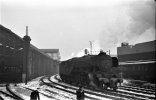
The lines running outside the trainshed at Darlington are Down Main, Up Main and Up Goods Loop. The speed limit on the mains at that point is 125 mph, although it reduces to 90 mph for a few chains over the Saltburn branch junction.
In the early 60s, the only daytime trains not to stop were the up and down Flying Scotsman (Scotsmen?), but there were some overnight trains as well.
A lasting memory is seeing a Tyne Dock 9F speed past hauling about 6 of the former South Tyneside EPB EMUs on their way to the Southern Region with a standard BR goods brake on the rear. It was running on Class H headlights, but way over 35 mph. I remember musing that it was a pity that the air pumps on the loco for operating the Tyne Dock - Consett ore wagon doors couldn't have been rigged to operate the brakes on the units!
== Doublepost prevention - post automatically merged: ==
When I used to spot at Newcastle Central in the 1950s heavy freight trains would go round the back of Platform 10 outside the train shed. As far as I recall they still do, although it's no longer Platform 10.
There were actually 4 goods lines past the back of Newcastle Central as this admittedly not very good photo of mine shows. The original outside wall of the station now has platforms 7&8 outside of it and there is a sort of by pass line which freight can use, though it just as often goes through the platforms.
== Doublepost prevention - post automatically merged: ==
The avoiding lines at Northallerton are, of course, the original Leeds Northern main lines. The mileposts from Northallerton all the way to Gateshead via Hartlepool are still from Zero at Leeds (I think Wortley Jc, but stand to be corrected on that) via Harrogate and Ripon. In the 1960s, I remember seeing some very basic platforms adjacent to Boroughbridge Road level crossing, but I'm not sure they were in use at all.
There is 1 passenger train booked that way, Sundays 1P77 - 13:36 Manchester Airport to Redcar Central, in addition there is an early morning York - Redcar Central ECS working.
Before the rebuild, I never saw anything use either of them, and their condition suggested that they were rarely if ever used.
There used to be a (if not more) centre road(s) at Stalybridge as well, by the time I was using the station it had been cut back to a central siding with buffer stop at the East end, but have seen photos of goods using the centre road.
Sorry for the delay in replying. It’s difficult to tell without speaking German, but my sense is that many were built in the late 19th century. German industry was growing immensely, hence traffic was increasing and in addition the German military played an important role in planning (with mobilisation via the railways).
In a sense this coincides with the last burst of railway infrastructure improvements in the UK (Crewe, approaches to Euston and Waterloo, GWR cut-offs for example). The alternative routes, by-passes etc were no doubt useful in WW2, but I suspect many were there already. If you get a chance to look at a map of the Ruhrgebiet‘s railways even now there are four track electrified freight only lines.
The curve at Ely counts, presumably. I think one early morning passenger service uses it but it mainly exists to avoid reversals at the station across what used to be a very congested level crossing.
The only booked passenger service in recent (normal) times is the 1553 SuO Norwich to Manchester Piccadilly, which runs that way as a Parly to avoid the lengthy closure process.
I think it's important in this thread to distinguish between freight only routes and freight only tracks, the former typically avoiding a station or stations (ie Camp Hill line) the latter still passing them, just not at a platform (ie the far west track opposite P7 at Peterborough).
Going back to Parlys, these are only relevant to the former.
Sorry for the delay in replying. It’s difficult to tell without speaking German, but my sense is that many were built in the late 19th century. German industry was growing immensely, hence traffic was increasing and in addition the German military played an important role in planning (with mobilisation via the railways).
None of the major freight-only routes are WW2.
The C19th Prussian/German governments specialised in replacing termini with through stations and putting in non-conflicting junctions; the only major route I know of was the "Kanonenbahn" from Berlin to Lorraine, but despite its name it wasn't all freight only, and it was never completed....
ISTR the regime built a diversion to avoid the Hamm viaduct (anticipating that the RAF would target it...) in WW2, and no doubt others, but they haven't survived.
== Doublepost prevention - post automatically merged: ==
Pedantically, it had regular passenger services until the March-Spalding closed - my 1958 timetable shows the North Country Continental and numerous dated extras not calling at Sleaford. But the Joint Line was always primarily freight, as you say.
Thanks. I suspect it might be too late in life to learn enough German to read books on the subject matter, and even in English on UK Railways there is often a huge amount about how the line got built and not a lot on how it got improved, if it did, by quadrupling, flying junctions etc.
Thanks. I suspect it might be too late in life to learn enough German to read books on the subject matter, and even in English on UK Railways there is often a huge amount about how the line got built and not a lot on how it got improved, if it did, by quadrupling, flying junctions etc.
Question rather than a statement or answer, but can a train (non electric of course) run round the back of Hitchin if coming from Cambridge? (I did search this thread, looks like it wasn't mentioned). It looks like the line behind the station (to the North/East side) is complete from Google Maps, but I really doubt it's a signalled route and the track might have been lifted since the satellite imagery was taken.
Question rather than a statement or answer, but can a train (non electric of course) run round the back of Hitchin if coming from Cambridge? (I did search this thread, looks like it wasn't mentioned). It looks like the line behind the station (to the North/East side) is complete from Google Maps, but I really doubt it's a signalled route and the track might have been lifted since the satellite imagery was taken.
I believe it is freight only and through Hitchin Up Yard and Hitchin CMEE (not sure what that stands for), and the exit from the CMEE south of Hitchin station is Ground Frame controlled (source: SimSig Kings Cross)
Ah yes, forgot Edinburgh. There’s a south side line, which once did have passengers but is now freight only (except in emergency). Suspect it was built for passengers though.
The only booked passenger service in recent (normal) times is the 1553 SuO Norwich to Manchester Piccadilly, which runs that way as a Parly to avoid the lengthy closure process.
I think it's important in this thread to distinguish between freight only routes and freight only tracks, the former typically avoiding a station or stations (ie Camp Hill line) the latter still passing them, just not at a platform (ie the far west track opposite P7 at Peterborough).
Going back to Parlys, these are only relevant to the former.
Would the Castle Donington line count as an avoiding line for Derby going south to east? It's primarily freight but I've been on passenger services using it during the Derby resignalling a couple of years ago.
In former years, the North Country Continental did not call at Sleaford, nor did some of the summer Saturday holiday trains from Manchester/Yorkshire/North-East England to East Anglian resorts.
We are aware of an issue with emails from the Forum to Microsoft-based email accounts (hotmail/outlook/live.com email addresses). This is being looked into currently, thanks for your patience meanwhile.