• Our new ticketing site is now live! Using either this or the original site (both powered by TrainSplit) helps support the running of the forum with every ticket purchase! Find out more and ask any questions/give us feedback in this thread!

Train numbers should be displayed in public timetables and information systems

Status
Not open for further replies.

StephenHunter

Established Member
Joined
22 Jul 2017
Messages
2,945
Location
London
This industry suffers from so many different numbering systems to identify essentially the same thing, from the train identity (headcode), the headcode (different in scheduling world, of course), the schedule UID, the Retail Service ID, etc. It feels to me that the only reason why we don't use an identity to represent services to the passenger is because of how many there are. It would probably be quite effective to use them on long distance services where reserved seats are the norm - after all Eurostar manage that absolutely fine and even use them in social media comms.

Most definitely. That's the norm in mainland Europe. For example NJ 425 being the Brussels-Innsbruck Nightjet service (it will become the Brussels-Wien service in December).
 
Sponsor Post - registered members do not see these adverts; click here to register, or click here to log in
R

RailUK Forums

AngusH

Member
Joined
27 Oct 2012
Messages
599
Two problems with train times as I see it:


1) The departure time of the train is used both as an expected departure time and as a unique train identifier for booked tickets,
but the train can be delayed so rendering it both inaccurate and confusing.

so you get lines like

"The late running 0943 to Edinburgh is now expected at 1003".
"The 1003 for Edinburgh is now due at 1042, do not board the delayed 0943 if you have tickets for the 1003!"

"This is the 1103 to London kings Cross, if you boarded at York with an advance ticket it must state that it is valid on the 1103"


Instead of

Train EC1234 to Edinburgh has been delayed and will arrive at 1003
Train EC1756 to Edinburgh is delayed and will arrive at 1042

"This is train EC1234, If you hold an advanced ticket, only tickets marked for train EC1234 are valid"


2) The unique identifier of a train that passengers use changes throughout the journey,

it's the 0900 at Edinburgh, the 1030 at Newcastle, the 1130 at York, etc.

If it was EC1234, that would be the only value that anyone needs to remember.


As a counter argument, if everything is working then train numbers introduce an extra value that is abstract and not connected with the time of the service or anything else.

I'd like to see a proper trial, because anything that cheaply reduces the possibility of dispute between passengers and guards is worth trying.

Edited slightly for clarity.
 
Last edited:

GusB

Established Member
Joined
9 Jul 2016
Messages
8,172
Location
Elginshire
Two problems with train times as I see it:


1) The departure time of the train is used both as an expected departure time and as a unique train identifier for booked tickets,
but the train can be delayed so rendering it both inaccurate and confusing.

so you get lines like

"The late running 0943 to Edinburgh is now expected at 1003".
"The 1003 for Edinburgh is now due at 1042, do not board the delayed 0943 if you have tickets for the 1003!"

"This is the 1103 to London kings Cross, if you boarded at York with an advance ticket it must state that it is valid on the 1103"


Instead of

Train EC1234 to Edinburgh has been delayed and will arrive at 1003
Train EC1756 to Edinburgh is delayed and will arrive at 1042

"This is train EC1234, If you hold an advanced ticket, only tickets marked for train EC1234 are valid"


2) The unique identifier of a train that passengers use changes throughout the journey,

it's the 0900 at Edinburgh, the 1030 at Newcastle, the 1130 at York, etc.

If it was EC1234, that would be the only value that anyone needs to remember.


As the counter argument, if everything is working then train numbers introduce an extra value that is abstract and not connected with the time of the service or anything else.

I'd like to see a proper trial, because anything that cheaply reduces the possibility of dispute between passengers and guards is worth trying.

Edited slightly for clarity.
There's a problem here, though. If I had booked to catch the 10.03 to Anytown which is delayed and not expected to arrive until 11.03, and the 09.03 train to Anytown turns up at 10.03 an hour late - as far as I'm concerned, the train has turned up on time. It doesn't matter whether I have an anytime ticket or one for a specific train. My ticket says depart on the 10.03. Should I be refused travel because I'm on the wrong late train?
 

AngusH

Member
Joined
27 Oct 2012
Messages
599
You could be refused travel/prosecuted today if you had an advanced ticket and traveled on the wrong train.

This is an attempt to remove that confusion.

If you have an anytime ticket it shouldn't matter, you could travel on either.

Extra: but i've certainly seen people board the wrong train because of time confusion and find that their seat reservation wasn't there, so it does affect anytime tickets too.

I also refer to this thread: https://www.railforums.co.uk/threads/potential-for-getting-wrong-train-on-advance-ticket.133103/
 
Last edited:

Tom

Member
Joined
19 Jan 2008
Messages
872
Location
35,000ft
Thankfully such a system already exists (or at least did!!). It used to show up in RTT actually (something along the lines of Retail Service ID or similar) but each reservable train was assigned it's own unique identifier. Perfect for "booked train only" tickets.
RTT derived the retail service ID from two fields received from Network Rail and didn’t cover all services with them, as RDG infilled a lot more in the timetable outputs from their side. I removed it in the rebrand as it is literally a concatenation on a high level of the two character ATOC code and 4 digit headcode field. There are another two digits sometimes used.

the RSID I think has its own issues in being used for a unique identifier as it becomes messy on portion working and the 5th and 6th digits begin to become relevant. Unless you’re pulling the timetables from RDG, you can’t do much there either. This is another example of the industry being overcomplicated in that respect. I’m firmly of the view that the operational systems should be gospel and anything downstream shouldn’t add data but be a subset of it, and that should be the case for timetables, real-time info, etc.
 

Llanigraham

On Moderation
Joined
23 Mar 2013
Messages
6,490
Location
Powys
Two problems:

What would you do when a headcode changes mid journey, because of something like a cancellation?

What would you do where two trains with the same headcode departed from the same station at similar times? And although rare it could happen.
 

StephenHunter

Established Member
Joined
22 Jul 2017
Messages
2,945
Location
London
1. It already happens in Europe, train numbers do change at frontiers.
2. Make sure it doesn't basically.
 

PeterC

Established Member
Joined
29 Sep 2014
Messages
4,786
Most definitely. That's the norm in mainland Europe. For example NJ 425 being the Brussels-Innsbruck Nightjet service (it will become the Brussels-Wien service in December).
Now that is the main arguement against the idea. Not invented here!
 

ainsworth74

Forum Staff
Staff Member
Global Moderator
Joined
16 Nov 2009
Messages
31,128
Location
Redcar
RTT derived the retail service ID from two fields received from Network Rail and didn’t cover all services with them, as RDG infilled a lot more in the timetable outputs from their side. I removed it in the rebrand as it is literally a concatenation on a high level of the two character ATOC code and 4 digit headcode field. There are another two digits sometimes used.

the RSID I think has its own issues in being used for a unique identifier as it becomes messy on portion working and the 5th and 6th digits begin to become relevant. Unless you’re pulling the timetables from RDG, you can’t do much there either. This is another example of the industry being overcomplicated in that respect. I’m firmly of the view that the operational systems should be gospel and anything downstream shouldn’t add data but be a subset of it, and that should be the case for timetables, real-time info, etc.

Interesting, I had assumed it wasn't just an oversight but there was some logic to it and sure enough there was! :)

Two problems:

What would you do when a headcode changes mid journey, because of something like a cancellation?

What would you do where two trains with the same headcode departed from the same station at similar times? And although rare it could happen.

Simples, don't use head codes as they're not suitable for this purpose.

Now that is the main arguement against the idea. Not invented here!

I have to say, whenever this has cropped in the past the arguments really do seem to boil down to either that or some variation of "we've always done it this way therefore we shall always continue to do it this way" (or both!).
 

xotGD

Established Member
Joined
4 Feb 2017
Messages
7,900
This is far too sensible so will never happen.

I'm booked on the 10.00 train. I'm travelling to XXX.

The departure board shows two departures at 10.00. One goes to YYY and the other goes to ZZZ. How do I catch the right train? With a 'flight number' the problem is solved.
 

Richard Scott

Established Member
Associate Staff
International Transport
Railtours & Preservation
Joined
13 Dec 2018
Messages
4,583
This is far too sensible so will never happen.

I'm booked on the 10.00 train. I'm travelling to XXX.

The departure board shows two departures at 10.00. One goes to YYY and the other goes to ZZZ. How do I catch the right train? With a 'flight number' the problem is solved.
Agree, I have found it invaluable when travelling in Europe especially if don't speak the language as guarantees you're on correct train. Think this would help general public no end.
 

Llanigraham

On Moderation
Joined
23 Mar 2013
Messages
6,490
Location
Powys
Simples, don't use head codes as they're not suitable for this purpose.

Agreed!!
Head codes are for signalling purposes.

The departure board shows two departures at 10.00. One goes to YYY and the other goes to ZZZ. How do I catch the right train? With a 'flight number' the problem is solved.

So what happens when they are both 1A11? And although rare it can and does happen!

And how do you catch the right train? You go to the right platform. because funnily enough Display Boards always tell you that as do the displays on the relevant platform as do the announcements.
 

Tom

Member
Joined
19 Jan 2008
Messages
872
Location
35,000ft
Head codes are for signalling purposes.
I don’t think that is a reasonable argument against it, as we end up creating yet another numbering system (I don’t think the RSID in its current form is ideal, either). We use headcodes for more than just signalling internally, why such a lot of fear about using them more widely? No identity is perfect but something with the most usage internally is a reasonably good place to start.

So what happens when they are both 1A11? And although rare it can and does happen!
Prefix it with the operator code a-la the RSID. I don’t think I can think of many clashes within 6 hours of each other on that.

Airlines can and do re-use flight numbers each day, mostly the American carriers but it happens.
 

xotGD

Established Member
Joined
4 Feb 2017
Messages
7,900
Agreed!!
Head codes are for signalling purposes.


So what happens when they are both 1A11? And although rare it can and does happen!

And how do you catch the right train? You go to the right platform. because funnily enough Display Boards always tell you that as do the displays on the relevant platform as do the announcements.
Yes, I'm sure someone would choose to give both 10.00 departures the same train number as well. Just to make life as difficult as possible for passengers.

Where are these Display Boards that tell me whether it is the train to YYY or the train to ZZZ that stops at XXX? If I have just alighted at P16 at Leeds I would need to cross to the main concourse to find such information. Otherwise it is flip a coin to determine whether it is the 10.00 from P10 or the 10.00 from P2 that I need to catch.
 

Llanigraham

On Moderation
Joined
23 Mar 2013
Messages
6,490
Location
Powys
I don’t think that is a reasonable argument against it, as we end up creating yet another numbering system (I don’t think the RSID in its current form is ideal, either). We use headcodes for more than just signalling internally, why such a lot of fear about using them more widely? No identity is perfect but something with the most usage internally is a reasonably good place to start.

Prefix it with the operator code a-la the RSID. I don’t think I can think of many clashes within 6 hours of each other on that.

Airlines can and do re-use flight numbers each day, mostly the American carriers but it happens.

RSID?? Explain please? Not an acronym I ever used.


Yes, I'm sure someone would choose to give both 10.00 departures the same train number as well. Just to make life as difficult as possible for passengers.

Where are these Display Boards that tell me whether it is the train to YYY or the train to ZZZ that stops at XXX? If I have just alighted at P16 at Leeds I would need to cross to the main concourse to find such information. Otherwise it is flip a coin to determine whether it is the 10.00 from P10 or the 10.00 from P2 that I need to catch.

Even the Display Boards on the platform at Caersws tell me what stations the train is calling at, and all the ones I see at New St, Moor St, and Wolverhampton do the same.
 

takno

Verified Rep - Traksy
Joined
9 Jul 2016
Messages
6,601
Fwiw I've always preferred to use headcodes over other options on Traksy. Partly that's because headcodes are already right there in the signalling feed, but they are reasonably easy to map to any other id, be it the unique but meaningless train uid (that's only unique during the day), or the gapingly awful trust IDs. From a technical perspective I tend to sling them all around as 32 bit numbers anyway.

Mostly I use headcodes because they are short, relatively memorable to most humans, understood throughout the industry, and apart from some tedious edge cases around London bridge they are pretty difficult to confuse. I'd be keen on seeing them used more widely, particularly on intercity trains
 

xotGD

Established Member
Joined
4 Feb 2017
Messages
7,900
Even the Display Boards on the platform at Caersws tell me what stations the train is calling at, and all the ones I see at New St, Moor St, and Wolverhampton do the same
Yes, when you've reached the correct platform you see a list of all the calling points for the next train. The problem is when you are just looking at the summary board for all departures - this only displays departure time and final destination. An extra column for Train Number would be very helpful.
 

Llanigraham

On Moderation
Joined
23 Mar 2013
Messages
6,490
Location
Powys
Yes, when you've reached the correct platform you see a list of all the calling points for the next train. The problem is when you are just looking at the summary board for all departures - this only displays departure time and final destination. An extra column for Train Number would be very helpful.

The display boards NOT on the platforms at New St and Euston all state what stations are being called at.
Even the ones in the booking offices at Ludlow, Machynlleth, Hereford, and Shrewsbury show the full calling pattern.
 

bramling

Veteran Member
Joined
5 Mar 2012
Messages
20,437
Location
Hertfordshire / Teesdale
This is far too sensible so will never happen.

I'm booked on the 10.00 train. I'm travelling to XXX.

The departure board shows two departures at 10.00. One goes to YYY and the other goes to ZZZ. How do I catch the right train? With a 'flight number' the problem is solved.

Don’t most departure boards list calling points, and most bookings give the final destination of the train?

I think using head codes would cause too much trouble during disruption, when things get messed up.
 

Tom

Member
Joined
19 Jan 2008
Messages
872
Location
35,000ft
I think using head codes would cause too much trouble during disruption, when things get messed up.
Perhaps it is too much trouble, perhaps it isn't. I've had experience in Germany in recent years where my ICE was cancelled and replaced with a scratch rake under an IC code. The information systems all declared that the scratch rake, running under a different identity, was a replacement for ICExxxx.

I have no doubt in my mind that something to uniquely identify long distance, reservable train services in this country is ultimately a good thing and would be less confusing than the current approach at times. We've all heard the announcements saying "make sure your reservation states this train the 1100 from King's Cross" (and I've even heard that after York!) whereas "make sure your reservation states train GR1W96" (as an example) is simpler and works throughout the journey. I don't know if RARS2, going live properly next month IIRC, fixes the problem with double booking particularly after pathing changes, mind...

TOCs are actively heading in the direction of better personalising journeys if they have the customer data to do and if the customer provides consent, of course. The work as part of pandemic to rapidly increase the availability of short notice reservations should be able to feed into that and aid customers.
 

markymark2000

On Moderation
Joined
11 May 2015
Messages
5,126
Location
Great Britain
To put my opinion forward, I can support partly having headcodes if you use like Voyagers or trains with large displays on the side and for longer distance trains because as some have pointed out, it can provide some help for passengers. My worry for it comes to platform display boards as they are already very congested with the amount of information on them these days, adding in headcodes could make things more complex. For the the multiple station boards (like Euston and Liverpool Lime Street) I think it could complicate them as well.

If codes of any kind were to be put into the public domain, we need to ensure that firstly, major information isn't being taken off in favour of the headcode (ie on train led destinations going between headcodes and actual destination), secondly, we need to ensure that it doesn't overcomplicate the network (Ie adding more information in areas which already show too much information) and thirdly, it must be done cheaply (you can't go around buying loads more bigger platform or station displays so the headcode can be added without removing other information).

If someone an demonstrate it fits these 3 criteria, I think I would consider it but otherwise, I can see it ending up causing more harm than good and end up satisfying a few very occasional travellers at the detriment to those who travel regularly.
 

XAM2175

Established Member
Joined
8 Jun 2016
Messages
3,471
Location
Glasgow
As an example of how train numbers are used in Germany:

Departure boards in the main concourses show trains in chronological order with a listing of the departure time, train category and number, major intermediate stations, destination, and platform. In this specific example, the InterCity Express (ICE) trains have train numbers that are unique to that service on that day, while the Regional (RB) and Regional Express (RE) services show route numbers instead of train numbers (which do exist, but are usually only seen on itineraries).

(Not seen in this photograph are many other categories of train that get unique numbers, but they include InterCity (IC), EuroCity (EC), Railjet (RJ), Nightjet (NJ), Eurostar (EST), Thalys (THA), etc etc, and the other categories that get route numbers, such as S-Bahn (S))

On platforms, the displays again show the departure time, the train number, major calling points, and destination, and also a depiction of the train formation aligned to the platform sectors.


On most long-distance trains external displays are provided, usually on or near at least one of the entry doors on each side of each car, that show the train number, car number (as numbers are used, instead of letters as in the UK), origin station, all intermediate stations, and the destination station.


The same information is repeated on the in-car displays.


Personally I find this to be very helpful when travelling - both long-distance, where they function similar to flight numbers, and on regional and S-/U-Bahn services where the route number functions much the same as it does on a bus service.

I will say that in any hypothetical implementation in the UK the "headcode" (really the train reporting number) is not the identifier that should be used, given that their primary purpose is in signalling, but the concept of using a suitable unique identifier is sound and shouldn't be dismissed.

And you can't call it a dirty foreign habit that should never be allowed to touch British shores because it's already sort-of done at St Pancras for Eurostar services:
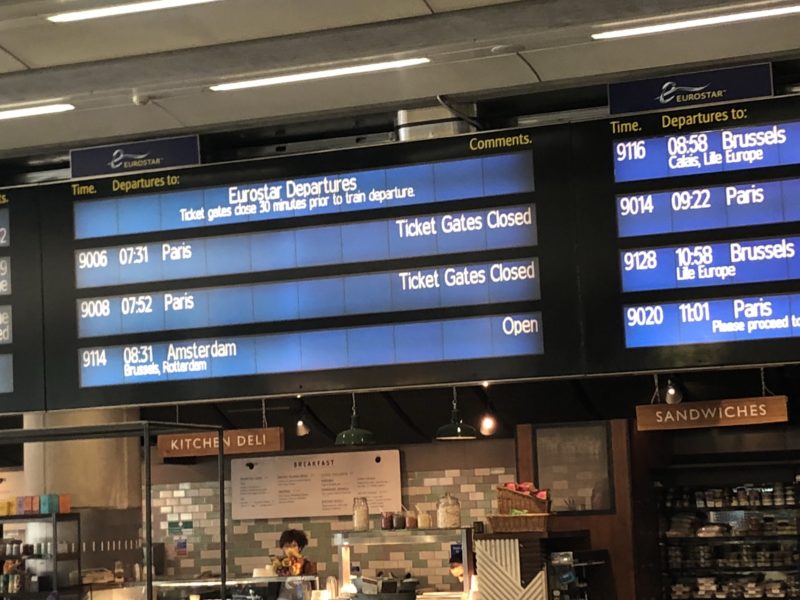
(except that the fellow who designed the surrounds for the display apparently wasn't told so yes the train number is in the "time" column)

 

Bletchleyite

Veteran Member
Joined
20 Oct 2014
Messages
113,765
Location
"Marston Vale mafia"
They are still displayed on Voyagers:

Euston_station_MMB_81_221109.jpg


Pendolinos also have a field for that, but they display VT followed by the actual headcode. I wonder if that difference is because the Pendolino can display letters in that field but the Voyager not.

On the old Virgin setup, the first number was a route code, so VT4xxx was the Chester/North Wales services, for example.
 

ainsworth74

Forum Staff
Staff Member
Global Moderator
Joined
16 Nov 2009
Messages
31,128
Location
Redcar
As an example of how train numbers are used in Germany:

Departure boards in the main concourses show trains in chronological order with a listing of the departure time, train category and number, major intermediate stations, destination, and platform. In this specific example, the InterCity Express (ICE) trains have train numbers that are unique to that service on that day, while the Regional (RB) and Regional Express (RE) services show route numbers instead of train numbers (which do exist, but are usually only seen on itineraries).

(Not seen in this photograph are many other categories of train that get unique numbers, but they include InterCity (IC), EuroCity (EC), Railjet (RJ), Nightjet (NJ), Eurostar (EST), Thalys (THA), etc etc, and the other categories that get route numbers, such as S-Bahn (S))

On platforms, the displays again show the departure time, the train number, major calling points, and destination, and also a depiction of the train formation aligned to the platform sectors.


On most long-distance trains external displays are provided, usually on or near at least one of the entry doors on each side of each car, that show the train number, car number (as numbers are used, instead of letters as in the UK), origin station, all intermediate stations, and the destination station.


The same information is repeated on the in-car displays.


Personally I find this to be very helpful when travelling - both long-distance, where they function similar to flight numbers, and on regional and S-/U-Bahn services where the route number functions much the same as it does on a bus service.

Thank you for that and hopefully will be useful for those who haven't seen the kind of displays that those of us who are in favour of train numbers are referring to! Also reminds of another thing I would like to import, using pictograms to show where trains stop on platforms and where key services on the train are located in relation to the platform. We seem to have a half hearted effort with pictograms now appearing on some routes and platform zones also being referred to in text form on CIS screens but the two could do with merging and rolling out to cover all trains that call at a station rather than just the lead operator (mostly).
 

markymark2000

On Moderation
Joined
11 May 2015
Messages
5,126
Location
Great Britain
As an example of how train numbers are used in Germany:

Departure boards in the main concourses show trains in chronological order with a listing of the departure time, train category and number, major intermediate stations, destination, and platform. In this specific example, the InterCity Express (ICE) trains have train numbers that are unique to that service on that day, while the Regional (RB) and Regional Express (RE) services show route numbers instead of train numbers (which do exist, but are usually only seen on itineraries).

(Not seen in this photograph are many other categories of train that get unique numbers, but they include InterCity (IC), EuroCity (EC), Railjet (RJ), Nightjet (NJ), Eurostar (EST), Thalys (THA), etc etc, and the other categories that get route numbers, such as S-Bahn (S))

On platforms, the displays again show the departure time, the train number, major calling points, and destination, and also a depiction of the train formation aligned to the platform sectors.


On most long-distance trains external displays are provided, usually on or near at least one of the entry doors on each side of each car, that show the train number, car number (as numbers are used, instead of letters as in the UK), origin station, all intermediate stations, and the destination station.


The same information is repeated on the in-car displays.


Personally I find this to be very helpful when travelling - both long-distance, where they function similar to flight numbers, and on regional and S-/U-Bahn services where the route number functions much the same as it does on a bus service.

I will say that in any hypothetical implementation in the UK the "headcode" (really the train reporting number) is not the identifier that should be used, given that their primary purpose is in signalling, but the concept of using a suitable unique identifier is sound and shouldn't be dismissed.

And you can't call it a dirty foreign habit that should never be allowed to touch British shores because it's already sort-of done at St Pancras for Eurostar services:

(except that the fellow who designed the surrounds for the display apparently wasn't told so yes the train number is in the "time" column)
I think for me, they looks good but I get the feeling that changing the boards to suit this would mean we would need a lot of new station boards buying which would be costly. The boards also look much bigger so you may even need to adapt stations to accommodate the increased size. It looks like less stations are shown on the boards so whereas at Liverpool Lime Street you have 10 boards showing you the next trains and showing all the stations, instead you have to know the train number for secondary stops so while you help 1 set of people (people who know and link stations by the train number), you negatively impact another set of people (occasional travellers to whom codes mean nothing and they just want to see the 07:30 goes to their station. Keeping with Liverpool Lime Street, the CLC stopper has different stops each hour if it doesn't list each stop, how do you know if that train stops at Trafford Park? How many codes would you need seeing as all stopping services can have a lot of varying service stopping patterns.

I think inside trains it wouldn't be as useful since you are already on the train, any issues affecting that train should be announced.

Exterior of the train, I think possibly is good on the Voyagers and Pendolinos and that would work if it was made into the headcode but my worry is making it more mainstream and putting it on more customer facing displays could be costly and you will end up helping some and making it worse for others so in the end, you have spent a lot of money and end up coming out the same or worse off (as i get the feeling regular passengers are those who would end up confused while helping irregular international travellers)
 

py_megapixel

Established Member
Joined
5 Nov 2018
Messages
7,518
Location
Northern England
I don't understand the argument that this would cause confusion for passengers. The rest of Europe copes fine with it, as does the airline industry!

Headcodes aren't really suitable for this purpose, however, due to the lack of indication of TOC as well as the fact that multiple services can exist in a day with the same headcode. The RSID (Retail Service Identifier) - which presumably is designed specifically for this purpose - would do much better in my opinion.
 

markymark2000

On Moderation
Joined
11 May 2015
Messages
5,126
Location
Great Britain
I don't understand the argument that this would cause confusion for passengers. The rest of Europe copes fine with it, as does the airline industry!

Headcodes aren't really suitable for this purpose, however, due to the lack of indication of TOC as well as the fact that multiple services can exist in a day with the same headcode. The RSID (Retail Service Identifier) - which presumably is designed specifically for this purpose - would do much better in my opinion.
How often does it occur for multiple trains with the same headcode pass through a station in a given day? I know over the network, there may be duplicate headcodes but headcodes I feel are simpler as they are only 4 characters so easier to cross check.

Airports use the flight numbers because generally you can have a lot of planes leaving at the same time to the same place and each one is non stop so if Easyjet and Ryanair leave at 06:30 to go to Stansted, people may end up at the wrong area or on the wrong plane. It's also more needed for security and baggage purposes so when you take into account the amount of times that the flight number is used for operational purposes, it makes sense.
International trains use it ok great but that doesn't mean we have to as well. Other countries drive on the other side of the road, doesn't mean we should go out tomorrow change how we do things. The way the UK has done things for years is quite ingrained and I am not generally against change but I do think it would cost us a lot of money to implement on an scale seen internationally and it adds to the complexity of using the railway network (more codes and things for people to remember. They railways already overfill people with information, the more information you give people, the more confused they get. Lots of cost and by the time you have pushed people away from the network, those who are helped will end up being in no better or worse off the but the costs will be so high, it would be a wasted effort.
 
Status
Not open for further replies.

Top