
• Our new ticketing site is now live! Using either this or the original site (both powered by TrainSplit) helps support the running of the forum with every ticket purchase! Find out more and ask any questions/give us feedback in this thread!

Train Describer message "LBSP" what does it mean? - BML disruption 04/03

Status
Not open for further replies.

Vexed

Member
Joined
12 Jan 2020
Messages
659
Location
Herts / Hants
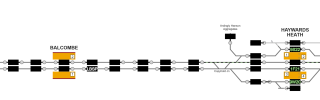
Currently (1100) just south of Balcombe one of the berths says LBSP on the up line. I understand there is a track circuit failure on the Balcombe viaduct and 9W20 and 1F21 are being held at Haywards Heath (HHE) so the LB part is almost certainly Line Block.

So that leaves the question what does SP stand for? My best guess is Line Block for S&T Protection.

Update at 1120: it looks like the bi-di running is being used on the down line! I have a vague recollection of reading somewhere it was out of use but maybe that was just south of HHE.

Update at 1150: LBSP is gone and things are moving on the up and down lines now
 

Attachments
  • msedge_8V1kVOeOHC.png
    msedge_8V1kVOeOHC.png
    89.4 KB · Views: 105
Last edited:
Sponsor Post - registered members do not see these adverts; click here to register, or click here to log in
R

RailUK Forums

swt_passenger

Veteran Member
Joined
7 Apr 2010
Messages
34,276
Currently (1100) just south of Balcombe one of the berths says LBSP on the up line. I understand there is a track circuit failure on the Balcombe viaduct and 9W20 and 1F21 are being held at Haywards Heath (HHE) so the LB part is almost certainly Line Block.

So that leaves the question what does SP stand for? My best guess is Line Block for S&T Protection.

Update at 1120: it looks like the bi-di running is being used on the down line! I have a vague recollection of reading somewhere it was out of use but maybe that was just south of HHE.

Update at 1150: LBSP is gone and things are moving on the up and down lines now
These sort of codes are not really centrally defined, and can often just be the particular signaller’s preferred shorthand. Your reasoning is as good as any.
 

JN114

Established Member
Joined
28 Jun 2005
Messages
3,529
Signal Protection possibly, but @swt_passenger is right; it’s whatever the signaller wants it to be.

The train describer is essentially the signaller’s whiteboard. Descriptions usually move around automatically, and can be automatically input from timetables on newer installations, but everything else is literally whatever the signaller wants - and only has to make sense to them.
 

Vexed

Member
Joined
12 Jan 2020
Messages
659
Location
Herts / Hants
Thanks for the replies. My mum was caught up in this and was on the last down train before bi di started, with only up trains moving between Haywards Heath and Balcombe Tunnel Jn for about 45 minutes. While I don't won't to wish disruption on anyone, it was nice to see bi di being used live on Traksy instead of me in SimSig!
 

TheBigD

Established Member
Joined
19 Nov 2008
Messages
2,043
In my area various combinations for line bloackages are used, there are no official ones as far as I know.

-LB- = line blockage
LBSP = line blockage signal protection
LB+D = line blockage with detonators
LBDP = line blockage detonator protection

Similar for possessions.

-T3-
POSS
ITEM and then item number in the next berth.

You may also see stuff like...

BLOK = line blocked for whatever reason
BTET = blocked to electric traction
NOGO = usually a siding that's out of use but may be other resons.
FAIL = train failure or equipment failure.
SHUT = line shut.

The 4 characters that bear a resemblance to what you are doing etc etc, are just a visual reminder to the signalman.

No doubt that other ares will use different ones that are familiar to them.
 

Annetts key

Established Member
Joined
13 Feb 2021
Messages
3,810
Location
West is best
-OOU = Out Of Use - usually for a siding, loop or headshunt that's out of use.
0Z00 = un-described on old Western electromechanical TD, so sometimes used by S&T testing the TD.
TEST = used by S&T testing the TD or sometimes the signaller testing it
* (space * space space) or **** = un-described (where the TD has received a step forward input from the signalling system, but no description was in the previous TD berth, sometimes described as a snowflake).

Please note that various different display systems have been used over the years, hence what is shown on a computer system may not be relevant to why a certain description is/has been used. As not all displays can show all the characters of the alphabet.
 

Bill57p9

Member
Joined
1 Dec 2019
Messages
885
Location
Ayrshire
There used to be a very descriptive "GONE" in Scotland. IIRC it was Longniddry Power Station.

I have seen RUST in a few places. Is that so that signallers can advise the next train to venture there to venture slowly?
 

Sunset route

Established Member
Joined
27 Oct 2015
Messages
1,224
It’s “Line Blockage Signal Protection”, it was being used to protect S&T engineers trying to fix a track circuit failure.
 

zwk500

Veteran Member
Joined
20 Jan 2020
Messages
18,544
Location
Northampton
I have seen RUST in a few places. Is that so that signallers can advise the next train to venture there to venture slowly?
I would interpret that as reminding the signaller to check track circuits work properly.
I interpret rust as a reminder that the Track Cricuits won't work reliably, and therefore that special attention be paid if any train needs to use it. Not unknown in advance of rare freight/railtour movements (or flows starting after some time) for a member of p-way to be sent to the area with some stiff brushes, brillo pads and the like (and a can of oil/grease for any points).
 

Annetts key

Established Member
Joined
13 Feb 2021
Messages
3,810
Location
West is best
I interpret rust as a reminder that the Track Cricuits won't work reliably, and therefore that special attention be paid if any train needs to use it. Not unknown in advance of rare freight/railtour movements (or flows starting after some time) for a member of p-way to be sent to the area with some stiff brushes, brillo pads and the like (and a can of oil/grease for any points).
Rust usually means that the rail head is known to be rusty and that the track circuit(s) will not reliably operate correctly with a train. Hence the signaller will have to carry out the relevant instructions (rules) in order to protect the train (as the track circuit is unable to do so).

And good luck getting the P.Way to do anything. If the line is not used enough, the amount of rust needs either the welders with their rail grinder, a grinding train/machine, or a loaded long heavy freight train running with its brakes partially on.
 
Status
Not open for further replies.

Top