• Our new ticketing site is now live! Using either this or the original site (both powered by TrainSplit) helps support the running of the forum with every ticket purchase! Find out more and ask any questions/give us feedback in this thread!

Towing capabilities of first-generation DMUs

Status
Not open for further replies.

delt1c

Established Member
Joined
4 Apr 2008
Messages
2,182
The 120's on the Aberdeen Inverness service in the 70's regularly had 1 or 2 fish vans in tow, also some DMBC's had the 2nd class area converted to DMBF to accomodiate additional fish traffic .
 
Sponsor Post - registered members do not see these adverts; click here to register, or click here to log in
R

RailUK Forums

The exile

Established Member
Joined
31 Mar 2010
Messages
9,451
Location
Somerset
The 120's on the Aberdeen Inverness service in the 70's regularly had 1 or 2 fish vans in tow, also some DMBC's had the 2nd class area converted to DMBF to accomodiate additional fish traffic .
Sure that delighted the first class passengers!
 

davetheguard

Established Member
Joined
10 Apr 2013
Messages
1,939
I remember in the late 70s & early 80s an 00.14 Reading -bay platform 7 which no longer exists- to Birmingham 3 car DMU (2 power cars with one trailer car in the middle as usual) being booked to haul a parcels van on the back (GUV General Utility Van or similar). The train connected out of the 23.40 HST from Paddington, and called at all stations to Oxford.

A DMU also hauled an early morning (about 04.30ish) Newspaper van from Reading to Newbury (which was detatched at Reading from a loco-hauled Newspaper train from Paddington). The Newspaper van was detached in the down side platform at Newbury, the DMU ran round it using the centre down through track, and after the van was emptied of newspapers, it was shunted to the up bay platform. The DMU later continued empty stock fron Newbury to Bedwyn to form the first up passenger train from there.

I also remember travelling overnight twice from London via Crewe and changing for the overnight York to Shrewsbury TPO travelling post office that also carried passengers. This connected with an early morning DMU from Shrewsbury to Aberystwyth which also conveyed a van off the TPO. The train connected at Machynlleth for the first down Cambrian Coast train of the day which was my destination on both occasions.
 
Last edited:

eastwestdivide

Established Member
Joined
17 Aug 2009
Messages
3,417
Location
S Yorks, usually
Dab Mullet Bream Flounder
Ah, my miskate.

I think I recall some drawing up somewhere between St Pancras-Leicester back in around 1980. Would that be right? Maybe on the Derby stopper (9 Mk1s) at somewhere like St Albans or Market Harborough??
Sorry, thought I was in another thread!
 
Last edited:

Undaunted

Member
Joined
3 Aug 2022
Messages
82
Location
Wessex
IIRC the Western had driving trailers specifically for use with the Bubble cars
One instance of the use of a bubble car plus driving trailer in the mid-1980s was on the Oxford-Banbury shuttle on Saturday afternoons. The drivers hated it, citing its significant impact on performance, and one or two of them would quietly ask for it to be removed after the first round trip.
 

Taunton

Veteran Member
Joined
1 Aug 2013
Messages
12,313
One instance of the use of a bubble car plus driving trailer in the mid-1980s was on the Oxford-Banbury shuttle on Saturday afternoons. The drivers hated it, citing its significant impact on performance, and one or two of them would quietly ask for it to be removed after the first round trip.
A 150hp heavyweight power car, as all the Western Region cars were, plus a heavyweight trailer, was the worst power/weight ratio of all. All standard units of this style with equal numbers of power cars and trailers had 230hp engines. The original 500xx Class 114 2-car sets used in Lincolnshire originally had 150hp engines, but were replaced. The Western Region went for 3-car sets, with two of the three powered. Although there were the driving trailers built for the single cars, I never saw one in use, and they were withdrawn early.
 

Gloster

Veteran Member
Joined
4 Sep 2020
Messages
13,036
Location
Up the creek
A 150hp heavyweight power car, as all the Western Region cars were, plus a heavyweight trailer, was the worst power/weight ratio of all. All standard units of this style with equal numbers of power cars and trailers had 230hp engines. The original 500xx Class 114 2-car sets used in Lincolnshire originally had 150hp engines, but were replaced. The Western Region went for 3-car sets, with two of the three powered. Although there were the driving trailers built for the single cars, I never saw one in use, and they were withdrawn early.

I think that the single cars’ Driving Trailers were from the mid-1970s into the 1980s mostly used on the Thames Valley branches or as strengtheners on London-Reading services. The Class 121 trailers were Composites, so making them rather more useful.
 

Gloster

Veteran Member
Joined
4 Sep 2020
Messages
13,036
Location
Up the creek
were any of the 4-wheel railbuses capable of hauling a trailing load?

If you mean the 1950s design ones, the answer seems to be no. Only the Waggon & Maschinenbau vehicles had couplings and buffing gear and it seems that they didn’t normally, if ever, do so. Road vehicles had to be used to carry parcels, etc., which bit into the economies.
 

Sprinter107

Member
Joined
26 Mar 2019
Messages
1,098
T
A 150hp heavyweight power car, as all the Western Region cars were, plus a heavyweight trailer, was the worst power/weight ratio of all. All standard units of this style with equal numbers of power cars and trailers had 230hp engines. The original 500xx Class 114 2-car sets used in Lincolnshire originally had 150hp engines, but were replaced. The Western Region went for 3-car sets, with two of the three powered. Although there were the driving trailers built for the single cars, I never saw one in use, and they were withdrawn early.
The driving trailers for the 121 cars were not withdrawn early. They lasted well into the NSE era, and were refurbished. The driving trailers for the 122s however didn't seem to last in passenger service as long. I never saw one of those in use.
 

Taunton

Veteran Member
Joined
1 Aug 2013
Messages
12,313
The WR 'bubble cars' did have guards and luggage van provision, which overcame some of the issues that the lack of these had on the GWR streamlined single cars. Despite by definition being intended for services with light demand they were then fitted out with high density suburban seating, because otherwise it was doubtless felt there would just not have been enough seats in the car, which was ironic on services like the Bridport branch, where many of the journeys had a single-digit load. In the event a good number of them appear to have been employed just as additional cars, or substitutes for one of the cars in a mainstream formation, on suburban services.
 

Merle Haggard

Established Member
Joined
20 Oct 2019
Messages
3,989
Location
Northampton
In early 1971, (?) I saw a former W.R. single car at Inverness with the seats removed and used as a parcels car. It might be a candidate for having been used to haul a trailing load - for example a CCT.
It sticks in my mind because I was in a sleeping car running into Inverness when it was being driven alongside at exactly the same speed. The line it was on converged with ours so I was surprised that it continued exactly alongside us. Its driver passed a signal at danger and the car ran through traps and onto the ballast alongside us, bouncing up and down and finally slowing down. Took me a while to work out the cause of the driver's inattention (and it wasn't me, I'm sure :) )
 

Harpo

Established Member
Joined
21 Aug 2024
Messages
3,911
Location
Newport
an early morning DMU from Shrewsbury to Aberystwyth which also conveyed a van off the TPO.
On Cambrian matters, in the period that Barmouth bridge was barred to locos, DMUs (parcel units?) were used as locos for ballast wagon movements.

More generally, I believe the first Exeter to Barnstaple unit each morning had a van in tow. Presumably papers?
 

davetheguard

Established Member
Joined
10 Apr 2013
Messages
1,939
I think that the single cars’ Driving Trailers were from the mid-1970s into the 1980s mostly used on the Thames Valley branches

The driving trailers for the 121 cars were not withdrawn early. They lasted well into the NSE era, and were refurbished.

A bubble car (class 121) coupled to a driving trailer was the normal provision on the Slough to Windsor branch for example.
 

Gloster

Veteran Member
Joined
4 Sep 2020
Messages
13,036
Location
Up the creek
In early 1971, (?) I saw a former W.R. single car at Inverness with the seats removed and used as a parcels car. It might be a candidate for having been used to haul a trailing load - for example a CCT.
It sticks in my mind because I was in a sleeping car running into Inverness when it was being driven alongside at exactly the same speed. The line it was on converged with ours so I was surprised that it continued exactly alongside us. Its driver passed a signal at danger and the car ran through traps and onto the ballast alongside us, bouncing up and down and finally slowing down. Took me a while to work out the cause of the driver's inattention (and it wasn't me, I'm sure :) )

A couple of 121 spent some time at Inverness to act as emergency cover in case a 120 was short of a power vehicle, the fleet of 120s or Aberdeen-Inverness services not being particularly large. This was even before the Oyne derailment knocked a power car and intermediate out.

More generally, I believe the first Exeter to Barnstaple unit each morning had a van in tow. Presumably papers?

In the early 1980s the 04.05 Exeter-Barnstaple was a three-car DMU with a GUV tied on the back for the newspapers. This was the GUV that is often seen in photos sitting in the middle-road at Barnstaple.
 

Harpo

Established Member
Joined
21 Aug 2024
Messages
3,911
Location
Newport
A bubble car (class 121) coupled to a driving trailer was the normal provision on the Slough to Windsor branch for example.
In WR terminology it was SPU & DET.

I remember a control log that reckoned a brake problem on the SPU caused it to be left at Slough and the remainder of the service operated by just the DET! (Obviously the other way around.)
 

matchmaker

Established Member
Joined
8 Mar 2009
Messages
1,884
Location
Central Scotland
Two types of dmu car, lightweight (short, aluminium body) and heavyweight (long, steel body). Some lightweights by independent manufacturers were not so "light". Twin engines 150hp as standard, but various heavyweights had 230hp ones. And different initial formations and combinations of power cars and trailers. So all together you really need to know the power-to-weight ratio of any set first. Then there were the characteristics of the route, whether flat or hilly.


In fact the Western Region 150hp single cars were somewhat used specifically for haulage. The Plymouth to Saltash shuttle used twin sets of such power cars, which towed on several trips a couple of 6-wheeled milk tankers from the Saltash creamery, decidedly heavy when full. The similar parcels cars had 230hp engines, and hauled vans as standard.

The most extreme of this was the Northern Ireland Railway, which had even more powerful 275hp engines in their power cars. These were treated as loose formations, making up sets of these with trailers and standard coaches for each diagram, but they even used two power cars together to haul the remaining nightly freight train from Belfast to Londonderry and back, it just being accepted they were slow (and extremely noisy) on gradients. The transmissions later became unreliable, it was said this arduous duty had really overstressed them.

The attached page from the 1969 Scottish Region SA may be of interest.Tail loads.jpg
 

robert thomas

Member
Joined
2 Jun 2019
Messages
347
Location
Neath
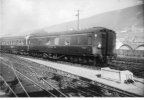
On 28th February 1964 I photographed sleeping car W9083W on the rear of the 2.50pm Swansea-Pembroke Dock leaving Swansea High Street.
 

Attachments

  • XZ14.jpg
    XZ14.jpg
    164.5 KB · Views: 56

davetheguard

Established Member
Joined
10 Apr 2013
Messages
1,939
On 28th February 1964 I photographed sleeping car W9083W on the rear of the 2.50pm Swansea-Pembroke Dock leaving Swansea High Street.

What an interesting photo, presumably there was no one actually in the sleeper as it was mid-afternoon! Unusual hours for the sleeping car attendant if there was.

I wonder what set of circumstances led to this working.

As an aside, I know there was a sleeper from Milford Haven to Paddington at one time (I even caught it once or twice), but was there ever one from Pembroke Dock?
 
Last edited:
Joined
3 Sep 2020
Messages
180
Location
Dublin
On 28th February 1964 I photographed sleeping car W9083W on the rear of the 2.50pm Swansea-Pembroke Dock leaving Swansea High Street.
I remember reading that, in the days of the Milford Haven sleeper, the cars used to be worked back to Swansea in day trains to be serviced. I'm wondering whether this is what was happening here, although I'm not aware of any Pembroke Dock sleeper either. I do know that Carmarthen was the farthest west sleepers went at one stage (that's certainly the case in the 1965 Western Region timetable on Timetable World) and maybe this car was being worked from Swansea to Carmarthen after servicing?
 

Gloster

Veteran Member
Joined
4 Sep 2020
Messages
13,036
Location
Up the creek
As an aside, I know there was a sleeper from Milford Haven to Paddington at one time (I even caught it once or twice), but was there ever one from Pembroke Dock?

There was a Sleeping Car in each direction in 1910, but by the following year the Up one started from Whitland. The service seems to have disappeared with, or even before, the Great War.

Source: The Pembroke and Tenby Railway (M.R.C.Price, Oakwood, 1986).
 

Sir Felix Pole

Established Member
Joined
21 Oct 2012
Messages
2,200
Location
Wilmslow
I remember reading that, in the days of the Milford Haven sleeper, the cars used to be worked back to Swansea in day trains to be serviced. I'm wondering whether this is what was happening here, although I'm not aware of any Pembroke Dock sleeper either. I do know that Carmarthen was the farthest west sleepers went at one stage (that's certainly the case in the 1965 Western Region timetable on Timetable World) and maybe this car was being worked from Swansea to Carmarthen after servicing?

In the 1965 WR timetable on Timetable World there are two Up sleepers from Carmarthen (one via Bristol) to Paddington, but only one Down - presumably this DMU working was to balance out the cars. In the 1965-66 timetable which I have there is an Up from Milford Haven and an Up from Carmarthen (via Bristol) but only a Down to Milford Haven.

There was also Paddington to Fishguard Harbour sleeper and v.v. in the summer months for Irish traffic.
 

Pigeon

Member
Joined
8 Apr 2015
Messages
1,123
I remember a period in the late 70s when the 17:20 SuO WOS-PAD kept being formed of DMUs rather than a hauled set as usual. I think Hereford was failing to provide the stock or locomotive, so they cancelled it between Hereford and Worcester and ran the remaining portion using a bunch of DMUs cobbled together off Worcester shed. Dunno what the problem was at Hereford, but it went on for several weeks like that.

Only someone seemed to have the idea that since the usual stock would be a rake of 10 or more coaches, they had to do their best to match that capacity with the DMU replacement. So we would get a 9-car DMU set droning all the way to Paddington with 2 or maybe 3 people in each vehicle. (And arriving very late.)

My recollection is hazy, but I think I can remember that the cabs had rows of (purple) lights which when lit confirmed engines running, coolant temperature and oil pressure o.k., one row for each power car, and I think only 6; would that not be a limit on the number of power cars?

6 rows of 3 lights, Engine No. 1, Air & Axle, Engine No. 2. "Axle" meaning that the (pneumatically-operated) final drive unit was correctly engaged.

However, although the indications for each power car were separate, the control was common, so it was possible to hook up more than 6 power cars and just do without the indications if you really wanted to. But 6 was (a) all you were ever likely to need and (b) the most you could reliably depend on to all respond to the controls (8 might work, but then again it might not), so 6 was the practical limit.
 
Status
Not open for further replies.

Top