• Our new ticketing site is now live! Using either this or the original site (both powered by TrainSplit) helps support the running of the forum with every ticket purchase! Find out more and ask any questions/give us feedback in this thread!

Tools Van With Crane Derailment 1926

Status
Not open for further replies.

Andy873

Established Member
Joined
23 Mar 2017
Messages
1,411
I came across an article about a derailment of a Tools van with crane which happened Friday 5 Feb 1926 around 6.30pm.

From The Blackburn Times, Saturday 6 February, 1926:

TOOL VAN DERAILMENT AT GREAT HARWOOD JUNCTION. Serious dislocation of railway traffic in East Lancashire was caused last evening by the derailment of a tool van with crane at Great Harwood Junction. The van was being taken from the Accrington line to the Padiham line, when, owing to some defect of some springs, it jumped the metals and fouled both lines between Blackburn and Great Harwood and also the line from Blackburn to Accrington.

Are we talking here about one railway vehicle or two? What's being described here please?
 
Last edited:
Sponsor Post - registered members do not see these adverts; click here to register, or click here to log in
R

RailUK Forums

Gloster

Veteran Member
Joined
4 Sep 2020
Messages
12,982
Location
Up the creek
The term that I have seen is ‘Tool Van’, however different companies had different terms. I suspect that it means a Tool Van that normally runs with the crane, rather than being one that could operate on its own to lesser incidents that didn’t need a crane. Cranes usually had three or four accompanying vehicles, including tool vans.
 

Rescars

Established Member
Joined
25 May 2021
Messages
2,545
Location
Surrey
As Gloster implies, "crane with tool van" would probably have been a better description. The crane was the star of the show. Most cranes of any size would have had a bolster wagon permanently attached as a runner on which to rest the jib of the crane. Frequently a tool van would have been attached as well - as part of the chorus line!

A derailed crane would have been a real nuisance. They were heavy things, so would need some serious lifting to get it back on track. This would no doubt have involved a second crane being summoned, inevitably from some distance away, so incurring further delays. If something other than the crane itself derailed, then everything would have been on hand to initiate immediate self-help. For the derailment to happen where it did and block the junction would only have compounded the agonies. Nice little earner when it came to overtime though?!
 

Taunton

Veteran Member
Joined
1 Aug 2013
Messages
12,277
A derailed crane would have been a real nuisance. They were heavy things, so would need some serious lifting to get it back on track. This would no doubt have involved a second crane being summoned, inevitably from some distance away, so incurring further delays. If something other than the crane itself derailed, then everything would have been on hand to initiate immediate self-help
The USA Trains magazine a while ago had a photograph of a heavy crane's tool van (actually a "Tool Car" there, of course), which has nosed down into a turntable pit, other end high in the air, with its crane most fortunately right behind, provided of course that the necessary tools could be extracted! None of the locomotives on the various turntable stub tracks were going anywhere until it was recovered. It was titled "Physician heal thyself", from the Biblical expression.
 

Merle Haggard

Established Member
Joined
20 Oct 2019
Messages
3,918
Location
Northampton
Might be worth pointing out that only the most important sheds had cranes, others having only tool vans. However, most derailments could be recovered without a crane, using re-railers or timber found nearby for wagons and coaches; locos might also require jacks.
 

AndrewE

Established Member
Joined
9 Nov 2015
Messages
7,341
was there ever a prototype of this? (It fits the description!)
crane-van.jpg
 

Acathater

Member
Joined
11 Dec 2025
Messages
712
Location
NorthWest
With a lift of only 10 tons that's some kind of yard crane bolted to a wagon. A breakdown crane is going to have a lift of 75 tons or more
 

Taunton

Veteran Member
Joined
1 Aug 2013
Messages
12,277
With a lift of only 10 tons that's some kind of yard crane bolted to a wagon. A breakdown crane is going to have a lift of 75 tons or more
The majority of crane callouts were to simple derailments of wagons, or even trees across the line, for which the lesser capacity is quite sufficient. Major locomotive derailments are unusual in comparison. Even for the big cranes, much of their work was actually preplanned, for the civil engineering department, lifting in bridge decks etc.
 

Pigeon

Member
Joined
8 Apr 2015
Messages
1,123
A lot of pictures I've seen of locomotive derailments show them using 2 cranes neither of which has the capacity to lift the loco on its own. Big cranes are awkward things both to haul and to use - heavy, and too much concentrated load. Also the stability of the crane is greater with an end lift rather than a side one.
 

Andy873

Established Member
Joined
23 Mar 2017
Messages
1,411
The majority of crane callouts were to simple derailments of wagons, or even trees across the line, for which the lesser capacity is quite sufficient. Major locomotive derailments are unusual in comparison. Even for the big cranes, much of their work was actually preplanned, for the civil engineering department, lifting in bridge decks etc.
Clearly there was some need of a crane at this location, whatever that was.

One possible theory, Whitebirk Drive, Blackburn's northern arterial road was being built around the mid 1920s. There were three obstacles to overcome, the Leeds and Liverpool canal, a new road over bridge to cross this was needed, finished towards the end of 1925. The East Lancs main line, for this the road went through its embankment requiring a new rail bridge, and finally another road over bridge to cross the loop line. Perhaps the crane was needed to lift parts of this road bridge? just a theory, perhaps the reason was just something more routine.

Speaking of bridges, are we allowed on here to link to a facebook page? I've come across a superb colour photo taken probably in 1964 of two bridges I knew about them but I had never seen them.
 

AndrewE

Established Member
Joined
9 Nov 2015
Messages
7,341
Clearly there was some need of a crane at this location, whatever that was.
I have read a book by a railway breakdown crane operator, I think his "day job" was in Stratford works or somewhere similar... It seems that they were out with their crane to various East London marshalling yards on an almost daily basis as wagons were being derailed during shunting. So frequently in fact that it made me wonder whether perhaps the shunters got a kickback from the breakdown gang out of their callout bonuses!
 

Rescars

Established Member
Joined
25 May 2021
Messages
2,545
Location
Surrey
Clearly there was some need of a crane at this location, whatever that was.

One possible theory, Whitebirk Drive, Blackburn's northern arterial road was being built around the mid 1920s. There were three obstacles to overcome, the Leeds and Liverpool canal, a new road over bridge to cross this was needed, finished towards the end of 1925. The East Lancs main line, for this the road went through its embankment requiring a new rail bridge, and finally another road over bridge to cross the loop line. Perhaps the crane was needed to lift parts of this road bridge? just a theory, perhaps the reason was just something more routine.

As a more exciting explanation, if it transpired that the crane was being worked as a Class A express passenger train with the loco carrying an express passenger headcode, then we could assume that the crane was a "breakdown crane going to clear the line".
 

Big Jumby 74

Established Member
Joined
12 Feb 2022
Messages
2,243
Location
UK
Cranes usually had three or four accompanying vehicles, including tool vans.
Have just dug out my old (unofficial) note books I kept from back in the day, and at my old location we quite often assisted the passage of the Stewarts Lane 'crane & tool vans' on its way out or back home. Never took any pics of it though, so rely on Paul Bartlett's site for that.
 

Taunton

Veteran Member
Joined
1 Aug 2013
Messages
12,277
I have read a book by a railway breakdown crane operator, I think his "day job" was in Stratford works or somewhere similar...
It was normal for the crew to be those from the shed (or works) mechanical maintenance team, for they most likely included, on each shift, those who had done mechanics etc at technical college, and thus understood crane angles and such like. It was also usual for the overall crane rig to be on a siding at the shed, where a sudden requirement for a locomotive could be most readily obtained.

The Taunton crew had a real challenge with the first GWR streamlined railcar, which broke down at (I think) Martock, on the single line to Yeovil, with a jammed gearbox. These first railcars had no buffers or drawgear, and now it had no means to move itself, so when they turned up with the breakdown vans and a pannier tank ingenuity was the order of the day - not for the first time for them, of course. Spanners and steel cables at least were plentiful in the vans.
 

Merle Haggard

Established Member
Joined
20 Oct 2019
Messages
3,918
Location
Northampton
I have read a book by a railway breakdown crane operator, I think his "day job" was in Stratford works or somewhere similar... It seems that they were out with their crane to various East London marshalling yards on an almost daily basis as wagons were being derailed during shunting. So frequently in fact that it made me wonder whether perhaps the shunters got a kickback from the breakdown gang out of their callout bonuses!

Certainly at ex-LNWR locations - sidings and yards - where wagon derailments were likely there was a large sign with the word 'RAMPS' on, to show where re-railing ramps were kept. Wagons on the floor routinely rerailed by local staff using the Jocko (shunt loco.).

Crews accompanying breakdown cranes were usually fitting staff on bonus & overtime. Just wonder if there was some reason Stratford breakdown crane often went out to minor derailments. Can't think why...
 

Big Jumby 74

Established Member
Joined
12 Feb 2022
Messages
2,243
Location
UK
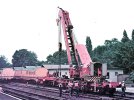
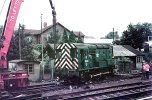
A couple of grainy pics of mine (my regular SLR camera was away for repairs at the time, so made do with a cheapy stand-in). East Wimbledon's ADRC 96201 attending '350' 09012, which had come a cropper at the London end parcel dock at Woking. August 1984. Associated tool van/staff mess vehicles to the left.
 

Attachments

  • BJ-Wimbledon crane ADRC 96201. Woking(1).jpg
    BJ-Wimbledon crane ADRC 96201. Woking(1).jpg
    197.7 KB · Views: 34
  • BJ-Wimbledon crane ADRC 96201. Woking(2).jpg
    BJ-Wimbledon crane ADRC 96201. Woking(2).jpg
    558.1 KB · Views: 34
Last edited:
Status
Not open for further replies.

Top