
• Our new ticketing site is now live! Using either this or the original site (both powered by TrainSplit) helps support the running of the forum with every ticket purchase! Find out more and ask any questions/give us feedback in this thread!

TOC Payments in 2024-25

Status
Not open for further replies.

Nicholas Lewis

Established Member
Joined
9 Aug 2019
Messages
8,005
Location
Surrey
Hidden amongst the DfTs 2024-25 annual report and accounts of 386 pages in note 27 is the payments made to TOC across this financial year.

27. Entities controlled but not consolidated: Train Operating Companies for which no investment is recognised in the Statement of Financial Position
Within these financial statements, the costs of subsidising passenger rail services have been recognised as expenditure, following the accounting policy disclosed in Note 1.22.


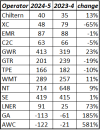
I've translated these into the table below.

1753630090432.png

The report provides no interpretation of the data and its difficult to reconcile some of the operator changes. Most have shown a modest reduction in "subsidy" as to be expected as ridership has recovered with Greater Anglia and Avanti West Coast showing considerable increase in payments to DfT. LNER appears to have lost its status post the covid rebound but GWR is the biggest outlier on subsidy increase. Perhaps when the operating companies release their formal annual report to companies house we get a better insight.
 

Attachments

  • 1753629915125.png
    1753629915125.png
    15.2 KB · Views: 99
Sponsor Post - registered members do not see these adverts; click here to register, or click here to log in
R

RailUK Forums

Class 170101

On Moderation
Joined
1 Mar 2014
Messages
8,661
Not really sure what the data shows but can it be understood that XC have reduced their subsidy requirement by between a third and a half?
 

YorkshireBear

Established Member
Joined
23 Jul 2010
Messages
9,666
Hidden amongst the DfTs 2024-25 annual report and accounts of 386 pages in note 27 is the payments made to TOC across this financial year.


I've translated these into the table below.

View attachment 184975

The report provides no interpretation of the data and its difficult to reconcile some of the operator changes. Most have shown a modest reduction in "subsidy" as to be expected as ridership has recovered with Greater Anglia and Avanti West Coast showing considerable increase in payments to DfT. LNER appears to have lost its status post the covid rebound but GWR is the biggest outlier on subsidy increase. Perhaps when the operating companies release their formal annual report to companies house we get a better insight.
I wonder what is driving the LNER increase. That seems odd considering their post COVID success and lack of any major issues (such as staffing) affecting them. GA phenomenal, be interesting to see what nationalisation does to that.
 

zwk500

Veteran Member
Joined
20 Jan 2020
Messages
18,522
Location
Northampton
It's worth noting that the actual headings are 'Departmental expenditure on ERMA/NRC' and the note quoted about subsidy recognised as expenditure indicates that this includes *All* DfT spending on a franchise, including capex/RDL for enhancements, as well as the day-to-day operating subsidy.

Without further figures being broken down (e.g. By the ORR) it's not possible to say for sure exactly what is and isn't included in that headline number.
 

London Trains

Established Member
Joined
9 Oct 2017
Messages
1,220
No, it shows northern fares are far to cheap to cover the costs if running a service!
If fares increased, people would be driven away from the railway and the amount of subsidy needed would end up increasing.

What needs to happen across the country is for improvements to be made and fares decreased to attract more people onto the railways - in the very short term more subsidy would be needed to make the improvements, but in the long term you would end up needing much less subsidy than now.
 

Moonshot

Established Member
Joined
10 Nov 2013
Messages
3,806
If fares increased, people would be driven away from the railway and the amount of subsidy needed would end up increasing.

What needs to happen across the country is for improvements to be made and fares decreased to attract more people onto the railways - in the very short term more subsidy would be needed to make the improvements, but in the long term you would end up needing much less subsidy than now.
Absolute garbage......fares have increased every year .....and up to the point of COVID happening, passenger numbers were also increasing. Pax numbers are on the rebound since COVID.... though that's not uniform across the board.
 

London Trains

Established Member
Joined
9 Oct 2017
Messages
1,220
Absolute garbage......fares have increased every year .....and up to the point of COVID happening, passenger numbers were also increasing. Pax numbers are on the rebound since COVID.... though that's not uniform across the board.
I'm talking about significant fare increases as was being suggested by saying fares are too cheap, not the standard yearly fare increases that are sort of in line with inflation. And my point was saying that the only way to get significant increases on pre-Covid passenger numbers is to make improvements to the railways (the Elizabeth Line being a case in point), especially given we should be trying to get people out of their cars and onto sustainable modes of transport.

No need to be rude either way.
 

43066

Veteran Member
Joined
24 Nov 2019
Messages
12,089
Location
London
If fares increased, people would be driven away from the railway and the amount of subsidy needed would end up increasing.

What needs to happen across the country is for improvements to be made and fares decreased to attract more people onto the railways - in the very short term more subsidy would be needed to make the improvements, but in the long term you would end up needing much less subsidy than now.

I’m just not sure this analysis is correct. Yes there would be a point where fare increases would reduce passenger numbers, but it’s not clear that we are anywhere near that now. Clearly some people are priced off, and will drive or use other transport methods, but others who are willing and able to pay will take their place. We have seen this on the WCML and ECML where capacity has risen and passenger numbers have hugely increased despite fares increasing. This shouldn’t be any surprise as the railway has always been used by the more affluent.

Fares have generally increased based on the higher RPI measure rather than CPI for many years now, passenger numbers have also risen, but subsidy hasn’t reduced. So it’s pretty clear in the current climate that the DfT aren’t going to want to take any action that further increases subsidy, even in the short term, and the temptation will be to increase fares further. Indeed this year fares have risen above RPI for only the second time since 2013.

Improvements like the Elizabeth Line are excellent, but take many, many years to come to fruition and have a nasty habit of going over budget.
 

swt_passenger

Veteran Member
Joined
7 Apr 2010
Messages
34,270
Are a few of the percentages in the table quite wrong?

Eg XC should be -39%, LNER 264%, GA 85%, AWC 480% - but I haven’t checked them all.

Also, are there no figures for SWR?
 
Last edited:

styles

Established Member
Joined
7 Dec 2014
Messages
4,745
Location
Gwynedd
Pretty minor but would %increase rather than %change make a bit more sense?

GA/AWC have clearly dropped massively but their %change appears positive.
 

ScotGG

Established Member
Joined
3 Apr 2013
Messages
1,585
SE due to very high track access charges from HS1? A noose around the rest of the network. Hopefully now track access fees are reducing that will go down. SE has such potential within London and growth areas in Kent away from HS1 but can't embrace them due to HS1 being a money sink. If HS1 was independent it'd be a different story.
 

godfreycomplex

Established Member
Joined
23 Jun 2016
Messages
1,751
SE due to very high track access charges from HS1? A noose around the rest of the network. Hopefully now track access fees are reducing that will go down. SE has such potential within London and growth areas in Kent away from HS1 but can't embrace them due to HS1 being a money sink. If HS1 was independent it'd be a different story.
There is a bit of that but let's not forget SE actually bears closer resemblance to Northern/TfW throughout most of its (quite rural) network - just with much longer trains
 

JamesT

Established Member
Joined
25 Feb 2015
Messages
4,851
Are a few of the percentages in the table quite wrong?

Eg XC should be -39%, LNER 264%, GA 85%, AWC 480% - but I haven’t checked them all.

Also, are there no figures for SWR?
It looks like the original poster has divided the wrong way round, e.g. XC's 2023/24 figure of £79m is 165% of 2024/25's £48m. But the change is going the other way where 2024/25 is 61% of the previous year, which is a 39% decrease as you note.
The original document has the figures on pages 336 and 337. SWR went from £162m subsidy to £121m.
 

The exile

Established Member
Joined
31 Mar 2010
Messages
9,361
Location
Somerset
It looks like the original poster has divided the wrong way round, e.g. XC's 2023/24 figure of £79m is 165% of 2024/25's £48m. But the change is going the other way where 2024/25 is 61% of the previous year, which is a 39% decrease as you note.
The original document has the figures on pages 336 and 337. SWR went from £162m subsidy to £121m.
It’s strange - some of the % figures are correct; others wildly out.
 

Clarence Yard

Established Member
Joined
18 Dec 2014
Messages
3,266
The 2023/4 figures seem to be at variance with the figures supplied to the ORR for their table 7226. The 2024/5 figures have yet to appear on table 7226.

When doing any year on year comparison, the key thing to remember what Fixed Track Access does between those years on a TOC by TOC basis. That is made worse by 2023/4 being the last year of CP6 and 2024/5 being the first year of CP7 so there will be significant differences in the subsidy/premium line for this item alone.

As FTA is effectively another form of Network Grant, normalising the subsidy/premium line to exclude FTA gives you a better comparison when it comes to analysing table 7226 figures.
 

Class 170101

On Moderation
Joined
1 Mar 2014
Messages
8,661
Did any operators actually make money / hand money back to the DfT once NR costs are included?
 

DarloRich

Veteran Member
Joined
12 Oct 2010
Messages
32,909
Location
Fenny Stratford
I'm talking about significant fare increases as was being suggested by saying fares are too cheap, not the standard yearly fare increases that are sort of in line with inflation
Fenny Stratford > Milton Keynes return 0800/1700: £9.30 (4 miles 10 chain)

Woodlesford > Leeds return 0800/1700: £5.30 (5miles 76 chain)

It is even the same train type for some of the journey!
 

setdown

Member
Joined
5 Jan 2016
Messages
329
Does it really matter? Trains will still run whatever.
Trains will still run, but the healthier the finances, the better things can be. SWR are still running their Class 444s... but in my experience they're often running around with the aircon systems blowing hot air, window glazing blown, graffiti down the side, and even starting to sit down for a few minutes at stations here and there due to faults.

Healthier financial performance might well help with budget for those things "around the edges".
 

43066

Veteran Member
Joined
24 Nov 2019
Messages
12,089
Location
London
SE due to very high track access charges from HS1? A noose around the rest of the network. Hopefully now track access fees are reducing that will go down. SE has such potential within London and growth areas in Kent away from HS1 but can't embrace them due to HS1 being a money sink. If HS1 was independent it'd be a different story.

I’m not sure any of this follows? SE’s HS1 services are well patronised, and the limitation there is stock rather than willingness to operate on HS1. In terms of the classic network, what potential is SE missing out on (metro is almost back up to pre Covid levels of service) and how do you know that’s due to HS1 track access charges?

It’s all largely wooden money anyway as access to HS1, including track access charges, is regulated by the ORR.
 

43066

Veteran Member
Joined
24 Nov 2019
Messages
12,089
Location
London
I assume that's tongue in cheek, otherwise it's an incredibly naive statement.

In fairness @dk1 is drawing from decades of experience, including working under BR, privatisation, Covid and now re nationalisation to make that statement.

I think it’s 100% accurate!
 

dk1

Veteran Member
Joined
2 Oct 2009
Messages
19,851
Location
East Anglia
I assume that's tongue in cheek, otherwise it's an incredibly naive statement.
No, not at all. Been employed on and interested in rail for over 40 years. Been so many ups & downs and yet they always carry on. Cant see that changing personally.
 

Krokodil

Established Member
Joined
23 Jan 2023
Messages
6,552
Location
Wales
I’m just not sure this analysis is correct. Yes there would be a point where fare increases would reduce passenger numbers, but it’s not clear that we are anywhere near that now. Clearly some people are priced off, and will drive or use other transport methods, but others who are willing and able to pay will take their place. We have seen this on the WCML and ECML where capacity has risen and passenger numbers have hugely increased despite fares increasing. This shouldn’t be any surprise as the railway has always been used by the more affluent.
There's evidence that some fares are priced beyond "maximum yield". Avanti's morning peak trains into Euston are often pretty quiet, only filling up at Milton Keynes if they stop there. Cutting the Anytime fares may prove profitable. Manchester's for example is horrendously overpriced.
 
Status
Not open for further replies.

Top