
• Our new ticketing site is now live! Using either this or the original site (both powered by TrainSplit) helps support the running of the forum with every ticket purchase! Find out more and ask any questions/give us feedback in this thread!

'Three Capitals' HSL triangle ETCS Fitment

Status
Not open for further replies.

zwk500

Veteran Member
Joined
20 Jan 2020
Messages
18,460
Location
Northampton
It cropped up on the Eurostar e300 thread (https://www.railforums.co.uk/threads/eurostar-e300-replacements.263567/page-6#post-7028717) and was suggested to split into a new thread, so here it is -

What is the current status of ETCS fitment programmes on the 'three capitals' triangle of LGV Nord, HSL-1, the Channel Tunnel and HS1? My understanding is that LGV Nord is due first (possibly in stages to Lyon and then Calais), then HSL-1, then the Tunnel with HS1, but I might be wrong. I've seen a Rail Engineer article before I'm sure but it doesn't come up on an initial google.

@signed provided this helpful map in the other thread:
No, the only roadmap I can see is from the following image from SNCF Réseau : (but that's probably a good idea for another thread, since it's off-topic here)
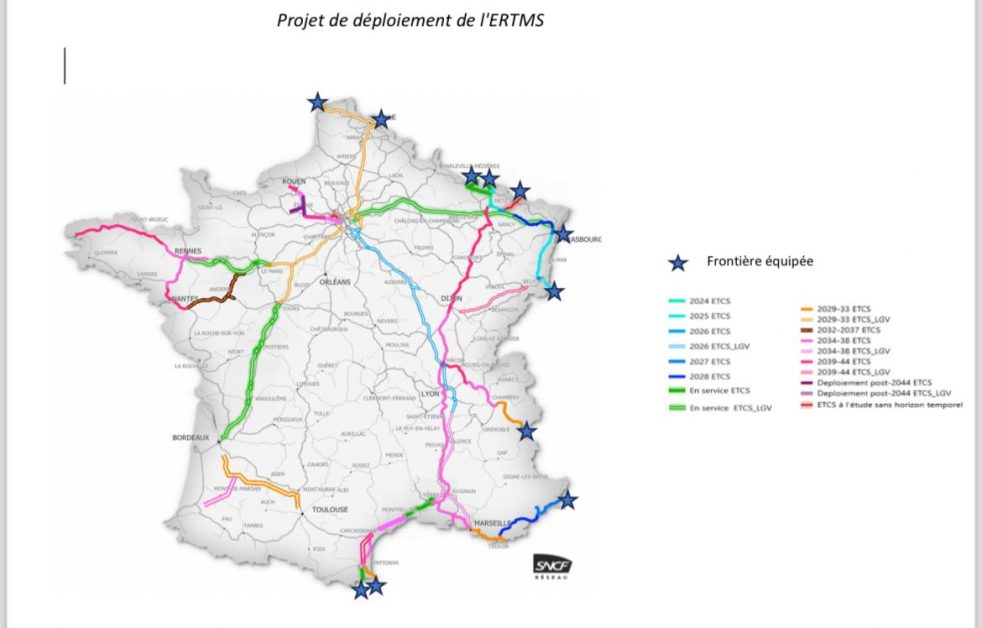
photo-2024-11-08-15-45-18-982x628.jpg


Source : https://www.ville-rail-transports.c...ferroviaire-pourquoi-la-france-est-en-retard/ (full article is behind paywall). Which puts the LGV Nord (probably HSL-1/Chunnel as well, I don't know) in a 2029-33 date
 
Sponsor Post - registered members do not see these adverts; click here to register, or click here to log in
R

RailUK Forums

TheHSRailFan

Member
Joined
16 Jun 2018
Messages
297
I didn't even know LGV-Nord was going to get ETCS. I know Sud-est is currently being converted to ETCS (for a long time now, whenever it finishes) and the 374s can run on it (as seen with the EU ERTMS sticker I have seen at St Pancras). Unsure of HS1 LTDs thoughts on the idea as they would need to consult and get funding from their "stakeholders". I'm pretty sure if it does happen then companies like DB would be 1 step closer to starting services here as I've been told the signalling of TVM (and KVB i think?) at St Pancras is weird and holds a lot of them back.
 

zwk500

Veteran Member
Joined
20 Jan 2020
Messages
18,460
Location
Northampton
I didn't even know LGV-Nord was going to get ETCS. I know Sud-est is currently being converted to ETCS (for a long time now, whenever it finishes) and the 374s can run on it (as seen with the EU ERTMS sticker I have seen at St Pancras).
In theory, everywhere will get ETCS eventually!

According to the graphic (and ORM), ETCS is in service in France on LGVs Bretagne, Sud Europe Atlantique, Est, Rhin-Rhone and sections between Avignon and the Spanish Border (Essentially any line opened after 2007).
374s have ETCS because L2 is used on the Belgian HSL-4 from Antwerp to the Dutch border and HSL-Zuid, while Level 1 is in use on the Belgian classic lines from Brussels to Antwerp. Given the rollout of ETCS on both trains and connecting lines, it makes sense that London-Paris-Brussels would follow at some point.
Unsure of HS1 LTDs thoughts on the idea as they would need to consult and get funding from their "stakeholders". I'm pretty sure if it does happen then companies like DB would be 1 step closer to starting services here as I've been told the signalling of TVM (and KVB i think?) at St Pancras is weird and holds a lot of them back.
HS1 will presumably be quite keen to move to a standardised system that makes it easier for additional potential operators to run on their infrastructure. Interesting to hear the KVB/TVM on HS1 is 'weird', I thought the whole point of it was to be as close to a french line as possible?
 

LNW-GW Joint

Veteran Member
Joined
22 Feb 2011
Messages
21,904
Location
Mold, Clwyd
LGV Nord is on the SNCF list for conversion to ETCS, and the PR said the TVM system there is "ageing".
Eurotunnel signalling is about the same age (30 years).
HS1 is about a decade newer, but I would have thought it would be unsatisfactory to retain a TVM island if the rest of the route is ETCS.
All Eurostar trains will have to be converted for LGV Nord, but I guess it leaves us with a cost to convert domestic class 395s.
The original LGV Atlantique (Paris-Tours/Le Mans) is also on the SNCF conversion list.
 

zwk500

Veteran Member
Joined
20 Jan 2020
Messages
18,460
Location
Northampton
Aha, found the original article I'd read: https://www.railengineer.co.uk/upgrading-the-continental-connection/ (from 2018)

Relevant quote:
nother ERTMS announcement has recently emerged, this time concerning the London to Paris and Brussels high-speed routes through the Channel Tunnel. At a meeting in Paris on 19 July, an agreement signed by four parties – UK HS1, Eurotunnel Getlink, SNCF Reseau and Infrabel – stated that they would work together to introduce ERTMS (European Rail Traffic Management System) on the routes concerned.

...

Indeed, because of the different ages of the TVM 430 equipment, the oldest in France and the Channel Tunnel will be the first, with that in Belgium coming later and HS1 being the last to be replaced. This will ensure that the installed equipment base has a reasonably long working life.

It must be remembered that ETCS is a radio-based system whereas TVM 430 uses track circuits, so the changeover will be a new method of working. For the Channel Tunnel, getting the radio signals in place should present no difficulties as many long tunnels in Europe and beyond are equipped with radiating cable – see the Rail Engineer article in issue 166 (August 2018) on ETCS operation in the Gotthard Base tunnel.

The Paris to Lille section has the most urgent need as this currently carries the most traffic – Eurostar, Thalys and other local services – with a need to increase the current capacity of 15 trains per hour.

In contrast, the Channel Tunnel is presumed to be the most complex as the new system must be capable of bidirectional working in the two tunnels plus changing from one track to the other at the two crossover points.

The provision of ETCS in-cab equipment will be a major consideration. The new Eurostar Class 374 trains from Siemens (the e320 class) already have it, since it is needed for the Brussels to Amsterdam high-speed line. The older Alstom-built Class 373 trains will need to be equipped, as will the Thalys trains that operate the Paris to Brussels service.
 

rvdborgt

Established Member
Joined
24 Feb 2022
Messages
2,477
Location
Leuven
In theory, everywhere will get ETCS eventually!
Correct. It will be mandatory in Belgium for existing rolling stock to be equipped for ETCS from the end of 2025; for new rolling stock, this is already mandatory.
SNCF have known this for many years but at the same time they're not planning to retrofit that into the TGV sets that run to Brussels. Instead, they're trying to get a temporary exemption until they have rolling stock that can replace the current sets. I'm sure though that getting an exemption won't be easy (Arriva didn't get one either for their train sets) and it would create precedents for other operators.
 

Belperpete

Established Member
Joined
17 Aug 2018
Messages
3,596
Aha, found the original article I'd read: https://www.railengineer.co.uk/upgrading-the-continental-connection/ (from 2018)

Relevant quote:
In contrast, the Channel Tunnel is presumed to be the most complex as the new system must be capable of bidirectional working in the two tunnels plus changing from one track to the other at the two crossover points.
I don't understand why the Channel Tunnel is presumed to be complex. Bidi with changing from one track to the other hardly seems complex to me from a signalling perspective. Standard practice on many lines. I would be very surprised if ETCS can't handle it.

Is the issue with the leaky feeder radiating cables used in tunnels, and the trains having to transition from one tunnel's cable to the other? But then trains must be able to transition from one radio transmitter to another above ground, at the boundaries between transmitter coverage, so surely the process would be the same.
 

Fragezeichnen

Member
Joined
14 Jun 2021
Messages
433
Location
Somewhere
Given the lack of trains fitted with TVM430 & KVB and the difficulty of doing so(at one point I seem to remember Alstom as sole supplier refused to manufacture any new TVM430 on board equipment and it was only possible for foreign operators to rent spare units from SNCF) it seems like it would be a big help to have ETCS all the way from Brussels to London, albeit at the cost of inability to do any diversions.

You could even reverse at St Pancras and serve....erm.... Grantham International.
 

stuving

Member
Joined
26 Jan 2017
Messages
722
This Railway Gazette article is newer - dated Wednesday. It should be announcing the successful completion of the transfer of LGV Sud-Est to ERTMS during 9th-12th November, but appears to have been put out before that was confirmed. I've not seen any "aren't we clever" PR from SNCF-Reseau, but neither have I seen any shock-horror "TGV shutdown overruns" news either, and no news is usually good news in such cases.

Other than new lines, this is the minister's take on priorities:
SNCF Réseau would roll-out ETCS on those high speed lines which are not currently equipped, prioritising LGV Nord where the current TVM equipment is ageing and LGV Atlantique where additional capacity is needed. In terms of conventional lines, the aim is to equip the North Sea – Mediterranean, Mediterranean and Atlantic TEN-T corridors, together with the Sablé – Angers – Nantes route.

Funding for the work is expected to come from the government, SNCF Réseau and the EU. Durovray said European ambitions for a wider roll-out were ‘too fast’, adding that there are currently no plans to equip the rest of the network, because of a lack of funding and human resources to undertake the necessary preparations.
 

nwales58

Established Member
Joined
15 Mar 2022
Messages
1,365
Location
notsure
KVB is required to get into Paris itself after leaving LGV Nord, so all trains would still need KVB
And will be needed indefinitely in France, and also St Pancras?

As I understand it only LGVs are TVM-equipped, off-LGV stations in France are on classic lines so transition from/to KVB is always needed (not even ETCS level 1 overlay). ETCS level 2 in France, as I understand the situation, is in *parallel* with TVM on LGV Est and Tours-Bordeaux. From what I've read ETCS is to replace TVM rather than work over the whole route.

Does SNCF Réseau even have a plan for an ETCS-only future?

(yes, I realise Level 1/2/3 terminology is changing, it's all now just ETCS, but I'm not up to date)
 

signed

Established Member
Joined
13 May 2024
Messages
2,376
Location
ROI
From what I've read ETCS is to replace TVM rather than work over the whole route.
Yes, TVM is removed when ETCS is present

LGV Est-Européenne has both ETCS L2 and TVM 430 and LGV Bretagne is ETCS L2 but only has TVM 300 for the older TGV Atlantique sets, one can expect that once those sets are retired, the equipment will be removed.

LGV Nord's TVM is also set to be removed once it's converted to ETCS.
 
Last edited:

MarcVD

Established Member
Joined
23 Aug 2016
Messages
1,241
I don't understand why the Channel Tunnel is presumed to be complex. Bidi with changing from one track to the other hardly seems complex to me from a signalling perspective. Standard practice on many lines. I would be very surprised if ETCS can't handle it.
This is in any case totally irrelevant because all high speed lines in Belgium and France are bidirectional and with crossovers every 20 or 30 km. The Channel Tunnel is no different, so no reason to deem it more complex.

For what matters, internal Infrabel plans now mention 2030 as the conversion date from TVM430 to ETCS level 2 on the HSL between Halle (south of Brussels) and the French border. ETCS level 1 is already operational between Halle and Brussels. Migration of that section to level 2 is currently not planned because GSM-R does not have enough capacity to handle the expected traffic, so it will have to wait for the migration to FRMCS first.
 

popeter45

Established Member
Joined
7 Dec 2019
Messages
1,483
Location
london
when ETCS is installed in the tunnel will the class 9's be fitted with ETCS or see them replaced with newer hardware as they will be at least 30-40 years old by then, somthing like a 160km/h High power Traxx?
 

moworola

New Member
Joined
14 Nov 2024
Messages
1
Location
London
when ETCS is installed in the tunnel will the class 9's be fitted with ETCS or see them replaced with newer hardware as they will be at least 30-40 years old by then, somthing like a 160km/h High power Traxx?
Would a Traxx be able to have the required tractive effort? A Eurotunnel Class 9 has 400 kN of tractive effort, and I would imagine Getlink would want any successor to have even more
 

popeter45

Established Member
Joined
7 Dec 2019
Messages
1,483
Location
london
Would a Traxx be able to have the required tractive effort? A Eurotunnel Class 9 has 400 kN of tractive effort, and I would imagine Getlink would want any successor to have even more
was thinking somthing similar to the Swedish lore locomatives in how they share alot of the traxx's design
 

HSTEd

Veteran Member
Joined
14 Jul 2011
Messages
20,281
And will be needed indefinitely in France, and also St Pancras?
I'd assume any conversion of HS1 to ETCS would also convert St Pancras.
It would be rather silly to go to all that trouble just to leave islands of the system at Ashford and St Pancras.

Ofcourse this represents an opportunity for HS1 in terms of improving domestic services that probably merits additional consideration.
 

zwk500

Veteran Member
Joined
20 Jan 2020
Messages
18,460
Location
Northampton
I'd assume any conversion of HS1 to ETCS would also convert St Pancras.
It would be rather silly to go to all that trouble just to leave islands of the system at Ashford and St Pancras.

Ofcourse this represents an opportunity for HS1 in terms of improving domestic services that probably merits additional consideration.
St Pancras is fairly straightforward - anything accessing it in normal service will be using ETCS from at least Ebbsfleet/Stratford Depot and yes you'd just turn the whole thing over to ETCS. The boundary transitions for maintenance are also relatively easy to handle as everything will be required to stop anyway. Ashford throws up an interesting question about whether the SEML will be anywhere near ETCS ready by the time HS1 needs renewals. If not, will it be worth providing the ETCS L2 overlay on the conventional signals? I hope Eurostar have restored services to Ashford by the time HS1 is converted. as at least then there'll be something tangible to be maintained, rather than just a strategic need/hope.
 

MarkyT

Established Member
Joined
20 May 2012
Messages
7,553
Location
Torbay
St Pancras is fairly straightforward - anything accessing it in normal service will be using ETCS from at least Ebbsfleet/Stratford Depot and yes you'd just turn the whole thing over to ETCS. The boundary transitions for maintenance are also relatively easy to handle as everything will be required to stop anyway. Ashford throws up an interesting question about whether the SEML will be anywhere near ETCS ready by the time HS1 needs renewals. If not, will it be worth providing the ETCS L2 overlay on the conventional signals? I hope Eurostar have restored services to Ashford by the time HS1 is converted. as at least then there'll be something tangible to be maintained, rather than just a strategic need/hope.
A L2 or L1 overlay at St Pancras and Ashford might be possible, keeping signals or not in the L2 case, or the existing KVB transponders could continue, at least for a while, with appropriate software emulation of KVB onboard. Assuming full ETCS in the area isn't complete, at Ashford, signals will still be required in the platforms for onward departures to the classic network, so an overlay of either ETCS will be required for incoming trains, retaining signals through the platforms, or the trains could continue to use KVB in this area. I expect onboard systems could be configured to change effortlessly between ETCS and KVB on the move, just as they do between TVM and KVB.
The active KVB beacons are very similar to Eurobalises, and use the same radio carrier frequencies but different message protocols. A standard Eurobalsise reader can interrogate KVB if the onboard computers have the appropriate software to emulate the KVB system. The beacons are coupled to the interlocking via a relay interface and encoder modules which could plausibly be replaced by an ETCS encoding system, connecting to active balises or a local radio block centre. The reason KVB was chosen over TVM at St. Pancras was low speed and junction complexity, with short blocks for capacity in the terminus layout. TVM couldn't do it with sufficient throughput. The Ashford rationale was different. Initially, trains transitioned to AWS/TPWS for the platforms, then back to TVM but new Velaros didn't have those legacy systems so KVB track infrastructure was also installed. Here's an illustration of the St. Pancras interlocking architecture:
1731784165334.png
From:
On leaving the London Tunnels, the cab signalling system TVM 430 switches over to conventional UK lineside colour light signalling with the KVB intermittent ATP system. Colour light signalling is necessary in this last kilometre due to the Network Rail interfaces, the need for routing information and because short block sections are required to meet the specified operational headway/journey time (which cannot be achieved within the low speed codes available to the TVM system due to the speed profile of the layout).
 
Last edited:

Belperpete

Established Member
Joined
17 Aug 2018
Messages
3,596
St Pancras is fairly straightforward - anything accessing it in normal service will be using ETCS from at least Ebbsfleet/Stratford Depot and yes you'd just turn the whole thing over to ETCS. The boundary transitions for maintenance are also relatively easy to handle as everything will be required to stop anyway.
The existing bidirectional boundary interfaces between the HSL and NR signalling at Ashford and St Pancras are not simple, and the interface paper took a long time to produce and get agreed However, a lot of the issues were due to the French being very reluctant to give us technical details of exactly how their interlocking system works at circuit level, as they considered that to be proprietary information, and us being unwilling to make assumptions.

Would conversion of the HSL to ETCS be a full resignalling with new interlockings, or just replacement of existing trackside beacons with ETCS L1 beacons? How easy would it be to overlay ETCS radio block controllers on the existing HSL interlockings?

If HSL is resignalled with new interlockings, they would need to be interfaced to whatever UK interlockings are on the GBR side of the various boundaries by then. That could be fun for someone (I got a couple of trips to Paris out of the original).
 

Bald Rick

Veteran Member
Joined
28 Sep 2010
Messages
35,682
I don't understand why the Channel Tunnel is presumed to be complex. Bidi with changing from one track to the other hardly seems complex to me from a signalling perspective. Standard practice on many lines. I would be very surprised if ETCS can't handle it.

I‘d say it’s the large terminals and all the connections to high speed and classic / classique lines that present the difficulty.
 

popeter45

Established Member
Joined
7 Dec 2019
Messages
1,483
Location
london
I‘d say it’s the large terminals and all the connections to high speed and classic / classique lines that present the difficulty.
it acts more as a classic line than a high speed one especally due to the 160km/h speed and freight work, thinking about it the idea to use TVM feels weird instead of using KVB when it was built, doesnt effect switching to TVM/AWS/ETCS each side
 

zwk500

Veteran Member
Joined
20 Jan 2020
Messages
18,460
Location
Northampton
it acts more as a classic line than a high speed one especally due to the 160km/h speed and freight work, thinking about it the idea to use TVM feels weird instead of using KVB when it was built, doesnt effect switching to TVM/AWS/ETCS each side
Given KVB requires actual signals and considering that the vast majority of the Tunnel's work is time-sensitive fast expresses mixed with high-frequency heavy shuttles operating very close to the portals on a self-contained network, I'm not particularly surprised TVM got chosen instead.
It also eliminates any problems of 'reading through', if drivers can see sufficiently far ahead to see multiple signals at once, and avoids a blown bulb 10 miles from either shore disrupting services until they can get it sorted. But @Belperpete sounds like they were closer to the decision making so might be able to correct me on any points?
 

Belperpete

Established Member
Joined
17 Aug 2018
Messages
3,596
Given KVB requires actual signals and considering that the vast majority of the Tunnel's work is time-sensitive fast expresses mixed with high-frequency heavy shuttles operating very close to the portals on a self-contained network, I'm not particularly surprised TVM got chosen instead.
It also eliminates any problems of 'reading through', if drivers can see sufficiently far ahead to see multiple signals at once, and avoids a blown bulb 10 miles from either shore disrupting services until they can get it sorted. But @Belperpete sounds like they were closer to the decision making so might be able to correct me on any points?
I was only involved with the interfaces, long after the decision to go for TVM had been made. But the choice of TVM for the tunnel and high speed line, as opposed to "old fashioned" KVB with lineside signals, seems in keeping with thinking at the time. It also avoided any issues with interfacing French and English signal aspects somewhere, or using French signal aspects on the English side of the tunnel.
 

Bald Rick

Veteran Member
Joined
28 Sep 2010
Messages
35,682
I was only involved with the interfaces, long after the decision to go for TVM had been made. But the choice of TVM for the tunnel and high speed line, as opposed to "old fashioned" KVB with lineside signals, seems in keeping with thinking at the time. It also avoided any issues with interfacing French and English signal aspects somewhere, or using French signal aspects on the English side of the tunnel.

As well as this, I‘d always assumed that TVM430 was more flexible in terms of being able to provide more ‘aspects’ to drivers, which given the varied top speeds of the 3 train types in the tunnel and the need to maximise capacity would be of prime importance.

Oh and the French knew best ;)
 
Status
Not open for further replies.

Top