Our new ticketing site is now live! Using either this or the original site (both powered by TrainSplit) helps support the running of the forum with every ticket purchase! Find out more and ask any questions/give us feedback in this thread!
If they haven’t been mentioned before……those small red and white striped tents you used to see when Post Office Telephone men were working on cables below pavement level. There was usually a kettle on a portable gas stove on the go if I remember correctly. When I was a kid I used to think they must be great fun to be in.
If they haven’t been mentioned before……those small red and white striped tents you used to see when Post Office Telephone men were working on cables below pavement level. There was usually a kettle on a portable gas stove on the go if I remember correctly. When I was a kid I used to think they must be great fun to be in.
The other day a song came on the radio (Air - Sexy Boy FWIW) which reminded me of a walk I did in early 1998 along the estuary near Bursledon, Hants, and got me thinking about that era.
Even though these are relatively recent times, at least three things on that day are now gone. The Fawley chimney which prominently dominated the southern skyline. The yellow sodium lights (see above). And the CIG or VEP which I used to get to and from Bursledon station.
And, slightly earlier in the year using stock which was pretty new at the time, the journey I made to Cambridge via London using a 442 and then a 365. Even that could not happen these days.
Red oil lamps guarding road repairs and obstructions. Cones just aren't the same.
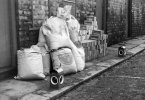
Behind the sacks in this Newcastle back lane are a bricked up door that may have been to a coal house and on the right a folding out refuse shute. This picture was taken about 1965 by which time dustbins were the long accepted method for refuse collection, later supplanted by assorted wheelie bins. By 1965 this area was a clean air zone and only smokeless fuels were probably being delivered in 1 cwt sacks.
Stone horse troughs, usually with an inscription pronouncing civic pride.
I've seen a couple in public places, used as planters, but the ones I knew as a child have disappeared, presumably decorating someone's garden.
Stone horse troughs, usually with an inscription pronouncing civic pride.
I've seen a couple in public places, used as planters, but the ones I knew as a child have disappeared, presumably decorating someone's garden.
That said, if there's enough power in the batteries to get the electronics working, it should (in theory at least) be possible to use regen braking down a long hill to charge the battery enough to start the engine.
Having had battery issues with my hybrid, the problem is that the failing battery won't power the electronics so nothing at all works. Thankfully the battery was replaced under warranty at the last service. As there was no argument about it I assume it is a common problem! For a while I had to carry around a 12V lithium booster which would give enough juice to power the electronics and then the car would start.
== Doublepost prevention - post automatically merged: ==
An abiding memory of the Trans-Siberian a few years ago was a wheel tapper going along the train at every major stop, a sound I hadn't heard for many years! It did result in a group of railwaymen looking very carefully at the bogie of our coach so I suspect they had found something of concern. Thankfully they decided to let it continue as finding a replacement 1st class sleeper at short notice might have been a problem.
As long as they don’t do what happened to one of my neighbours. He came home to find an empty skip dumped in the road right outside his house, blocking his car in and leaving nowhere to put his works’ van. They had the right house number, but wrong road. It took him nearly a week to get them to move as, when they bothered to answer the ‘phone, they kept saying they were fully booked and couldn’t get round.
Red oil lamps guarding road repairs and obstructions. Cones just aren't the same.
Behind the sacks in this Newcastle back lane are a bricked up door that may have been to a coal house and on the right a folding out refuse shute. This picture was taken about 1965 by which time dustbins were the long accepted method for refuse collection, later supplanted by assorted wheelie bins. By 1965 this area was a clean air zone and only smokeless fuels were probably being delivered in 1 cwt sacks.
The bricked up door is almost certainly for the night soil men to collect the pail from the outdoor toilet (they would replace it with another pail). I suspect that the refuse shute is a coal shute. Refuse would have been removed with the night soil (or burnt).
The bricked up door is almost certainly for the night soil men to collect the pail from the outdoor toilet (they would replace it with another pail). I suspect that the refuse shute is a coal shute. Refuse would have been removed with the night soil (or burnt).
Some of the doors would still open when I was a lad. Coal might have gone straight in originally but by the time I can remember the 1 cwt bags were carried on the coalman's back into the yard tipped in behind the slatted up boards. 10 cwt or more bought in the summer for lower prices.
We had an inside toilet but the flats on the other side of the lane were outside, all fully connected to the street drainage and sewage system.
The refuse hopper was hinged to tip the ash and other rubbish into a weekly dust cart collection. Probably the latest technology in 1905 but not practical and I'd suspect not used for long,if at all. Back then waste was 90% ash. Anything that would compost to the compost heap. Anything that would burn went on the fire to make ash. Empty milk bottles were collected each morning, soft drinks bottles were returned to retailer for 1d or 2d back per bottle. Apart from ash the main contents of an average dust bin would probably be tin cans.
Some of the doors would still open when I was a lad. Coal might have gone straight in originally but by the time I can remember the 1 cwt bags were carried on the coalman's back into the yard tipped in behind the slatted up boards. 10 cwt or more bought in the summer for lower prices.
We had an inside toilet but the flats on the other side of the lane were outside, all fully connected to the street drainage and sewage system.
The refuse hopper was hinged to tip the ash and other rubbish into a weekly dust cart collection. Probably the latest technology in 1905 but not practical and I'd suspect not used for long,if at all. Back then waste was 90% ash. Anything that would compost to the compost heap. Anything that would burn went on the fire to make ash. Empty milk bottles were collected each morning, soft drinks bottles were returned to retailer for 1d or 2d back per bottle. Apart from ash the main contents of an average dust bin would probably be tin cans.
Indeed so! Our bin was very lightly loaded.
We were not urban enough to have back entries for bin and night soil collection. Not our house, but further down our road the night soil was collected up to about 1972. Elsewhere in the borough: it was somewhere about 1990 before the services was stopped.
The original bin lorry I remember from the 1950s was a Scammell three wheeler, attached to the original horse drawn dust cart (still with its shafts) by a complicated lash-up of ironmongery and leather straps!
Old-style pedestrian signals at light-controlled crossings, at the same height as the traffic lights - there are still plenty of them around but they are increasingly being replaced by the new style ones with the red and green man at waist level above the button that you press to activate the lights.
I presume this is being done because the new style ones are better for short-sighted and partially sighted people. As you can usually see across to the pedestrian lights on the other side of the road, presumably the thinking is that long-sighted people can see the ones on the other side.
And what about zebra crossings - there don't seem to be many of them these days. They seem to have mostly been replaced by pelican crossings, which are obviously safer on busy roads.
There is still a zebra crossing on the road that passes through the Royal Hallamshire Hospital complex in Sheffield, but apart from that it seems quite a while since I last saw one anywhere.
And what about zebra crossings - there don't seem to be many of them these days. They seem to have mostly been replaced by pelican crossings, which are obviously safer on busy roads.
Back on topic, I'd like to concur with the fact that you very rarely see children playing outside in public areas (or anywhere, for that matter; they all seem to be too busy indulging in whatever rubbish appears on whatever electronic device they happen to be using).
I had an idea that the bus company here just wouldn't entertain. When there's people with restricted mobility/ prams/ wheelchairs to get off, when you pull up to the stop, don't open the doors until the first people are at the front of the bus, ready to get off. People wanting to get on look directly at the driver and if they see nobody between them, they just assume that nobody is getting off and step on as soi as the doors open.
The thing that gets me angry are those that try to get on while you're still getting off, I always stop and say ' he/ she knows you're there, they aren't going to drive off without you' followed usually by some expletive
As we're doing cars, I learned to drive in my mum's old Austin Metro which had a manual choke and only four forward gears.
When the car was replaced with one that had five gears, mum was suspicious of the fifth gear and refused to use it. When she finally got used to having five gears, the car was replaced again with one that had six
My stepdaughter passed her test 8 months ago, bought a car within days of passing and has driven regularly ever since, she has yet to go into her 5th gear, she's frightened of the additional speed and responsibility IMO
== Doublepost prevention - post automatically merged: ==
I do - I had an old sodium light right outside my house until a couple of months ago, when it was replaced with a new LED one. I have less light in my bedroom now than I used to (although it was never really a problem as I used thick curtains).
What I don't like about the new streetlight is it only lights the area directly below it. The old one used to light up my drive and front door. Since it's been replaced, the area around my front door is pitch black, so I've had to have a security light installed.
My parents cul de sac has their streetlights on only one side of the street. As there is a bend in the road near the entrance/ exit, the drives to each of the houses are offset (street is all semi detached bungalows with driveways and garages on the detached side) and so where the ideal place for a streetlight on the other side of the road would be, there's a driveway.
My parents, as you might have already guessed, live on the side without the streetlights, since the upgrade to LED's you cannot make anything out on their side of the street, when I get my key out to go into their house when I'm visiting, if it's night-time, since I have Yale lock keys for their house, my flat and my office, I have to wake up my phone or put its torch on to see as I just can't discern which is which in the gloom.
What about those push-button illuminated town centre maps? A big glass fronted case with a local map inside, usually with small advert cards for local businesses around the edge. You’d push a button for a point of interest (e.g. library, town hall, bus station) and a small torch bulb sticking out of the map at the location you wanted would light up to show you where it was. A bit like google maps with location based advertising pop-ups in the pre-internet age. There used to be ones in Rotherham and Doncaster, and the last one I saw working was at a seaside town in North Wales, possibly Colwyn Bay, around 20 years ago.