
rogerfarnworth
Member
- Joined
- 21 Feb 2018
- Messages
- 927
When and why were railways created? What were the circumstances which brought about their existence?
History does not make it easy to take out one example from a steady continuum of change. ... There have been tracks or plateways since Roman times. You might say that these could be brought within the term railway and therefore the Romans invented the railway.
Except there were railways of a sort, at least as far back at 600 BCE, possibly going back even further, maybe as far back as 1000 BCE. The clearest example being the Diolkos Trackway, a paved trackway near Corinth in Ancient Greece which enabled boats to be moved overland across the Isthmus of Corinth.
For many people, however, the railways began with the Stockton and Darlington (S&D), though I’m sure people appreciate that history is not always what it seems.
The linked article is based on a short three page article by David Wilson which he wrote in the early 1990s, entitled, 'Mother of Inventions'. It explores some of the significance of the development of the railways and why they seem to hold a special place in our national consciousness.
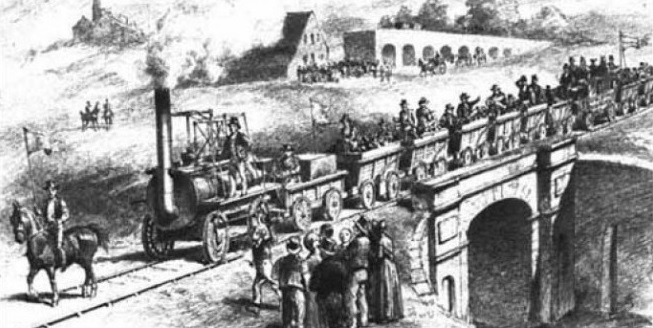
 rogerfarnworth.com
There will always, and inevitably, be more to say about the development of railways than can be covered in a short article. Some discussion of how those development occurred would is worthwhile in the context of the 200th anniversary of the opening of the Stockton and Darlington Railway later in 2025. I have been asked to prepare a talk about Stockton & Darlington railway for a special interest group in East Shropshire and considering it's importance will preoccupy me in coming months. I hope this first article will be of interest to some readers.
History does not make it easy to take out one example from a steady continuum of change. ... There have been tracks or plateways since Roman times. You might say that these could be brought within the term railway and therefore the Romans invented the railway.
Except there were railways of a sort, at least as far back at 600 BCE, possibly going back even further, maybe as far back as 1000 BCE. The clearest example being the Diolkos Trackway, a paved trackway near Corinth in Ancient Greece which enabled boats to be moved overland across the Isthmus of Corinth.
For many people, however, the railways began with the Stockton and Darlington (S&D), though I’m sure people appreciate that history is not always what it seems.
The linked article is based on a short three page article by David Wilson which he wrote in the early 1990s, entitled, 'Mother of Inventions'. It explores some of the significance of the development of the railways and why they seem to hold a special place in our national consciousness.
The Mother of All Inventions. …
Why were railways created? What were the circumstances which brought about their existence?History does not make it easy to take out one example from a steady continuum of change. … David Wil…
rogerfarnworth.com
There will always, and inevitably, be more to say about the development of railways than can be covered in a short article. Some discussion of how those development occurred would is worthwhile in the context of the 200th anniversary of the opening of the Stockton and Darlington Railway later in 2025. I have been asked to prepare a talk about Stockton & Darlington railway for a special interest group in East Shropshire and considering it's importance will preoccupy me in coming months. I hope this first article will be of interest to some readers.
It is clear that the claim to fame of the Stockton and Darlington (S&D) is lessened, at least, by the prior claim of the Middleton Railway both as first to be sanctioned by Parliament and first to make commercial use of steam power. The claims associated with other railways which preceded the S&D also must be significant. However, there is one important and fundamental difference between it and them. David Wilson says that, unlike the Middleton Railway, “the S&D was constructed with a view to carrying other companies’ goods and, to a lesser extent, to carry people.” [1: p61]
In addition, he says, “Bear in mind the distinction between the carriage of goods and people, and between carrying one’s own goods and those of others. In many ways this type of division is what distinguishes the modern concept of the railway as a system for the transport of goods and passengers on a hire and reward basis from the early plateways and railways such as the Middleton, which were not essentially built to carry anything other than goods, typically coal, for their owners.”