• Our new ticketing site is now live! Using either this or the original site (both powered by TrainSplit) helps support the running of the forum with every ticket purchase! Find out more and ask any questions/give us feedback in this thread!

The Hatfield Rail Crash aftermath

Status
Not open for further replies.

norbitonflyer

Established Member
Joined
24 Mar 2020
Messages
5,754
Location
SW London
Not sure on full impact, but yes, 91023 was involved in both this and Heck. Hence why on upgrades and renumbering it became 91132 as against 91123.
Almost undamaged in both incidents as the derailment at Hatfield happened behind it, and at the Great Heck head-on collision it was at the rear.
A similar coincidence happened on Gwr - three of the vehicles towards the rear of the Southall train were repaired, only to be involved in the Ladbroke Grove collision a few years later. Rather than put them back into service, they were used for an evacuation exercise.

Although the ORR report found that it had no bearing on the cause of the accident at Hatfield, the press made much of the person at the controls being a trainee, albeit driving under supervision from a qualified trainer.
 
Last edited:
Sponsor Post - registered members do not see these adverts; click here to register, or click here to log in
R

RailUK Forums

Bikeman78

Established Member
Joined
26 Apr 2018
Messages
6,181
Almost undamaged in both incidents as the derailment at Hatfield happened behind it, and at the Great Heck head-on collision it was at the rear.
A similar coincidence happened on Gwr - three of the vehicles towards the rear of the Southall train were repaired, only to be involved in the Ladbroke Grove collision a few years later. Rather than put them back into service, they were used for an evacuation exercise.

Although the ORR report found that it had no bearing on the cause of the accident at Hatfield, the press made much of the person at the controls being a trainee, albeit driving under supervision from a qualified trainer.
Wasn't there a 47 that was supposedly jinxed? It was renumbered but still had another collision. Renumbering 91023 out of sequence was pointless. Anyone that knew anything about railways would know which loco it was and anyone that didn't wouldn't know or care.
 

Twingo37175

Member
Joined
24 Mar 2019
Messages
246
Wasn't there a 47 that was supposedly jinxed? It was renumbered but still had another collision. Renumbering 91023 out of sequence was pointless. Anyone that knew anything about railways would know which loco it was and anyone that didn't wouldn't know or care.
47299, incident at Barnetby I believe
 

43096

On Moderation
Joined
23 Nov 2015
Messages
18,819
Wasn't there a 47 that was supposedly jinxed? It was renumbered but still had another collision. Renumbering 91023 out of sequence was pointless. Anyone that knew anything about railways would know which loco it was and anyone that didn't wouldn't know or care.
And it was even more pointless as it would have become 91123 anyway. For some reason only the last two digits mattered - and making it 91132 only underlined its notoriety.
 

norbitonflyer

Established Member
Joined
24 Mar 2020
Messages
5,754
Location
SW London
47299, incident at Barnetby I believe
Renumbered from 47216 - before the accident - because a psychic claimed the locomotive was cursed. The accident was at Wrawby, near Barnetby, when it took a bite out iof a DMU.

Perhaps more understandable was the reluctance of NBR drivers to take No 224 over the new Tay Bridge after it had been recovered from the Firth following the events of the "last very Sabbath of 1879, which will be remembered for a very long time" . It was not until 1908, on the 29th anniversary of the disaster, that some brave soul broke the taboo.

OS Nock reported that the GNR Atlantic 276 involved in the 1908 Grantham disaster subsequently had a poor reputation with GNR drivers, and Nock noted that when a batch of C1s were transferred to the Great Central Division in LNER days, the ex-GNR men made sure No 276 was among them. The ex-GC drivers seemed unaware of its reputation and it seemed to perform better there.
 

Sir Felix Pole

Established Member
Joined
21 Oct 2012
Messages
2,177
Location
Wilmslow
B of B 34066 'Spitfire', was reckoned to be jinxed by crews, having been involved in the terrible 1957 Lewisham disaster. It had also had several other minor prangs during its career.
 

mikeS

New Member
Joined
23 Dec 2024
Messages
1
Location
Malton
Gauge corner cracking, which was the underlying cause of the failure, is caused when the wheels of a train are not tracking well, and the wheel flange comes into contact with the side if the rail. At Hatfield, it was the outer rail on the curve that was affected. But the effect of the blanket speed restrictions across the network was that trains were now going around curves well below the balancing speed for the cant and radius of the curve. The result was then a lot of new and unnecessary gauge corner cracking, but now all on the inner rail of curves. Had the Railway Technical Centre in Derby still been the acknowledged world leading centre of knowledge for train-wheel interaction, this technically ill informed decision to impose the network wide speed restrictions would not have been made.
 

Meerkat

Established Member
Joined
14 Jul 2018
Messages
9,276
Do I remember correctly that whilst Railtrack got slaughtered for it several railways in Europe took a look at their track and ended up replacing vast mileages of it, just did it a lot more quietly and without the draconian speed restrictions?
 

Sad Sprinter

Established Member
Joined
5 Jun 2017
Messages
3,186
Location
Way on down South London town
I seem to recall when I was about 5 going from London to Cardiff which too about 3-4 hours. I remember distinctly my Dad telling me that every signal was turned off and an engineer was waving a coloured flag instead to guide the train. That seems implausible but I do remember a catastrophic journey in that period which might have been a post-Hatfield thing.
 

Harpo

Established Member
Joined
21 Aug 2024
Messages
3,863
Location
Newport
Railtrack was an astonishingly arrogant organisation in its infancy. The likes of Edmonds, Horton and co set a distinctively hard, early Railtrack style.

When Railtrack caught a cold with its lax approach to negotiating the first Track Access Agreement with the Western it’s HQ emasculated front line negotiators, continually rejecting details negotiated in good faith with TOCs, and enraging them too.

This was followed by a spell of engineering supremacy, overturning hard-learned renewals wisdom and insisting assets could be sweated. The resultant spates of broken rails on deferred sites, including crucially through the Severn Tunnel, was perhaps an early warning?
 

Falcon1200

Established Member
Joined
14 Jun 2021
Messages
6,558
Location
Neilston, East Renfrewshire
this technically ill informed decision to impose the network wide speed restrictions would not have been made.

Surely the speed restrictions were imposed because Railtrack had no idea of the extent of Gauge Corner Cracking and were concerned, if not petrified, that another tragedy would occur, pending rails being tested? But no doubt the law of unintended consequences applied.

I remember distinctly my Dad telling me that every signal was turned off and an engineer was waving a coloured flag instead to guide the train.

That must have another, different incident, Hatfield did not involve any fault with the signalling.
 

Merle Haggard

Established Member
Joined
20 Oct 2019
Messages
3,930
Location
Northampton
Railtrack was an astonishingly arrogant organisation in its infancy. The likes of Edmonds, Horton and co set a distinctively hard, early Railtrack style.

When Railtrack caught a cold with its lax approach to negotiating the first Track Access Agreement with the Western it’s HQ emasculated front line negotiators, continually rejecting details negotiated in good faith with TOCs, and enraging them too.

This was followed by a spell of engineering supremacy, overturning hard-learned renewals wisdom and insisting assets could be sweated. The resultant spates of broken rails on deferred sites, including crucially through the Severn Tunnel, was perhaps an early warning?

Maybe veering off topic but the rail freight backwater I worked for had negotiators in the organisation that just accepted any track access charge Railtrack offered despite apparent illogicality by comparison to others that existed, or strange variations between day/night and electric/diesel track access charges over the same route, and refused to re-negotiate even though armed with evidence*. They were soon headhunted by Railtrack though, the lifeboat on a sinking ship (they thought - I wonder how that worked out).
Railtrack never seemed to understand responsibility either; telling us they were diverting and we had to tell our customers that their 100 slu train was now limited to 80. When the issues with the contract (not least pricing) so created were raised with our Railtrack negotiator he just turned his back and left our office. They were in charge, take it or leave it!
*with 4 variables it was easy, using simultaneous equations, to demonstrate that in the case of 1 of the 4 permutations Railtrack were paying us for consuming electricity at night on the WCML - but I kept quiet about that one.
 

Magdalia

Established Member
Joined
1 Jan 2022
Messages
7,389
Location
The Fens
Gauge corner cracking, which was the underlying cause of the failure, is caused when the wheels of a train are not tracking well, and the wheel flange comes into contact with the side if the rail. At Hatfield, it was the outer rail on the curve that was affected. But the effect of the blanket speed restrictions across the network was that trains were now going around curves well below the balancing speed for the cant and radius of the curve. The result was then a lot of new and unnecessary gauge corner cracking, but now all on the inner rail of curves. Had the Railway Technical Centre in Derby still been the acknowledged world leading centre of knowledge for train-wheel interaction, this technically ill informed decision to impose the network wide speed restrictions would not have been made.
The key reason for the speed restrictions was risk management.

A 125/100 mph derailment does a lot more damage, and is likely to kill more passengers, than a 40 mph derailment. The 40 mph restriction mitigated the risk of another derailment leading to more fatalities.

I was commuting on the GN at the time, and passed over the rail that cracked at 100mph less than 24 hours before the incident. If the catastrophic crack had occurred when my train passed over it then....

As someone possibly putting their life on the line just getting on a train to go to work, I felt much less uncomfortable trundling along at 40 mph than belting along at 100 mph.

I seem to recall when I was about 5 going from London to Cardiff which too about 3-4 hours. I remember distinctly my Dad telling me that every signal was turned off and an engineer was waving a coloured flag instead to guide the train. That seems implausible but I do remember a catastrophic journey in that period which might have been a post-Hatfield thing.
The 3-4 hour journey does sound like post Hatfield, but your Dad's explanation seems implausible to me too!
 

edwin_m

Veteran Member
Joined
21 Apr 2013
Messages
28,666
Location
Nottingham
The key reason for the speed restrictions was risk management.

A 125/100 mph derailment does a lot more damage, and is likely to kill more passengers, than a 40 mph derailment. The 40 mph restriction mitigated the risk of another derailment leading to more fatalities.

I was commuting on the GN at the time, and passed over the rail that cracked at 100mph less than 24 hours before the incident. If the catastrophic crack had occurred when my train passed over it then....

As someone possibly putting their life on the line just getting on a train to go to work, I felt much less uncomfortable trundling along at 40 mph than belting along at 100 mph.


The 3-4 hour journey does sound like post Hatfield, but your Dad's explanation seems implausible to me too!
But it was risk management where the risks weren't understood.

Firstly there was a catalogue of failures which led to the rail at Hatfield not being replaced in time despite various warnings.

Secondly the network-wide speed restrictions were because Railtrack didn't understand whether similar risks existed elsewhere.

As far as I'm aware, there was no other rail anywhere that was in the sort of dangerous condition of the one at Hatfield.
 

Magdalia

Established Member
Joined
1 Jan 2022
Messages
7,389
Location
The Fens
But it was risk management where the risks weren't understood.
The risk of a train derailing at 125 mph and killing people was understood. It had already happened once. 40 mph mitigated that risk.
As far as I'm aware, there was no other rail anywhere that was in the sort of dangerous condition of the one at Hatfield.
Immediately after Hatfield nobody knew that one way or the other until the rails had been inspected.

Until that was done, a worst case scenario had to be assumed.
 

Bald Rick

Veteran Member
Joined
28 Sep 2010
Messages
35,817
Surely the speed restrictions were imposed because Railtrack had no idea of the extent of Gauge Corner Cracking and were concerned, if not petrified, that another tragedy would occur, pending rails being tested?

AIUI They were imposed following a discussion ’at the highest levels of Government’
 

edwin_m

Veteran Member
Joined
21 Apr 2013
Messages
28,666
Location
Nottingham
The risk of a train derailing at 125 mph and killing people was understood. It had already happened once. 40 mph mitigated that risk.

Immediately after Hatfield nobody knew that one way or the other until the rails had been inspected.

Until that was done, a worst case scenario had to be assumed.
And there's the issue. If Railtrack had had full data on the state of its infrastructure and the high level engineering expertise to interpret it, then they would have understood it was not a widespread problem and that the restrictions were an over-reaction.

A risk includes both probability and severity. The severity was understood but the probability was not.
 

D6130

Established Member
Joined
12 Jan 2021
Messages
9,073
Location
West Yorkshire/Tuscany
I’ve always wondered who this ’psychic’ was and how British Rail came into contact with them.
IIRC, an Immingham driver (or possibly his wife?) visited a fortune-teller while on holiday in Blackpool and said fortune-teller looked into her crystal ball and said "I see a bad train crash involving a locomotive numbered 47 216"....or words to that effect. As a result that loco was boycotted by drivers at the depot until management were forced to renumber it. It was a bit like the 91 023/91 132 situation in later years.
 

edwin_m

Veteran Member
Joined
21 Apr 2013
Messages
28,666
Location
Nottingham
Didn't the gauge corner cracking also lead to the new measurement train, the yellow HST In autumn 2002.
Track recording has been around since the 1970s but I can't say if the NMT introduced any new capabilities relevant to GCC.
 

nanstallon

Member
Joined
18 Dec 2015
Messages
1,063
Railtrack was an astonishingly arrogant organisation in its infancy. The likes of Edmonds, Horton and co set a distinctively hard, early Railtrack style.

When Railtrack caught a cold with its lax approach to negotiating the first Track Access Agreement with the Western it’s HQ emasculated front line negotiators, continually rejecting details negotiated in good faith with TOCs, and enraging them too.

This was followed by a spell of engineering supremacy, overturning hard-learned renewals wisdom and insisting assets could be sweated. The resultant spates of broken rails on deferred sites, including crucially through the Severn Tunnel, was perhaps an early warning?
You can be sure that these 'gentlemen' didn't leave the organisation empty-handed. Whatever happens, they always get their rewards, British style, for failure.
 

61653 HTAFC

Veteran Member
Joined
18 Dec 2012
Messages
19,352
Location
Yorkshire
IIRC, an Immingham driver (or possibly his wife?) visited a fortune-teller while on holiday in Blackpool and said fortune-teller looked into her crystal ball and said "I see a bad train crash involving a locomotive numbered 47 216"....or words to that effect. As a result that loco was boycotted by drivers at the depot until management were forced to renumber it. It was a bit like the 91 023/91 132 situation in later years.
Given that said psychic was (and this is a hill I'm happy to die on) undoubtedly pulling numbers out of her posterior, a whole lot of trouble would've been saved if she'd happened to pick random digits that didn't correspond to an actual locomotive...
 

ChiefPlanner

Established Member
Joined
6 Sep 2011
Messages
8,331
Location
Herts
Track recording has been around since the 1970s but I can't say if the NMT introduced any new capabilities relevant to GCC.

Did not the cessation of rail grinding by Railtrack expedite these problems. ? Presumably to save money.

Told by a certain MD , that the South Wales Valleys never had issues as the then 142/143 sets in traffic acted as rail grinders in service. This may be a rail myth.
 

Ploughman

Established Member
Joined
15 Jan 2010
Messages
3,103
Location
Near where the 3 ridings meet
Didn't the gauge corner cracking also lead to the new measurement train, the yellow HST In autumn 2002.
Similar recording was carried out by LAB5 pre the New train. However the main concern was Top and Line faults plus Twist.
I cannot recall any recording being made of Rail condition.
I went on LAB 5 a number of times as Area Civil Engineer's Rep in the early 90's, to get an early read of any trouble spots and report them to the office.
The Sprinter Track recorder was also in use from the mid 80's again I travelled on this as well.
 

Wilts Wanderer

Established Member
Joined
21 Nov 2016
Messages
3,199
Did not the cessation of rail grinding by Railtrack expedite these problems. ? Presumably to save money.

Told by a certain MD , that the South Wales Valleys never had issues as the then 142/143 sets in traffic acted as rail grinders in service. This may be a rail myth.

Rail wear is the natural controlling factor for rolling contact fatigue. Tight curves and long-wheelbase vehicles are a good combination for heavy wear so this does not surprise me. If I recall correctly, Railtrack was trying to reduce wear rates (and therefore increase rail life and reduce cost) by introducing US-style heat-hardened rail that was more resistant to it, but also simultaneously cut back on rail grinding regimes, because they did not understand the importance of grinding where wear does not naturally occur. Without grinding or wear, the RCF cracks were able to propagate without being naturally ground away. It was the definitive example of Railtrack’s lack of engineering capability and focus on profit.

(Incidentally good lubrication of the gauge face is also a component in a ‘healthy’ system for controlling RCF, as is proper design / maintenance of the cant deficiency.)
 
Last edited:

Ken H

Established Member
Joined
11 Nov 2018
Messages
6,718
Location
N Yorks
This article is interesting
A few years after Hatfield, the Rail Defect Management System (RDMS) was introduced to standardise the reporting of rail defects and breaks. This enabled a more meaningful analysis of data to be carried out and supported the required rail management processes...

...detailed inspections revealed far more RCF sites than previous records had shown.
From 2000, Railtrack and then Network Rail installed further wheel impact measuring systems which allowed train and freight operators to monitor the impact forces...
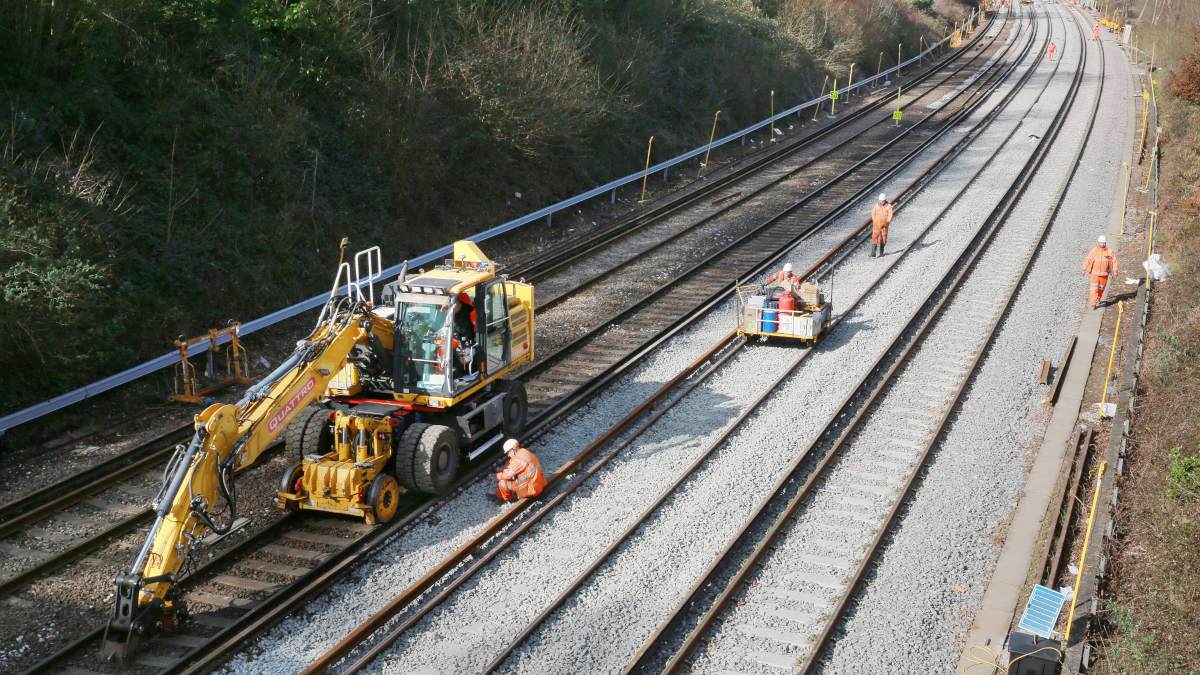
With greater understanding of RCF, further rail grinding machine shifts were procured. So too were hand grinding teams that could deal with the shorter lengths of RCF.

After Hatfield, Railtrack invested in 64-stone rail grinders that did not require a possession. By using single pass grinding, as opposed to multi-pass grinding, the process was speeded up with over 20 miles of grinding achieved in shifts...

...Smaller 32-stone machines were retained for shorter plain line sections and for use on the Southern where the electrified third rail initially prevented the use of in-traffic grinding.
On many routes, manual track inspection has been largely replaced or supplemented by automated inspection.
There have been significant improvements in track geometry, especially regarding discrete faults. It was established that many rail breaks occurred at discrete geometry faults or dips....
With the huge reduction in rail breaks, the UK is now seen as a world leader in rail management. Yet RCF has not gone away and there are still around 60 to 100 rail breaks each year...
 
Status
Not open for further replies.

Top