• Our new ticketing site is now live! Using either this or the original site (both powered by TrainSplit) helps support the running of the forum with every ticket purchase! Find out more and ask any questions/give us feedback in this thread!

The Great Eastern Main Line diesel era onwards

Status
Not open for further replies.

Magdalia

Established Member
Joined
1 Jan 2022
Messages
7,443
Location
The Fens
I am intrigued still by the Felixstowe and Framlingham school portions and the years in which they would have operated.
In steam days [and almost certainly into dieselisation until removal of the title in 1962] the 3.30 ex Liverpool Street was 'The Broadsman'. They would not have messed with that!

In the path of the 3.30 was the 3.33 Yarmouth which in my 1955 Summer Timetable is RC [Refreshment Car] to Yarmouth and TC [Through Carriages] to Felixstowe arr. 5.51.

Both trains were non-stop Ipswich. In the timetable 3 and 6 minutes at Ipswich respectively.
A portion on the Broadsman would have been the exception not the rule!

In 1959 the following Yarmouth train was retimed starting at 1538 and with Chelmsford and Colchester calls, but no longer with a Felixstowe portion.

I hadn't appreciated that the old 1533 Yarmouth had a Felixstowe portion, so until 1958 the Felixstowe pupils could have just used that, probably with some extra reserved carriages.

The only report I have of a Framlingham special is an up train in Railway Observer May 1959:

FRAMLINGHAM - On 24th March the end of term special for Framlingham College was worked by B12/3 61535. It was composed of 6 bogies and worked through to Liverpool St, being booked to stop at Ipswich, where it became a relief to the 9-45am Norwich express. This is the first time since the introduction of the diesel service that the special has run.

But it is before Ipswich shed went completely diesel in November 1959, and possibly the last time that it was steam hauled.
 
Last edited:
Sponsor Post - registered members do not see these adverts; click here to register, or click here to log in
R

RailUK Forums

Big Jumby 74

Established Member
Joined
12 Feb 2022
Messages
2,256
Location
UK
Another work well worth a read, is 'Diesel Depots - The Early Years' (Irwell Press/Hawkins/Hooper/Reeve - 1989). As the title suggests it is a generic Diesel Depot work about the new depot structures, the Diesel locos themselves being more of a back drop to many of the images, but the nature of early Diesel Depots lends this work to showing more about GE area depots than most other Regions, that area forming the mainstay perhaps for the start of the steam to Diesel transition. One example is a fine picture within the first few pages taken from the buffer stops of Kings Cross Loco, facing the station, with NBL Type 2 (21), BRC&W Type 2 (26), Baby Deltic (23) all in view. Wish I'd been around to witness those few short years...
 

Taunton

Veteran Member
Joined
1 Aug 2013
Messages
12,347
Both Felixstowe and Framlingham had Hogwarts style school trains for the boarding schools at start and end of term at least until 1961, but I've never found any pictures.
Much as the prospect of a "School Train" sounds exciting, we all dragged up to London Victoria in my youthful times to see a cousin off to boarding school in Bexhill. "The School Train will leave Victoria at 2.35" the parents' letter said. Note the capitals. Now while I did not quite expect the headmaster to be driving the locomotive, at least I expected something interesting on the departure board.

Alas, it turned out to be a complement of ... three, together a sallow-faced junior teacher who had made the trip up to London to accompany them back. They occupied one seating bay in the regular Ore via Eastbourne service.
 

Harpo

Established Member
Joined
21 Aug 2024
Messages
3,995
Location
Newport
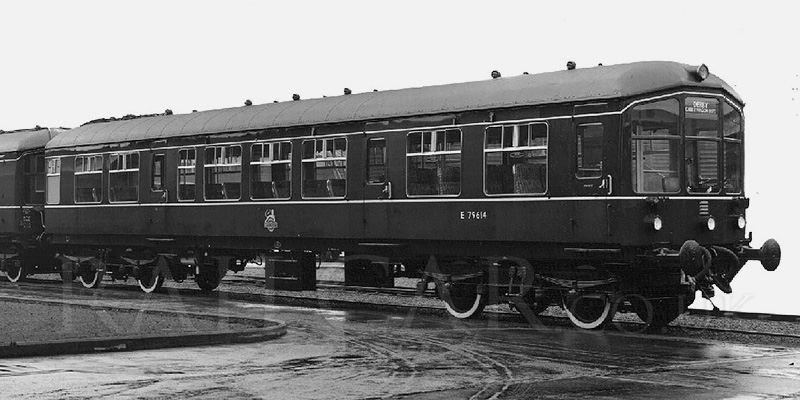
Wouldn't have been a Class 100 in East Anglia in 1956. The Class 100s started their working lives in 1957, and were imitially allocated to Scotland and NW England. They did not move to east Anglia until 1969, to replace the non-standard early "Yellow Diamond" units based there.

In 1956 it was probably a Metro Cammell unit (looked similar to a 101, but mechanically very different) or a Derby Lightweight with the earlier design of cab
title-new.jpg
Great thanks! Definitely a Derby not a Mett-Camm although there are two other shots of Mett-Camms on the branch. As @Magdalia mentions, so many Dr ICA photos lack dates and more. These were no exception!
 

StephenHunter

Established Member
Joined
22 Jul 2017
Messages
2,955
Location
London
Both Felixstowe and Framlingham had Hogwarts style school trains for the boarding schools at start and end of term at least until 1961, but I've never found any pictures.

Did the prefects get first class?

When I am at my railway and we have corridor stock running, I will mention to families we have it, calling it "Harry Potter-style carriages".
 

70014IronDuke

Established Member
Joined
13 Jun 2015
Messages
4,099
Until summer 1961 the Great Eastern only had 5 EE Type 4s D200 and D202-205. That was just about enough to cover about half of the Liverpool Street-Norwich service and not much else. The other half were still worked by Britannias. The few locos released by the Type 4s moved onto other prime services such as the boat trains to and from Harwich. Somehow the Essex Coast Express to Clacton also got included.

In summer 1961 ex GN locos D201/06/07 arrived, these were effectively replaced by Deltics on the ECML. But the key arrivals to replace the Britannias were the EE Type 3s D6700-29. These should have been delivered in 1960, but they were late and their introduction was further delayed by the same bogie problems that affected the Deltics, hence the Britannias lasting until the end of summer 1961.
Some time in 1961 - I thought it was around Easter, but maybe the Whitsun hols - I went with an older lad called Fletcher to March. The depot seemed heaving with Britannias, including the doyen of the class. In order to get round quickly, he told me he'd take the numbers, and afterwards it seems we'd seen every GE Brit bar 70009. (I'd got that, and I did wonder if he'd 'cheated' for me - which I would not have done myself.)
East of March, I can't remember seeing any steam workings, everything was Brush 2s or DMUs on the branches.
It is possible, I suppose, that this was early summer holidays.
I certainly remember being - in today's vernacular - gobsmacked by March. I mean, the depot and yards seemed huge, dwarfing the town. I wonder if anyone has ever done a 'social history' of the town, because the railway must have employed a large percentage of the local population. Maybe not quite the same proportions as Woodford Halse, but significant, I'd have thought.

Diesel multiple units took over East Anglia branch and stopping services at an early stage. A large fleet of the original "Yellow Diamond" cars, both the Derby and the Met-Cam types, were delivered there in 1955-56, and took over the bulk of these services, including lines which were later closed. They gravitated as far down as the GE London branches from this time.
They even gravitated to Bletchley on Sundays, working the 9.00-ish Cambridge - Bletchley and return around 1960-61, possibly into 1962. (Not sure when the branch lost its Sunday service.)
 

eastdyke

Established Member
Joined
25 Jan 2010
Messages
2,058
Location
East Midlands
The only report I have of a Framlingham special is an up train in Railway Observer May 1959:

FRAMLINGHAM - On 24th March the end of term special for Framlingham College was worked by B12/3 61535. It was composed of 6 bogies and worked through to Liverpool St, being booked to stop at Ipswich, where it became a relief to the 9-45am Norwich express. This is the first time since the introduction of the diesel service that the special has run.

From the Framlingham Archive:
Between 1954 and 1958, Framlingham College charterd (sic) a train at the beginning and end of term. This was usually a through train to Liverpool Street, but on this occasion a J15, 0-6-0, No. 65459 was used to pull the carriages to Campsea Ash (Wickham Market). The platform was too short for these special trains, and the passengers had to move to the nearest coaches to the station in order to board or alight.
65459.jpg

Also gleaned from the site [I never new he praticed in Framlingham!]
Engine No. 6156 (sic) was a Class B12, 4-6-0, and bound for Liverpool Street on a Sunday excursion in August 1952. By this period, the average daily number of passengers was only seven, and closure became inevitable. We have to be thankful to the late Dr Ian Allen, who was a GP in the town for many years. His main interest was railways in East Anglia. These photos of Framlingham station activity are a rare and important record.

61561.jpg​

And it gets even more rare! If the date is correct it was Good Friday 1963. What would be the occasion?
This photo records the ony (sic) time a diesel locomotive ever worked a passenger train into Framlingham station. The date is 12th April, 1963, when a buffet car excursion from Liverpool Street was worked by a Brush type '2' diesel electric locomotive No D5595. This was some eleven years after the end of regular passenger services.
D5595.jpg

The Transport Treasury Collection is home to the archives [amongst others] of Dr Allen's legacy. Unfortunately there are no previews but there are no less than 92 objects tagged Framlingham. Perusal may re-pay further research.
 
Last edited:

Magdalia

Established Member
Joined
1 Jan 2022
Messages
7,443
Location
The Fens
And it gets even more rare! If the date is correct it was Good Friday 1963. What would be the occasion?
The Good Friday 1963 date is correct, and it is the last known passenger train on the Framlingham branch. It was a special train for ramblers from Liverpool Street. But I suspect that it wasn't the only diesel hauled passenger train on the branch.

The ramblers also had a train to Leiston on the 1962 August Bank Holiday weekend but I've yet to find a picture of that. Dr Allen seems to have missed it.

The Transport Treasury Collection is home to the archives [amongst others] of Dr Allen's legacy. Unfortunately there are no previews
As usual the main drawback with Dr Allen's pictures is the lack of dates.

The B12 picture link suggests that the loco is 61561, which was withdrawn in 1958. The J15 65459 lasted to the end of steam at Ipswich, moved to Stratford, but was withdrawn early in 1960.

They even gravitated to Bletchley on Sundays, working the 9.00-ish Cambridge - Bletchley and return around 1960-61, possibly into 1962. (Not sure when the branch lost its Sunday service.)
The Sunday Cambridge-Bletchley service survived to June 1964. It was 2 round trips from the Cambridge end, whereas most of the service was LMR operated. It was occasionally loco hauled, especially at start and end of Cambridge University terms.

I certainly remember being - in today's vernacular - gobsmacked by March. I mean, the depot and yards seemed huge, dwarfing the town. I wonder if anyone has ever done a 'social history' of the town, because the railway must have employed a large percentage of the local population. Maybe not quite the same proportions as Woodford Halse, but significant, I'd have thought.
The nearest I know of is a book called Crossing Fences by Henry Orbell, which is more of a memoir than a social history. Henry Orbell was a career railwayman and local politician in March, and there is a Henry Orbell Close in the town. Copies are hard to find.
 

eastdyke

Established Member
Joined
25 Jan 2010
Messages
2,058
Location
East Midlands
I'm hoping that you can help me with my research here!

For a brief period in 1959 and 1960 Ipswich had some NBL Type 2s: what did they do?

Do you recall how the splitting and joining was done at Beccles? Was the loco working through from/to Ipswich always the Yarmouth portion? What worked the portion that wasn't the through loco?
I skimmed through the Transport Treasury stuff of Dr. Allen and purchased 4. Copyright prevents me from copying the pictures but (unless you have done so already) these may interest [undated as usual]:

D498: D6124 tn frt Beccles [no landmarks significant to me]
E976: 69706 N7 (RR) L/E waiting to move onto Lowestoft coaches & 70030 (RF) Tn Yarmouth portion of a dn exp at Beccles

OFF TOPIC a couple showing 34039 whilst covering for Britannias undergoing remediation:
S48: 34039 (LR) T/F Bury St Edmunds-Ipswich tn up slow lvg Haughley (driver H Holliday) 1952 [tender first and very fine!!]
S50: 34039 (RF) Tn for Lowestoft on Beccles bank 1952 [express - no landmarks significant to me]
 

70014IronDuke

Established Member
Joined
13 Jun 2015
Messages
4,099
The Sunday Cambridge-Bletchley service survived to June 1964. It was 2 round trips from the Cambridge end, whereas most of the service was LMR operated. It was occasionally loco hauled, especially at start and end of Cambridge University terms.
Ah, I hadn't realised the unit did two trips, or that the Sunday service had lasted so long. (Not that it was actually very good!)
The nearest I know of is a book called Crossing Fences by Henry Orbell, which is more of a memoir than a social history. Henry Orbell was a career railwayman and local politician in March, and there is a Henry Orbell Close in the town. Copies are hard to find.
Interesting. I have no idea of other industries in March back in the 50s and 60s and before. I suppose a good chunk of both men and women worked in agriculture. A few on water management? Was there any canning done in the town?
Somehow, what with the size of the shed and Whitemore yard, I suspect the railway was the biggest single local employer up to the early 60s, at least.
 

Magdalia

Established Member
Joined
1 Jan 2022
Messages
7,443
Location
The Fens
Was there any canning done in the town?
Kings Lynn and Wisbech had canning factories but I'm not aware of any in March. There was building supplies on the edge of the Fens too, such as bricks at Whittlesey and sand and gravel at St Ives.
 

Gloster

Veteran Member
Joined
4 Sep 2020
Messages
13,059
Location
Up the creek
A look at various maps does not reveal much in the way of industry: there were a couple of works, but these might not have been more than was needed to serve local demand. There were a number of nurseries and it was the county town of the Isle of Ely until 1965, so it would have had the council employees and various related businesses.
 
Status
Not open for further replies.

Top