Our new ticketing site is now live! Using either this or the original site (both powered by TrainSplit) helps support the running of the forum with every ticket purchase! Find out more and ask any questions/give us feedback in this thread!
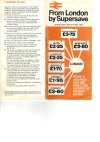
I hope I'm OK starting this thread. I've been doing some sorting out and came across a leaflet from 1972 advertising Supersave tickets from London that I thought might be of interest. It looks like I didn't take advantage of the offer as the leaflet still has the un-used booking form in it.
London to Glasgow or Edinburgh for £3.75 when (googling tells me) an average man's wage was around £36 per week.
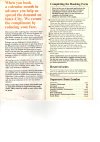
Pre the internet so one had to complete and post a form a calendar month (and up to three months) before one wanted to travel along with payment by cheque or postal order - although if one wanted to go from Euston to Liverpool or Glasgow or from St Pancras to Sheffield one could apply in person and pay cash. It cost an extra 25p if one wanted to reserve a seat.
The leaflet also says that one could take the form to a British Rail Station Ticket Office or Appointed Travel Agent.
Tickets were posted to you or if there was no seat available your fare would be returned.
The Conditions of Issue have as clause 2 (see attached scan) "A ticket is valid for a journey between the stations shown on the ticket or from or to intermediate stations served by the train on which the ticket is valid for travel" and clauses 8 and 9 deal with changes or refunds prior to the date of travel.
So are these the earliest what we would now call Advance Tickets or were they available even before this?
I hope I'm OK starting this thread. I've been doing some sorting out and came across a leaflet from 1972 advertising Supersave tickets from London that I thought might be of interest. It looks like I didn't take advantage of the offer as the leaflet still has the un-used booking form in it.
London to Glasgow or Edinburgh for £3.75 when (googling tells me) an average man's wage was around £36 per week.
Pre the internet so one had to complete and post a form a calendar month (and up to three months) before one wanted to travel along with payment by cheque or postal order - although if one wanted to go from Euston to Liverpool or Glasgow or from St Pancras to Sheffield one could apply in person and pay cash. It cost an extra 25p if one wanted to reserve a seat.
The leaflet also says that one could take the form to a British Rail Station Ticket Office or Appointed Travel Agent.
Tickets were posted to you or if there was no seat available your fare would be returned.
The Conditions of Issue have as clause 2 (see attached scan) "A ticket is valid for a journey between the stations shown on the ticket or from or to intermediate stations served by the train on which the ticket is valid for travel" and clauses 8 and 9 deal with changes or refunds prior to the date of travel.
So are these the earliest what we would now call Advance Tickets or were they available even before this?
I've dug through my 1972 and 1973 editions of the Transport Ticket Society Journal for news. We start with a report on pp21–23 of January 1972, reporting the trial scheme and its subsequent extension (as reflected on your leaflet):
"SUPERSAVE. This facility, which has been recently introduced by British Rail, an is arrangenent whereby passengers who can book well in advance can obtain considerable reductions on ordinary single fares for travel by selected trains.
A pilot scheme was introduced by the London Midlnnd Region between London and Liverpool and London and Glasgow fron 13 Decenber 1971. This provides for second class single fares of £3.75 between London and Glasgow and £2.25 between Londen and Liverpool by specified trains. To obtain these fares intending travellers nust book at least one calendar month in advance of the date of travel. The ticket issued is available only on the date and by the train for which it is issued. Bookings under this scheme are being made on those trains on which spare seats are regularly available, but only a limited nunber are being made for each particular train. No particular seats are reserved for Supersave passengers, but they are pernitted to take advantage of the nornal seat reservation arrangenents. Because of the limited nature of the pilot scheme all bookings have to be made at or through control points at Euston, Glasgow Central or Liverpool Lime Street stations. Fares give reductions of up to about 50% of ordinary fares, with half fares for children.
The main scheme was introduced from 10 January 1972, with bookings being accepted from 10 December [1971]. It operates on the following services [as well as the pilot schemes, which continued into 1972]:
London Paddington–Bath/Bristol/Weston-super-Mare/South Wales/West of England
Reading–Bristol/Weston-super-Mare/South Wales
London Kings Cross–Edinburgh/Grimsby/Cleethorpes/Hull/Leeds/Bradford/Newcastle/York
London St Pancras–Sheffield"
A detailed description of the tickets themselves followed.
~~
The scheme was short-lived, as per page 367 of September 1973 Journal:
"When the fares increase took place on 17 June [1973] the whole scheme was superseded by the introduotion of Economy Returns which operate under much the same arrangement as Supersave but are available to many more destinations."
The following month's edition (page 404) goes on to describe the Economy Return:
"Available between most stations with full booking facilities. These are second class and are based on single fares for return journeys between prinoipal points, with a minimum of £3, with add-on proportions for other stations. Tickets must not be issued less than 21 days before the date of the outward journey which must be specified at the time of booking. Tickets are valid for travel outward on Tuesday, Wednesday or Thursday on the date shown on the ticket, and for return on Tuesday, Wednesday or Thursday within one calendar month but not during the week of outward travel. Train service restrictions are minimal."
I am not aware of any earlier attempts by BR at advance booking schemes - I think this is the first. It is remarkable how similar some aspects are to modern-day Advance tickets.
I don't have any example of Supersave tickets in my own collection (unless there are any lying around in one of my boxes of "miscellaneous paper tickets"), but I hold on behalf of a friend and long-time ticket collector a very comprehensive mounted and itemised collection of BR and RSP paper and card tickets and other ephemera (anything with a printed "form number" on it, basically), so I'll have a look through the folders later and see if I can find any.
== Doublepost prevention - post automatically merged: ==
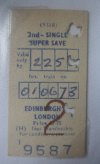
From the above mentioned folders I've found a Seat Reservation coupon, presumably dating from either 1972 or 1973, and a rather nice issued buff-coloured Edmondson ticket for an Edinburgh–London journey (interestingly, Kings Cross is not specified). Note the spaces for the time and date of the train to be added, the price (£3.75), the "2" overprint denoting Second Class, and the (9328) at the top – the National Location Code of Edinburgh Waverley. (H) near the bottom denotes Scottish Region.
I used Super Save to and from Glasgow in summer 72 - out on the Sunday morning train (via Hellifield, taking 8hr) and back overnight (on a Fair weekend - GLC told me it shouldn't have been issued when I tried to book a seat!). I'd forgotten the 1-month booking deadline.
It's interesting that they were replaced by tickets that were much more flexible (none of this booked-train-only).