• Our new ticketing site is now live! Using either this or the original site (both powered by TrainSplit) helps support the running of the forum with every ticket purchase! Find out more and ask any questions/give us feedback in this thread!

Stations with two signal boxes

Status
Not open for further replies.

Phil25

Member
Joined
17 Sep 2025
Messages
24
Location
Poland
Hello, I have a question regarding stations that are operated by two signal boxes. Imagine one signal box is at one end of the station and the other one at the other end. So my question is: is the section between the last signal of the first signal box (ie starter) and the first signal of the other signal box (ie home) operated as absolute block? From my personal observations I think that these were operated as absolute block, with some additional bell codes often in use. I think such a section of course could work as permissive block, but that's not what matters to me. If the answer is yes then I would expect a block instrument for every line or platform (when the first signal box's starter is the other's home).

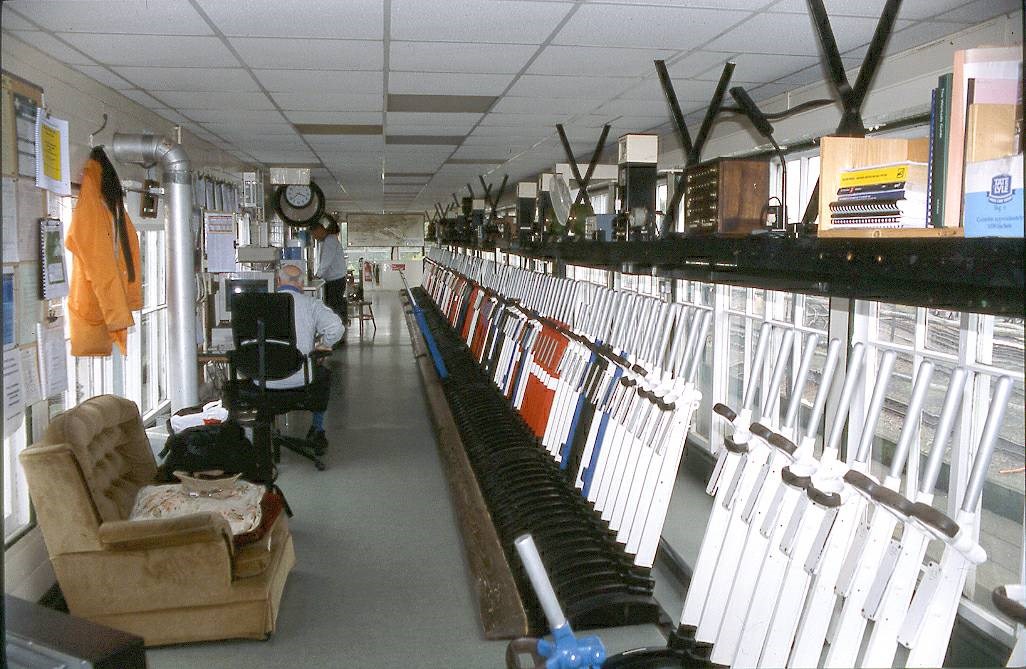
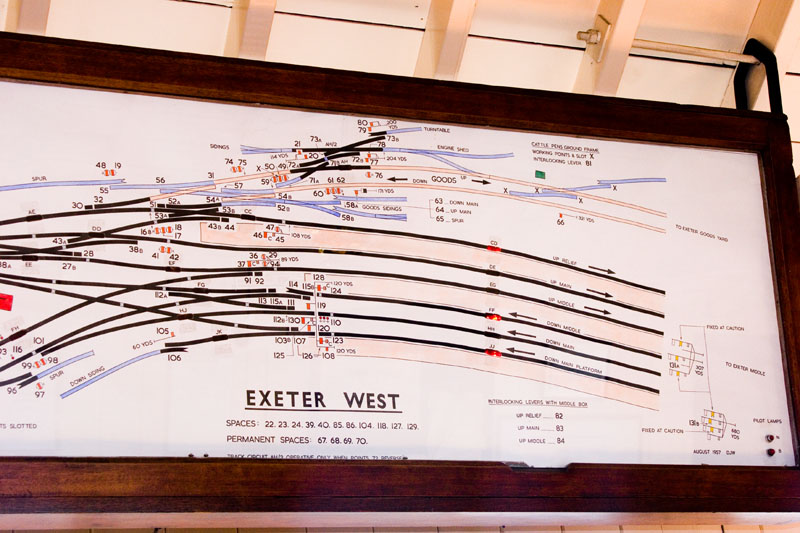
There aren't a lot of such signal boxes in operation. Some examples of such boxes include Exeter West, Stockport, Severn Bridge Junction. If you look at the diagram of Exeter West you can notice many lines and platforms, however what seems odd to me is that when you look at the shelves of Exeter West signal box you can see just 5 block instruments. So how did Exeter Middle know where the train would go? I'm also wondering why there is no block instrument for the goods line. I would love to mention other examples but I didn't find any high-quality photos taken inside the other boxes. However you can make out that there are a lot of block instruments in these signal boxes. I'm putting this in history as it's pretty much history we're talking about.
DiagramRHEnd.jpg

Exeter West signal box diagram


37059271111_5afa576a2c_b.jpg

inside Exeter West signal box


Stockport_No.2_Signalbox_-_signalbox_interior_-_geograph.org.uk_-_1918679.jpg

inside Stockport no2 signal box


Stockport%20No1%20Signal%20Box%20Interior%20210319g-XL.jpg

inside Stockport no1 signal box

e50b3cd1612946efa9deea8dcda90fe3.jpg

inside Severn Bridge Junction signal box


1200px-Crewe_North_Junction.JPG

additionally - inside Crewe North signal box
 
Sponsor Post - registered members do not see these adverts; click here to register, or click here to log in
R

RailUK Forums

matchmaker

Established Member
Joined
8 Mar 2009
Messages
1,877
Location
Central Scotland
I can only answer in regard to signal boxes I know of, but is/was a common arrangement, Stirling Middle to Stirling North is absolute block on the Perth lines, Dingwall South to Dingwall North and Aviemore South to Aviemore North were absolute block. The latter two were double line sections on a single line.
 

Rescars

Established Member
Joined
25 May 2021
Messages
2,526
Location
Surrey
I can only answer in regard to signal boxes I know of, but is/was a common arrangement, Stirling Middle to Stirling North is absolute block on the Perth lines, Dingwall South to Dingwall North and Aviemore South to Aviemore North were absolute block. The latter two were double line sections on a single line.
Same for Newton Stewart East and West.
 

Trackman

Established Member
Joined
28 Feb 2013
Messages
4,257
Location
Lewisham
Exeter West signal box is at Crewe Heritage Centre. It was dismantled and reconstructed at Crewe around 1995.
It could be they didnt include some instruments.
Furthermore, it is a fully working simulation, simulation traffic to the box is controlled by humans rather than a computer.
Not visited yet, on my long 'to-do' list, think you can book a simulation - if you are brave enough to take it on.
 

Gloster

Veteran Member
Joined
4 Sep 2020
Messages
12,956
Location
Up the creek
Exeter West signal box is at Crewe Heritage Centre. It was dismantled and reconstructed at Crewe around 1995.
It could be they didnt include some instruments.
Furthermore, it is a fully working simulation, simulation traffic to the box is controlled by humans rather than a computer.
Not visited yet, on my long 'to-do' list, think you can book a simulation - if you are brave enough to take it on.

The top photo looks as though it is probably correct for the later days at Exeter West. There were Up and Down Main, Up and Down Middle, Up Relief and Down Platform (I don’t actually know if that is the pairing for the instruments) Lines, all to Exeter Middle. Then there were the instruments to whichever boxes they were in circuit to on the Salisbury line and towards Newton Abbot, which would be the furthest instruments. The Goods Lines closed in 1978.

As far as indicating where the train was going at Exeter West, there were special routing bell codes. For a Down express that wasn’t stopping at Exeter, Hele & Bradnich (previously Cullompton, i think) would send 3-3-3 to Stoke Canon after the Train Entering Section had been acknowledged. Stoke Canon then offered the train on as 3-3-3 (rather than 4) and this would tell Exeter Middle that the train could stay on the Main, which had no platform. Similar codes were used in the Up direction and to indicate trains diverging on to the old SR lines. It got more complicated at Newton Abbot, where Down trains had two routes and could be stopping or non-stopping, and Taunton, where you once had three routes on the Down: to Exeter, Barnstaple or Minehead, plus two on the Up. (I think my memory is accurate here.)
 

Wilts Wanderer

Established Member
Joined
21 Nov 2016
Messages
3,199
Bewdley on the SVR is the only (to my knowledge) preserved station with two signal boxes, Bewdley North and Bewdley South. The two main running lines (platforms 1 & 2) are worked on the Absolute Block principle. The loop platform (3) is nowadays worked by directional lever, previously it was the shortest electric-token single line section on the BR network. Other loops on the up and down sides are treated as double-ended sidings / yard arrangements.

I think whatever standard options were available, you’ll find non-standard quirks at most locations with two or more boxes. Layouts would be designed with bespoke oddities to suit local traffic requirements. Even the Down Main at Bewdley has its own quirk (installed by the SVR) - a fully controlled wrong-direction move using the GWR ‘backing signal’ on the south end of platform 1. Unless I’m mistaken this is now unique, one of the last examples having been on the Up platform at Castle Cary until removed in the 1980s.
 

Gloster

Veteran Member
Joined
4 Sep 2020
Messages
12,956
Location
Up the creek
Bewdley on the SVR is the only (to my knowledge) preserved station with two signal boxes, Bewdley North and Bewdley South. The two main running lines (platforms 1 & 2) are worked on the Absolute Block principle. The loop platform (3) is nowadays worked by directional lever, previously it was the shortest electric-token single line section on the BR network. Other loops on the up and down sides are treated as double-ended sidings / yard arrangements.

I think whatever standard options were available, you’ll find non-standard quirks at most locations with two or more boxes. Layouts would be designed with bespoke oddities to suit local traffic requirements. Even the Down Main at Bewdley has its own quirk (installed by the SVR) - a fully controlled wrong-direction move using the GWR ‘backing signal’ on the south end of platform 1. Unless I’m mistaken this is now unique, one of the last examples having been on the Up platform at Castle Cary until removed in the 1980s.

Presumably it is on loan from the National Railway Museum, which claimed it when it was taken out of use, as it is listed in the Science Museum Collection. I am fairly sure it was the last one in use, just outliving one at Croes Newydd.
 

Wilts Wanderer

Established Member
Joined
21 Nov 2016
Messages
3,199
Presumably it is on loan from the National Railway Museum, which claimed it when it was taken out of use, as it is listed in the Science Museum Collection. I am fairly sure it was the last one in use, just outliving one at Croes Newydd.

Are you saying the backing signal at Bewdley is the Castle Cary example? I wasn’t aware of that?
 

warwickshire

On Moderation
Joined
6 Feb 2020
Messages
2,302
Location
leamingtonspa
Previously Banbury station had two boxes,
Banbury South and Banbury North,
Each end of the station, Long gone now though,
With Banbury North controlling the North End of Banbury station and Banbury South controlling the South end of Banbury Station.
 

Gloster

Veteran Member
Joined
4 Sep 2020
Messages
12,956
Location
Up the creek
Are you saying the backing signal at Bewdley is the Castle Cary example? I wasn’t aware of that?

Sorry, I misinterpreted your comment. It is the same as the Castle Cary one, having a three way route indicator, but presumably came from somewhere else and the Castle Cary one is somewhere in the NRM’s collection.
 

Rescars

Established Member
Joined
25 May 2021
Messages
2,526
Location
Surrey
Further to Gloster's comments about Exeter West, arrangements must have been particularly complicated in locations like Worcester Shrub Hill, with its goods lines, avoiding lines and scissors crossovers. AIUI Station box controlled the east end of the station and Junction box controlled the west end as well as the routes to Hereford and Droitwich (and access to the loco shed).
 

John Webb

Established Member
Joined
5 Jun 2010
Messages
3,750
Location
St Albans
St Albans City station at one time had a North Box and a South Box. All four lines through the station were worked absolute block between the two boxes. The reason for two boxes was the northern entrance/exit to the goods yard was too far away from the South Box (which controlled the south exit from the goods yard and the exit from the engine shed) under Board of Trade regulations. The yard closed in the mid-1960s and the South Box was reconfigured in 1970 to cover the whole station area and the North box removed.
 

midland1

Member
Joined
18 Aug 2019
Messages
445
Location
wigston
How did Nairn work when it had two boxes and one signalman?
He had a bicycle, no joke.

== Doublepost prevention - post automatically merged: ==

Bewdley on the SVR is the only (to my knowledge) preserved station with two signal boxes, Bewdley North and Bewdley South. The two main running lines (platforms 1 & 2) are worked on the Absolute Block principle. The loop platform (3) is nowadays worked by directional lever, previously it was the shortest electric-token single line section on the BR network. Other loops on the up and down sides are treated as double-ended sidings / yard arrangements.

I think whatever standard options were available, you’ll find non-standard quirks at most locations with two or more boxes. Layouts would be designed with bespoke oddities to suit local traffic requirements. Even the Down Main at Bewdley has its own quirk (installed by the SVR) - a fully controlled wrong-direction move using the GWR ‘backing signal’ on the south end of platform 1. Unless I’m mistaken this is now unique, one of the last examples having been on the Up platform at Castle Cary until removed in the 1980s.
What about Dereham in Norfolk, North and South boxes.
 

Rescars

Established Member
Joined
25 May 2021
Messages
2,526
Location
Surrey
He had a bicycle, no joke.
The Highland and other Scottish companies favoured the type of arrangement at Nairn in quite a few locations where there were passing loops on single lines. There were boxes (or more accurately ground frames) to work the points and signals at each end of the station, whilst the block (tablet) instruments were located centrally in the main station building. I'd guess the official provision of the bicycle at Nairn was a comparatively recent innovation.
 

D6130

Established Member
Joined
12 Jan 2021
Messages
8,989
Location
West Yorkshire/Tuscany
The Highland and other Scottish companies favoured the type of arrangement at Nairn in quite a few locations where there were passing loops on single lines. There were boxes (or more accurately ground frames) to work the points and signals at each end of the station, whilst the block (tablet) instruments were located centrally in the main station building. I'd guess the official provision of the bicycle at Nairn was a comparatively recent innovation.
Those arrangements applied principally at stations where the passing loops had been lengthened for military/naval traffic during the first world war.
 

172007

Member
Joined
2 Jan 2021
Messages
1,141
Location
West Mids
Worcester Shrub Hill might be in the running if you count Worcester Tunnel Junction box as one end of the station.
Signals SH77 and SH78 at the end of platforms 1B and 2B are section signals to Henwick and Tunnel Jct.
 

Gloster

Veteran Member
Joined
4 Sep 2020
Messages
12,956
Location
Up the creek
Those arrangements applied principally at stations where the passing loops had been lengthened for military/naval traffic during the first world war.

The Highland had been using the system with boxes at each end of the loop and the token instruments in the booking office since it first introduced signalling, but it was uncommon elsewhere. The Highland seems to have chosen it because it allowed staff economies on its lightly trafficked lines: it presumably saw longer dwell times as acceptable once they counted the bawbees.

As a general point, although many stations with boxes at each end worked Absolute Block between them, the signalling would generally be laid out to allow permissive working, shunt movements and wrong-line running. The boxes would have lengthy special instructions authorising how the various movements should be carried out. Later on some became track-circuited between the boxes and this became an early form of Track Circuit Block; I have heard it called Bell Block.
 

edwin_m

Veteran Member
Joined
21 Apr 2013
Messages
28,613
Location
Nottingham
The Highland had been using the system with boxes at each end of the loop and the token instruments in the booking office since it first introduced signalling, but it was uncommon elsewhere.
Having it at Abermule was one of the causes of the disaster there, where the token got handed from person to person and eventually back to the same driver who had just surrendered it.
 

Gloster

Veteran Member
Joined
4 Sep 2020
Messages
12,956
Location
Up the creek
Having it at Abermule was one of the causes of the disaster there, where the token got handed from person to person and eventually back to the same driver who had just surrendered it.

Abermule was slightly different in that there was a signal box at one end of the loop, but at the other end was a ground frame released by the signal box, so there was not Absolute Block working through the station. The placing of the token instruments in a room off the booking office was probably a reasonable way of releasing the signalman for other work, but ultimately it was very slack working that led to the accident.
 

Mcr Warrior

Veteran Member
Joined
8 Jan 2009
Messages
17,185
Noted that the OP mentioned Stockport at the top of this thread. What stretches of line do the respective boxes control in the area.
 

Phil25

Member
Joined
17 Sep 2025
Messages
24
Location
Poland
Well it was sort of a stupid question with Exeter West. Because I have just noticed (upon taking a closer look) that these block instruments are labelled 'Main Lines', 'Middle Lines', 'Relief Lines' so I guess it does actually make sense. It's kinda crazy to think tho that Bewdley had a token for such a short piece of track. What I'm also curious about is does anyone know any particular special bell codes that were authorised in certain places? Like Exeter had its special bell codes of course.

As a general point, although many stations with boxes at each end worked Absolute Block between them, the signalling would generally be laid out to allow permissive working, shunt movements and wrong-line running. The boxes would have lengthy special instructions authorising how the various movements should be carried out. Later on some became track-circuited between the boxes and this became an early form of Track Circuit Block; I have heard it called Bell Block.
Do you know when exactly did the TCB become common on the railway? Also I'm curious how did wrong-line running work on platforms made for one direction. As someone else mentioned there was surely a long list of special bell codes.
Other loops on the up and down sides are treated as double-ended sidings / yard arrangements.
I have never heard anything about yard arrangements in areas where two signal boxes operate. With one signal box signalling trains from/into sidings is as simple as pulling a lever. So what's the difference when it comes to two signal boxes? Also thank you for explaining how thinks worked at that station.
 

Wilts Wanderer

Established Member
Joined
21 Nov 2016
Messages
3,199
I have never heard anything about yard arrangements in areas where two signal boxes operate. With one signal box signalling trains from/into sidings is as simple as pulling a lever. So what's the difference when it comes to two signal boxes? Also thank you for explaining how thinks worked at that station.

At its most simplest level, I imagine it involves the North and South signallers speaking on the telephone and coming to a clear understanding about moves signalled into the yard / Rock Siding.
 

Gloster

Veteran Member
Joined
4 Sep 2020
Messages
12,956
Location
Up the creek
Well it was sort of a stupid question with Exeter West. Because I have just noticed (upon taking a closer look) that these block instruments are labelled 'Main Lines', 'Middle Lines', 'Relief Lines' so I guess it does actually make sense. It's kinda crazy to think tho that Bewdley had a token for such a short piece of track. What I'm also curious about is does anyone know any particular special bell codes that were authorised in certain places? Like Exeter had its special bell codes of course.


Do you know when exactly did the TCB become common on the railway? Also I'm curious how did wrong-line running work on platforms made for one direction. As someone else mentioned there was surely a long list of special bell codes.

I have never heard anything about yard arrangements in areas where two signal boxes operate. With one signal box signalling trains from/into sidings is as simple as pulling a lever. So what's the difference when it comes to two signal boxes? Also thank you for explaining how thinks worked at that station.

Special bell codes were common all over the place. The way that railway signalling thinks is that a bell code leads to a clear understanding between signalboxes as to what is happening: any unusual or specific to a station movement that is made reasonably frequently will have a bell code. There is therefore no doubt in either signalman’s mind as to what the other is doing.

Wrong line working in a station could straightforwardly by bell signals and the block where authorised or there could be direction levers or releases. The complexity of the arrangements and the provision of signals would depend on the frequency that it was needed.

Sidings are often a sort of no-man’s land to the signalmen. Letting trains into them might have local arrangements, such as release by yard staff, but generally a signalman wouldn’t be concerned about whether the next signalman was also letting a train in. Often yards had specified Arrival roads and these would be different for opposite directions.

If you Google ’ newton abbot train routing bell codes ‘ and chose Help file for !Signalbox , which came top for me, you will come across what looks like the Box Special iInstructions for Exeter West.
 
Status
Not open for further replies.

Top